Soap Creek oral history · February 23, 1991 · A five-minute visit
What can a fallen tree tell you?
Bob Zybach and Marvin Rowley look at the trees, roots and soil · Listen & read
The question is about trees. The answer starts underground.
During a tour of Oregon State University’s research forest, Bob asks whether hardwoods deserve more attention. Marvin Rowley points to a fallen Douglas-fir and its shallow roots.
Hear their exchange, follow the published words, then look at the evidence behind the story.
About two minutes of original audio. Allow a little longer to explore the page and place.
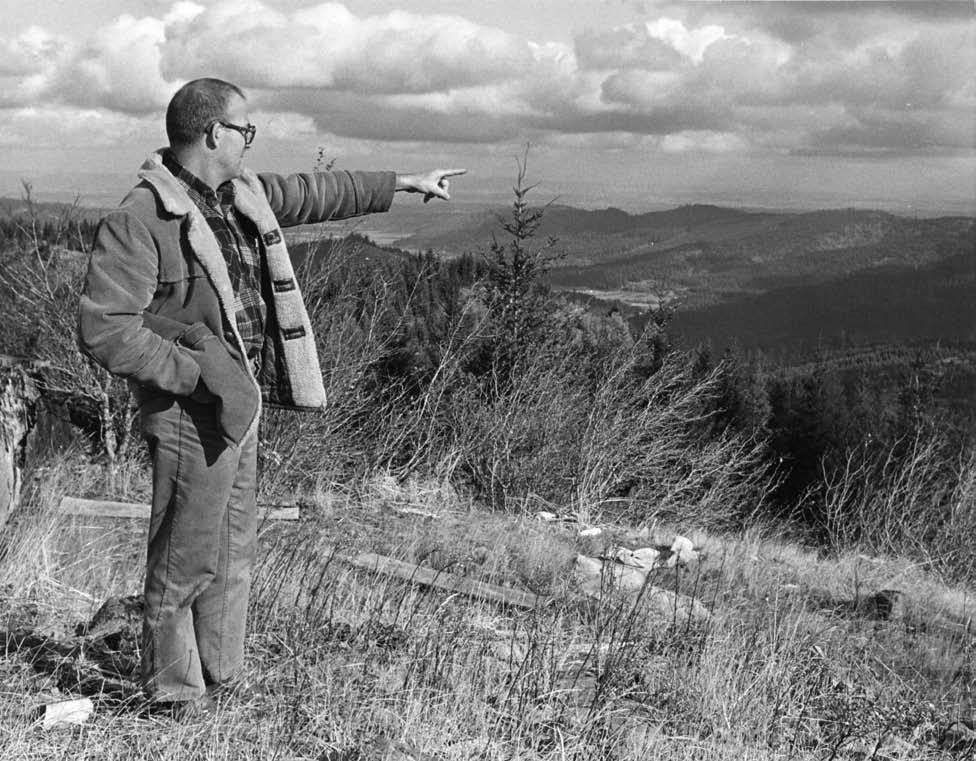
Marvin Rowley on McCulloch Peak in McDonald Forest, from the monograph’s cover photograph. It shows the forest setting; it is not identified as the location of this conversation. Date and photographer are not credited in the book.
First listening edition · Ready for Bob and Dave to try
Hear the voices, then follow the words
Two minutes of the conversation, on this page. Press play and read along, or choose a passage below — each one moves the player to that moment.
Two minutes cut from the Library’s preservation copy of tape side 04 (OSU Special Collections and Archives Research Center, Soap Creek Valley oral histories, OH 006). The complete recording is held by the archive; the Library’s copy is not published while rights and notification questions are settled.
The excerpt was cut on September 13, 2026. Its boundaries were measured from the waveform and the words were checked against a machine transcription. Review by ear is still pending.
These are the published words. Spoken wording can differ. The first time on each passage is its place in this two-minute excerpt; the second is its place on the full tape.
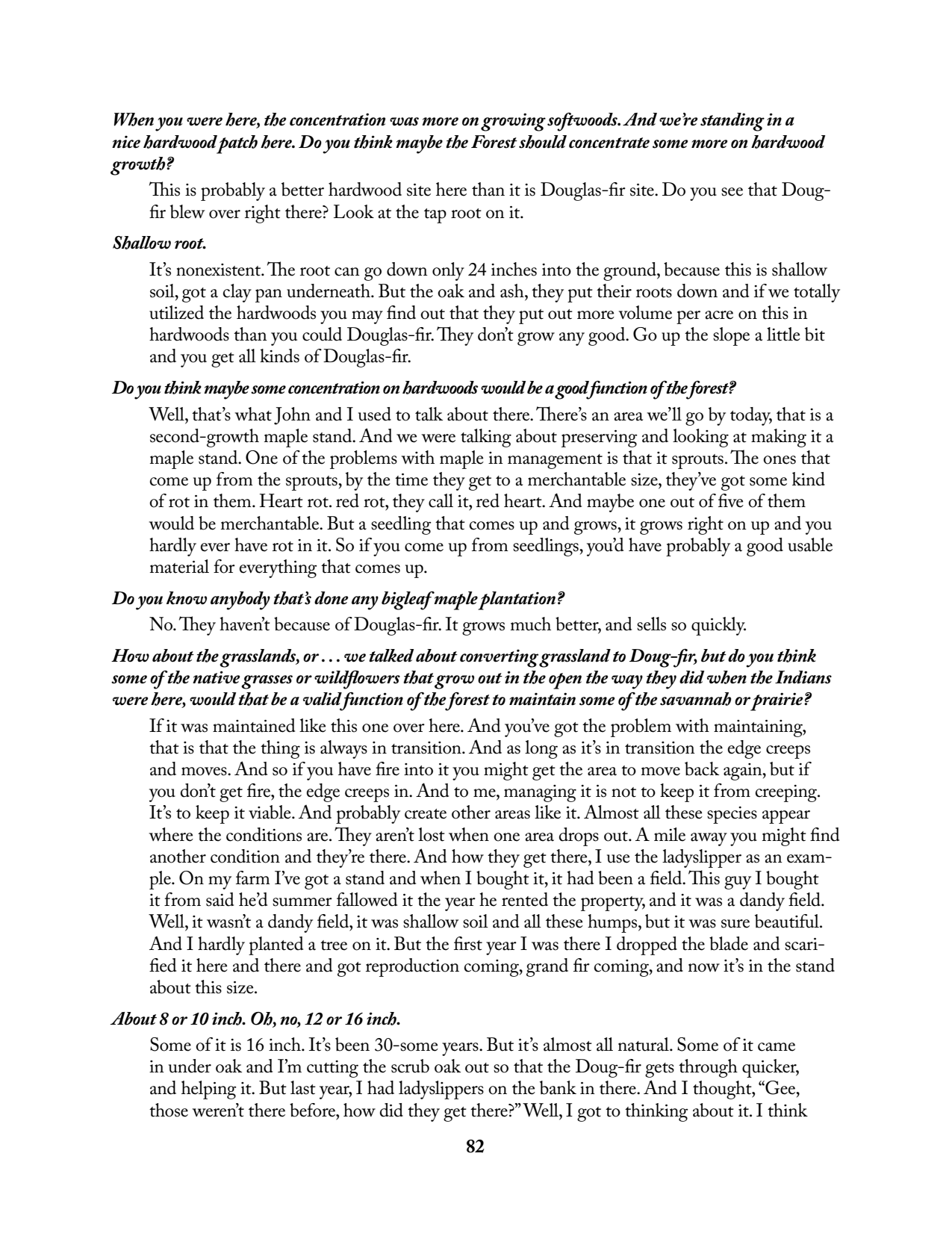
Bob Zybach: When you were here, the concentration was more on growing softwoods. And we’re standing in a nice hardwood patch here. Do you think maybe the Forest should concentrate some more on hardwood growth? p. 82
Marvin Rowley: This is probably a better hardwood site here than it is Douglas-fir site. Do you see that Doug-fir blew over right there? Look at the tap root on it. p. 82
Marvin Rowley: It’s nonexistent. The root can go down only 24 inches into the ground, because this is shallow soil, got a clay pan underneath. But the oak and ash, they put their roots down and if we totally utilized the hardwoods you may find out that they put out more volume per acre on this in hardwoods than you could Douglas-fir. They don’t grow any good. Go up the slope a little bit and you get all kinds of Douglas-fir. p. 82
Bob Zybach: Do you think maybe some concentration on hardwoods would be a good function of the forest? p. 82
Marvin Rowley: Well, that’s what John and I used to talk about there. There’s an area we’ll go by today, that is a second-growth maple stand. And we were talking about preserving and looking at making it a maple stand. One of the problems with maple in management is that it sprouts. The ones that come up from the sprouts, by the time they get to a merchantable size, they’ve got some kind of rot in them. Heart rot. red rot, they call it, red heart. And maybe one out of five of them would be merchantable. But a seedling that comes up and grows, it grows right on up and you hardly ever have rot in it. So if you come up from seedlings, you’d have probably a good usable material for everything that comes up. p. 82
Bob Zybach: Do you know anybody that’s done any bigleaf maple plantation? p. 82
Marvin Rowley: No. They haven’t because of Douglas-fir. It grows much better, and sells so quickly. p. 82
Look again
An observation becomes a question
What does Rowley point to? What does he infer from it? Open each note, then decide what you would want to check on the ground.
The fallen tree
Rowley asks Bob to look at a blown-over Douglas-fir and its roots. His explanation connects that particular tree to shallow soil and a clay layer beneath it.
He contrasts the hardwood patch with Douglas-fir growing farther up the slope. A useful next question is whether the soil changes as well. The recording gives his interpretation; it does not supply a soil survey.
A management choice
The conversation moves from which trees fit the ground to maple seedlings, timber quality and markets. Which reasons come from what Rowley observes here, and which come from his wider experience?
Keep one sentence from the interview and one question of your own. That is a starting point for using an oral history as evidence.
The printed session begins at Oak Creek Guard Station and continues through the forest. The exact hardwood patch in this exchange remains to be identified.
The cover photograph gives a different view: Rowley on McCulloch Peak. Together, the picture, the place names and the conversation invite us to look at the forest at several scales.
This conversation: Marvin Rowley, narrator; Bob Zybach, interviewer, February 23, 1991. The complete monograph credits oral-history interviews by Royal G. Jackson, Jennifer Lee and Bob Zybach. Published in 2009 by Oregon State University’s College of Forestry.
The archive’s record of this recording · Soap Creek Valley oral histories, OH 006, Oregon State University Special Collections and Archives Research Center. Tape side: OH06-rowley-marvin-19910224-04.wav. The Library holds a preservation copy of this side in private storage; the two-minute excerpt above is cut from it.
The text is the published interview, not a replacement machine transcript. The retained machine transcription includes repeated words and short acknowledgments that the print omits. The speaker labels follow the printed question-and-answer typography and session heading. Titles, explanations and questions are the Library’s additions, prepared with Codex assistance.
The two-minute excerpt on this page was cut on September 13, 2026 from the Library’s preservation copy of tape side 04, which it obtained that day and keeps in private storage. Its boundaries — 9:03.80 to 11:09.02 on the tape — were measured from the waveform, and the words were checked against a second-pass machine transcription that matched the printed lines. The passage times were corrected at the same time; the earlier times, taken from a retained machine transcription, were about a second early at each cue, and the earlier stop of 11:08 clipped the last word. Bob and Dave’s review by ear is still pending, and no by-ear review is claimed. The filename says February 24; the printed session and the retained transcription of recording 01’s opening identify February 23, 1991.
Source use and corrections
The original recording was supplied by Oregon State University’s archives through Chris Petersen. This educational excerpt does not grant a general license to reuse the recording, printed text or photograph. The individual Collection rights statements remain applicable. Corrections and the Library’s editorial policy →