Soap Creek Valley oral history series · Monograph #3
Donald Dickey
Monograph #3 in the Soap Creek Valley oral history series: Donald M. Dickey and Maxine Dickey, recorded in 1 session between August 18, 1990 and August 18, 1990, printed 1991.
Family History and Life on Berry Creek, Benton County, Oregon: 1928-1941
The printed cover. Full-size scan on
the creator's own site, nwmapsco.com.
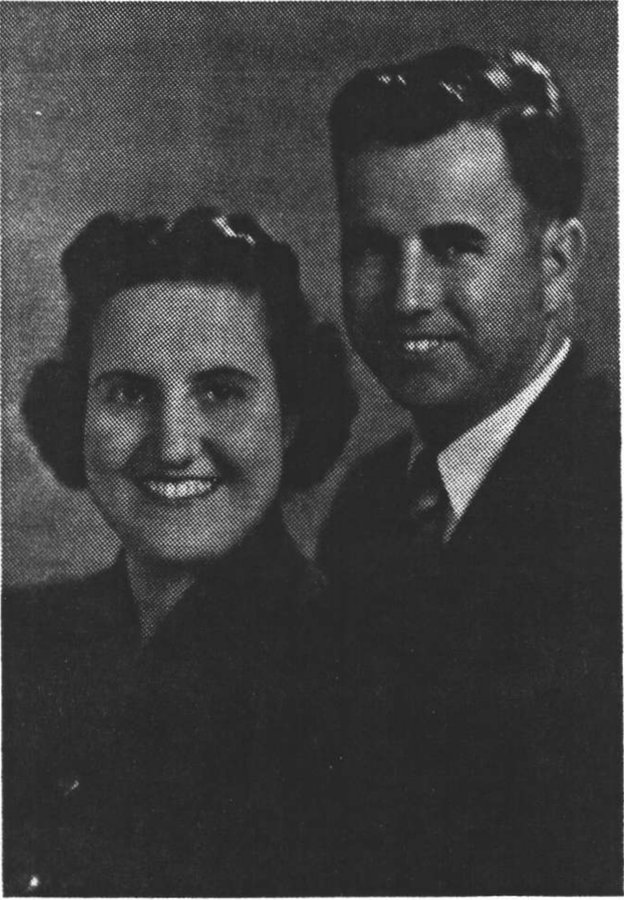
Donald M. Dickey and Maxine Dickey.As printed: “Don and Maxine Dickey, c. 1944” From the front matter of the printed monograph (front-4 (one of three photos on this plate)), reproduced from the creator's own scan.
Zybach, Bob and Neil Vanderburg 1995. Donald Dickey. Family History and Life on Berry Creek, Benton County, Oregon: 1928-1941. Soap Creek Valley History Project, Monograph #03, 2nd printing. Oregon State University Research Forests and College of Forestry, Corvallis, Oregon: 69 pp.
Bob Zybach (interviewer); Neil Vanderburg (interviewer); Bob Zybach (co-author); Neil Vanderburg (co-author); Lisa Buschman (transcriber); Lisa Buschman (editor); Lisa Buschman (indexer); William Atkinson (authorizer); Bonnie Humphrey-Anderson (other); Patricia Dickey Creelman (other); Maxine Dickey (other); Samuel H. Moore (photographer); Bob Zybach (series-editor)
Printed
1991, Title page of the scanned PDF reads 'OSU RESEARCH FORESTS / Oregon State University / 1991' (1st printing). Bob Zybach's series catalogue cites this monograph as 'Zybach, Bob and Neil Vanderburg 1995 ... Monograph #03, 2nd printing'; the PDF filename is Zybach-Vanderburg_1991.pdf. Both are recorded: citation year 1995 (2nd printing), printed year on this copy 1991. · Oregon State University Research Forests and College of Forestry, Corvallis, Oregon
Withheld from this edition.
Printed pp. 12–14 — 3
pages of this volume are withheld while the Library
completes a review. Each keeps its number and its permanent link, so a
citation to any of them still lands on the page it names. The reasons
differ from page to page and are not given here, so that the notice on
one page says nothing about another.
What is withheld, and why.
Front matter, as printed
Cover, as printed
DONALD DICKEY Family History and Life on Berry Creek Benton County, Oregon: 1928-1941 / Oral History Interview by Bob Zybach and Neil Vanderburg / Soap Creek Valley History Project OSU Research Forests OSU RESEARCH FORESTS Monograph #3
Cover photograph
Cover Photo: The cover photo is of the Moore Family farm in the Soap Creek Valley, probably taken by Samuel H. Moore around 1899 or 1900. Provided by the courtesy of Myra Moore Davidson and the Soap Creek Schoolhouse Foundation.
Acknowledgments
The Soap Creek Valley History Project was authorized by, and is under the direction of, Dr. William Atkinson, Director of the OSU Research Forests. Funding for the project is provided by the OSU College of Forestry.
Transcription to computer files was completed by Lisa Buschman, OSU Research Forests secretary, who also assisted in the final editing, formatting, and indexing. The quality of her work has provided the standard by which the monographs in this series are being assembled.
Patricia Dickey Creelman wrote a memorial to her father, Donald Dickey, which is printed as Appendix A. These words were written shortly after learning of his death, and read by Patricia at his funeral, on October 2, 1990. They project an accurate reflection of the character of Donald Dickey, as viewed through the eyes of one of his children.
Maxine Dickey wrote about her career as a school teacher in Benton and Polk Counties, which is included in Appendix B. The portion dealing with Maxine's memories of teaching at Airlie High School was read at the April 11, 1991 meeting of the Polk County Historical Society, which had gathered at the Airlie Fire Station to hear a presentation of the town's history. Her comments and observations - which had arrived by mail only a few hours earlier for inclusion in this monograph - were greeted with laughter and sustained applause by the 50 or so members of the audience, many of whom were students of "Miss Van Patten's" during the early days of World War II.
Soap Creek Valley History Project
The Soap Creek Valley History Project was undertaken by the Oregon State University's Research Forests in 1989 for the purpose of better understanding the history, ecology, and culture of an area that has been directly impacted by OSU land management practices for over sixty years. An important part of the project has been the locating of recorded interviews with individuals who have had an influence upon the valley's history. Additional recordings have also been made with significant individuals who have not been previously consulted, as well as "follow-up" interviews with a few people who have continued to contribute to our understanding of the Soap Creek area.
The publication of these interviews as a series of cross-referenced monographs has been undertaken in an effort to make them available to resource managers, researchers and educators. It will also provide accurate and accessible references for a planned written history of the Soap Creek Valley, a primary objective of this research.
One of the basic accomplishments of the project has been the creation of a computerized concordance file. This was made possible through the assistance and expertise of Bonnie Humphrey-Anderson, of the Homer Museum staff, and Lisa Buschman, secretary for the OSU Research Forests. This file allows for both the efficient and systematic indexing of the monographs in this series, as well as providing a method for cross-referencing other research materials being used in the construction of a scholarly history of the Soap Creek Valley. Wherever possible, that history is being assembled from the written and spoken words of the people who made it and lived it. The use of the concordance file allows information from the journal entries of botanist David Douglas, the transcribed words of Kalapuyan William Hartless, the spoken memories of pioneer "Grandma" Carter, and the recollections of Don Dickey -- a history spanning over a century and a half -- to be systematically searched and organized as if they were all products of the same pen (or word processor).
Citations should mention both the Homer Museum and OSU Research Forests.
Introduction
Donald Dickey was a good man.
Neil Vanderburg and I interviewed Don near the end of his life, while he was being treated for a terminal illness at the Green Valley Care Center in Eugene. During the course of the interview - which spanned two visits and exceeded four hours during a Saturday afternoon - we were interrupted several times by nurses, visitors, other patients; including the people attending and visiting his roommate, who was situated in another bed a few feet away. Adding to the general confusion were the normal technical difficulties - such as changing tapes and adjusting volume levels - that attend any cording session. Yet, despite all of the distractions and his own personal discomfort (not the least of which included a series of recorded questions from a person he had never met before), Don was able to maintain a remarkable sense of humor and cooperativeness that was both amazing and inspiring. This wasn't a show of maintaining a "stiff-upper-lip" in the face of adversity; rather it was the case of a man seeing a job that needed to be done, and giving it his best effort to help out. The effort was not only appreciated and admired, it was also focused, courteous, thorough and complete.
Don's life and career are examined in some detail in the following transcript, but to understand the strength of his character and the values he instilled in others, one must read the appendices written by his wife and daughter. This is not because he was particularly self-effacing or overly modest, but simply because the task at hand was to record the details of a history in which he had participated. And only that. His own predicament might be annoying and inconvenient, but that was simply circumstance - not an excuse for poor workmanship or an opportunity for self promotion. Certainly not a situation for sympathy or self-pity. Donald Dickey was a strong and confident man; he didn't have time for excuses or compromised efforts. I'm glad that he was able to record some of his ideas and accomplishments for those of us that share his interests in history and wildlife, education and family.
The reason for the foregoing comments is not to memorialize Don Dickey - that is best left and better done by those who knew him and loved him - but to give the reader of this monograph an idea as to the type of man that is answering a series of unrehearsed questions, and the trying circumstances in which he is doing so. When is wife, Maxine, tells a family story (page 34) that ends in the punchline, "Think you'll ever amount to anything, Dickey?" and Don laughs and says, "Rate I'm going now, I don't think so," it is not "gallows" humor at all; although in print it may appear to be so. Those of us that heard that comment in person laughed along with Don, and not simply to be polite or comforting. It was a genuinely funny quip - impeccably timed - from a man that enjoyed life and had the ability to share that joy with others, no matter the circumstances.
This document is primarily concerned with history of the Berry Creek community to the immediate north of the Soap Creek Valley during the time of the Great Depression, from 1928 until the start of World War II. As such, it should prove to be of value to a wide variety of students and researchers interested in western Oregon history during that era, whether that interest is in wildlife patterns, forestry, agriculture, education, genealogy, climate, or any number of other topics upon which Don comments. Donald Dickey was an active participant in the affairs of his community, a knowledgeable and trained observer, and had the ability to communicate details in a concise and insightful manner. It was a pleasure to work with him. He was a good man.
Bob Zybach Corvallis, Oregon May 1, 1991
The recording sessions
August 18, 1990 — Green Valley Care Center, Eugene, Oregon Interviewers: Bob Zybach, Neil Vanderburg · Mode: interview · Source: as stated Header on printed page 1: 'Interview conducted by Bob Zybach and Neil Vanderburg at the Green Valley Care Center, August 18, 1990, with Donald and Maxine Dickey.' The Introduction (page ii) states the interview 'spanned two visits and exceeded four hours during a Saturday afternoon'; only the one date is printed. A lunch break is marked in the transcript at printed page 29 and the recording ends at printed page 56 ('[END OF RECORDING]').
Captions are printed exactly as they appear in the book. The photographs
themselves are in the printed volume and are not online yet; the scanned
PDF of the whole book shows them.
The cover photo is of the Moore Family farm in the Soap Creek Valley, probably taken by Samuel H. Moore around 1899 or 1900. Provided by the courtesy of Myra Moore Davidson and the Soap Creek Schoolhouse Foundation. Photograph in the printed book, [front-1] (not yet online) c. 1899-1900 · Photograph by Samuel H. Moore · Courtesy Myra Moore Davidson and the Soap Creek Schoolhouse Foundation
The Dickey's Berry Creek Home Photograph in the printed book, [front-4] (not yet online)
Don and Maxine Dickey, c. 1944 Photograph in the printed book, [front-4] (not yet online) c. 1944
The Dickey family: father James, mother Mamie, and sons Kenneth, Leland, and Donald. Photograph in the printed book, [front-4] (not yet online)
Index to this volume
Bob's own back-of-book index, made live: each page number opens that page
of the transcript. Every heading also appears in the
Series Index, where it gathers references
from all fifteen monographs.
The first line is the citation as it is printed in the original. Use it when
you cite the work itself. Use the second when you cite this page.
As printed
Zybach, Bob and Neil Vanderburg 1995. Donald Dickey. Family History and Life on Berry Creek, Benton County, Oregon: 1928-1941. Soap Creek Valley History Project, Monograph #03, 2nd printing. Oregon State University Research Forests and College of Forestry, Corvallis, Oregon: 69 pp.