Soap Creek Valley oral history series · Monograph #5
John Jacob & Wilma Rohner
Monograph #5 in the Soap Creek Valley oral history series: John Jacob "Jake" Rohner and Wilma "Willie" Rohner, recorded in 3 sessions between September 18, 1990 and September 30, 1990, printed 1993.
Family Farming On Coffin Butte Between World Wars. Benton County, Oregon: 1919-41
The printed cover. Full-size scan on
the creator's own site, nwmapsco.com.
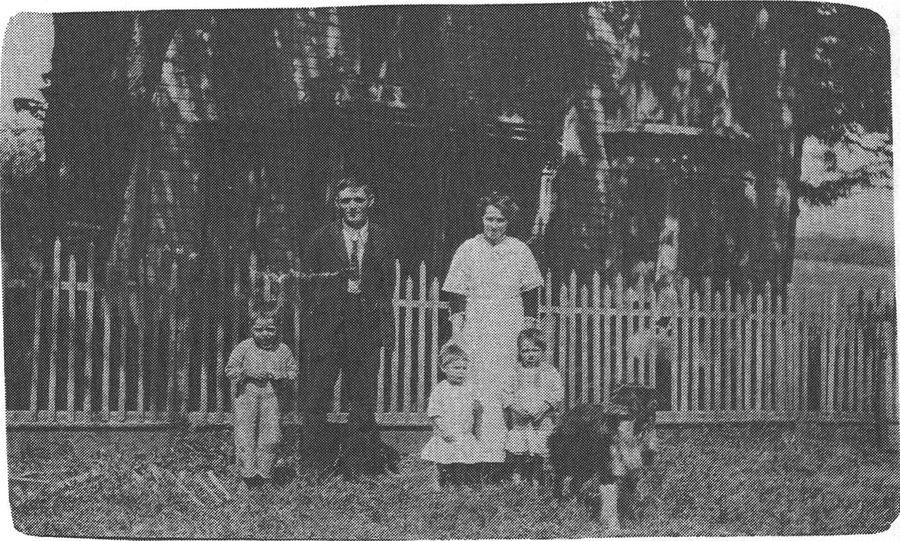
John Jacob "Jake" Rohner (pictured as a young child) with his parents and siblings Nellie and Sam Rohner.As printed: “Title Page Photo: This photograph of the Rohner family was taken in front of their first Benton County residence, the old Writsman home near Coffin Butte. Pictured with their parents are young Jake (b. 1914), Nellie (b. 1915), and Sam (b. 1916). All of the children were born in this house.” From the front matter of the printed monograph (front-2 (title page)), reproduced from the creator's own scan.
Zybach, Bob 1993. John Jacob and Wilma Rohner. Family Farming on Coffin Butte Between World Wars, Benton County, Oregon: 1919-1941. Soap Creek Valley History Project, Monograph #05. Oregon State University Research Forests and College of Forestry, Corvallis, Oregon: 132 pp.
3 sessions, September 18, 1990 to September 30, 1990
Transcribed, audited, edited
Bob Zybach (interviewer); Bob Zybach (editor); William Atkinson (authorizer); Lisa Buschman (transcriber); Lisa Buschman (indexer); Holly Behm Losli (editor); Holly Behm Losli (indexer); Tami Torres (editor); Pam Beebee (other); Bonnie Humphrey (other); Samuel H. Moore (photographer); Myra Moore Lauridson (other); Wilma "Willie" Rohner (photographer); Neil Vanderburg (other)
Printed
1993 · Oregon State University Research Forests and College of Forestry, Corvallis, Oregon
Withheld from this edition.
Printed p. 10, pp. 73–74, p. 101 — 4
pages of this volume are withheld while the Library
completes a review. Each keeps its number and its permanent link, so a
citation to any of them still lands on the page it names. The reasons
differ from page to page and are not given here, so that the notice on
one page says nothing about another.
What is withheld, and why.
Front matter, as printed
Cover, as printed
JOHN JACOB & WILMA ROHNER
Family Farming On Coffin Butte Between World Wars
Benton County, Oregon: 1919-41
Oral History Interviews by Bob Zybach
Soap Creek Valley History Project
OSU Research Forests
Monograph #5
Cover photograph
Cover Photo: Courtesy of Myra Moore Lauridson and the Soap Creek Schoolhouse Foundation. Pictured is the Moore family farm on Soap Creek, taken about 1899 or 1900 by Mrs. Lauridson's father, Samuel H. Moore.
Acknowledgments
The Soap Creek Valley History Project was authorized by, and is under the direction of, Dr. William Atkinson, Director of the OSU Research Forests. Funding for the project is provided by the OSU College of Forestry.
Lisa Buschman, former OSU Research Forests secretary, transcribed interview recordings to computer files and assisted with draft editing, formatting, and indexing. Holly Behm Losli and Tami Torres, OSU Research Forests text editors, completed final formatting and indexing under the direction of Pam Beebee, OSU Research Forests Office Manager. This project could not have been completed without the help of these people.
Soap Creek Valley History Project
The Soap Creek Valley History Project was undertaken by the Oregon State University's Research Forests in 1989 for the purpose of better understanding the history, ecology, and culture of an area that has been impacted by OSU land management practices for nearly seventy years. An important part of the project has been the locating of recorded oral history interviews with individuals who have had an influence upon the valley's history. New recordings have also been made with significant individuals who have not been previously consulted, as well as "follow-up" interviews with people who have continued to contribute to our understanding of the Soap Creek area.
The publication of these interviews as a series of cross-referenced and indexed monographs has been undertaken in an effort to make them available to resource managers, researchers and educators. An additional use is accurate and available references for a planned written history of the area.
One of the primary accomplishments of the project has been the creation of a computerized concordance file. This was made possible through the assistance and expertise of Bonnie Humphrey,of the Horner Museum staff, Lisa Buschman, former secretary for the OSU Research Forests, and Holly Behm Losli, text editor for OSU Research Forests. The file allows for both the efficient and systematic indexing of the monographs in this series, as well as providing a method for cross-referencing other research materials being used in the construction of a scholarly history of the Soap Creek Valley. Wherever possible, that history is being assembled from the written and spoken words of the people who made it and lived it. The use of the concordance file allows information from the journal entries of botanist David Douglas, the transcribed words of Kalapuyan William Hartless, the memories of pioneer "Grandma" Carter, and the recordings of Depression-era farmers Jake and Willie Rohner--a history spanning over a century and a half--to be systematically searched and organized. The index to this monograph is an example of the applied use of the file.
Introduction
John Jacob (Jake) Rohner and his sister, Wilma (Willie), are two of the nicest people I have ever met. Willie is also one of the funniest. A shortcoming of oral histories is the loss of timing, emotion, laughter, and other expressions that can't be adequately described in typewritten words. Much of Jake's basic kindness and honest helpfulness still survives the process of being interviewed, recorded and transcribed--but much is lost. The same holds true with Willie's stories and observations. In print they're often hilarious--in real life they're really hilarious! Working with these two people over the course of the past few years has been a genuinely pleasant experience.
The Rohners are a close-knit family. Since his wife's death last year, Jake often has meals with his sister Willie and Elsie, who live a short distance down the road. Brother Ed also maintains a farm nearby, and married sisters Sam and Nellie remain in constant touch.
People that have known the Rohners through the years invariably say nice things about the family. "Honest," "hard-working," and "good farmers" are terms that are often used. Neil Vanderburg, a retired Corvallis-area farmer (and occasional co-author), probably summed the family up best when I first asked him about Jake and Willie: "Everybody who knew the Rohners respected them. They were honest, hard-working people that knew how to live off a farm. They were nice people, kind of quiet, that you could always trust." I think Neil understood them pretty well.
The following story is of an immigrant Swiss family's farming life in Benton County, Oregon during the Great Depression. The story begins with the purchase of a farm on the northern slopes of Coffin Butte near the end of World War I, and ends with the farm's purchase by the U.S. Army for training purposes at the beginning of World War II. Many of the photographs in the appendix were taken with "a cheap Brownie" by 16-year old Willie after she had been specifically instructed to stay away from construction activities. Their printing in this publication provides graphic insights into the effect Camp Adair had upon many local families during the early 1940s.
Bob Zybach
Corvallis, Oregon
August 5, 1993
The map
Map of September 30, 1990 Tour of Coffin Butte neighborhood. Circled letters correspond to chapter headings in Table of Contents.
The recording sessions
September 18, 1990 — Jake Rohner's home, Benton County, Oregon Interviewer: Bob Zybach · Mode: interview · Source: as stated Part I. Printed session note: "The following transcript was made from a recorded interview with Jake Rohner that took place at Jake 's home on September 18, 1990. Due to some problems with the recording equipment, about 40 minutes of the interview--between Part I and Part H [II] failed to record. After reviewing the transcripts, Joke [Jake] and Willie provided written corrections and additions. These comments appear throughout the manuscript enclosed in [brackets] and include the initials of the person that has provided the information." The gap is flagged in the text at p.6 ("Problem with the tape recorder resulted in 40-minute gap.") and p.12 ("Tape recorder problem continued.").
September 30, 1990 — Automobile tour of the Coffin Butte area, Benton County, Oregon Interviewer: Bob Zybach · Mode: tour · Source: as stated Part II. Printed session note: "The following transcript was made from a recorded interview with Jake Rohner that took place during an automobile tour of the Coffin Butte area on September 30, 1990. Stopping points along the tour route are noted on the map at the front of this book with alphabetized letters. The same alphabetic system is used in the following text to coordinate discussions with speqfic [specific] locations." Fifteen lettered stops, A-O.
September 30, 1990 — Jake Rohner's home, Benton County, Oregon (afternoon) Interviewer: Bob Zybach · Mode: photo-elicitation · Source: as stated Part III. Printed session note: "The following transcnpt [transcript] was made from an interview with fake [Jake] and Willie at fake's [Jake's] home, during the afternoon of September 30, 1990. After reviewing the initial transcripts, fake [Jake] and Willie provided written corrections and additions. These com,nents [comments] appear throughout the manuscript enclosed in [brackets] and include the initials of the person that has provided the information." Both narrators present; speakers are marked in the printed text as [JAKE] and [WILMA]. A note "Pause in Recording" appears at p.64.
Contents
Coverp. [front-1]
Title Pagep. [front-2]
ACKNOWLEDGEMENTSp. [front-3]
THE SOAP CREEK VALLEY HISTORY PROJECTp. i
SOAP CREEK VALLEY MAPp. ii
Map of September 30, 1990 Tour of Coffin Butte neighborhoodp. iii
SOAP CREEK VALLEY MAPPrinted page iiLocator map: State of Oregon, Polk and Benton counties, with Coffin Butte and Soap Creek Valley indicated. Marked "NOT TO SCALE".
Map of September 30, 1990 Tour of Coffin Butte neighborhoodPrinted page iiiLegend: A · B · C · D · E · F · G · H · I · J · K · L · M · N · OHand-drawn map. Printed caption: "Map of September 30, 1990 Tour of Coffin Butte neighborhood. Circled letters correspond to chapter headings in Table of Contents." Circled letters A-O key the Part II chapters; the map also carries family/place labels (SMITH, BERRY CREEK, ROBISON, BLASCH, McCLAIN, FOLKS HILL, E. WILES, KESTER, P. CARTER, MACKEY, COFFIN BUTTE, TORGESON, SHEPARD, DOBRININ, E. CARTER, ROHNER, STELL[MACHER], WILLIAMSON, WELLS, CAMP ADAIR, WRITSMANS HILL, MILES/WILES, TUDACH/STUDACK, SCHULMER[ICK], WELLS SCHOOL, MUNSON, TAMPICO SCHOOL, GLENDER, KINDERM[AN], MARCKS/GLENDERS HILL, COOPER, ADAIR VILLAGE, HOFFMAN, JOHNSON, GOVIER, HOSPITAL HILL, BLAKE).
Photographs
Captions are printed exactly as they appear in the book. The photographs
themselves are in the printed volume and are not online yet; the scanned
PDF of the whole book shows them.
Cover Photo: Courtesy of Myra Moore Lauridson and the Soap Creek Schoolhouse Foundation. Pictured is the Moore family farm on Soap Creek, taken about 1899 or 1900 by Mrs. Lauridson's father, Samuel H. Moore. Photograph in the printed book, [front-1] (not yet online) about 1899 or 1900 · Photograph by Samuel H. Moore · Courtesy Myra Moore Lauridson and the Soap Creek Schoolhouse Foundation
Title Page Photo: This photograph of the Rohner family was taken in front of their first Benton County residence, the old Writsman home near Coffin Butte. Pictured with their parents are young Jake (b. 1914), Nellie (b. 1915), and Sam (b. 1916). All of the children were born in this house. Photograph in the printed book, [front-2] (not yet online)
Powderhouse Photograph. Twelve-year old Buddy Rohner stands at the door of this recent addition to the Rohner Farm. Photograph in the printed book, p. 115 (not yet online) 1941 · Photograph by Wilma "Willie" Rohner · Courtesy Jake and Willie Rohner Read the page it is printed on
Backhoe Photograph. The first new road construction for Camp Adair takes place across the Rohner farm. Photograph in the printed book, p. 115 (not yet online) 1941 · Photograph by Wilma "Willie" Rohner · Courtesy Jake and Willie Rohner Read the page it is printed on
Coffin Butte Blast Photograph. A distant puff of smoke signals the beginning of Camp Adair quarrying activities along the northern base of Coffin Butte. Photograph in the printed book, p. 116 (not yet online) 1941 · Photograph by Wilma "Willie" Rohner · Courtesy Jake and Willie Rohner Read the page it is printed on
Coffin Butte Panorama. Within a few months the U.S. Army has completely changed the shape and appearance of Coffin Butte. Photograph in the printed book, p. 117 (not yet online) 1941 · Photograph by Wilma "Willie" Rohner · Courtesy Jake and Willie Rohner Read the page it is printed on
Overpass Photograph. A cloverleaf is constructed to connect Coffin Butte to military headquarters by bridging Highway 99 to the east of the Rohner Farm. Photograph in the printed book, p. 118 (not yet online) 1941 · Photograph by Wilma "Willie" Rohner · Courtesy Jake and Willie Rohner Read the page it is printed on
Camp Adair Photograph. Buddy Rohner stands to the foreground of recent Camp Adair construction to the east of the Rohner Farm. Photograph in the printed book, p. 118 (not yet online) 1941 · Photograph by Wilma "Willie" Rohner · Courtesy Jake and Willie Rohner Read the page it is printed on
Barracks Photograph. In 1951 the U.S. Army sold surplus buildings to local landowners and other buyers. Photograph in the printed book, p. 118 (not yet online) 1951 · Courtesy Jake and Willie Rohner Read the page it is printed on
Rohner Family Photograph. Coffin Butte lies to the northeast in this photograph, taken around 1940. From left to right, family members are (Front Row) Bud, Elsie, and Willie, (Back Row) Jake, Jr., Ralph Weaver, Nellie, Merle Prindel, Sam, Bertha, and Jake, Sr. Photograph in the printed book, p. 119 (not yet online) around 1940 · Courtesy Jake and Willie Rohner Read the page it is printed on
Baldy and Prince Photograph. Jake, Sr. and two of his favorite employees. Note the unusual vegetation pattern on Coffin Butte in the background. Photograph in the printed book, p. 120 (not yet online) Courtesy Jake and Willie Rohner Read the page it is printed on
Father and Calves Photograph. New Brown Swiss arrivals at the Rohner Farm. Photograph in the printed book, p. 120 (not yet online) Courtesy Jake and Willie Rohner Read the page it is printed on
Rohner Farm Photograph. This view of the Rohner Farm looks southward from the upper slopes of Coffin Butte. Photograph in the printed book, p. 120 (not yet online) Courtesy Jake and Willie Rohner Read the page it is printed on
Gold Oak Tree Photograph. An early settler is said to have built a small brick cabin next to this tree. A legend of buried gold also is part of the tree's history. Photograph in the printed book, p. 121 (not yet online) Courtesy Jake and Willie Rohner Read the page it is printed on
Stellmacher House Photograph. No one knows why the house was moved to this location. It burned in 1942, shortly after the establishment of Camp Adair. Photograph in the printed book, p. 121 (not yet online) Courtesy Jake and Willie Rohner Read the page it is printed on
Doc Rohner House Photograph. Marge Dodele Rohner stands in front of the veterinarian's Corvallis home. Photograph in the printed book, p. 122 (not yet online) Courtesy Jake and Willie Rohner Read the page it is printed on
Widmer Photograph. Jake, Sr. with bachelor orchardist, Arnold Widmer. Photograph in the printed book, p. 122 (not yet online) Courtesy Jake and Willie Rohner Read the page it is printed on
Index to this volume
Bob's own back-of-book index, made live: each page number opens that page
of the transcript. Every heading also appears in the
Series Index, where it gathers references
from all fifteen monographs.
The first line is the citation as it is printed in the original. Use it when
you cite the work itself. Use the second when you cite this page.
As printed
Zybach, Bob 1993. John Jacob and Wilma Rohner. Family Farming on Coffin Butte Between World Wars, Benton County, Oregon: 1919-1941. Soap Creek Valley History Project, Monograph #05. Oregon State University Research Forests and College of Forestry, Corvallis, Oregon: 132 pp.