Soap Creek Valley oral history series · Monograph #10
Velma Carter Rawie
Monograph #10 in the Soap Creek Valley oral history series: Velma Carter Rawie, recorded in 1 session between March 19, 1991 and March 19, 1991, printed 1994.
A History of the Carter Family and the Town of Wells, Benton County, Oregon: 1845 - 1941
The printed cover. Full-size scan on
the creator's own site, nwmapsco.com.
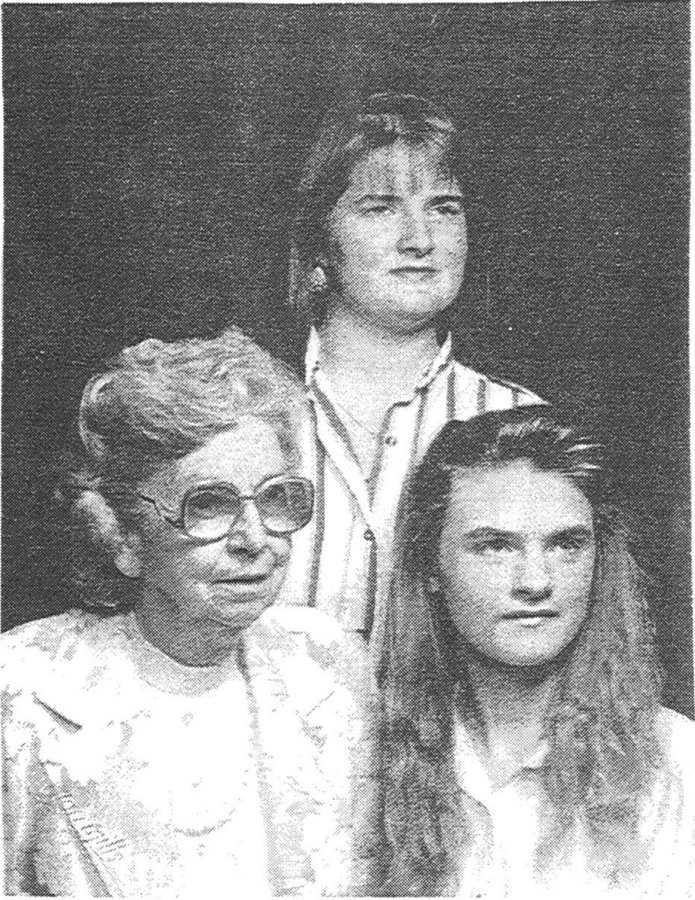
Velma Carter Rawie with granddaughters Tonya Rawie and Traci Rawie.As printed: “Title Page Photo: Velma Carter Rawie and her two granddaughters, Tonya Rawie and Traci Rawie. Mrs. Rawie's oral history outlines the story of six generations of this Benton County pioneer family, between 1846 and 1994.” From the front matter of the printed monograph (front-2 (title page)), reproduced from the creator's own scan.
Zybach, Bob 1994. Velma Carter Rawie. A History of the Carter Family and the Town of Wells, Benton County, Oregon: 1845-1941. Soap Creek Valley History Project, Monograph #10. Oregon State University Research Forests and College of Forestry, Corvallis, Oregon: 130 pp.
Bob Zybach (interviewer); Bob Zybach (editor); William Atkinson (authorizer); Lisa Buschman (transcriber); Lisa Buschman (indexer); Holly Behm Losli (editor); Tami Torres (editor); Md. Shahidul Islam (editor); Pam Beebee (series-editor); Bonnie Humphrey (indexer); Velma Carter Rawie (co-author); Tolbert Carter (co-author); George H. Himes (editor); Ianthe Smith (other); Myra Moore Lauridson (other); Samuel H. Moore (photographer); Wilma Rohner (other); Lorna Grabe (other); Donald Tomlinson (other)
Printed
1994 · Oregon State University Research Forests and College of Forestry, Corvallis, Oregon
Withheld from this edition.
Printed pp. 27–28, p. 71, p. 105 — 4
pages of this volume are withheld while the Library
completes a review. Each keeps its number and its permanent link, so a
citation to any of them still lands on the page it names. The reasons
differ from page to page and are not given here, so that the notice on
one page says nothing about another.
What is withheld, and why.
Front matter, as printed
Cover, as printed
VELMA CARTER RAWIE A History of the Carter Family and the Town of Wells Benton County, Oregon: 1845 - 1941
Oral History Interviews by Bob Zybach
Soap Creek Valley History Project OSU Research Forests Monograph # 10 1994
Cover photograph
Cover Photo: Courtesy of Myra Moore Lauridson and the Soap Creek Schoolhouse Foundation. Pictured is the Moore family farm on Soap Creek, taken about 1899 or 1900 by Mrs. Lauridson's father, Samuel H. Moore.
Acknowledgments
The Soap Creek Valley History Project was authorized by, and is under the direction of, Dr. William Atkinson, former Director of the OSU Research Forests. Funding for the project is provided by the OSU College of Forestry.
Lisa Buschman, former OSU Research Forests secretary, transcribed recordings to computer files and assisted with draft editing, formatting, and indexing. Holly Behm Losli, Tami Torres and Md. Shahidul Islam, OSU Research Forests text editors, completed final formatting and indexing under the direction of Pam Beebee, OSU Research Forests Office Manager. This project could not have been completed without the help of these people.
Cover Photo: Courtesy of Myra Moore Lauridson and the Soap Creek Schoolhouse Foundation. Pictured is the Moore family farm on Soap Creek, taken about 1899 or 1900 by Mrs. Lauridson's father, Samuel H. Moore.
Title Page Photo: Velma Carter Rawie and her two granddaughters, Tonya Rawie and Traci Rawie. Mrs. Rawie's oral history outlines the story of six generations of this Benton County pioneer family, between 1846 and 1994.
Soap Creek Valley History Project
THE SOAP CREEK VALLEY HISTORY PROJECT
The Soap Creek Valley History Project was undertaken by the Oregon State University's Research Forests in 1989 for the purpose of better understanding the history, ecology, and culture of an area that has been directly impacted by OSU land management practices for nearly seventy years. An important part of the project has been the location and publication of existing recorded oral history interviews with individuals who have had an influence upon the valley's history. New recordings have also been made with significant individuals who have not been previously consulted, as well as "follow-up" interviews with a few people who have continued to contribute to our understanding of the Soap Creek area.
The publication of these interviews as a series of cross-referenced monographs has been undertaken in an effort to make them available to resource managers, researchers and educators. An additional use is accurate and available references for a planned written history of the area.
One of the primary accomplishments of the project has been the creation of a computerized concordance file, currently on IBM Word Perfect 5.1. This was made possible through the assistance and expertise of Bonnie Humphrey, of the former Homer Museum staff, Lisa Buschman, secretary for the OSU Research Forests, and Holly Behm Losli and Tami Torres, text editors for OSU Research Forests. The file allows for both the efficient and systematic indexing of the monographs in this series, as well as providing a method for cross- referencing other research materials being used in the construction of a scholarly history of the Soap Creek Valley.
The Soap Creek history is being assembled from the written and spoken words of the people who made it and lived it. The use of the concordance file allows information from the journal entries of botanist David Douglas, the transcribed words of Kalapuyan William Hartless, the memories of pioneer "Grandma" Carter, and the recordings of her great granddaughter, Velma Rawie, to be systematically searched and organized. The index of this monograph is an example of the applied use of the file.
Citations should mention both the OSU College of Forestry and OSU Research Forests.
Introduction
Velma Rawie is a third-generation descendent of an interesting and influential Benton County pioneer family. She is also one of the few remaining former residents of Wells, Oregon. Wells was a Coffin Butte-area farming community in northern Benton County that became a ghost town almost overnight, in 1941. Mrs. Rawie's story--which details the circumstances surrounding the arrival and settlement of the Tolbert Carter family near the future site of Wells, beginning in 1846, and the demise of the town at the beginning of World War II-- were recorded and partially indexed and edited in the comfort of her attractive Corvallis home. Her current house is just a short distance from where she and her husband, Ralph Rawie, operated a dairy farm and raised their two sons in the years that followed the war.
Mrs. Rawie is an extremely personable and cooperative person, and displayed an admirable amount of patience during the three and a half years it took to complete this project. As one of the few remaining members of the Carters and of Wells,. she often expressed her interest in keeping the memories of these important facets of Benton County (and Oregon) history "alive" and making certain that the recorded details were "as accurate as possible." I believe that readers of this oral history will agree that she has accomplished both objectives very well. This document provides a solid foundation for others to build upon, whether five years from now, or 50 years. Her family's story is an important one, and spans the entire time of Benton County's existence, beginning with its creation in 1847.
Of particular interest to students of pioneer Oregon history is Tolbert Carter's tale of the hardships endured during the 1846 construction of the southern route of the Oregon Trail (also known as the "South Road" and as the "Applegate Trail"). Appendix B is a reprinting of his account as it first appeared over 90 years ago in the "Transactions of the Oregon Pioneer Association." Appendix C is the final portion of Carter's memoir which--so far as known--is printed here for the first time. Apparently this conclusion to Carter's original document was lost or misplaced after his death in 1899, and was subsequently left out of the Oregon Pioneer Association publication. Its printing here adds an important chapter to our understanding of local history.
Finally, no history of early 1900s Benton County should be considered complete without mention of Martha Angeline Bileui "Grandma" Carter, the Wells matriarch (and wife of Tolbert Carter) whose fame grew to a statewide level during the latter years of her life. A newspaper accounting of her 100th birthday party in 1934 is included as the last appendix to this document. This history is an accurate (at least as accurate as human memory and newspaper accountings will allow) attempt to keep the legacy of the pioneer Carter family and the story of Wells, Oregon "alive" and well. Whatever success is achieved in these endeavors can be credited to Mrs. Velma Carter Rawie. It has been a pleasure to work with her, and I think it will be almost as pleasant--and as informative--for future readers and researchers to listen to what she has to say.
Bob Zybach Corvallis, Oregon September 18, 1994
The map
This map of Wells, Oregon was printed on February 1, 1942 by the U.S. Army Engineers War Department, shortly after the town had been occupied by the U.S. Army. The map shows the names of the town's landowners immediately prior to the federal government acquisition and subsequent civilian evacuation of the area.
The recording sessions
March 19, 1991 — the home of Velma Carter Rawie, Corvallis, Oregon Interviewer: Bob Zybach · Mode: photo-elicitation · Source: as stated Headed 'March 19, 1991 Interview' (printed p. 1). Tape-change markers are printed at the end of tape 1, side 1 (p. 15), tape 1, side 2 (p. 31), tape 2, side 1 (p. 47) and tape 2, side 2 (p. 63); the transcript continues to p. 78 with no further marker. Much of the session is spent looking through Mrs. Rawie's family photographs and scrapbook, and at a 1936 aerial photograph. No extant cassette is listed in OSU's archive (per SCARC OH 006 finding aid).
SOAP CREEK VALLEY LOCATION MAPPrinted page iiCaptioned 'Fig. XIII. 1993 Western Oregon Location Map', credited '(Zybach 1993a 4)'. Shows the State of Oregon with Portland, Nashville, Wells and Soap Creek Valley; marked 'NOT TO SCALE'.
Town of Wells, Sec. 11, T. 11 S., R. 4 W. (U.S. Army Engineers, War Department)Printed page iiiThis map of Wells, Oregon was printed on February 1, 1942 by the U.S. Army Engineers War Department, shortly after the town had been occupied by the U.S. Army. The map shows the names of the town's landowners immediately prior to the federal government acquisition and subsequent civilian evacuation of the area. The map image carries lettered/numbered parcel codes (C-89 … C-103) beside landowner names; the scan's text layer does not render them reliably, so they are not transcribed here.
Photographs
Captions are printed exactly as they appear in the book. The photographs
themselves are in the printed volume and are not online yet; the scanned
PDF of the whole book shows them.
Cover Photo: Courtesy of Myra Moore Lauridson and the Soap Creek Schoolhouse Foundation. Pictured is the Moore family farm on Soap Creek, taken about 1899 or 1900 by Mrs. Lauridson's father, Samuel H. Moore. Photograph in the printed book, [front-1] (not yet online) about 1899 or 1900 · Photograph by Samuel H. Moore · Courtesy Myra Moore Lauridson and the Soap Creek Schoolhouse Foundation
Title Page Photo: Velma Carter Rawie and her two granddaughters, Tonya Rawie and Traci Rawie. Mrs. Rawie's oral history outlines the story of six generations of this Benton County pioneer family, between 1846 and 1994. Photograph in the printed book, [front-2] (not yet online)
This photograph of the new family car was taken with mother Rose Carter behind the steering wheel. Father Pearl Carter is sitting on the running board to the far left (his hat appears just under his wife's hands). Other family members include Uncle Mox (E. A. Carter), his wife, Anna Carter, his son, Lyle Carter, a cousin, Nellie White, Seth White, Aunt Mattie Carter Tomlinson, and Grandma Williamson. Photograph in the printed book, vii (not yet online)
John A. Carter, his wife, Mary C. Carter, and their daughter, Martha Ann ("Aunt Mattie") Carter relax on the porch of Carter's Store, c. 1915. Photograph in the printed book, p. 11 (not yet online) c. 1915 Read the page it is printed on
A Wells-area farmer stops by the Carter Store on his way to the Fisher's Warehouse with a load of grain, c.1900. Local farmers would often stop by the store for a soda or a drink of water and a chance to pick up their mail or "catch up on the gossip." Photograph in the printed book, p. 17 (not yet online) c.1900 Read the page it is printed on
Black and white copy of the 1881 cover of the "Merchant's Gargling Oil Songster." The original cover was printed in four colors. Photograph in the printed book, p. 22 (not yet online) 1881 Read the page it is printed on
This railroad car, and others like it, was used as to bring "Revival Meetings" to Wells and to other communities with railroad service in the late 1800s and early 1900s. Photograph in the printed book, p. 26 (not yet online) late 1800s - early 1900s Read the page it is printed on
This photograph of a Wells community picnic took place at Sulphur Springs, probably on the 4th of July in 1920. Family and friends identified by Velma Rawie and her sister Bessie in 1994 include Velma (Bessie got in trouble for being away "craw-dadding" in Soap Creek while the photgraph was being taken), Alva Wise, Mrs. Wise, Arnold Barzee, Aunt Ella Williamson, Aunt Mattie Tomlinson, Beulah Douglas (Phelps), Harry Douglas, Clyde Tomlinson, Fern Barzee, Gene Beal, Glee Allen, Gus Dodele, Mabel Dodele, Hazel Lacey, Jesse Williamson, John A. Carter, Rose Carter, Leah Barzee, Uncle Lon Williamson, Mae Douglas, Mildred Douglas, Nina Torgeson, Pearl Carter, Roy Torgeson, Ruth Torgeson, Verle Dodele Ryals, Vida Holman, and Will Tomlinson. Photograph in the printed book, p. 34 (not yet online) probably 4th of July, 1920 Read the page it is printed on
The Wells Oregon Electric Substation, c. 1930 (often called "Wells Station't). The substation was operated by the Lacey family, who lived in a home provided by the Southern Pacific Railroad (S.P.R.R.). S.P. freight trains were driven by steam engines at that time, and often obtained water in from the water tank that is pictured. Photograph in the printed book, p. 40 (not yet online) c. 1930 Read the page it is printed on
North Palestine Church, Wells, Oregon (n.d.; probably 1900-1930). Located on the Tolbert Carter DLC. Funeral services for Carter were attended by "representative citizens from all over the county and this part of the state" at this church in October, 1899. Photograph in the printed book, p. 48 (not yet online) n.d.; probably 1900-1930 Read the page it is printed on
This photograph of Wells School's students and teachers in the early 1920s was provided by Wilma Rohner. Coffin Butte and Gus and Mabel Dodele's house and barn can be seen in the background. In 1994, Velma Rawie and her sister, Bessie, were able to identify the following people: Teachers Gladys Groocock and Mr. Fish (Fish's son stands directly in front of his father, to the far right of the group and Mrs. Groocock is on his father's right), Art Ivers, Bessie Price (Velma was too young to attend school at the time), Camilla Ivers, Clive Cook, Jakie Rohner, Dean Allen, Delois Morss, Don Tomlinson, Doris McClain (Dannen), Ed Ivers, Edith Rohner, Eldon Dixon, Ila Mae Cook, Levita McClain, Lyle Carter, Margarite Allen, Owen Cook, Robert McClain, Russel Morss, Vernon Morss, Violet Haight, Walter Dixon, and Walter Vanderpool. Photograph in the printed book, p. 56 (not yet online) early 1920s Read the page it is printed on
Wells Public School, c.1910. Photograph in the printed book, p. 66 (not yet online) c.1910 Read the page it is printed on
Velma Carter and Bessie Price, walking to Wells school along the Red Electric railroad tracks, c.1921. Photograph in the printed book, p. 77 (not yet online) c.1921 Read the page it is printed on
This photograph of Velma Rawie was published in the Corvallis Gazette-Times in 1962. Photograph in the printed book, p. 80 (not yet online) 1962 Read the page it is printed on
Copy of an 1881 bifi of sale to James Gingles for a piano to be delivered to the Wells Store. The piano was probably intended for use at the Gingles Church or the Gingles School. Daniel F. Beauy may have been a distant relation to the Beatty family that homesteaded in the Tampico area during the 1850s. Photograph in the printed book, p. 84 (not yet online) 1881 Read the page it is printed on
Tolbert Carter, probably taken about the time he served in the Oregon State legislature. This former portrait of Tolbert Carter may have been taken as early as 1872, when he was first elected to the Oregon State Legislature as the Benton County Representative, or as recent as 1895, when he was serving a 4-year term as the Joint Senator of both Lincoln and Benton Counties. Photograph in the printed book, p. 108 (not yet online) 1872-1895 Read the page it is printed on
Grandma Carter, taken about the same time as the photograph of her husband. Photograph in the printed book, p. 114 (not yet online) Read the page it is printed on
Index to this volume
Bob's own back-of-book index, made live: each page number opens that page
of the transcript. Every heading also appears in the
Series Index, where it gathers references
from all fifteen monographs.
The first line is the citation as it is printed in the original. Use it when
you cite the work itself. Use the second when you cite this page.
As printed
Zybach, Bob 1994. Velma Carter Rawie. A History of the Carter Family and the Town of Wells, Benton County, Oregon: 1845-1941. Soap Creek Valley History Project, Monograph #10. Oregon State University Research Forests and College of Forestry, Corvallis, Oregon: 130 pp.