Welcome to America's School Trust Library. Explore the history of land
set aside to support public schools and the records of how states manage
it. The Library brings together books, maps, financial reports, legal
documents, and news so you can see what was promised, what the land
earned, and what each state makes public. This tour shows you where to
begin.
School Trusts
Compare states and State land maps
Use Compare states to explore differences in school trust lands, funds,
and public records. Use State land maps to find available maps and see
what each state publishes about the location of its trust lands.
Compare school trust funds and payments to schools across states.
Trust finances shows how well each figure is supported by sources and
makes gaps in the available financial information clear.
Browse Books & documents for reading organized by topic, including
history, laws, and research. For information about a particular state,
choose Find your state under School Trusts in the menu.
The Writing Room is open to readers. Browse a draft handbook on
school trust law; The Forgotten
Forever Gift to Public Schools, a history; Who Steals from
Children, the Oregon record; and Stewards of the Republic,
ideas for the future. Read essays on building institutions that
support public schools for generations.
School trust news follows developments in school trust lands and funds,
including court filings, hearings, and settlements. Commentary shares
contributors' views on what the records show. A free Library Card lets
you track your reading and contribute to the Library.
This is a case, not a solicitation. America’s School Trust Library has not opened a bank account, and until it does it is not asking anyone for money. What follows is the other half of the transaction, written first. How to give will be posted when the Library’s account is open. There is no envelope in this booklet.
Read or download: web copy (PDF) ·
press copy (PDF) — print-ready, with bleed and crop
marks. 20 pages; about 30 minutes to read.
The promise
What this document is, and is not
This is a case, not a solicitation. America’s School Trust Library has not opened a bank account, and until it does it is not asking anyone for money. What follows is the other half of the transaction, written first. How to give will be posted when the Library’s account is open. There is no envelope in this booklet.
In 1785, two years before the Constitutional Convention, Congress decided that one square mile in every township of the western surveys would belong to the schools. Not to a church. Not to a governor. To the children who would live there.
The Land Ordinance solved a practical problem: the new nation had land and no money, and paid for schools with the one asset it had. Congress kept the reservation as each new public-land state entered the Union, writing the terms into the act admitting it, and doubled the grant to Sections 16 and 36 as the surveys reached drier country. Oregon entered in 1859, and its Constitution accepted the grant as a trust — the land and its proceeds held for the common schools, and for nothing else.
This is the part that surprises people. These were not appropriations, to be renewed or cut. They were grants with conditions attached, accepted by the states in their own founding documents. A promise made once, meant to run forever.
Six decisions of the United States Supreme Court have said what that promise requires. They span 137 years of unbroken authority, and they are the reason a library about this can be built at all.
The land
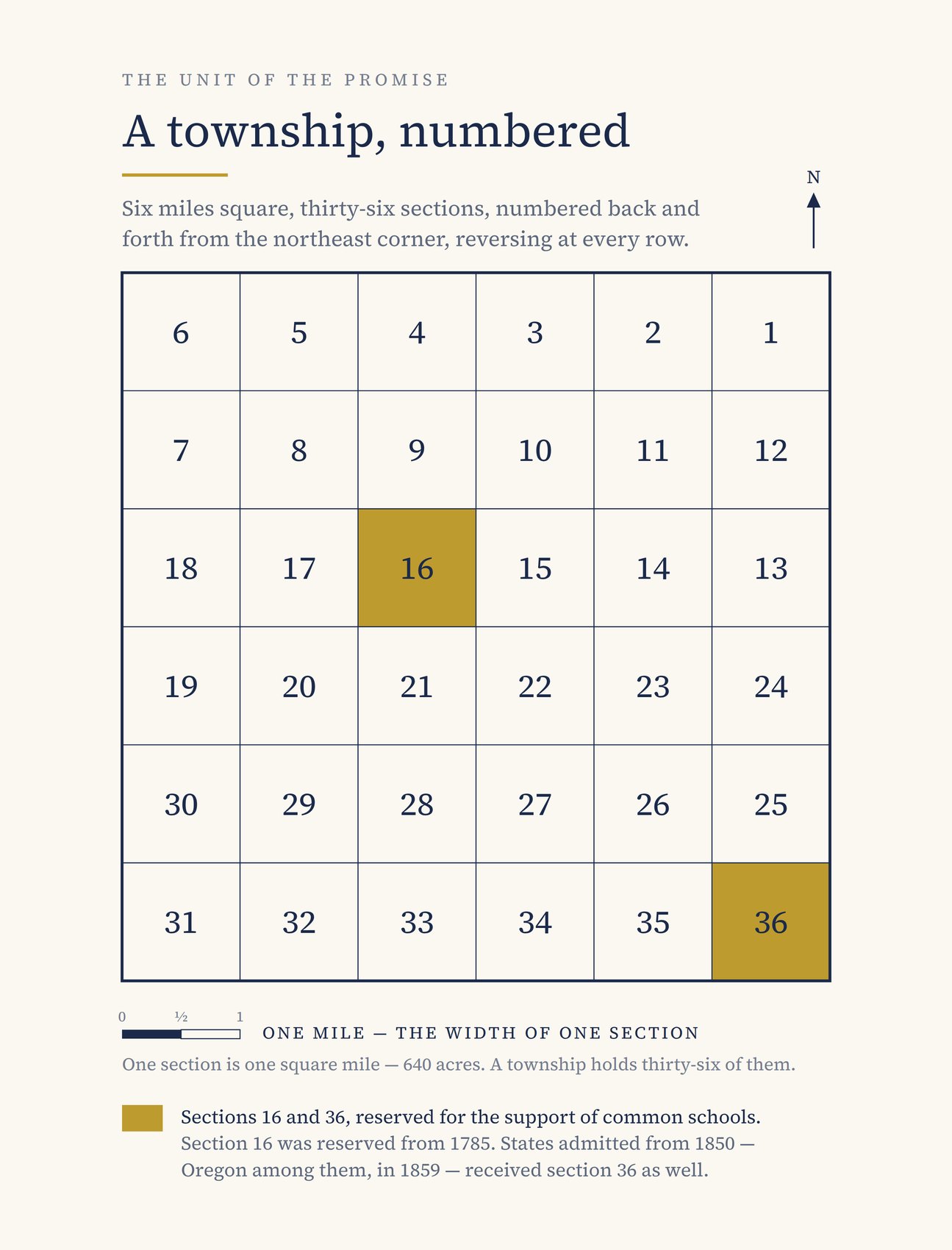
A township is a survey unit, not a town: a square six miles on a side, divided into thirty-six sections of one square mile each, 640 acres apiece. Section 16 sits near the middle, Section 36 at the southeast corner, and in Oregon both were set aside for the schools before a settler filed a claim. The reservation came first; everything else was laid out around it.
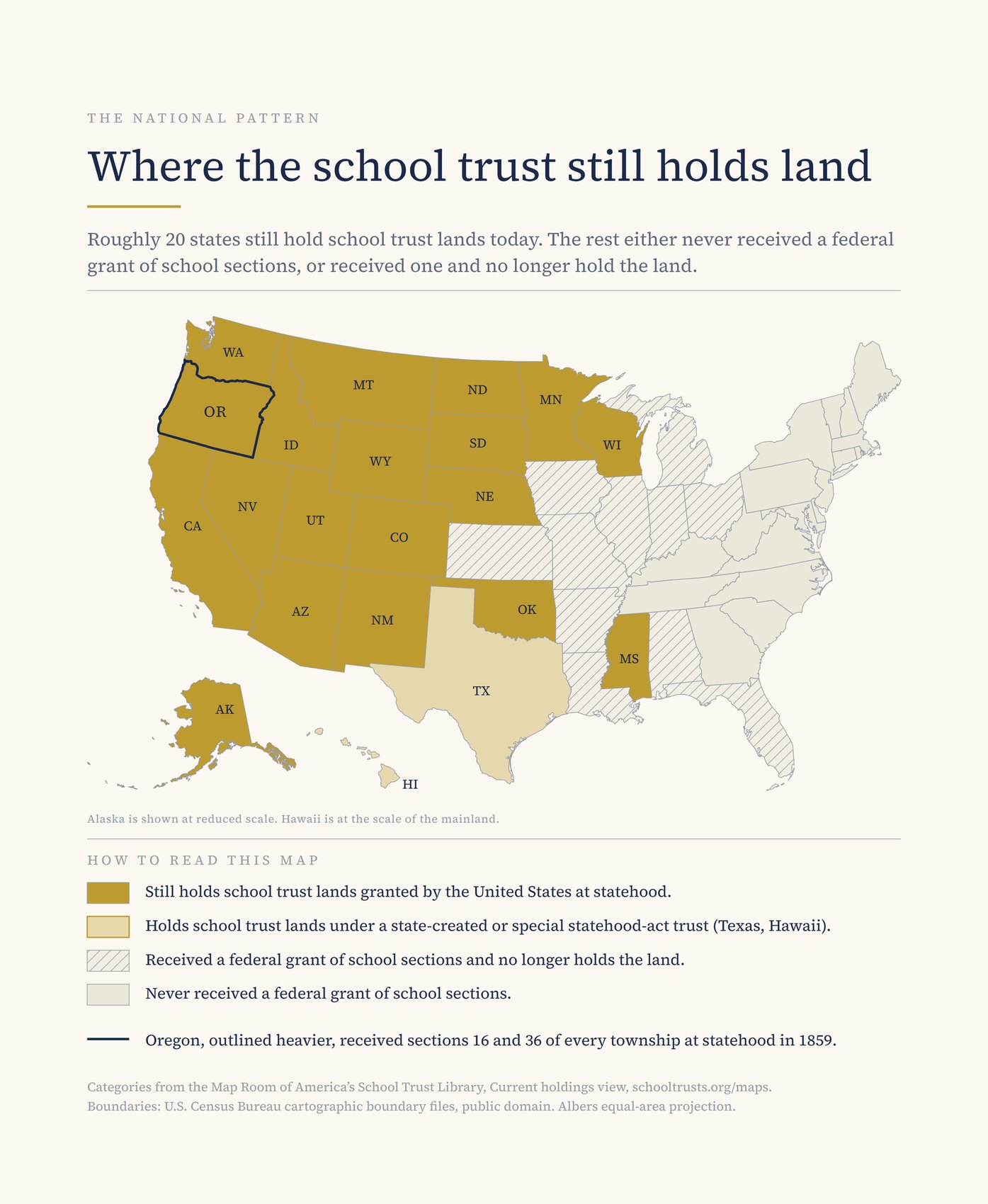
That is why the promise is legible on the ground: the corners are still findable in a hayfield or a road ditch, marked by posts, stone mounds and later brass caps. Where the land was sold, the proceeds were to stay in a permanent fund and only the earnings be spent; where it was kept, the state manages it as a trustee. Roughly twenty states still hold school trust lands today, the money still moves, and the grid is the deed.
Figure 1.The unit of the promise. Surveyors cut the public land into townships six miles square and numbered the thirty-six sections inside each one back and forth from the northeast corner. Section 16 was reserved for schools from 1785; states admitted from 1850 — Oregon among them, in 1859 — received section 36 as well.
Drawn for the Library after the U.S. Public Land Survey System convention (Act of May 18, 1796, and successors).
A record with no keeper
Every state that holds school trust lands has a record of them, and almost none of those records live in one place.
The granting act is in a federal statute book. The constitutional language is in a state code. The conveyances are in county deeds and land patents. The fund balances are in annual reports that change format and address every few years. The decisions are scattered through court reporters, and the tools that make them searchable were built for lawyers. The history, the part explaining why any of it happened, is in the files of researchers, retired agency staff and volunteers.
Those files do not survive a move, a failed drive, or a funeral. This is not a failure of care. It is the ordinary fate of a record with no keeper.
A generation that wants to know what its state did with the school lands should not have to reconstruct it from scattered boxes. This one did.
“A record bound to any outcome dies with it.”
That sentence is the Library’s own, from What the Library Seeks, the note it sent the two advocacy boards in 2026. A record kept by whoever is winning is not a record. It is an exhibit.
Figure 2.The trust that is left. Roughly twenty states still hold school trust lands today — land the United States set aside for schools and never took back. Oregon, outlined heavier, received sections 16 and 36 of every township at statehood in 1859. Texas and Hawaii hold theirs under trusts of a different kind.
Categories from the Library’s own Map Room, Current holdings view. Boundaries: U.S. Census Bureau cartographic boundary files, public domain. Albers equal-area projection.
The Library
America’s School Trust Library is an Oregon nonprofit public benefit corporation, Oregon Registry No. 259005891, incorporated July 21, 2026. It holds Oregon Department of Justice charitable registration No. 72571, granted July 10, 2026. Its Bylaws, its Conflict of Interest Policy, and its Constitution with a Readers’ Bill of Rights are published in full, in their adopted text, at schooltrusts.org/governance/.
It exists to gather the record of America’s school lands and keep it. Freely, neutrally, permanently. It takes no side in any case or campaign.
That last sentence is not modesty. It is the whole design. Two organizations press the case for the promise in courtrooms and statehouses — Advocates for School Trust Lands, a national nonprofit, and Oregon Advocates for School Trust Lands, its Oregon counterpart. That is their work, and the Library takes no part in it; its adopted Constitution keeps it out of litigation, campaigns and legal advice.
The whole Library serves at one address, schooltrusts.org: reading rooms for the cases, a map room, counting-house pages for the state funds, a file for each state — about 444 pages of its own on September 3, 2026, and 2,282 in the search index at the September 7 build with its first special collection counted. Its long-term work is a hornbook: one citable reference work on school-trust law across the roughly twenty trust-land states, built in public with its sources shown.
Everything is free — no fee, no paywall, no account. A person who disagrees with everything the advocates believe uses the same shelves and finds them unchanged.
What six months produced
The Library’s record begins on February 20, 2026, when the research started. Three tracks ran at once. The institution was assembled in the order the law requires: Oregon charitable registration July 10, Articles filed July 21, the founding board seated and the governing instruments adopted effective August 3, one web address and a printed booklet August 10. The collection grew alongside it: a legal reference work in working edition June 7, the first verification pass through the governing decisions June 10, the Zybach Collection built from August 27 and public September 4. The verification ran underneath both: two separate corrections ledgers merged and renumbered August 9; a site audit on August 13 that found 229 errors across 441 pages, all then fixed; corrections numbered 019, 020 and 021 on August 23, September 3 and September 6.
None of that was done by a staff. It was done by three volunteer Directors, one of whom does most of it, working with AI tools under a rule the Constitution states plainly: a machine may draft, but a named human with the evidence signs, and may not sign on the strength of a machine summary.
The scarce thing in that arrangement is the human check. That is the fact this document turns on.
One collection, and what bringing it in required
The Zybach Collection is the Library’s demonstration that a life’s work can be carried into public custody without being taken from the person who made it.
The historian Bob Zybach spent decades recording the memory of one Oregon valley: fifteen printed monographs of oral history from the Soap Creek Valley, his 1999 thesis, an auto tour, interviews from the Elliott State Forest, and document series on Letitia Carson and the 1828 Umpqua Memorial. The Library published it as a working edition on September 4, 2026, and by September 5 it stood at 1,829 pages, each printed page separately addressable so a citation lands where it points. It has not yet been accessioned — formally taken into the collection — and the Library’s three-year plan makes it the first.
Four facts about how it was done are why it appears here.
The Library paid nothing and took nothing exclusive. The licence is non-exclusive and uncompensated. The creator keeps every right he holds, including every commercial right, and can publish the same material anywhere else tomorrow.
108 pages were held back — 76 pages that locate sites, 28 that carry personal data, and 4 held at the creator’s decision. Each carries one plain notice and keeps its printed number and permanent link, so a citation still lands. The reasons are recorded internally, because publishing them would defeat the hold.
The rights work corrected the Library’s own assumptions. A first pass was fluent, confident and wrong about who owned what. Checking against primary sources — including the appendix of his 1999 thesis, which prints the seven release forms used between 1975 and 1998 — found one series with no signed release on record. The public rights page says so.
The relationship is disclosed. The creator serves on the board of one of the two advocacy organizations named earlier; the Library pays him nothing, and no Director gains from the collection.
Wow! I just spent about an hour on this and it is amazing! A little bit intimidating dealing with my own work, but definitely impressive and functional.
Quotation pending his written approval — Bob Zybach, email, September 5, 2026
For Bob Zybach to write
In the creator’s own words
A short passage in your own hand. Nothing is printed without your approval.
The standard: the corrections ledger
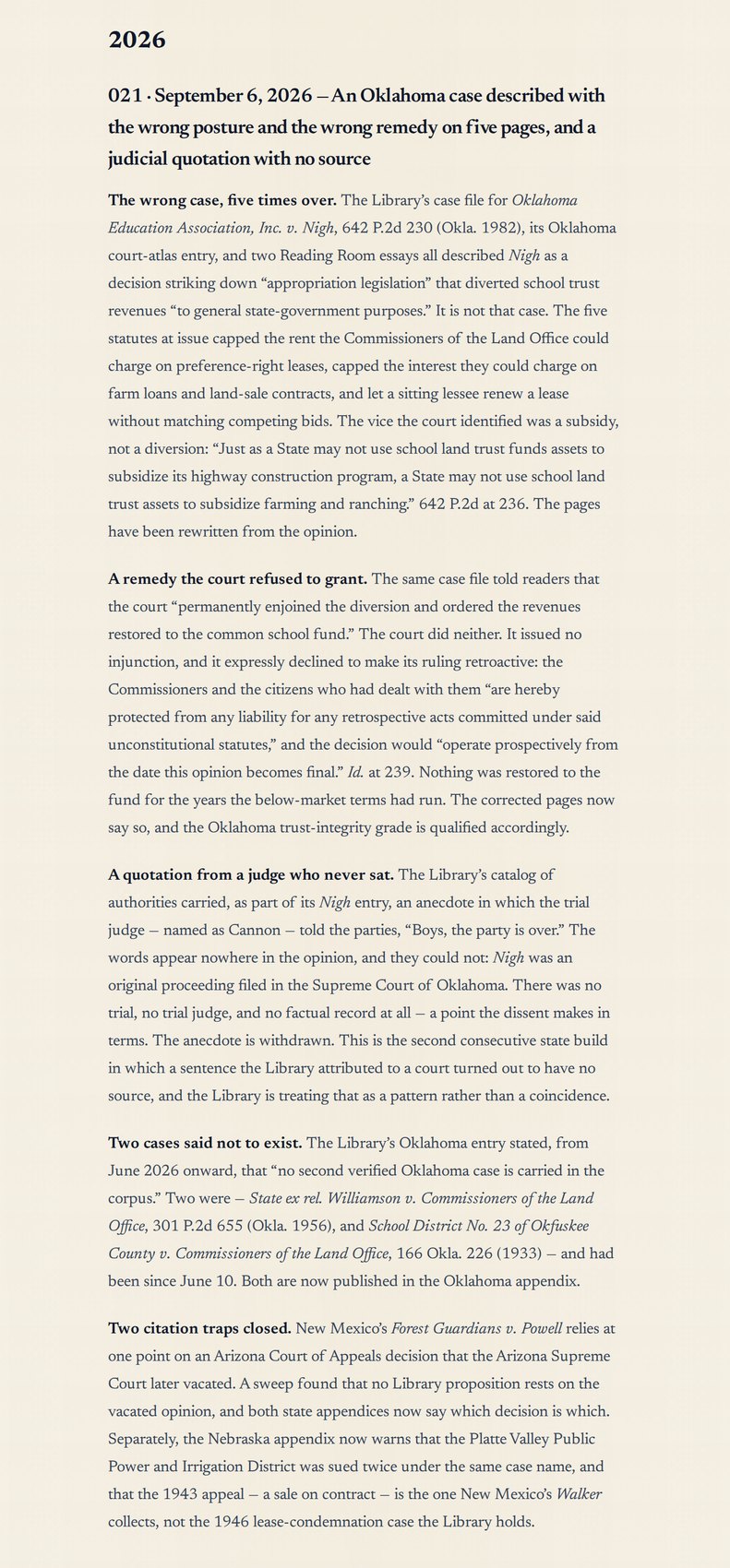
Figure 3.One mistake, numbered. Entry 021, of September 6, 2026, withdraws an Oklahoma decision the Library had described on five pages with the wrong posture and the wrong remedy, and an anecdote that quoted a trial judge in a case that had no trial. The entry names every page it changed and says what the opinion actually holds.
America’s School Trust Library, schooltrusts.org, read September 7, 2026.
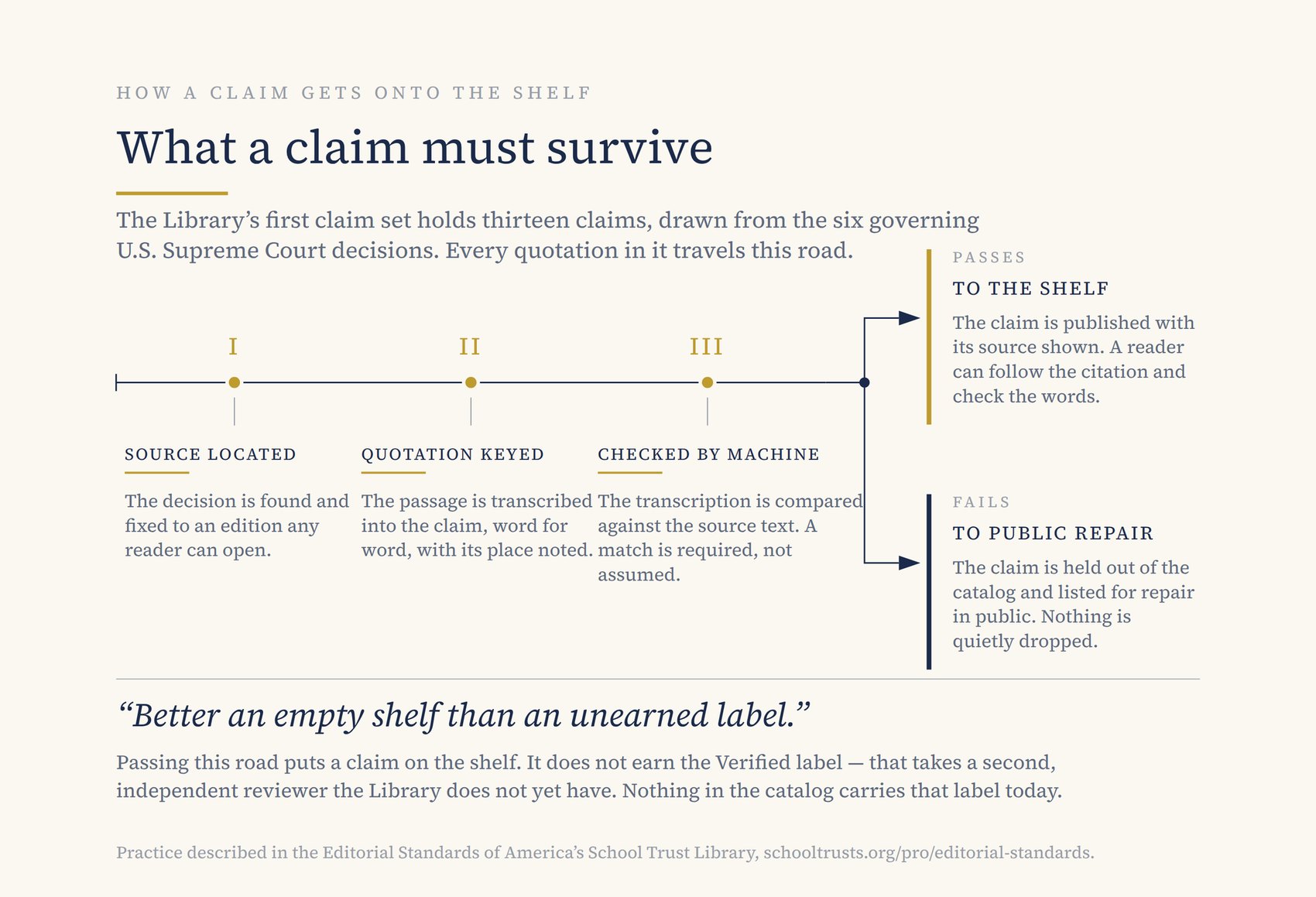
The Library has one label it will not give away. Verified means a second, independent reviewer has checked the item against its source and signed for it. The Library does not yet have that reviewer, so nothing carries the label — not one of the 72 holdings counted on August 10, 2026, including the ones its own founders wrote. Better an empty shelf than an unearned label.
The other half of that standard is the corrections ledger: a numbered, public list of the Library’s own errors, running through entry 021 when it was read on September 7, 2026. Its first three entries correct the Library’s outdated statements about itself. A corrections ledger that begins anywhere else is not a corrections ledger.
The two most recent entries
Entry 020, September 3, 2026. A sentence the Library had attributed to the United States Supreme Court in Ervien v. United States was not in the opinion. It was withdrawn from the two pages that carried it.
Entry 021, September 6, 2026. An Oklahoma case, OEA v. Nigh, had been described using a quotation from a trial judge — in a case that had no trial. The description was corrected.
Both were produced by the Library’s own method, caught by its own checking, and published with numbers on them.
A funder should read entries 020 and 021 before anything else the Library publishes. They are the strongest evidence that the rest can be trusted — and the reason the first thing money buys here is a second pair of eyes.
Figure 4.What a claim must survive. A quotation is located in an edition a reader can open, transcribed word for word with its place noted, then compared by machine against the source text. A claim that passes goes on the shelf. A claim that fails is held out and listed for repair in public — it is not quietly dropped. Passing the road does not earn the Verified label: nothing reaches the Verified shelf without a second, independent human reader, and the Library does not yet have one.
Drawn for the Library from its Editorial Standards, schooltrusts.org/pro/editorial-standards.
The plan in one page
The Library’s plan for 2027 to 2029 asks to be judged against six tests with pass rules a stranger could apply, and sets out two budgets. Both are reproduced here in the plan’s own words. One term recurs: a State Co-Librarian takes editorial responsibility for one state’s file, named or under a pseudonym the board verifies and holds in confidence.
Test
Pass by December 31, 2029
1 · State founding records at item level
The granting act, the constitutional school-lands provision and the leading decisions for every trust state — each a deposited copy with a checksum, catalogued as its own item, each carrying a second reviewer’s name
2 · The reference work on school-trust law
Complete for every trust state; every citation checked against the courts’ official reports by a law librarian who did not draft it; 0 open misattributions; every correction propagated
3 · Co-librarians
One per trust state, each seated after three accepted contributions; every state without one says so on its page
4 · Accessions
Zybach first, under a signed deed of gift; Advocates for School Trust Lands’ records offered second and accessioned or declined in writing; five instruments on each — signed gift, finding aid, rights and takedown page, diligence log, written diffuseness check
5 · Run by people who did not found it
Board of at least 5, with an educator and a records professional; founder off it; President not the founder; a paid librarian; finance review by two non-Treasurer directors
6 · Permanent custody, stable addresses
Permanence policy published; every cited source a deposited copy at a stable address; 0 addresses moved without a redirect; a link audit published yearly; two or more copies, one beyond the Library’s control; successor test done once
Counted from September 7, 2026, when nothing carried the Verified label, no co-librarian was seated and no collection had been accessioned. Four other terms, in ordinary words: a deed of gift is the signed instrument by which a donor hands material over on stated conditions; a finding aid is the description an archive publishes of what it holds; a checksum is a short code that proves a stored file has not changed; a successor test asks whether someone outside the Library could rebuild the collection from what is published. A diffuseness check is the written answer the board owes before any substantial accession: what school-trust question does this collection illuminate? Where there is no good answer, the Library declines.
Test 5 carries two dates: the founder leaves the Library’s board about June 14, 2027, within the year the Founders’ Statement of June 14, 2026 set for it, and the presidency is filled by a Director who is not the founder by December 31, 2027.
2027
2028
2029
Three years
Base case — the line for the Library in the school-trust movement plan, a September 6, 2026 draft for the board of Advocates for School Trust Lands
$30,000
$62,000
$93,000
$185,000
Funded case — the plan’s own construction, built on two figures in the Library’s May 4, 2026 vision paper
$150,000
$160,000
$190,000
$500,000
Difference
$120,000
$98,000
$97,000
$315,000
Neither budget is adopted; the board adopts budgets. These are expenses, and the plan sets receipts equal to them in every year because the Library holds no reserve. The base case carries no salary line in any year; its 2028 and 2029 figures are a straight line between that plan’s figures for 2027 and 2030, both landing inside the year-three range of $50,000–$100,000 in the Library’s own Constituency Plan, an internal planning paper of May 6, 2026.
Tests 1, 2, 3, 4 and 6 can be met on the base case — more slowly, by unpaid officers and volunteers, with verification as the line the Library refuses to cut. Test 5 cannot. A board of five, a founder who has left and a President who is not the founder are all free. A paid librarian is not. Of the $315,000 between the two cases, $230,000 is the salary itself and $85,000 keeps every other line at or above the base case — so the librarian is not paid for out of verification or collections.
The first ask is a person
The funded case above is the plan’s own construction, built on two figures the Library’s May 4, 2026 vision paper offered as successive asks — $150,000 for a first phase, $500,000 over three years. The plan takes the first as its 2027 figure and the second as its three-year total, and lets the middle years follow under one rule: no line falls below the base case.
The first line of the first phase is not a feature. It is a person.
The reason is in the Library’s own Constitution. Article IX provides that where the Library lacks the people required for a form of review the work stays unfinished and labelled unfinished, and that a vacancy transfers authority to no machine, vendor, donor or founder. The empty Verified shelf is that article operating; the Library cannot buy its way past it with tools, and would not want to.
The reason is also in that movement plan: institutional funders read a one-person movement as a person rather than an institution — a compliment to the person and a problem for the funding. A library with a second name on the checking is an institution; without one it is a founder’s project.
Two different things wear the word librarian here.
The Law Librarian is an office of the Library, open now: a one-year renewable term, uncompensated, not a Director. The holder owns the citation standard, sits as the second signature on the Verified shelf, and decides corrections on the merits, crediting the sender. If the seat is vacant, the Verified shelf does not grow. That is the point of it.
The funded case adds a paid librarian, the Library’s first paid hand, whose whole work is the shelf: accessions and their rights work, the citation standard in daily practice, the reference desk, the corrections from outside.
The plan prices that post as a planning assumption — half-time in 2027 at $45,000 including payroll taxes and benefits, full-time after — while saying plainly that the record holds no quoted salary and the Library should hire against a real one.
For the Board of Directors to write
The librarian’s terms
The adopted band, the term, and whether the first paid librarian is an employee or a contractor.
Two things a program officer should not have to ask for. The funded case’s receipts assume $100,000 a year from foundations in 2027 and 2028 and $115,000 in 2029 — assumptions, not money in hand — under one rule: after 2027 no single household supplies more than a fifth of the year’s receipts. And that movement plan asks the chief executive of Advocates for School Trust Lands to coordinate any foundation approach with the Library, so nobody receives two asks for one post.
What a gift would buy
At the scale of the funded case: a named second reader on the Verified shelf; accessions finished on a professional schedule rather than a volunteer one; the reference work carried from working draft to citable; copies in more than one custody, because one server is not preservation. At the scale of one gift:
An example — one gift against one year (an example, not a price list)
Take a single gift of $5,000, at the Benefactor tier, against the base case for 2027 of $30,000. That gift is one sixth of the year, and the plan’s line items say what a sixth buys: the whole year’s hosting, domains, mirrors and preservation deposits ($3,000), and half the collections budget ($4,000). The shelf stays up, and one collection is finished properly.
Every figure is a dated planning assumption. This shows how the arithmetic works, not what a gift purchases.
What the money never buys
The Library’s Constitution, Article V, and its Conflict of Interest Policy state this as a rule rather than a preference. A gift to this Library never buys:
Litigation. The Library takes no position in any case and files none. A gift to it does not fund anyone’s litigation.
A position. It takes no side in any case or campaign, and holding a document is not endorsing it.
A trustee’s finding. No state, agency, land board or officer may pay the Library for a conclusion about its own conduct.
A veto. No donor, sponsor, litigant, government body, vendor, Director, officer, editor or affiliated organization may buy, condition or secretly veto a source’s inclusion, a status label, a correction or a conclusion.
The Verified label. Verification requires a second, independent human reader. No gift moves a label ahead of that check.
Direction. The Library accepts no direction from any advocacy organization, including the two named earlier, in both of which its founder holds office. That overlap is disclosed because it is real, and the plan dates its end.
Three further limits belong beside those: no trust money — the schools’ own money, kept for the schools — no share of any settlement, award or transaction, and no collection the board cannot answer the diffuseness question for.
A rule of this kind is decorative until it is used. The board expects to decline a gift one day, and to say so in the ledger.
The tax position, and how giving will work
The tax position is stated in the only words the Library uses, and nothing is added to them:
Federal tax status
The Library has not yet filed its application for federal tax-exempt recognition; it is being prepared. No federal tax-exemption determination has been issued, and until one is, the Library does not describe contributions as tax-deductible.
Read that as what it is: a corporation seven weeks old, which will not describe a benefit it cannot yet evidence.
A program officer will ask which form. The short attestation form is open only to organizations projecting gross receipts of $50,000 or less in each of the next three years — the gate reads receipts, not spending — and neither case stays under it: base receipts cross in 2028, funded receipts in 2027. The plan settles that question and sets out what the Library will file.
The tiers below were designed on May 4, 2026 and never launched. They are printed so a reader sees what constrains the Library as well as what recognizes a donor.
Tier
Amount
What it is
Library card
Free
Anyone. Reading asks nothing: no fee, no account.
Friends
$25
A name on the Friends page, if wanted. Symbolic, not transactional.
Patron
$250
Fine-print attribution on a state file the patron chooses.
Benefactor
$5,000
A named feature — a chapter, a state file, a section of a reference work.
Founding Circle
$25,000 and above
Naming at the scale of a room; time-limited, and few.
Three rules travel with every name on that table. Reversibility: a name goes up under an agreement that lets the Library take it down, because an institution that cannot un-name an asset has sold something it does not own. Transparency: donor lists are public; anonymity is available and signals nothing, but no gift’s existence is concealed. No editorial influence: a name on an asset is a name on an asset; Article V governs the rest.
How to give will be posted when the Library’s account is open.
The board’s own signature
The three Directors of America’s School Trust Library are Dave Sullivan (President and Treasurer), Kenneth Magee (Secretary) and Barry Shane (Director). Two Director seats and the Law Librarian seat are open.
This page is left for two of them to sign in ink, so the case carries a name and a date rather than a house voice.
For Dave Sullivan, President to write
Signature and date
Signed in ink on the printed page. No signature image is reproduced anywhere.
For Kenneth Magee, Secretary to write
Signature and date
Signed in ink, certifying the corporate facts recited here against the Library’s records.
“The record is kept by people, and the Library’s shelves have room for the ones you know.”
America’s School Trust Library, What the Library Seeks, 2026.
The whole shelf is at Participate. Mistakes
are corrected in public, with a number, in the
corrections log.
Drafted with an AI system for the Library’s board, from the Library’s own record, and checked against that record by people. Version 1, September 2026.