Welcome to America's School Trust Library. Explore the history of land
set aside to support public schools and the records of how states manage
it. The Library brings together books, maps, financial reports, legal
documents, and news so you can see what was promised, what the land
earned, and what each state makes public. This tour shows you where to
begin.
School Trusts
Compare states and State land maps
Use Compare states to explore differences in school trust lands, funds,
and public records. Use State land maps to find available maps and see
what each state publishes about the location of its trust lands.
Compare school trust funds and payments to schools across states.
Trust finances shows how well each figure is supported by sources and
makes gaps in the available financial information clear.
Browse Books & documents for reading organized by topic, including
history, laws, and research. For information about a particular state,
choose Find your state under School Trusts in the menu.
The Writing Room is open to readers. Browse a draft handbook on
school trust law; The Forgotten
Forever Gift to Public Schools, a history; Who Steals from
Children, the Oregon record; and Stewards of the Republic,
ideas for the future. Read essays on building institutions that
support public schools for generations.
School trust news follows developments in school trust lands and funds,
including court filings, hearings, and settlements. Commentary shares
contributors' views on what the records show. A free Library Card lets
you track your reading and contribute to the Library.
America’s School Trust Library is an Oregon nonprofit public benefit corporation, Oregon Registry No. 259005891, incorporated July 21, 2026. It keeps the documentary record of America’s school trust lands — the land Congress granted each new state to support its public schools, and the permanent funds that land feeds. Much of that record was never in an archive: it sits in basements, filing cabinets and aging websites, and when the person who kept it dies, most of it goes too. What follows is one collection arriving, dated so it can be checked, and it includes the parts that went badly. It was written for the Library’s board, and for two readers after it: the next person deciding whether to trust the Library with an archive, and anyone who might serve it.
Read or download: web copy (PDF) ·
press copy (PDF) — print-ready, with bleed and crop
marks. 15 pages; about 23 minutes to read.
Editor's note, September 14, 2026.The three answers printed in this booklet under Bob Zybach’s name were given aloud in a recorded telephone conversation on September 13, 2026. The Library has now published that conversation, as spoken and lightly edited for print, at How a Collection Comes In: The Conversation, so that a reader can see the answers in the setting they came from.
A man with a life’s work, and three questions
America’s School Trust Library is an Oregon nonprofit public benefit corporation, Oregon Registry No. 259005891, incorporated July 21, 2026. It keeps the documentary record of America’s school trust lands — the land Congress granted each new state to support its public schools, and the permanent funds that land feeds. Much of that record was never in an archive: it sits in basements, filing cabinets and aging websites, and when the person who kept it dies, most of it goes too. What follows is one collection arriving, dated so it can be checked, and it includes the parts that went badly. It was written for the Library’s board, and for two readers after it: the next person deciding whether to trust the Library with an archive, and anyone who might serve it.
Bob Zybach is a historian — Oregon forest history, oral history and historical ecology. Between 1975 and 1995, twenty-one people who had lived their lives in Soap Creek Valley, north of Corvallis, told its history into a tape recorder; he edited the interviews into fifteen indexed books, printed between 1990 and 2009, most by Oregon State University’s Research Forests and College of Forestry. Later he did the same on the Elliott State Forest, Oregon school trust land for most of a century — which is why a school-trust library keeps this record.
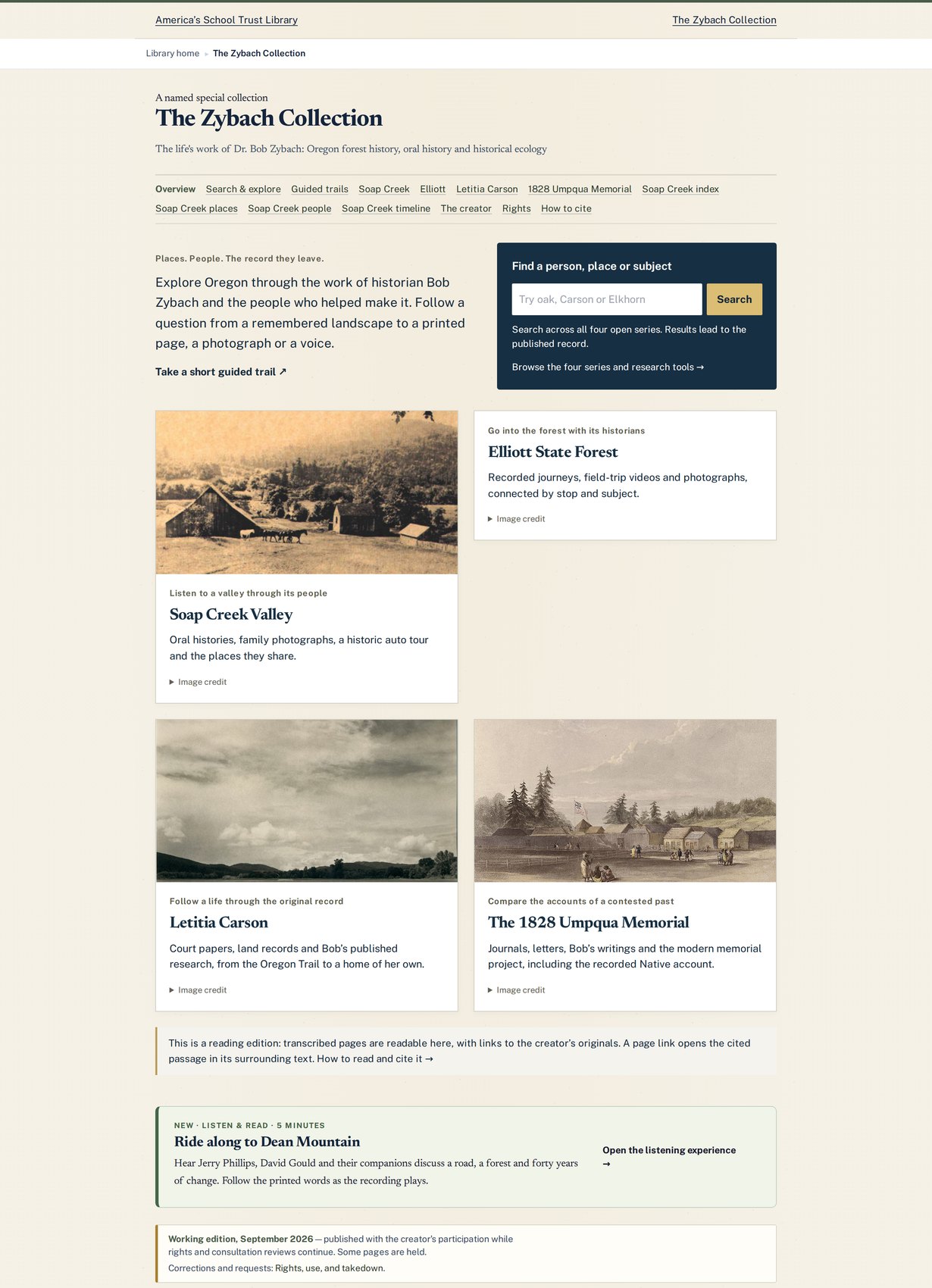
Figure 1.A collection with a front door. The Zybach Collection opens on four series — Soap Creek Valley, the Elliott State Forest, Letitia Carson, the 1828 Umpqua Memorial — and a search box that reaches all four. The panel at the foot names the edition: working, September 2026, published while rights and consultation reviews continue.
America’s School Trust Library, schooltrusts.org, read September 7, 2026.
On the night of June 11, 2026 he was sent a packet: an invitation to help found the Library, with a draft collection policy and a form of gift whose terms were already a licence rather than a sale. He answered the next evening with concerns rather than thanks.
First, where will it be housed? Can OSU Archives … be approached as a key repository? People will be uncomfortable working on something that is largely conceptual, focused on a topic that few folks know or care about, and being formed at a location that could disappear at any given time.
Second is compensation. I’m not sure I’m comfortable gifting several decades of my work … What would be the value to me?
— Bob Zybach, email, June 12, 2026
The third concern was his time. Nothing in the packet answered any of the three. What changed was the paper: Donor became Contributor, the option under which a creator assigns copyright to the Library was struck out, the originals would stay wherever he chose, and everything would be reversible.
Bob Zybach — What I was trying to build
My major professor — I’ve connected with him on this, and he is really happy with it. I haven’t had any direct contact with him in fifteen years or so. He’s an expert on this stuff. He was the one that got me going on oral histories, and he’s one of the co-authors — 1975 or '79. Karen Thomas was one of his students, and then I became a student. He owned land in Eddyville and we had a real mutual-respect type of relationship. So he was my major professor, and he was in oral history, and because of that I got employed as a student employee to do oral histories on Soap Creek Valley. That was the academic green light, and I was paid to do it.
But my reason for doing it was very simple. Oral histories were invented in 1948, and they had three basic formats. One was autobiographical. One was an event that happened — a carnival, or an asteroid hit or something — and then they’d talk to all the people. The third one was maybe a biography. But they didn’t have geography. And Soap Creek Valley is something I’d been working with as a reforestation contractor. We deal with sub-basins. We’re not dealing with legal descriptions so much as where the water flows and where the fire goes. At the time the beef ranch was being managed by the OSU Research Forests, so I was hired by them, through Bill Atkinson, to do it.
The idea was, and remains, that the actual experts on the land aren’t agency representatives or academics at the university. It’s the people that lived there, and had been there for a while, and were involved in the history. So that was the undertaking: to develop a new type of oral history on OSU land, and to use those experts, and the still-emerging field of oral history, to demonstrate how that can be done and to what degree.
That was the reason I was so careful with all the indexing. Tape recorders and a methodology — a specific methodology — made oral histories possible. We had reel-to-reel tape recorders — that’s what Royal used; I used a cassette recorder. We were able to get other student workers to do transcripts. Then we’d audit the transcripts and share them with the interviewees for any corrections or concerns, and send them back to the transcriptionist to index them by the topics that were covered. It was a time-consuming process. It was expensive, and it had lots of errors, because it had lots of humans.
The result was a series of fifteen oral histories. I think I did about a dozen of them. I typically had a student assistant do the recording while I did the interviewing, but not always. And then the idea was: okay, we’ve got all these done, and they’re not accessible. They’re really hard to reference. Two or three of them tried computer indexing and got the pagination wrong, and then they were in print. A couple of them we reprinted to correct that; a couple of them, that didn’t happen. The next step was to compile them into a three-volume set with a common index for everything, so that they would be citable references and the errors would be removed. There was interest in doing it, but there was no funding and no time.
So what we were trying to build was a demonstration project: a methodology for capturing and sharing landscape history on a sub-basin scale. It isn’t taught in our schools, and most people are so mobile now that these generational memories have largely disappeared from much of the landscape. When people were farmers and relied on walking or horses, they became intimately familiar with the environment, so there was no reason to teach it.
There are two types of history, and I bring that out in my thesis. One is the record of people on the landscape — rock carvings, buried patches [as transcribed] and so on, indications of what people were doing in the past; archaeological resources. The other is documentation: photographs, written words, eyewitness accounts. This group was able to take it back almost to the original donation land claims. They knew the history of the land and its development — maybe not all of the characters, but some of them, Greenberry Smith and a few others. I think Charlie was born in 1890 [Library note, September 14, 2026: the collection’s People page gives 1898–1993 for Charlie Olson. Bob now recalls probably 1898, based on his memory of the 1890s. This is a qualified recollection, not independent verification; his spoken 1890 is retained.] and had memories going back to about 1900. The newest ones we did were about 1992, and those memories went back to World War II, which was significant for that valley — the World War II history as well as the Indian history.
Oral histories were invented specifically to get the transcription, so there would be documentation. With what we’ve got going with AI now, that whole process is in the rear-view mirror, like buggy whips. We can do videos, feed them to AI, and have immediate results of better quality than what we were doing thirty and forty years ago.
Bob Zybach, from a recorded conversation with Dave Sullivan, September 13, 2026 — his spoken words, lightly edited for print by the Library.
The promise was that everything could be undone
On August 17 and 18, 2026 the two men spent two days on Oregon backroads looking at burned ground. On August 21 Dave Sullivan, the Library’s president, wrote to open a shared folder for the collection. The letter ended with a promise.
Finally, everything will be reversible. If you don’t like the direction things seem to be headed, we can always just delete everything or find a new jointly approved direction. Few things except death and taxes cannot be undone.
— Dave Sullivan, letter to Bob Zybach, August 21, 2026
That is reversibility and joint direction, not a veto over what the Library publishes. He answered in under forty-five minutes, and five days later wrote out the thing he had given up on.
August 21 — This sounds great!
August 26 — My original plan (before AI and when I was younger) was to reprint all of the interviews with the same formatting in a 3-volume set, with a common Index for all at the conclusion of volume 3.
— Bob Zybach, emails, August 21 and 26, 2026
On August 27 and 28 the Library built a first edition from what he sent. All fifteen books were made page-addressable — 1,591 printed pages, each keeping its printed number as its permanent address, so a citation made in 1994 still lands. His own back-of-book index came back live: 1,823 headings, 12,618 references, a page for every place a narrator named. No sentence of his text was rewritten; where tape and page disagreed, the item went into a queue for him and nowhere else.
Things I was trying to do in the 1990s so far as publications and interactive maps would have cost somewhere between $30,000 and $90,000+ and been lesser quality than this! … Many hours spent on these tasks have now been proven worthwhile — 30 years later!
This “first test” is wonderful and even surprising in quality, speed, and accountability!
— Bob Zybach, email, August 28, 2026
The next step was not another build but a kitchen table. In the small hours of August 29, before they met that afternoon, he wrote:
I printed up about a dozen key pages on Soap Creek and have them annotated with specific questions — many being posed first by AI!
— Bob Zybach, email, August 29, 2026
The next evening he was sent a set of unfiltered recommendations written by the AI system the Library drafts with — Claude, made by Anthropic — and answered them line by line the same evening. The Library had built an archivist’s front door: where each file came from, how it was checked, the machinery of citation. He wanted a reader’s, with that apparatus — the indexes and the notes on where things came from — one click back. Twenty-eight edits took the internal file codes, strings of letters that meant something to the build and nothing to a reader, off the reader’s pages.
This is amazing and good points! · Product #1! · I was right to be confused!
— Bob Zybach, email, August 30, 2026
Then the Library found out it was wrong
Before anything went public, the Library checked who owned what against the primary record rather than its own assumptions — finding aids, which are the descriptions archives publish of what they hold; the state and federal registries; and the appendix of his 1999 thesis that prints the seven release forms used between 1975 and 1998. That research, dated August 31, 2026, corrected the Library three times.
The Elliott material is not under an open licence, as the Library had twice said. That licence line sits in a web page’s footer and covers the website, not the archive.
The books are not in the public domain. The rule forfeiting copyright for want of a notice ended in March 1989, and the nine examined are all 1990 or later; the other six are dated but unverified.
He was not the interviewer. The finding aid credits four interviewers and eight research assistants; for about a third of the interviews he conducted none, and holds no interviewer’s copyright at all.
A fourth error was the Library’s own: the June draft recited provisions of the Library’s articles of incorporation that the articles actually filed with the State do not contain. He had been handed a document promising something that did not exist. He was told so in writing, and the promise was written into the draft licence as a covenant, where it will bind once the licence is signed.
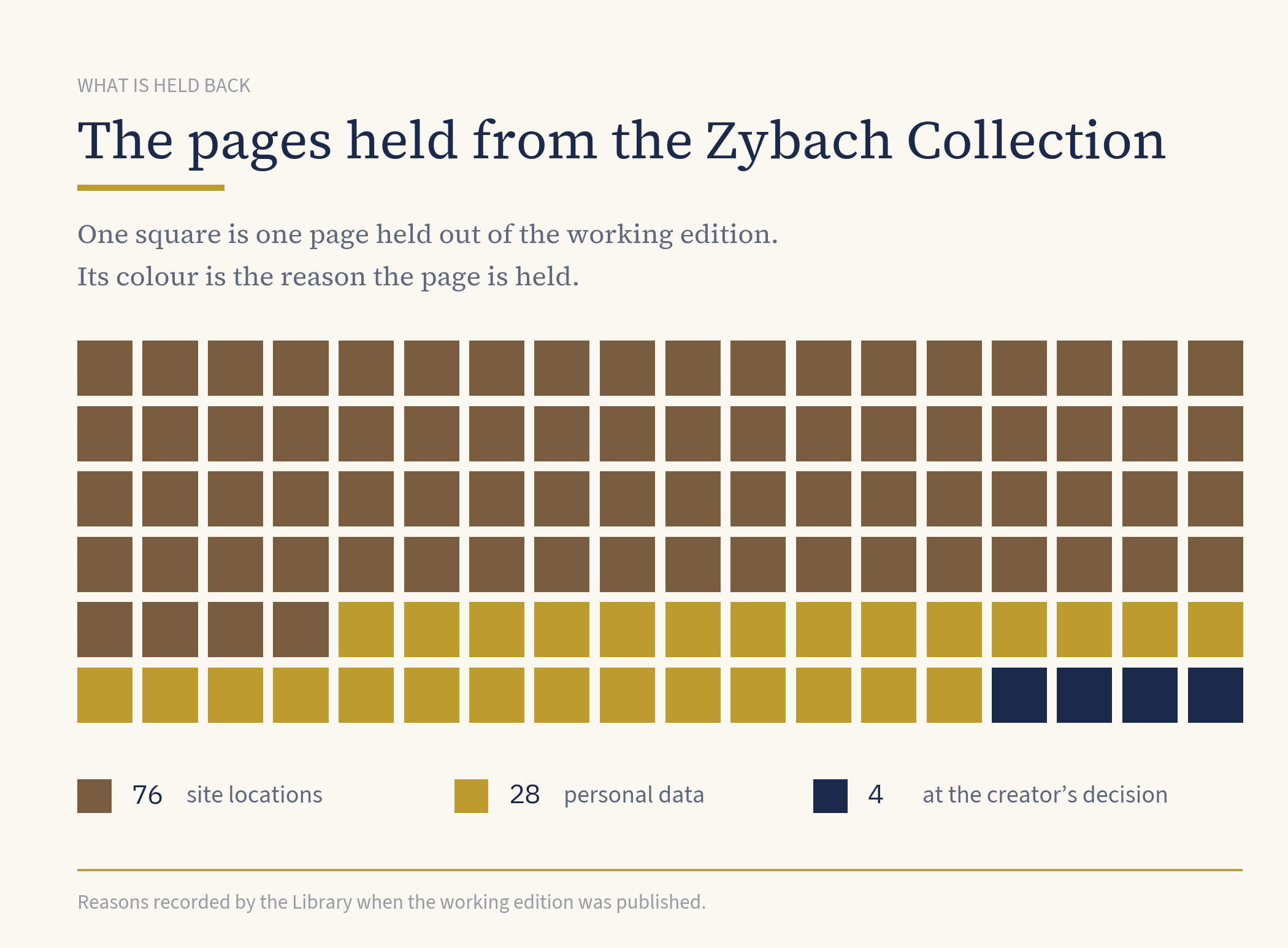
The collection went public on September 4, 2026 — and 108 printed pages did not: 76 pages that locate sites, 28 that carry personal data, and 4 held at the creator’s decision. One plain notice covers them all and keeps each page’s printed number and permanent link, so a citation to a held page still lands; the reasons are not published. The Library’s ground is narrow: printing a passage in a book in 1993 and putting a searchable point on a public map in 2026 are not the same act, and the second would be the Library’s own. Consultation continues, and a hold lifts as easily as it was set. One thing more was true that day and still is: his written permission is not yet recorded, and the site says so on its own face.
Figure 2.What is held back. One square is one page kept out of the working edition of the Zybach Collection, and its colour is the reason. Most are held because they name a site on the ground. The four navy squares are held because the man whose work it is asked for them to be.
Drawn for the Library from the Zybach Collection’s record of held pages, September 4–5, 2026.
That night he was sent a report written for him alone — thirty-six pages, its decisions set out as cards he could tick, cross out or argue with. He read the first seven before midnight, worked on to page 27 before dawn, and sent those pages back with twenty of them marked up.
Bob Zybach — What surprised me
I was shocked at how quick and high-quality the results were: the ability to work directly with what I had written rather than hallucinating, to follow specific guidelines, and to come up with a final-draft result that needed just a little touch-up or formatting. It shocked me how well AI can follow verbal instructions.
It’s like the difference between a hand-push mower and a riding mower — or hiring somebody else to do it. I did not expect the increase in quality and capability, because when we worked with it before, a year or two ago, I could see value and I put it to work making summaries, but it was pretty clunky and it needed to be reworked. The auditing was a problem, and this just took care of ninety percent of that. That much improvement was entirely unexpected.
…
[Asked whether anything in the collection was inaccurate:] I think I mentioned one thing earlier on one of them, but not really — that’s been the shocking thing. Before, when AI summarized a hundred-page report of mine, it gave a pretty good summary; it missed a key point, but it didn’t hallucinate anything. I was expecting a step up from that, not ten steps up.
…
And it’s the fact that we can have this conversation, and tell AI what to do, and it will do it, or ask for more direction. I never saw that day coming. Even if you could predict it, having it there to use is an entirely different animal. That’s the part that’s incredible to me.
Bob Zybach, from a recorded conversation with Dave Sullivan, September 13, 2026 — his spoken words, lightly edited for print by the Library.
Later that day, September 5, came a second wave: two more series, and twelve narrator portraits cropped from the front matter of his own books. Three of the fifteen have no printed portrait, and nothing was substituted. The collection stood at 1,829 pages.
Wow! I just spent about an hour on this and it is amazing! A little bit intimidating dealing with my own work, but definitely impressive and functional.
— Bob Zybach, email, September 5, 2026
On September 6 they recorded a conversation instead of writing a memo, and the changes he asked for in it were live within hours. He wrote before dawn the next morning.
This is really incredible — Well beyond what I was envisioning and couldn’t complete 30 years ago, and only now coming to realize the possibilities during the past few days and week. Worth the wait.
The ability to query these indexes so easily, and to have such a solid list of linked accreditations and readily available information for photographs, quotations, place names, etc. is the highest and best intended use of my research I can imagine. And especially if these research methods (“wisdom of elders?”) can be so well captured and consulted for current and future generations in other locations.
— Bob Zybach, email, September 7, 2026
The same email asked for three further changes, and asked whether that was the right way to ask for them. That is where the record stands: in the middle, with the creator asking for edits and getting them.
The method, plainly
The material stays his. The licence is non-exclusive: permission to publish that leaves him free to publish, sell or license the same material anywhere else. He keeps his copyright and every commercial right, the originals stay where he keeps them, and the Library pays him nothing and takes nothing exclusive.
Sensitive pages are held before publication, not after a complaint — one identical notice, the printed page number and permanent link preserved, the reasons kept internal.
Rights are checked against the primary record — the release forms, the finding aids, the registries — including when the answer embarrasses the Library.
The edition admits it is unfinished. Every page carries this: “Working edition, September 2026 — published with the creator’s participation while rights and consultation reviews continue. Some pages are held.” Beside it sit a takedown policy under which a narrator’s or a family’s objection ends the matter, and a numbered corrections log. The errata rule here is his: an error is corrected without ceremony but recorded once, in one dated log — the Library’s own ledger.
A recorded conversation counts as instructions. Talking is faster than writing for a man with a full week; what he says on tape is what gets built.
He gets a document he can mark up — decisions as cards, the recommendation stated as a recommendation, with room to cross it out.
Anything can be undone. Holds lift, pages come down, series close, the edition can be withdrawn. That was the promise of August 21, and it is why the rest was possible.
Bob Zybach — What I want a reader to do with it
That was my whole reason for putting it together. I was hoping, and still hope, that the methodology would be made more generally available: here is a way to get expertise on local landscapes, and to make materials that can be taught in the schools, so that people moving into an area, or younger people, could follow their interest with the index and replicate this. And maybe now go back and cover the thirty years since this was done, with the people who have been living there since — a new set of people — and continue the history of Soap Creek Valley in that method. So that was one thing I’d hoped for immediate use — that now AI might have eclipsed.
The approach — detailed landscape histories with the local experts, the people who know the roads and trails and the land and the neighbors — I’d like to see that become part of the curriculum in our public schools.
The long term, fifty years, is exactly what we talked about before. This isn’t a New York Times bestseller. It’s an academic approach to giving people, in a mobile age, important insights into not only the history of their land but the management options going forward: what can be done, what should be done, what was a mistake, what was a proven success, and how those can be replicated. That’s the practical value. At fifty and seventy-five years it would be descendants, students, local historians — or botanists, people tracking invasive weeds, or people looking for evidence of rare and endangered species that some of the folks interviewed mentioned.
So the short term is the methodology, replication and the educational applications, which haven’t happened yet. The long term is people like us, looking back. When I read survey notes from the 1850s, the person who made them has been gone more than fifty years, and their information is of real interest to me — valuable research data on forest history, forest management, wildlife habitat. We’ve been dealing with a lot of assumptions and computer modeling and printouts and statements that are just not factual, but they’re easy to make.
Bob Zybach, from a recorded conversation with Dave Sullivan, September 13, 2026 — his spoken words, lightly edited for print by the Library.
The same door, for anyone else
Nothing here worked only because it was this collection. A retired agency employee with thirty years of files, a county historian with a shelf of self-published volumes, a family with a grandfather’s papers — the seven rules above are the whole of the method, and they do not change with the collection. The terms are the same for everyone: your material stays yours, access is free, the mistakes are published with numbers on them, and you may stop it at any point. The Library cannot promise money. It can promise that nothing will happen to your work that you did not agree to. If you hold a record like that, write to library@schooltrusts.net, or start at schooltrusts.org/contribute/.
The whole shelf is at Participate. Mistakes
are corrected in public, with a number, in the
corrections log.
Drafted with an AI system for the Library’s board, from the Library’s own record, and checked against that record by people. Version 1, September 2026.