Welcome to America's School Trust Library. Explore the history of land
set aside to support public schools and the records of how states manage
it. The Library brings together books, maps, financial reports, legal
documents, and news so you can see what was promised, what the land
earned, and what each state makes public. This tour shows you where to
begin.
School Trusts
Compare states and State land maps
Use Compare states to explore differences in school trust lands, funds,
and public records. Use State land maps to find available maps and see
what each state publishes about the location of its trust lands.
Compare school trust funds and payments to schools across states.
Trust finances shows how well each figure is supported by sources and
makes gaps in the available financial information clear.
Browse Books & documents for reading organized by topic, including
history, laws, and research. For information about a particular state,
choose Find your state under School Trusts in the menu.
The Writing Room is open to readers. Browse a draft handbook on
school trust law; The Forgotten
Forever Gift to Public Schools, a history; Who Steals from
Children, the Oregon record; and Stewards of the Republic,
ideas for the future. Read essays on building institutions that
support public schools for generations.
School trust news follows developments in school trust lands and funds,
including court filings, hearings, and settlements. Commentary shares
contributors' views on what the records show. A free Library Card lets
you track your reading and contribute to the Library.
This report is the Library’s account of its first six months, February 20 to September 7, 2026. It is a record, not a case. Every count carries the date it was taken, and where the Library has been wrong it says so, with the number it put on the mistake.
Read or download: web copy (PDF) ·
press copy (PDF) — print-ready, with bleed and crop
marks. 15 pages; about 23 minutes to read.
A library, and six months of it
America’s School Trust Library is a public library for one subject. In 1785, two years before the Constitutional Convention, Congress decided that one square mile in every township of the western surveys would belong to the schools — not to a church or a governor, but to the children who would live there. Roughly twenty states still hold those lands today — as a guardian holds money for a child — along with the permanent funds raised by selling them. The record of it sits scattered across state agencies, county courthouses, university basements, and the hard drives of volunteers who mean well and will not live forever. The Library gathers that record and keeps it: free to read, sources shown, mistakes corrected in public. It takes no side in any case or campaign.
It is an Oregon nonprofit public benefit corporation — a corporation formed under Oregon law for a public purpose, with no owners and no shares. Its Articles of Incorporation were e-filed on July 21, 2026, Oregon Registry No. 259005891; it holds Oregon Department of Justice charitable registration No. 72571, granted July 10, 2026. Its Bylaws, its Conflict of Interest Policy, and its Constitution with a Readers’ Bill of Rights were adopted on August 3, 2026 and are published in full at schooltrusts.org/governance/. Three people sign for it: Dave Sullivan, President and Treasurer; Kenneth Magee, Secretary; Barry Shane, Director. It is not part of Advocates for School Trust Lands, the national organization that presses the case for the school-land promise in courtrooms and statehouses, nor of its Oregon counterpart, Oregon Advocates for School Trust Lands. That work is theirs. The Library’s own Constitution keeps it out of litigation, campaigns and legal advice.
This report is the Library’s account of its first six months, February 20 to September 7, 2026. It is a record, not a case. Every count carries the date it was taken, and where the Library has been wrong it says so, with the number it put on the mistake.
Six months on one calendar
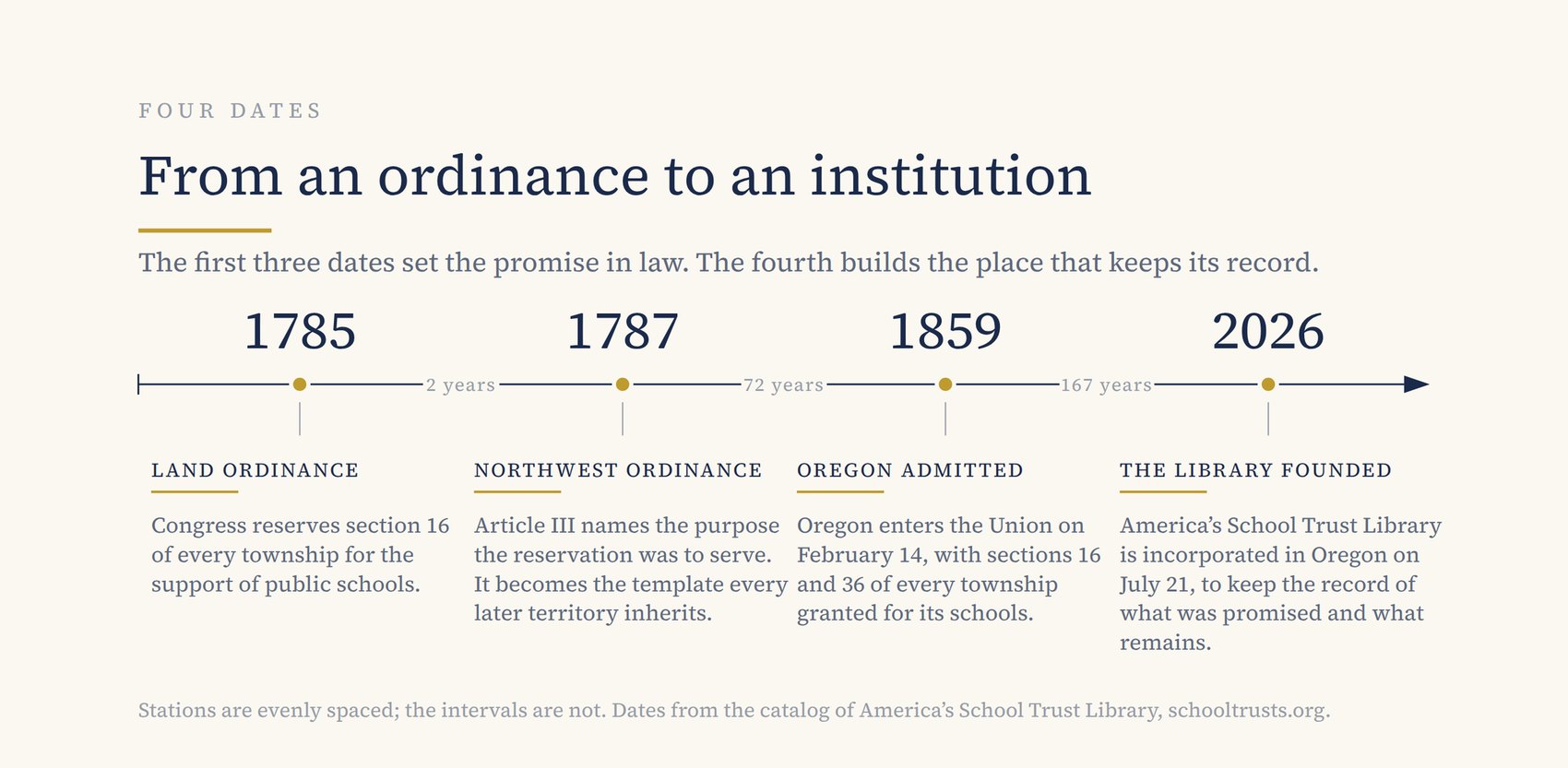
Figure 1.From an ordinance to an institution. Three acts of law built the school trust: the Land Ordinance of 1785, the Northwest Ordinance of 1787, and Oregon’s admission in 1859 with sections 16 and 36 of every township. The fourth date gives its record a permanent home — the Library was incorporated in Oregon on July 21, 2026.
Drawn for the Library from its own catalog of dates.
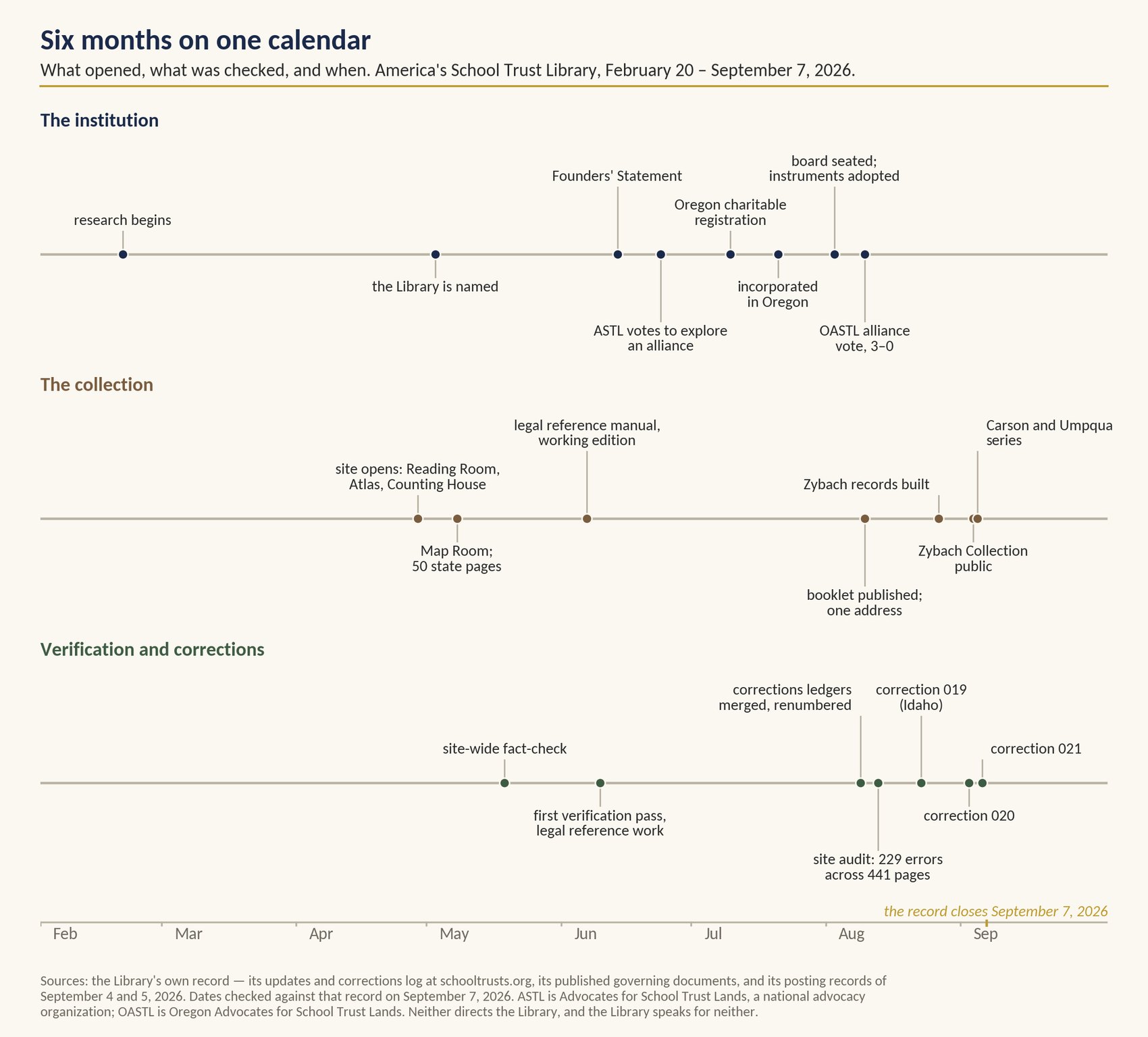
Figure 2. Three tracks against one calendar: what the institution did, what came onto the shelves, and what was checked or corrected, February 20 to September 7, 2026. ASTL is Advocates for School Trust Lands, a national advocacy organization; OASTL is Oregon Advocates for School Trust Lands. Neither directs the Library, and the Library speaks for neither.
America’s School Trust Library
Three tracks, and what their order shows
This calendar covers six months of 2026. The record it keeps begins from three acts: the Land Ordinance of 1785, which reserved Section 16 of every township for schools; the Northwest Ordinance of 1787, whose third article declared that “schools and the means of education shall forever be encouraged”; and Oregon’s admission in 1859, whose Admissions Act carried the grant and whose constitution accepted it as a trust.
The three tracks are the institution — the work of becoming something a stranger could inherit; the collection — what came onto the shelves; and verification — what was checked, and what was found wrong. Read across them, three things stand out.
The collection came before the corporation. The site opened on April 29 with a Reading Room for the cases, an Atlas, and a Counting House for the state funds. The Library was named on May 3, was not incorporated until July 21, and had no board until August 3. The corporation was built around work that already existed, which is why a reader can inspect the work without taking anyone’s word about the plans.
Checking started before the institution did. A site-wide fact-check ran on May 19 and the first verification pass on the legal reference work on June 10 — which is why there was a numbered corrections ledger with nineteen entries in it before September arrived.
Two weeks carry much of the record. Between August 3 and August 13 the founding board was seated, two separate corrections ledgers were merged and renumbered, a twenty-page booklet about the Library was published, two web addresses became one, Oregon Advocates for School Trust Lands voted 3–0 for an alliance, and an audit of the whole site found 229 errors across 441 pages and fixed them. The first week of September carries the Zybach Collection, two further series, and corrections 020 and 021.
What the figure does not show is the work that failed, and what was still open on September 7. Both are further on in this report.
What is on the shelf, and what is not on it
The Library serves at one address, schooltrusts.org. At the September 7, 2026 build its search index held 2,282 pages, the largest part of them the Zybach Collection described later. The Library’s own writing, reference work and state files stood at about 444 pages on September 3. Nothing sits behind a fee, a paywall or an account.
Every state has a file, ordered the same way: the federal grant, the state’s own constitutional and statutory language, the decisions, the money and what it pays out, then the gaps the Library has flagged. Four numbers run through the whole shelf. 1785, the year Section 16 of every township was reserved for the common schools. Roughly twenty states holding trust lands today. Six decisions of the United States Supreme Court on the compact — the bargain each state struck with Congress at statehood, taking the school sections and accepting in its own founding documents the conditions attached to them. And 137 years of unbroken authority across those six, from Trustees of Vincennes University v. Indiana in 1852 to Asarco Inc. v. Kadish in 1989.
What
Count
As of
Pages in the site’s search index
2,282
the September 7, 2026 build
The Library’s own site pages
about 444
September 3, 2026
Pages in the Zybach Collection
1,829
September 5, 2026
Pages held back from that collection
108
September 5, 2026
Catalog holdings
72
August 10, 2026
Holdings carrying the label Verified
none
August 10, 2026
Numbered entries in the corrections ledger
through 021
September 7, 2026
Booklet
20 pages and a cover
published August 10, 2026
Directors
three
since August 9, 2026
Each count was taken on the day beside it. They are not meant to sum.
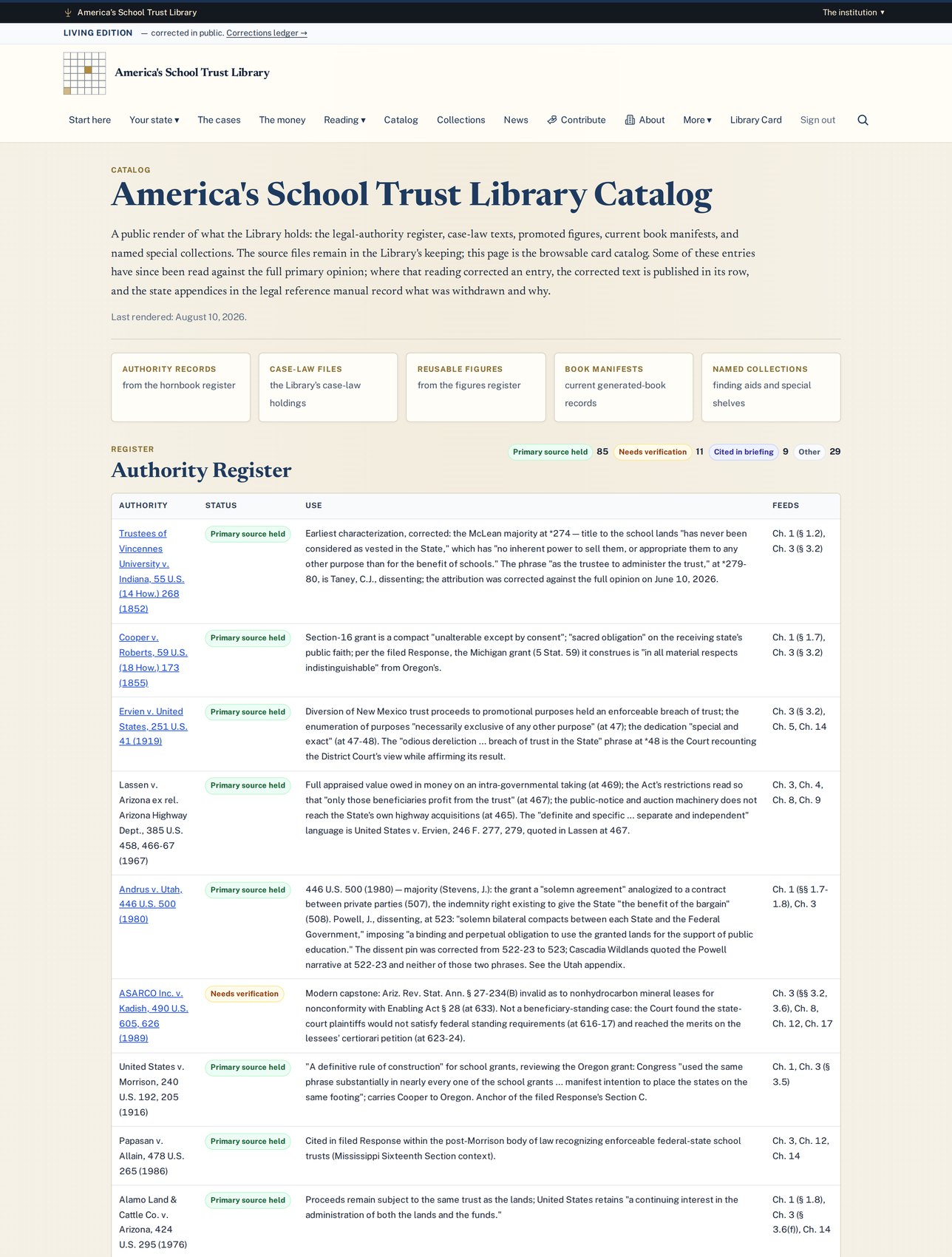
Figure 3.The card catalog, in public. Every authority the Library relies on is listed with its status, the use it is put to, and the chapters it feeds. The status column is the point: an entry says Primary source held or Needs verification, and no entry on this page says Verified. The visible counts are authority records, not the catalogued holdings.
America’s School Trust Library, schooltrusts.org, read September 7, 2026.
The empty row is the one to look at. Verified, at this Library, means a second, independent reviewer has checked an item against its source and signed for it. There is no such reviewer yet, so on August 10 not one of the 72 holdings carried the label — including the ones the Library’s own founders wrote.
“Better an empty shelf than an unearned label.”
The Library’s long-term work is a single citable reference to the law of those states — the kind of one-volume work a lawyer reaches for first. A working edition went up on June 7 and says on every page that it is a draft.
When the Library is wrong, it says so with a number on it
The corrections ledger is public and numbered, and each entry keeps what the record said, what it says now, and when it changed. It opens with the Library’s own housekeeping: in the ledger’s words, three statements that were true when written and were left standing too long after events passed them. As of September 7, 2026 it runs through entry 021. Two entries are worth reading whole.
Entry 020, September 3, 2026. For months the Library had published, as the holding of the United States Supreme Court in Ervien v. United States, a sentence that does not appear in the opinion. No reader caught it. The Library’s own citation check had recorded the absence in June and kept the sentence out of a book in progress, but that fix never reached the public pages; a second full reading of the opinion found it there. It was withdrawn from two pages, the wrong wording preserved beside the right one.
Entry 021, September 6, 2026. An Oklahoma case, OEA v. Nigh, had been described on the Library’s pages with a quotation from a trial judge — in a case that had no trial.
Entry 020 also discloses a second and different error in the same case, and that one is still standing. In one chapter of the Library’s reference work, a line about “the odious dereliction of a breach of trust in the state” — words the district court wrote — is attributed to the Supreme Court, and to Justice McKenna by name. That chapter is held back for counsel’s review, and the ledger records the error and the hold together.
The lesson is not that the Library makes mistakes; anything that publishes does. It is that a correction must reach every page carrying the error, not only the page that prompted it. Correction 016, in August, found six of twelve pages citing one case still missing its later reversal, and recorded that the earlier fix had “reached the page that prompted it and no other.” A report listing only the corrections that finished would be the wrong kind of report. This one names an error still on the site.
How to check this report in five minutes
Read entries 020 and 021 at schooltrusts.org/about/corrections/log/. Read the Constitution’s rule against taking a position in any case or campaign at schooltrusts.org/governance/. Then open schooltrusts.org/collections/zybach/, follow a narrator’s passage to the printed page number beneath it, and see whether the page it names is the page you land on.
How a collection came in: the Zybach Collection
Between 1975 and 1995, twenty-one people who had lived their lives in Soap Creek Valley, north of Corvallis, Oregon, told its history into a tape recorder. The historian Bob Zybach, whose fields are Oregon forest history, oral history and historical ecology, edited those interviews into fifteen indexed books, printed between 1990 and 2009, most of them by Oregon State University’s Research Forests and College of Forestry; Oregon State holds the tapes. Forty years later he did comparable work on the Elliott State Forest, which was school trust land for most of a century. That is why a library about school lands keeps this record.
The terms came before the material. The packet that went to him in June was already a non-exclusive licence — permission to publish that leaves the creator free to publish, sell or license the same work anywhere else. His reply raised three concerns: permanence, meaning where the originals would live; the value of a life’s work; and his own time. The rewrite answered all three. He is a Contributor, not a Donor; the copyright-assignment option was dropped; the originals stay wherever he chooses; everything is reversible. The Library pays him nothing, takes nothing exclusive, and leaves him every right he holds today.
The records were built on August 27 from his fifteen monographs, his 1999 thesis and his index. The collection went public on September 4 as a working edition, labelled unfinished on every page because rights and consultation reviews continue. Letitia Carson, 1845–1888, and the 1828 Umpqua Memorial followed on September 5, when it stood at 1,829 pages; a later build reports 1,835.
What the Library added is around the words, not in them. No sentence was paraphrased, summarised or rewritten. Every printed page keeps its number and its own address, so a citation lands where it should. His own Series Index — the sixteenth item in the set — was rebuilt as a live index of 1,823 headings and 12,618 references; 1,071 named places each have a page; a timeline sets 1,571 dated statements side by side in the narrators’ own words. Twelve of the fifteen books carry a narrator portrait in their front matter, and those twelve were cropped and placed. Three do not, and nothing was substituted.
This is really incredible — Well beyond what I was envisioning and couldn’t complete 30 years ago, and only now coming to realize the possibilities during the past few days and week. Worth the wait.
Quotation pending his written approval — Bob Zybach, email, September 7, 2026
What is held back, and why
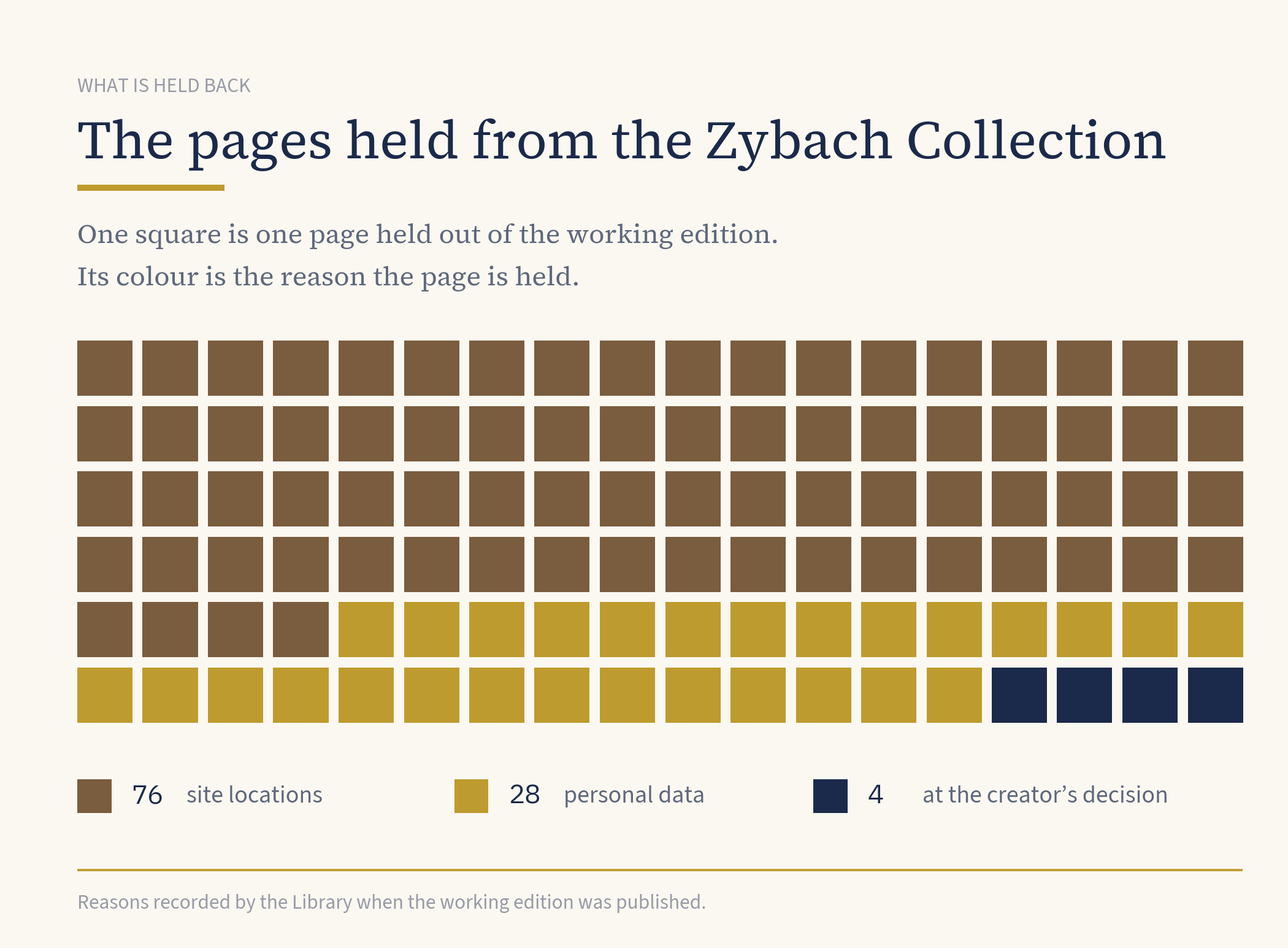
Of the Soap Creek series, 108 pages are withheld from the public edition: 76 pages that locate sites, 28 that carry personal data, and 4 held at the creator’s decision. The same rule was applied to the two series published on September 5.
Figure 4.What is held back. One square is one page kept out of the working edition of the Zybach Collection, and its colour is the reason. Most are held because they name a site on the ground. The four navy squares are held because the man whose work it is asked for them to be.
Drawn for the Library from the Zybach Collection’s record of held pages, September 4–5, 2026.
Every held page carries one plain notice, identical everywhere, and keeps its printed page number and its permanent link, so a citation still lands in the right place. Nothing says which holds are which; the reasons are recorded internally and not published, because a published list of reasons would be a map.
The rule behind them is one sentence on the page that records where everything came from: printing a passage in a monograph in 1993 and putting a searchable point on a public map in 2026 are not the same act, and the second one is the Library’s. Those pages stay held while consultation with the appropriate tribal governments is arranged.
The Library published its takedown rule with the collection, not after a complaint: two business days to acknowledge a request, removal from search at once while it is reviewed, a written decision within ten business days, and a request from a tribal government honoured immediately. A narrator’s objection, or that narrator’s family’s, is final, without investigation or argument. Whatever a release form signed thirty years ago allows, a person who spoke into a microphone about their own life gets to change their mind about it.
A hold is a decision about the Library’s own edition. It is not a claim to control what anyone else has published.
One thing is outstanding and should be said plainly. The collection’s rights page says of itself: “His written permission for this working edition is being recorded now, and the formal instrument follows.” That sentence stays there until it is no longer true.
The ability to query these indexes so easily, and to have such a solid list of linked accreditations and readily available information for photographs, quotations, place names, etc. is the highest and best intended use of my research I can imagine. And especially if these research methods (“wisdom of elders?”) can be so well captured and consulted for current and future generations in other locations.
Quotation pending his written approval — Bob Zybach, email, September 7, 2026
What six months cost, and who paid
Part of the answer sits in the record with no number attached. The Library has no employees and no paid librarian. Its Directors serve without compensation; the Bylaws allow reimbursement of reasonable expenses, and payment for separately approved services only after full disclosure and approval by the disinterested Directors. It pays the creator of its largest collection nothing. Nothing has been printed. It has not opened a bank account, by the board’s choice, so how to give will be posted when the account is open.
One sentence covers the federal tax position, and it is the only one the Library uses. The Library has not yet filed its application for federal tax-exempt recognition; it is being prepared. No federal tax-exemption determination has been issued, and until one is, the Library does not describe contributions as tax-deductible.
The rest is a question only the founder can answer, and it is asked here rather than estimated.
For Dave Sullivan to write
What six months cost, and who paid
The figures for February 20 to September 7, 2026, in whatever categories are true — software and AI subscriptions, filing and registration fees, domain and hosting, research materials, travel. For each: the amount, the period, and who paid — your own pocket, another organization, or gifts to the Library. If drafting, design or production time was donated, say so and by whom.
What comes next
The Library’s plan for 2027 through 2029 is a separate document, The Next Three Years. It sets six measurable tests, says what “larger” would mean in holdings, people, readers and money, carries the cost estimates, and puts dates against what this report leaves open. Four items belong here. Two Director seats and a Law Librarian seat are open, and the second, independent reviewer the Verified label waits for is one of them. The federal exemption application is being prepared; the window in which a filing relates back to the Library’s formation runs to about October 31, 2028. The Library’s own board has not yet acted on the reciprocal alliance resolution drafted on August 27, which would answer the Oregon vote of August 10. And the succession is already written down: the Founders’ Statement of June 14 commits the board to separate from shared membership with the advocacy organizations within about a year; the founder keeps the advocacy chair and leaves the Library’s board within that year; and the Library’s presidency is a seat to be filled by the end of 2027.
The whole shelf is at Participate. Mistakes
are corrected in public, with a number, in the
corrections log.
Drafted with an AI system for the Library’s board, from the Library’s own record, and checked against that record by people. Version 1, September 2026.