Welcome to America's School Trust Library. Explore the history of land
set aside to support public schools and the records of how states manage
it. The Library brings together books, maps, financial reports, legal
documents, and news so you can see what was promised, what the land
earned, and what each state makes public. This tour shows you where to
begin.
School Trusts
Compare states and State land maps
Use Compare states to explore differences in school trust lands, funds,
and public records. Use State land maps to find available maps and see
what each state publishes about the location of its trust lands.
Compare school trust funds and payments to schools across states.
Trust finances shows how well each figure is supported by sources and
makes gaps in the available financial information clear.
Browse Books & documents for reading organized by topic, including
history, laws, and research. For information about a particular state,
choose Find your state under School Trusts in the menu.
The Writing Room is open to readers. Browse a draft handbook on
school trust law; The Forgotten
Forever Gift to Public Schools, a history; Who Steals from
Children, the Oregon record; and Stewards of the Republic,
ideas for the future. Read essays on building institutions that
support public schools for generations.
School trust news follows developments in school trust lands and funds,
including court filings, hearings, and settlements. Commentary shares
contributors' views on what the records show. A free Library Card lets
you track your reading and contribute to the Library.
This plan covers 2027, 2028 and 2029. It is for the Library’s board, which may adopt, amend or set it aside; and for anyone outside who would rather judge the Library by something it can fail than by the way it describes itself. Every figure here is a planning assumption until the board adopts a budget. Where a number rests on an estimate the sentence says so; where the record holds no number, this plan says that instead of supplying one.
Read or download: web copy (PDF) ·
press copy (PDF) — print-ready, with bleed and crop
marks. 20 pages; about 30 minutes to read.
Editor's note, September 10, 2026.Two things this plan describes as pending have since happened. The board acted by unanimous written consent on September 10, 2026 — adopting this plan and its companions as Version 1, directing the federal filing, and directing that the presidency pass from the founder by December 31, 2027; its two directors with no interest in either advocacy organization accepted the alliance with Oregon Advocates for School Trust Lands on the Library’s side, the founder taking no part — and the postings for the three open seats this plan says were not yet published were published on September 10, 2026 at Open seats. The text below stands as adopted; the organizational record carries the action.
Editor's note, September 10, 2026.Replies about the three open seats go to the President, Dave Sullivan, at drdavesullivan@gmail.com, not to the Secretary as this edition says; the change was made September 10, 2026 and the postings at Open seats carry it.
The plan in one page
America’s School Trust Library is an Oregon nonprofit public benefit corporation, Oregon Registry No. 259005891, incorporated July 21, 2026. It collects, verifies and freely publishes the record of America’s school trust lands — the land the United States began setting aside in 1785 to support public schools, which roughly twenty states still hold today. The Library takes no side in any case or campaign. It belongs to nobody.
This plan covers 2027, 2028 and 2029. It is for the Library’s board, which may adopt, amend or set it aside; and for anyone outside who would rather judge the Library by something it can fail than by the way it describes itself. Every figure here is a planning assumption until the board adopts a budget. Where a number rests on an estimate the sentence says so; where the record holds no number, this plan says that instead of supplying one.
Six tests for 2029, each with a pass rule a stranger could apply, a count dated September 7, 2026, and an office that owns it.
Four measures of what “larger” means — holdings, people, readers, money — with a 2026 baseline and 2027 and 2029 targets.
A succession with dates. Three seats are open now; the presidency is filled by the end of 2027; the founder leaves the Library’s board within the year the Founders’ Statement of June 14, 2026 set for it.
Two budgets, labeled, each shown as expenses and as receipts. A base case that spends $30,000 in 2027 and about $93,000 in 2029, conformed to the movement plan’s line for the Library; and a funded case reaching $150,000 in 2027 and $500,000 across the three years, in which the first paid librarian is hired. Five of the six tests can be met on the base case; the sixth cannot.
One federal filing. Form 1023 — the application to the Internal Revenue Service for recognition as a charity exempt from federal income tax — has not been filed. This plan supplies the three-year projection the form requires, and its receipts side decides which form to use.
Four gates. No new program without a named maintainer. Nothing published without a second reader. No money from a trustee for a finding. No direction from an advocacy organization.
Behind it sits one line from the Library’s own draft posting for its open seats: they exist so decisions are made by people who did not build the Library, and so the founder can be outvoted.
Six tests for 2029
A plan that cannot be failed is a mood. Table 1 gives each test’s pass rule, its count on September 7, 2026, and who says so; the notes below say only what the table cannot. The Library expects to report at least one of these failed.
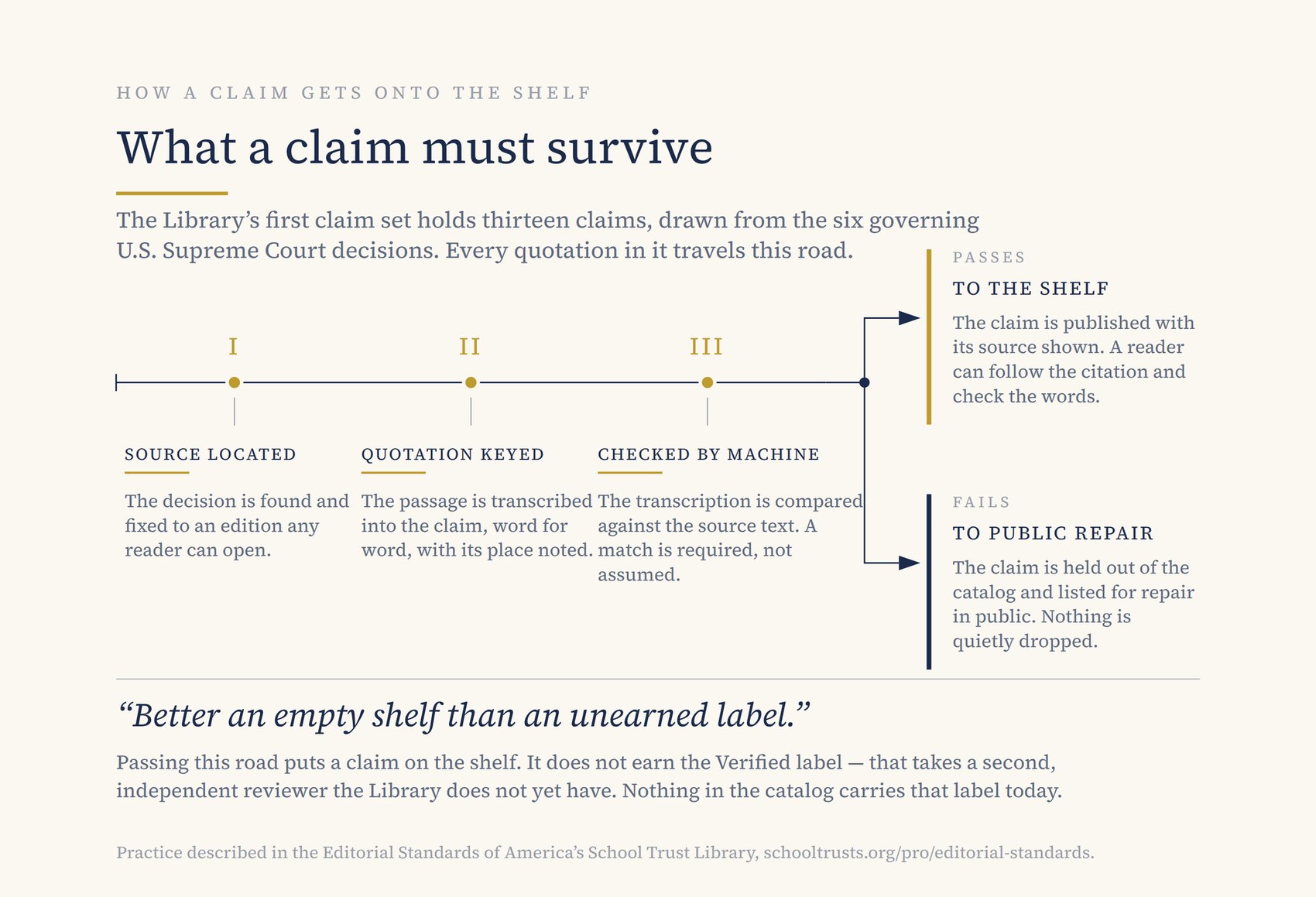
Figure 1.What a claim must survive. A quotation is located in an edition a reader can open, transcribed word for word with its place noted, then compared by machine against the source text. A claim that passes goes on the shelf. A claim that fails is held out and listed for repair in public — it is not quietly dropped. Passing the road does not earn the Verified label: nothing reaches the Verified shelf without a second, independent human reader, and the Library does not yet have one.
Drawn for the Library from its Editorial Standards, schooltrusts.org/pro/editorial-standards.
On test 1. A deposited copy is the Library’s own file of the document, kept with a checksum — a short computed fingerprint that shows the file has not changed — rather than a link to somebody else’s website. The number of trust states is itself unsettled, the canon figure being “roughly twenty,” so the first task under this test is a published, sourced list of them. And nothing reaches the Verified shelf, the shelf of items a second reader has checked, until there is a second reader; that is why the count of Verified items is zero.
On test 2. The Library’s reference work on school-trust law is one citable book organizing the granting acts, constitutions and decisions of the trust states; verification pass 82 ran September 6. Two defects were live on September 7 — a sentence attributed to the U.S. Supreme Court that is not in that opinion, and a page cite a correction had restored on one surface and not another. The second is why this test includes propagation.
On test 3. A State Co-Librarian — the named curator who takes editorial responsibility for one state’s file — serves under a real name, or under a pseudonym the board verifies and holds in confidence, because some of the best candidates work for the agencies whose records they would keep. Targets: five by the end of 2027, twelve by 2028, every trust state by 2029. From zero, five a year is one person every ten weeks.
On test 4. The Zybach Collection went public as a working edition on September 4, 2026 — 1,829 pages by September 5, with 108 held: 76 pages that locate sites, 28 that carry personal data, and 4 held at the creator’s decision. It is not yet accessioned, which is to say not yet formally taken into the collection under a signed instrument. What it produced is a method: a non-exclusive licence rather than an assignment, so the creator keeps his copyright and every commercial right; originals stay wherever he chooses; everything reversible; each held page replaced by one generic notice keeping its printed page number and a permanent link, so a citation still lands. Five instruments travel with any accession: a signed gift; a finding aid, the list of what a collection contains and where each part of it sits; a public rights and takedown page; a diligence log of what was checked and when; and the written check the collection policy requires, that the material belongs in this Library at all. The second accession named is Advocates for School Trust Lands’ records — ASTL, the national advocacy organization, a Utah nonprofit founded in 1999 as Children’s Land Alliance Supporting Schools. Nothing here commits it; that is a request its own board would grant or refuse.
On test 5. This is the only test money decides. Its terms come from the bylaws, not from this plan.
On test 6. A board draft of September 6, 2026 proposes a public watch of the trust states — monthly notes to each land board, annual report cards, a ledger of parcels — as a program of Advocates for School Trust Lands, running on the Library’s published record. That board has not acted on it. The Library neither grades nor advocates; its part is custody. The failure mode is already on the premises: the corrections ledger is served at two addresses and the site’s navigation links to only one. Permanence is not only keeping the file. It is keeping the path to it.
Test
Count, Sept 7, 2026
Pass, Dec 31, 2029
Who says so
1 · State founding records at item level
72 catalogued holdings (Aug 10); 0 labeled Verified; 19 of 220 case-law items public; nearly all holdings bare links
The granting act, the constitutional school-lands provision and the leading decisions for every trust state — each a deposited copy with a checksum, catalogued as its own item, each carrying a second reviewer’s name
Collections and standards, with the Law Librarian’s second signature
2 · The reference work on school-trust law
Working edition published June 7, 2026 and still a draft — the August 3 shelf walk lists it as work in progress; 82 verification passes; 2 known live defects; ledger through entry 021 (Sept 6)
Complete for every trust state; every citation checked against the courts’ official reports by a law librarian who did not draft it; 0 open misattributions; every correction propagated
The Law Librarian, one page a year to the board
3 · Co-librarians
0 seated; application page and recruitment plan drafted May 12, 2026
One per trust state, each seated after three accepted contributions; every state without one says so on its page
The Librarians’ Council recommending, the board confirming
4 · Accessions
0
Zybach first, under a signed deed of gift; Advocates for School Trust Lands’ records offered second and accessioned or declined in writing; five instruments on each — signed gift, finding aid, rights and takedown page, diligence log, written diffuseness check
The board, disinterested directors voting where a director is the donor
5 · Run by people who did not found it
Board of 3; 2 people holding 3 offices; 0 paid staff; 3 seats open, postings drafted Sept 5, unpublished
Board of at least 5, with an educator and a records professional; founder off it; President not the founder; a paid librarian; finance review by two non-Treasurer directors
The board
6 · Permanent custody, stable addresses
Not measured; the corrections ledger served at two addresses, only one of them linked from the site’s navigation
Permanence policy published; every cited source a deposited copy at a stable address; 0 addresses moved without a redirect; a link audit published yearly; two or more copies, one beyond the Library’s control; successor test done once
Collections and standards, annually
Table 1. The six tests and the counts they start from. Sources: the Library’s catalogue, corrections ledger, bylaws, Constitution, draft postings, collection policy and Law Librarian charter.
What “larger” means, in four measures
“Growth” is the word institutions use when they do not want to be checked. The Library grows in four directions and each has a counter.
Holdings
Sept 7, 2026
End of 2027
End of 2029
Catalogued items
72 (Aug 10, 2026)
About 60 state founding documents deposited and catalogued, plus what is held
Every trust state’s file complete at item level
Items labeled Verified
0
The first, once the Law Librarian seat is filled
Every claim in the reference work
Case-law items public
19 of 220 held
220 of 220
220, plus what the years add
Pages in the search index
2,282 (Sept 7 build)
Not targeted
Not targeted
Accessioned collections
0
1 complete, 1 offered
Every accession carrying all five instruments
Table 2. Holdings. “About 60” is arithmetic, not a count: three document classes across roughly twenty trust states. The page total is deliberately not a target.
People. On September 7, 2026 the board is three: Dave Sullivan, President and Treasurer; Kenneth Magee, Secretary; Barry Shane, Director. Two people hold three offices; three seats are open. There is no Librarians’ Council, and no second reviewer — which is why nothing is labeled Verified. By the end of 2027: five directors, one an educator and one a records professional; the Law Librarian seated; five co-librarians; the Council created with a chair and three named librarians. By the end of 2029: five to seven directors; a co-librarian in every trust state; and a named successor for the Law Librarian, because a seat with no successor is a countdown.
Readers. The Library does not count its readers and this plan does not estimate them. On September 7, 2026: 2,282 pages sit in the site’s search index, and nine automated readers are refused entry by a single setting in the file that tells machines what they may read — the Library’s own monitor calls it the one institutional promise being broken by a setting rather than by an argument. The ledger runs to entry 021 and does not break out how many corrections came from outside. In 2027 the Library publishes a counting method and the first number from it, admits the machine readers, records each new correction’s origin, and publishes terms for its reference service with a named director signing the answers. By 2029 the reader figure is published monthly with its method beside it, and — a planning assumption resting on the Library’s own claim that the corrections door is its widest recruiting door — at least half of new corrections arrive from outside.
Money. Through May 4, 2026 the Library’s whole cash cost was the founder’s discretionary funding for software and domain registrations, well under $1,000; the nearest baseline run-rate in the record is that same document’s estimate of $5,000–$15,000 a year. There is no bank account — not opened, by the President’s choice — so the Library can take in nothing and nothing it publishes says how to give. One rule to adopt with the first budget, borrowed from the movement plan’s test for its own funders: after 2027, no single household supplies more than a fifth of the Library’s revenue in a year. Today one supplies effectively all of it.
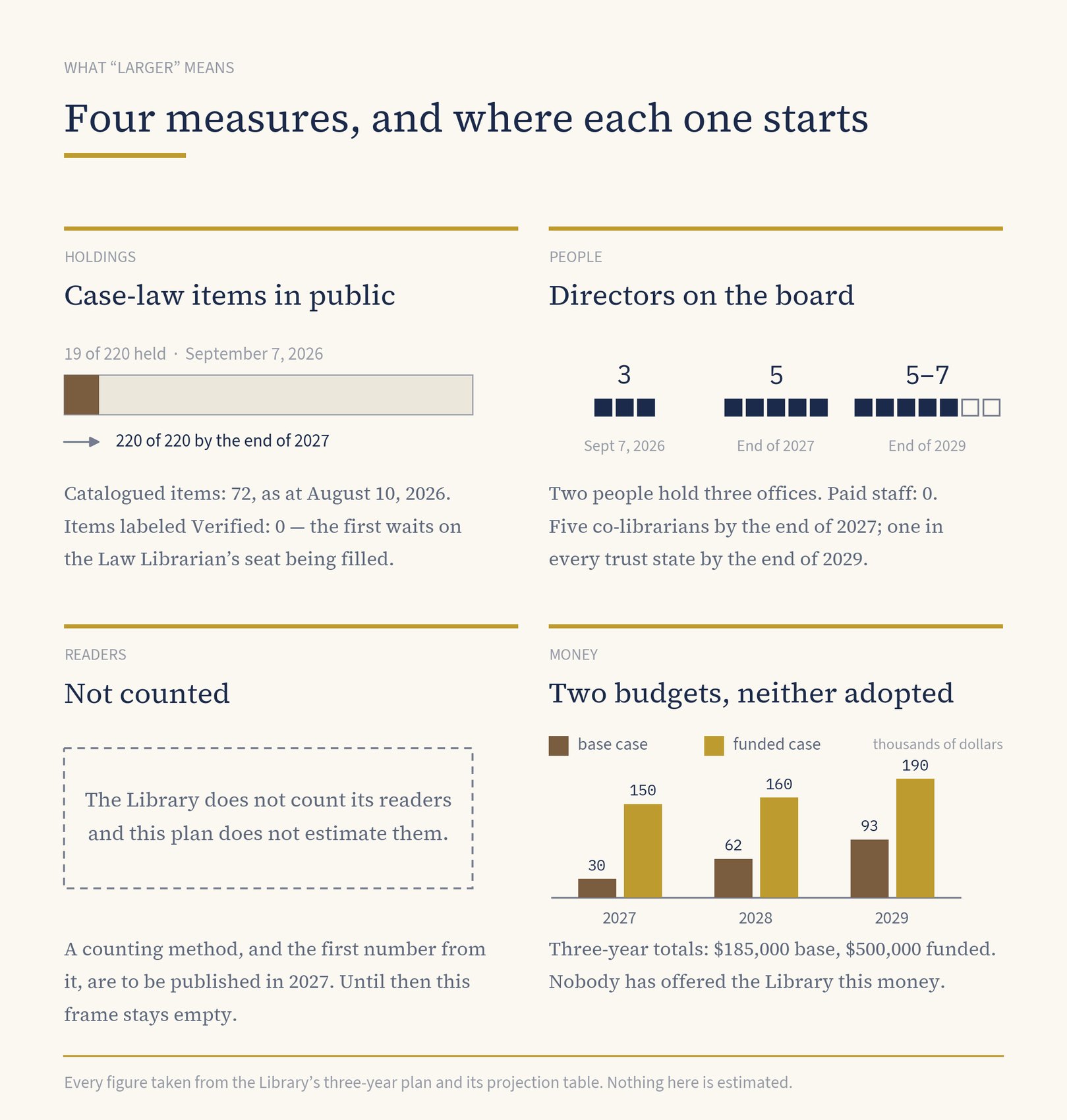
Figure 2.Four measures, and where each one starts. Nineteen of the Library’s 220 held case-law items are public today and all 220 are to be public by the end of 2027. The board of three becomes five. The readers panel is blank because the Library does not count its readers and the plan does not estimate them.
Drawn for the Library from its plan The Next Three Years and the projection table beside it, September 2026.
A slot, not a number
What the first six months actually cost, and who paid it, belongs here; the President supplies it and the companion report carries it. This plan uses the May 4, 2026 estimate as its baseline and labels it an estimate throughout.
Organization and succession
Three seats, open now. Two Director seats and the Law Librarian seat are open. The postings were drafted September 5, 2026 and are not yet published; replies route to the Secretary, Kenneth Magee, at library@schooltrusts.net. All three are one-year terms, uncompensated and renewable, and require a signed annual disclosure. The bylaws set the board at three to eleven and record the intention to grow to five, then toward seven; at five the composition rule bites — at least one educator and at least one librarian, archivist or records professional — a reason to fill the seats deliberately rather than quickly. Two rules a board of three cannot comfortably satisfy argue for the same thing: the annual financial review is assigned to at least two directors, the Treasurer excluded where practical; and the President should not also serve as Treasurer unless the board makes a written finding that the arrangement is temporary and necessary. Either that finding goes in the minutes or the offices are split — and the Treasurer need not be a director, so splitting them costs no seat.
The presidency, and the founder’s departure. Two dates govern the next fifteen months, and they are not the same. The Founders’ Statement of June 14, 2026 commits the board to separate from shared membership with the advocacy organizations within about the first year — about June 14, 2027; on September 6, 2026 the founder confirmed how that resolves for him, keeping the advocacy chair and leaving the Library’s board within that year. On September 7 he set the second: the presidency is filled by the end of 2027. Between them lies a gap of up to six months, made real by the rule that the President must be a director.
By March 2027 — seat directors four and five. Everything else depends on it, and it makes the finance review possible for the first time.
By about June 14, 2027 — the founder’s Library seat ends, and with it the two offices he holds. The Constitution requires a vacant office to be shown as vacant or interim, never presented as staffed, so the board names a presiding director in the same act.
By December 31, 2027 — the presidency filled by a director who is not the founder, the treasurership either filled separately or the written finding made.
Continuing. The founder may still give the Library documents, answer questions, and be cited. He may not direct it. That is the whole content of the separation.
The Secretary, meanwhile, keeps minutes and notices, authenticates the corporate records, and preserves board approvals, adopted instruments, the roster, disclosures and filings. Through 2027: receive replies to the three postings; enter the reciprocal alliance resolution in the record when the board acts, and cause the public pages to state the date; maintain the Constitution’s adoption and succession records; and correct the officer of record with the state, since the Articles as filed name an initial Secretary who no longer serves. Oregon carries officers on the annual report, so the report due July 21, 2027 must show the current slate.
The Treasurer oversees funds, accounts, records, budgets, tax filings and charitable reports. Four tasks are sequential and none is done: open the bank account; set the fiscal year by board resolution; adopt the annual budget the bylaws require; and produce the three-year expense and receipts projection the federal filing needs, which is the pair of tables overleaf.
The Librarians’ Council is created, the bylaws say, when volunteer collection work becomes regular. It advises on collection priorities, cataloguing, preservation, source standards and correction practice. It does not govern the corporation. Create it when the first three named librarians are appointed or the first accession is complete, whichever comes first; then run it as the program document describes: one hour quarterly, remote; minutes published; one page to the board each quarter; appointments recommended by the Council and confirmed by the board.
Two budgets
Neither is adopted. The board adopts a budget; this plan supplies two shapes, each shown twice — what it spends and what it must receive — and the arithmetic between them.
The base case is conformed exactly to the line for the Library in the movement plan’s board draft of September 6, 2026: about $30,000 in 2027, rising to about $125,000 in 2030 — a figure that draft calls “this plan’s estimate of an independent organization’s cost, shown so the parts add up; it is not ASTL’s to budget.” Nobody has offered the Library this money. For 2028 and 2029 the draft gives no figure, so this plan draws a straight line between the two it does give: about $31,700 a year, landing on about $62,000 in 2028 and about $93,000 in 2029, both inside the Library Constituency Plan’s year-three range of $50,000–$100,000, dated May 6, 2026. There is no salary line in any of the three years: the work is done by unpaid directors, volunteers, and an AI drafting system with a named human signing.
The funded case is this plan’s own construction, not a conformity between two documents. It is informed by two figures in Vision v3 (May 4, 2026) which are successive asks there rather than one: a first-phase ask of $150,000 covering twelve months, and a second-phase ask of $500,000 over three years. This plan takes $150,000 as its 2027 figure, sets $500,000 as its three-year total, and lets 2028 and 2029 follow from those two choices under one rule — no line falls below the base case, because a funded Library should not do less of anything. It assumes the first paid librarian is hired in 2027 or 2028, and the run-rate reaches the Constituency Plan’s year-five range of $150,000–$300,000 early. Not adopted, not funded, contingent on money that does not exist today.
Table 3. The three-year expense projection. Three-year totals: base $185,000, funded $500,000. The yearly base totals are the sourced figures; the division into lines is this plan’s assumption, and the board may re-cut it without changing a total. So is the salary line — the record holds no quoted librarian’s salary, its nearest priced comparison being the movement plan’s state desk at about $55,000 a year for a half-time coordinator, a small board and shared services. Hire against a real quote. Two prices inside the base case are quoted rather than assumed: the $600 filing fee, and printing — 25 copies of a saddle-stitched booklet about $200–$400, 100 copies about $350–$700, on the August 10, 2026 quote.
Expenses are the wrong half for the federal filing, which asks what the Library will receive. It holds no reserve, so receipts are set equal to expenses in every year of both cases.
Receipts line
2027 base
2027 funded
2028 base
2028 funded
2029 base
2029 funded
Gifts from directors and their households
$20,000
$30,000
$12,000
$30,000
$18,000
$35,000
Other individual gifts, and the patron tiers
$10,000
$20,000
$25,000
$30,000
$35,000
$40,000
Foundations and institutions
$0
$100,000
$25,000
$100,000
$40,000
$115,000
Total receipts
$30,000
$150,000
$62,000
$160,000
$93,000
$190,000
Table 4. The three-year receipts projection. Every figure here is a planning assumption and none of it is money in hand. The record holds no pledge, grant or dues to the Library, and no bank account to receive any. The patron tiers — Friends $25, Patrons $250, Benefactors $5,000, a Founding Circle above that — were designed in the May 4, 2026 roadmap and never launched. The first line is bounded by the rule this plan proposes: after 2027, no household above a fifth of the year’s receipts, which holds it just under a fifth in both cases.
Year
Difference
What the difference buys
Tests it moves
2027
$120,000
A half-time librarian; the first accession finished on a professional schedule instead of a volunteer one; travel to seat the first five co-librarians
3, 4, 5
2028
$98,000
The librarian full-time, with every other line at or above the base case
1, 2, 5
2029
$97,000
The post sustained into a third year — what makes it a job rather than a grant
5
Three years
$315,000
One salaried post, sustained, and no other line cut to pay for it
Test 5
Table 5. The reconciliation. Of the $315,000 between the two cases, $230,000 is the salary itself; the remaining $85,000 keeps every other line at or above the base case, so the librarian is not paid for out of verification or collections.
The last column carries the most useful finding in this plan. Tests 1, 2, 3, 4 and 6 can be met on the base case — more slowly, with volunteers and unpaid officers doing the checking, and with verification the line the Library refuses to cut. Test 5 cannot. A board of five, a founder who has left and a President who is not the founder are free; a paid librarian is not. If the board adopts the base case it should amend Test 5 to say so, rather than carry a test it has decided not to fund.
The federal filing
Form 1023 has not been filed. The Library’s whole public position on its federal tax status is one sentence, and this plan does not add to it:
“The Library has not yet filed its application for federal tax-exempt recognition; it is being prepared. No federal tax-exemption determination has been issued, and until one is, the Library does not describe contributions as tax-deductible.”
Three live pages said “has been filed.” That was wrong, it is being corrected, and it is recorded here rather than quietly fixed, because a corrections practice that excludes the institution’s own corporate record is decoration.
What follows says nothing further about where the Library stands. It is what the Library intends to file, on what projection, and by when.
Which form. Form 1023-EZ is a short attestation form at a $275 user fee, open only to organizations projecting gross receipts of $50,000 or less in each of the next three years and total assets of $250,000 or less. The full Form 1023 costs $600, requires a mission narrative, a three-year budget and the governing documents, and is the determination institutional funders expect. The gate reads receipts, not spending, so Table 4 answers it — and answers the same way in both cases: base receipts cross $50,000 in 2028, funded receipts in 2027. Neither is eligible for the short form. The Library files the full Form 1023 — also the fiduciary-honest answer, since the July 20, 2026 decision worksheet directs that the projection be answered for the Library actually intended, not the one that makes the short form available.
How long it takes. The Internal Revenue Service issues 80 percent of Form 1023 determinations within 191 days, and on a June 28, 2026 reading of its own published status it was working on applications submitted on or before January 12, 2026. Plan on most of a year.
Which projection. The board adopts one of the two cases: if it intends to seek grants and major gifts, the funded case is the truthful one even with no money in hand; if not, the base case is.
The window. Recognition relates back to the date of formation if the application is filed within 27 months of the end of the month of formation. The Library was formed July 21, 2026, so the window closes October 31, 2028 — room enough, but not so much that the filing should wait on anything but the projection and an accountant’s read.
Two things to settle with the filing, not after it. The Articles as filed carry Oregon’s boilerplate purposes and a dissolution clause running to any organization the Internal Revenue Service recognizes as charitable and exempt, or to a government body for a public purpose. They do not carry the school-trust purpose, and the bylaws do not supply one: on dissolution they defer to the Articles and add only a preference, that the board should favor an organization committed to preserving and freely publishing this record. The one instrument reciting a priority order is the June 2026 draft licence, which the Articles do not match. The full form puts the governing documents in front of a reviewer, so the board should decide whether to amend the Articles before or alongside the filing. Second: until a determination issues, the Library plans on the stricter of the rules that could apply to it — one reason the first accession is a gift under a non-exclusive licence, and the Library pays its first donor nothing.
Gates, not dates
Every target in this plan is a gate. A gate is a condition, not a calendar entry: work starts because the condition is met, not because the month arrived. Four are absolute, and each has an owner and a reporting date — because a gate that is never met is a way of never deciding.
No new program without a named maintainer — the person who answers when the thing is wrong. No new room, service, program or corporation opens without one, and the name goes in the minutes. Owner: the board; reported at each quarterly meeting.
Nothing published without a second reader. No item enters the Verified shelf on one person’s reading, and where the Library lacks the people for a form of review the work stays marked provisional. The Law Librarian may withhold an item, require a correction, and record a dissent the board does not remove; the board may overrule a withholding only by recorded vote, with the reasons published alongside. If that seat is vacant, the Verified shelf does not grow. That is the point of it. Owner: the Law Librarian; reported one page a year.
No money from a trustee for a finding. A trustee here means a member or officer of a state land board or equivalent — the people whose records the Library keeps. The Library does not sell a finding, a label or a place on a shelf, and money never buys litigation, a position, a trustee’s finding, or a donor’s veto over what is published. Owner: the Treasurer, under the conflict-of-interest policy; reported with the annual financial statements.
No direction from an advocacy organization. The Library may hold an alliance, catalogue such an organization’s records and cite its filings; it may not take instruction from one. No collaborator, donor, litigant, officer, director or affiliated organization may require the Library to hide, alter, delay or misstate a public record because the record is inconvenient. Owner: the board, the President recusing where the conflict is his; reported in the annual disclosures.
A fifth rule is not a gate but a habit, and it is the one the Library will be judged by: a slipped target is reported, with its number, in the same place the target was published. Not hidden, and not restated smaller.
The alliances as they stand
The word is alliance, and it means one thing: information, education and preservation, with no control, no agency, no money and no litigation position on either side.
Oregon Advocates for School Trust Lands — the Oregon advocacy organization, a private foundation — adopted its alliance resolution on August 10, 2026, by 3–0, the Library’s founder disclosing his dual role and sitting out.
Advocates for School Trust Lands — the national organization — proposed its Resolution B for August 13, 2026. That meeting was postponed for absentees and the resolution is carried over. It has not been adopted. As proposed it is limited to information, education and preservation; not exclusive, controlling or financial; neither organization directs the other, owes it money or speaks for it; its chief executive recommends to the Library candidates for its board, members for its Librarians’ Council, and collections worth preserving; a liaison is named, someone other than the Library’s founder; and either board may end it by resolution.
The Library’s own board has not acted. A reciprocal resolution has been in draft since August 27, 2026, its terms mirroring the executed Oregon instrument. One clause matters most: nothing in an alliance may affect what the Library accessions, catalogues, publishes, corrects or withdraws. An alliance that could change what the shelves say would not be worth having, to either side. The consent packet accompanying this plan asks the board to act on it.
For three of the six tests the alliances are the delivery mechanism, not a courtesy: the recommendation clause is where co-librarians, Council members and the second accession are most likely to come from, and the day a resolution passes is the day to ask for names.
The whole shelf is at Participate. Mistakes
are corrected in public, with a number, in the
corrections log.
Drafted with an AI system for the Library’s board, from the Library’s own record, and checked against that record by people. Version 1, September 2026.