Welcome to America's School Trust Library. Explore the history of land
set aside to support public schools and the records of how states manage
it. The Library brings together books, maps, financial reports, legal
documents, and news so you can see what was promised, what the land
earned, and what each state makes public. This tour shows you where to
begin.
School Trusts
Compare states and State land maps
Use Compare states to explore differences in school trust lands, funds,
and public records. Use State land maps to find available maps and see
what each state publishes about the location of its trust lands.
Compare school trust funds and payments to schools across states.
Trust finances shows how well each figure is supported by sources and
makes gaps in the available financial information clear.
Browse Books & documents for reading organized by topic, including
history, laws, and research. For information about a particular state,
choose Find your state under School Trusts in the menu.
The Writing Room is open to readers. Browse a draft handbook on
school trust law; The Forgotten
Forever Gift to Public Schools, a history; Who Steals from
Children, the Oregon record; and Stewards of the Republic,
ideas for the future. Read essays on building institutions that
support public schools for generations.
School trust news follows developments in school trust lands and funds,
including court filings, hearings, and settlements. Commentary shares
contributors' views on what the records show. A free Library Card lets
you track your reading and contribute to the Library.
America’s School Trust Library keeps the public record of America’s school lands — freely, neutrally, and permanently. It is not asking you for money. It asks for documents and hands. Five ways in: librarians and archivists · lawyers · legislators, trustees and agency staff · teachers · families and historians who hold records.
Read or download: web copy (PDF) ·
press copy (PDF) — print-ready, with bleed and crop
marks. 23 pages; about 35 minutes to read.
Editor's note, September 10, 2026.Replies about the three open seats go to the President, Dave Sullivan, at drdavesullivan@gmail.com, not to the Secretary as this edition says; the change was made September 10, 2026 and the postings at Open seats carry it.
Ways to Help
America’s School Trust Library keeps the public record of America’s school lands — freely, neutrally, and permanently.
It is not asking you for money.
It asks for documents and hands.
Five ways in: librarians and archivists · lawyers · legislators, trustees and agency staff · teachers · families and historians who hold records.
schooltrusts.org
What this Library is
In 1785, two years before the Constitutional Convention, Congress decided that one square mile in every township of the western surveys would belong to the schools — a township being the six-mile survey square the country was laid out in. Not to a church, not to a governor: to the children who would live there.
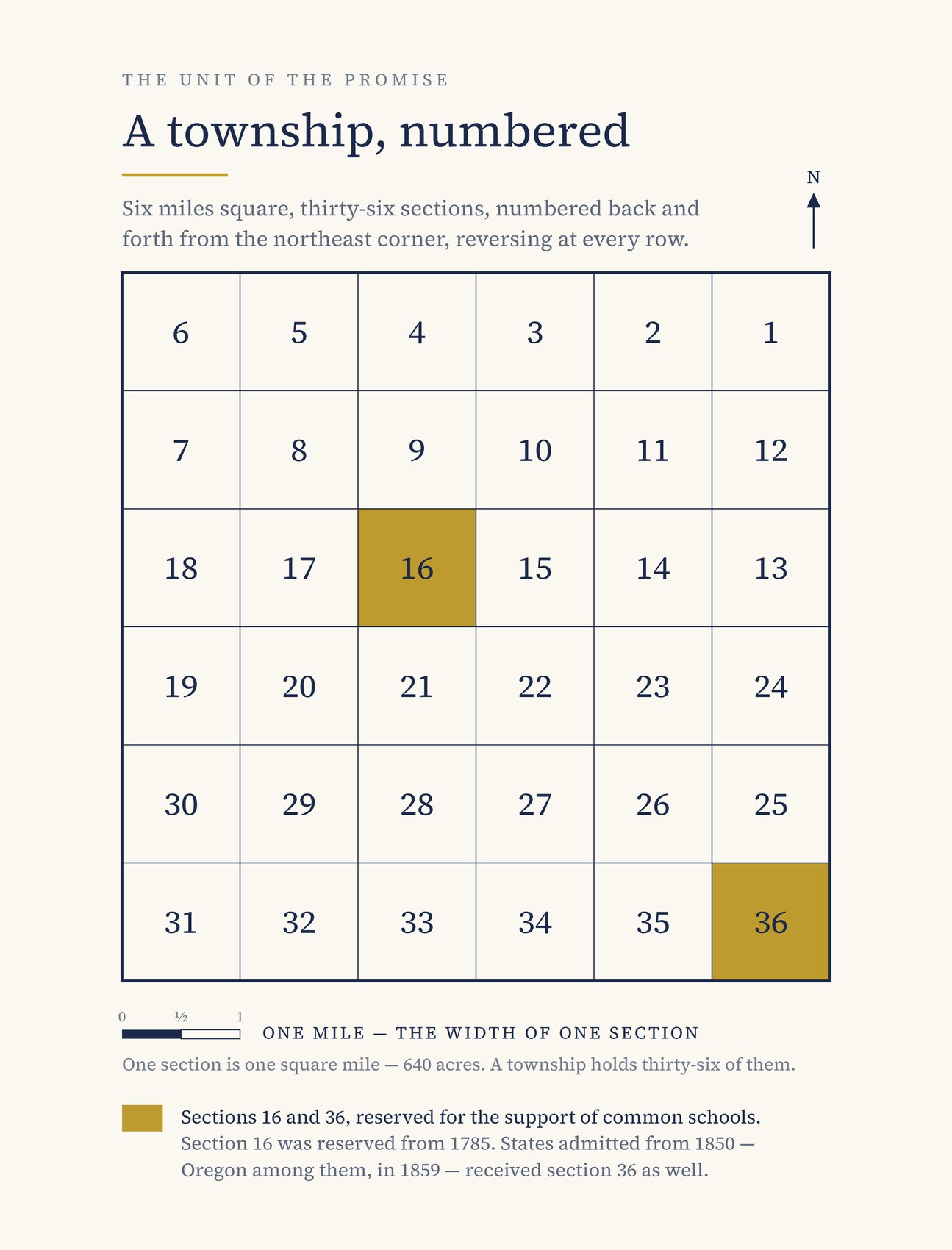
Figure 1.The unit of the promise. Surveyors cut the public land into townships six miles square and numbered the thirty-six sections inside each one back and forth from the northeast corner. Section 16 was reserved for schools from 1785; states admitted from 1850 — Oregon among them, in 1859 — received section 36 as well.
Drawn for the Library after the U.S. Public Land Survey System convention (Act of May 18, 1796, and successors).
Roughly twenty states still hold school trust lands today; the money still moves and the obligations are still live. But the record sits scattered across state agencies, courthouses, university basements, and the hard drives of volunteers who mean well and will not live forever.
America’s School Trust Library exists to gather that record and keep it. It takes no side in any case or campaign — which is not modesty but the whole design.
The Library is an Oregon nonprofit public benefit corporation, Oregon Registry No. 259005891, Articles e-filed July 21, 2026; Oregon Department of Justice charitable registration No. 72571, July 10, 2026. Its bylaws, conflict-of-interest policy, and Constitution with a Readers’ Bill of Rights are published in full, as adopted, at schooltrusts.org/governance/. Three people sign for it: Dave Sullivan, President and Treasurer; Kenneth Magee, Secretary; Barry Shane, Director.
The whole Library serves at schooltrusts.org, free, and reading asks for no account. At the September 7, 2026 build, 2,282 pages stood in its search index.
“The record is kept by people, and the Library’s shelves have room for the ones you know.”
What it asks of everyone
Three things, and none of them is money.
Read it. Start with your own state’s file at schooltrusts.org/states/, or the Map Room at /maps/. Reading asks nothing of you: no fee, no account, no agreement with anything the Library says.
Correct it. If something is wrong — a figure, a date, a citation, a characterization — say so. A free Library Card opens the correction form; write to the Library instead if you would rather not open one. Corrections are decided on the merits, published with a number, and credited to the sender.
Keep it. The record is kept by people: librarians, archivists, teachers, lawyers, retired agency staff, directors, and the person in your state who has the box of papers nobody else has.
The Library is not asking anyone for money. It asks for documents and hands. It does not ask you to take a position, and it does not take one itself.
How to say yes
Write two paragraphs to the Library at library@schooltrusts.net, addressed to the Secretary, Kenneth Magee.
Say what you have done that bears on this — a shelf you have kept, a state you know, a box you have — and what you would take on. An honest “a few hours a month, irregularly” is a real answer.
For the two Director seats and the Law Librarian seat, two paragraphs is plenty; there is no form to fill in. The librarian and co-librarian roles — a State Co-Librarian is the senior curator of one state’s records — also have application pages: /apply/librarian/, /apply/state-co-librarian/, /express-interest/co-librarian/. Either route reaches a person.
One honest limit
The Library has not yet filed its application for federal tax-exempt recognition; it is being prepared. No federal tax-exemption determination has been issued, and until one is, the Library does not describe contributions as tax-deductible.
For librarians and archivists
You already know what this Library is short of. It has 72 holdings in its catalog as of August 10, 2026, and not one of them carries the label Verified — because Verified means a second, independent reviewer has checked the item against its source and signed for it, and the Library does not yet have that reviewer. A data point on a state page may carry a Verified badge for that figure; the catalog’s Verified label, for a whole holding checked by a second reader, has not yet been earned by any holding. Better an empty shelf than an unearned label.
That is the gap, and filling it is professional work.
The shelves that need a keeper
A state’s record. The Library keeps a file for every state. A State Co-Librarian is the senior curator of one state’s corner of that record — the person whose name sits at the foot of those pages. The work is bounded: review what the Library says about your state and flag what is wrong; identify the period sources its shelf is missing; triage what other readers send in. The Library’s own description of the load is five to ten hours a month after an onboarding pass, renewable annually.
The corrections queue. Every submitted error has to be reproduced, checked against the primary source, decided, published with a number, and — the part institutions fail at — propagated to every other page that repeated it. The Library has failed that test more than once, which is why it is written down as a duty rather than left as an intention.
What the Library asks, and what it does not
It asks for accuracy, good faith, and a stated amount of time. It does not ask for political alignment: this is a record-keeping institution, not an advocacy outlet. It does not ask you to leave your job, and it does not ask for a credential — the filter is the written standard and the review, not the résumé.
One thing to know before you say yes: the Library publishes its own mistakes with numbers on them, in a ledger anyone can read, and the first entries in that ledger corrected the Library’s own statements about itself. If a correction ledger that names an institution’s errors in public would embarrass you, this is the wrong shelf.
A Law Librarian seat is open too — the seat that makes Verified mean something, described with the others at the back.
How to say yes
Write to the Library at library@schooltrusts.net: two paragraphs on what you have kept and what you would take on. For the librarian and co-librarian roles the site also has application pages — /apply/librarian/, /apply/state-co-librarian/ and /express-interest/co-librarian/. Either route reaches a person.
For lawyers
The law of this field is old, settled in its main lines, and almost nowhere gathered. A lawyer who wants to read it must reconstruct it from six decisions of the United States Supreme Court spanning 137 years, the enabling acts and constitutional clauses of roughly twenty states, and a century of state cases nobody has gathered.
The Library is gathering them. Its reference work on school-trust law — a hornbook, in the old sense: one ordered statement of a field’s law, every proposition tied to the authority it rests on — is in first draft, published as it is built, with its gaps marked as gaps.
That draft needs lawyers. Not for a case. For the citations.
The work that is actually available
Verify one footnote. Read the case, confirm the citation, confirm it has not been reversed or superseded, and say whether it supports the proposition it is cited for.
Build one state’s list. Assemble a state’s cases and authorities, each one checked and tied to what it stands for.
Write one case summary. Eight hundred words on a school-trust decision — facts, holding, what it means for beneficiaries — in language a school-board member can read.
Why the citations are the point
Two entries from the Library’s corrections ledger, this month:
Entry 020, September 3, 2026: a sentence attributed to the United States Supreme Court in Ervien v. United States was not in the opinion. It was withdrawn from two pages.
Entry 021, September 6, 2026: an Oklahoma case, OEA v. Nigh, had been described using a quotation from a trial judge — in a case that had no trial.
Those are errors a lawyer catches in an afternoon and a lay reader never catches at all. The Library’s method uses AI assistance and says so on every page; it has produced real work and also real errors of exactly this kind.
The Law Librarian seat
That is why the seat exists. The Law Librarian is the person who can say, on the record, that a citation has been checked against the reporter — and who is accountable when one has not been. The seat owns the citation standard, sits as the second signature on the Verified shelf, and decides incoming corrections on the merits. Its terms are with the other open seats at the back.
A person who would enjoy finding this Library wrong is precisely the person for this seat.
How to say yes
Write to the Library at library@schooltrusts.net, addressed to the Secretary, Kenneth Magee: which seat interests you, or which citation you would like to check first. Two paragraphs is plenty; there is no form to fill in. If you think the Library’s method is unsound, say so; that is a useful answer.
For legislators, trustees and agency staff
You already hold this record. The Library asks two things of you and no more: read what it says about your state, and tell it what it has wrong.
It is not asking for a bill, a hearing, a vote, testimony, an endorsement, or a position. It has none of its own.
Your state’s page is your state’s record
Each state has a file, and the file is built in a fixed order: the federal grant that created the trust, the state’s own constitutional and statutory language accepting it, the decisions, the money — what the fund holds and what it distributes — and last, plainly marked, the gaps the Library has not been able to close.
It is citable. The Library keeps a numbered corrections ledger and does not silently rewrite what it has published: a later correction creates an erratum — a dated note saying what was wrong and what it now says — or a successor version, so a citation made this year can still be checked in ten. Its counting-house pages carry a confidence marker on each figure; its map-room pages record, state by state, who publishes their accounts and who does not.
It is checkable against you. If a figure on your state’s page is stale, wrong, or drawn from a report your office has superseded, that is what the Library needs to hear. A free Library Card opens the correction form; write to the Library instead if you would rather not open one. A credible challenge gets a reasoned answer.
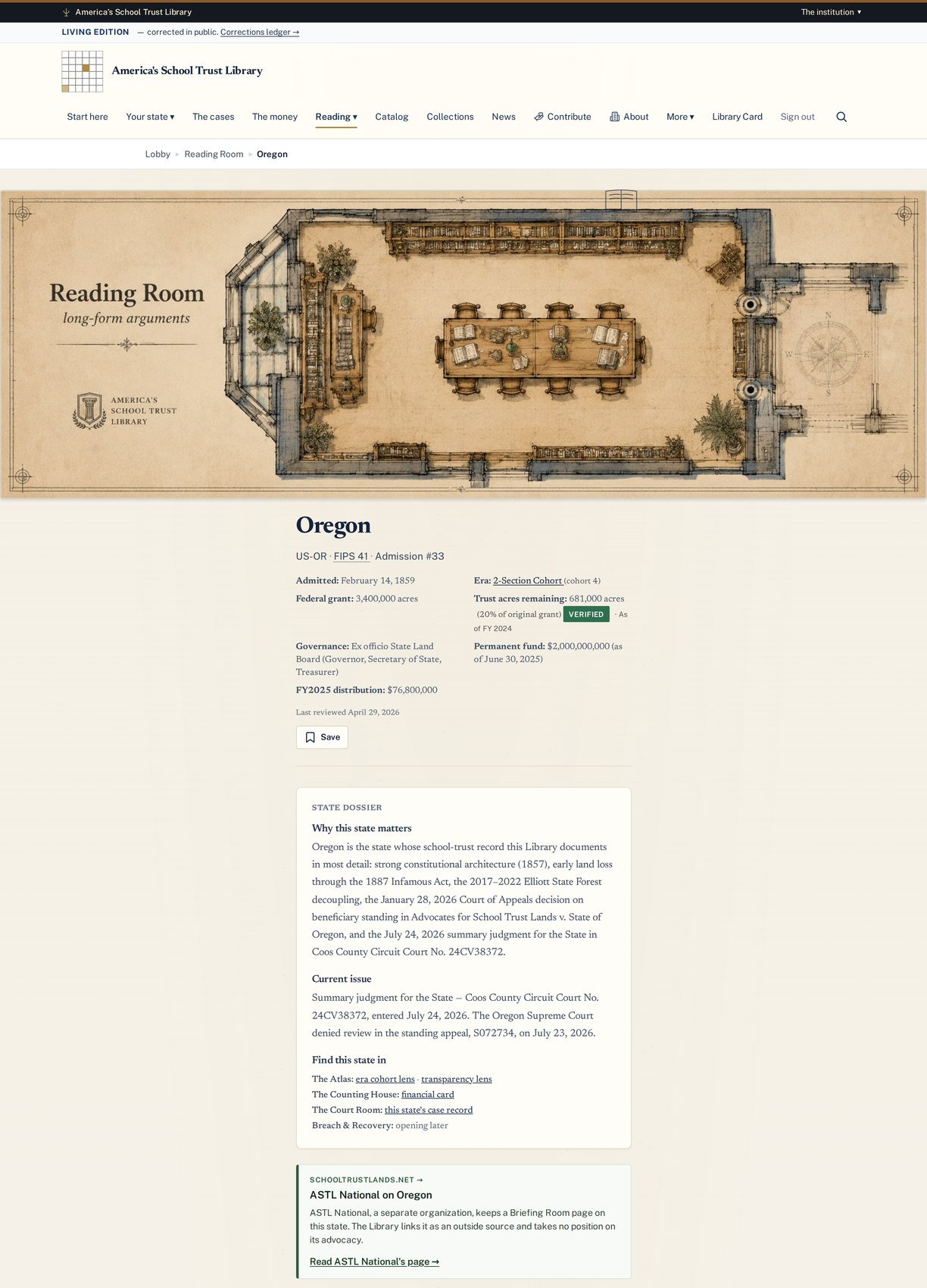
Figure 2.One state, one page. Oregon’s page opens with the figures a trustee is asked about — admitted 1859, a grant of 3,400,000 acres, 681,000 acres remaining, a permanent fund of $2,000,000,000 as at June 30, 2025 — and then says when each was last reviewed. A Verified badge on a single data point is not the catalog’s Verified label for a whole holding, which no holding yet carries.
America’s School Trust Library, schooltrusts.org, read September 7, 2026.
What you can send
Old agency reports; board minutes; lease and sale records; audits; maps; the annual report from the years before the website. If you are not sure something belongs, describe it rather than send it.
Nothing confidential. Nothing privileged. Nothing your agency treats as closed. The Library does not want it and will not take it.
The curator’s seat, if you want it
A State Co-Librarian curates one state’s corner of the Library’s records: reviewing what is there, flagging what is wrong, identifying the period sources that should be added — enabling-act language, audit reports, attorney-general opinions, superintendents’ reports, reform-era statutes — and triaging what readers in the state send in.
Five to ten hours a month after an onboarding pass. Standing accrues; the commitment is bounded; it renews annually. The state’s pages carry the curator’s name.
What the Library asks is accuracy, good faith and a few hours. What it does not ask: political alignment; a position on any active litigation, pending audit or policy dispute; or any material your agency considers confidential.
How to say yes
Write to the Library at library@schooltrusts.net, saying which state you know and how you know it — or apply directly at /apply/state-co-librarian/. Either route reaches a person. The pseudonymity tier is a tick-box on that application page; the verification is handled by the board and stays with the board.
For teachers
The oldest school-funding decision in American history is a shape on a map, and it is probably within a few miles of your classroom.
In 1785 Congress directed that the western lands be surveyed into townships six miles square, and that Section 16 of every township be reserved for the support of public schools within it. A township is a survey unit, not a town: thirty-six sections of one square mile each, 640 acres apiece, numbered from the northeast corner. Section 16 sits near the middle. Where one section no longer raised what a school needed, Congress doubled the grant and added Section 36.
Two years later the Northwest Ordinance put the reason in a sentence that ends “… schools and the means of education shall forever be encouraged” (Northwest Ordinance, 1787, Article 3). It is easy to quote and hard to enforce, which is most of the history of the school lands in one line.
The corners are still findable — posts, stone mounds, later brass caps, in hayfields and road ditches. The grid is the deed. That is a lesson you can walk to.
What the Library can put in front of a class
Primary sources, free, with no account required: the granting act in the federal statute book; your state’s constitutional clause accepting the trust; land patents, which record the moment a piece of ground leaves the public domain; fund reports; maps; photographs of the schools the sections were for. Each is shown with where it came from, and what has not been verified is marked as not verified.
For older students the more interesting object may be the corrections ledger — a numbered public list of what this institution published and then got wrong. The errors are real and the fixes are dated.
What a teacher can give back
A finding. A class that checks one figure on its own state’s page against the state’s own report is doing verification work. If the class finds an error, a free Library Card opens the correction form — or you can simply write to the Library — and the correction goes into the public ledger with the sender credited.
Local records. School-district minutes, a school’s own history, a photograph of the schoolhouse the section paid for, the file nobody has opened since the move. Attics matter as much as archives.
The story itself. The 1785 story is not taught in most places, and you are standing where it could be.
How to say yes
Write to the Library at library@schooltrusts.net: what you teach, where, and what you would want a packet to contain. If you would rather begin by using the shelves, they are open at schooltrusts.org/states/ and always will be — free, permanently, and reading asks for no account.
For families and historians who hold records
Somebody in your family kept the papers. A career’s worth of field notes; agency reports from an office that no longer exists; interviews on cassette; photographs with names on the back.
Those files do not survive a move, a failed drive, or a funeral. This is not a failure of care. It is the ordinary fate of a record with no keeper.
The Library has now done this once, in public, with a living creator watching every step. Here is what happened.
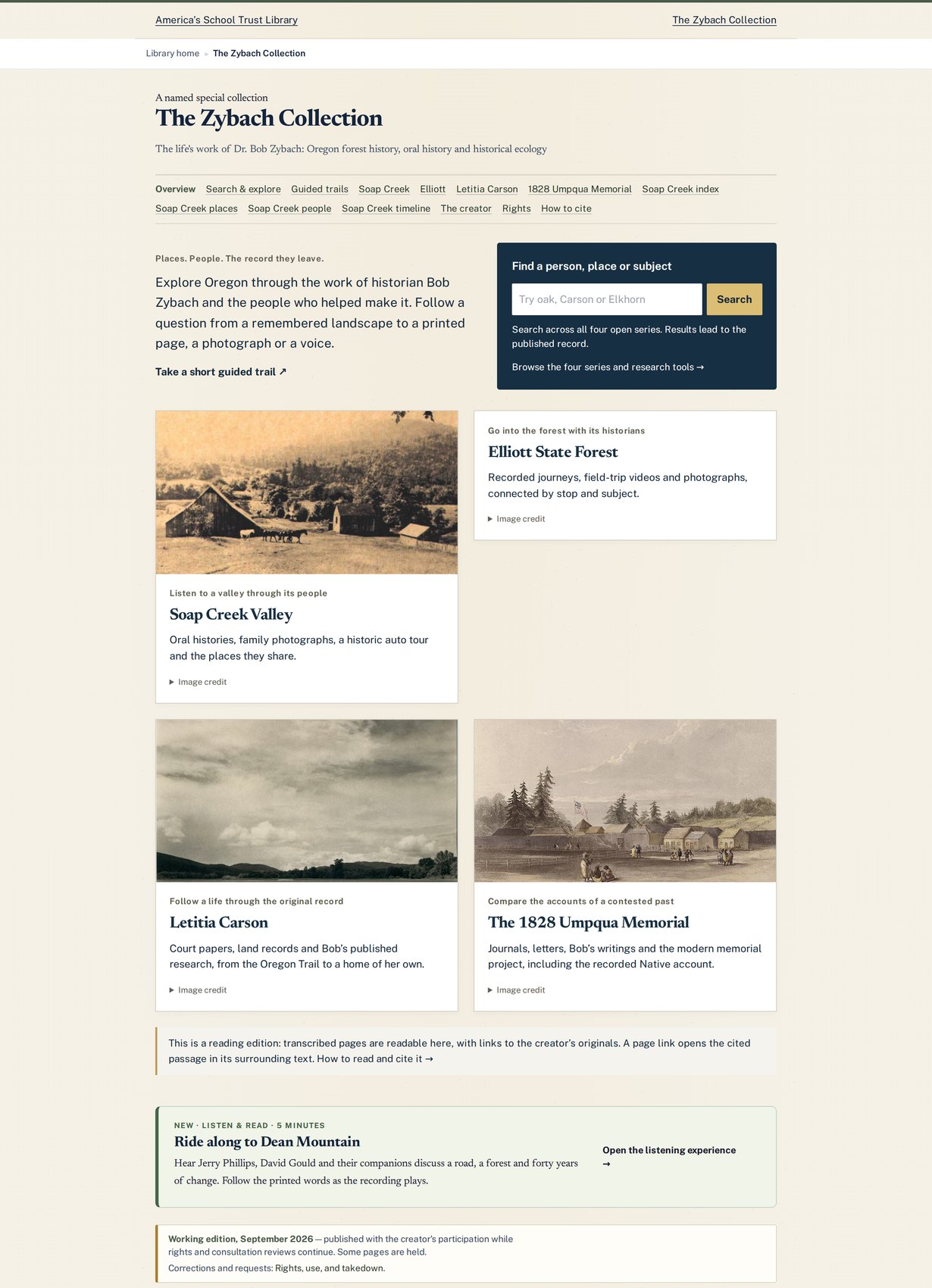
Figure 3.A collection with a front door. The Zybach Collection opens on four series — Soap Creek Valley, the Elliott State Forest, Letitia Carson, the 1828 Umpqua Memorial — and a search box that reaches all four. The panel at the foot names the edition: working, September 2026, published while rights and consultation reviews continue.
America’s School Trust Library, schooltrusts.org, read September 7, 2026.
What the Library did with one man’s life’s work
In June 2026 the Library sent Dr. Bob Zybach a signing packet for his research archive. The Library’s pages describe him as the historian of Oregon forest history, oral history and historical ecology. His reply the next day raised three concerns: permanence, meaning where the originals would live; the value of a life’s work; and his own time. The packet was rewritten. He became a Contributor, not a Donor. The copyright-assignment option was dropped. The originals stay wherever he chooses.
It went public on September 4, 2026 as a working edition — labelled unfinished, because it is — and on September 5 stood at 1,829 pages, every monograph page addressable so that any page can be cited and linked.
And some of it is held. 108 pages of the Soap Creek monographs and the 1999 thesis are held under one notice, with further material in the 1828 series; the reasons are kept internal. Each held page keeps its printed number and its permanent link, so a citation to it still lands in the right place.
Wow! I just spent about an hour on this and it is amazing! A little bit intimidating dealing with my own work, but definitely impressive and functional.
Quotation pending his written approval — Bob Zybach, email, September 5, 2026
For Bob Zybach to write
In Bob’s own words
Anything you would tell a person who is deciding whether to let a library do this to their papers — including what worried you, and whether it turned out to be the right worry. About 150 words. It goes in as you write it.
The terms, in plain words
A non-exclusive licence. You give the Library permission to publish and keep every right you hold today, including every commercial right; you may publish, sell or license the same material anywhere else.
No money changes hands. The Library pays nothing for a collection and takes nothing exclusive; that is what keeps you free.
The originals stay where they are. The Library’s edition is a copy and an index, not a claim on your paper.
Holds for anything sensitive. Material can be withheld from the edition under one generic notice, with the reasons kept internal — including anything you have not yet decided about.
A takedown rule, published before the collection went up. Two business days to acknowledge; removal from search while a request is reviewed; a written decision within ten business days. A request from a tribal government is honoured immediately. A narrator’s or a family’s objection is final — no investigation, no argument.
Nothing is locked shut. A hold or a withdrawal can be asked for at any time and is decided under the published takedown rule.
Describe what you hold rather than sending it, and the Library will tell you whether it belongs: before any substantial accession the board answers in writing where it belongs and what school-trust question it illuminates. If there is no good answer the Library declines, with thanks and a referral. A collection in the wrong library is lost twice.
How to say yes
Write to the Library at library@schooltrusts.net: what you hold, roughly how much of it there is, where it is now, and what you would need promised before you let it be copied. Nothing is signed at that stage, and nothing is moved.
What recognition looks like
The three open seats are uncompensated. What the Library offers instead is rarer, and it offers it deliberately.
Credit on the page. An accepted contribution carries its maker’s name, and the attribution travels with the page; a correction is credited to its sender by name unless they ask otherwise. Scholarship that uses the Library will cite pages carrying those names.
A seat. Named roles are real: a state’s records carry their curator’s name at the foot, and the Library keeps a public ledger of who holds which office. A title on a real institution’s roster is usable in a bio, a CV, or an obituary. A vacant office is shown as vacant, never as staffed.
A shelf. A substantial body of work is kept as a named collection, intact, with its creator’s own biographical note and its own finding aid — the guide that tells a reader what is in a collection and where.
Recognition follows work already done. That is why it means anything.
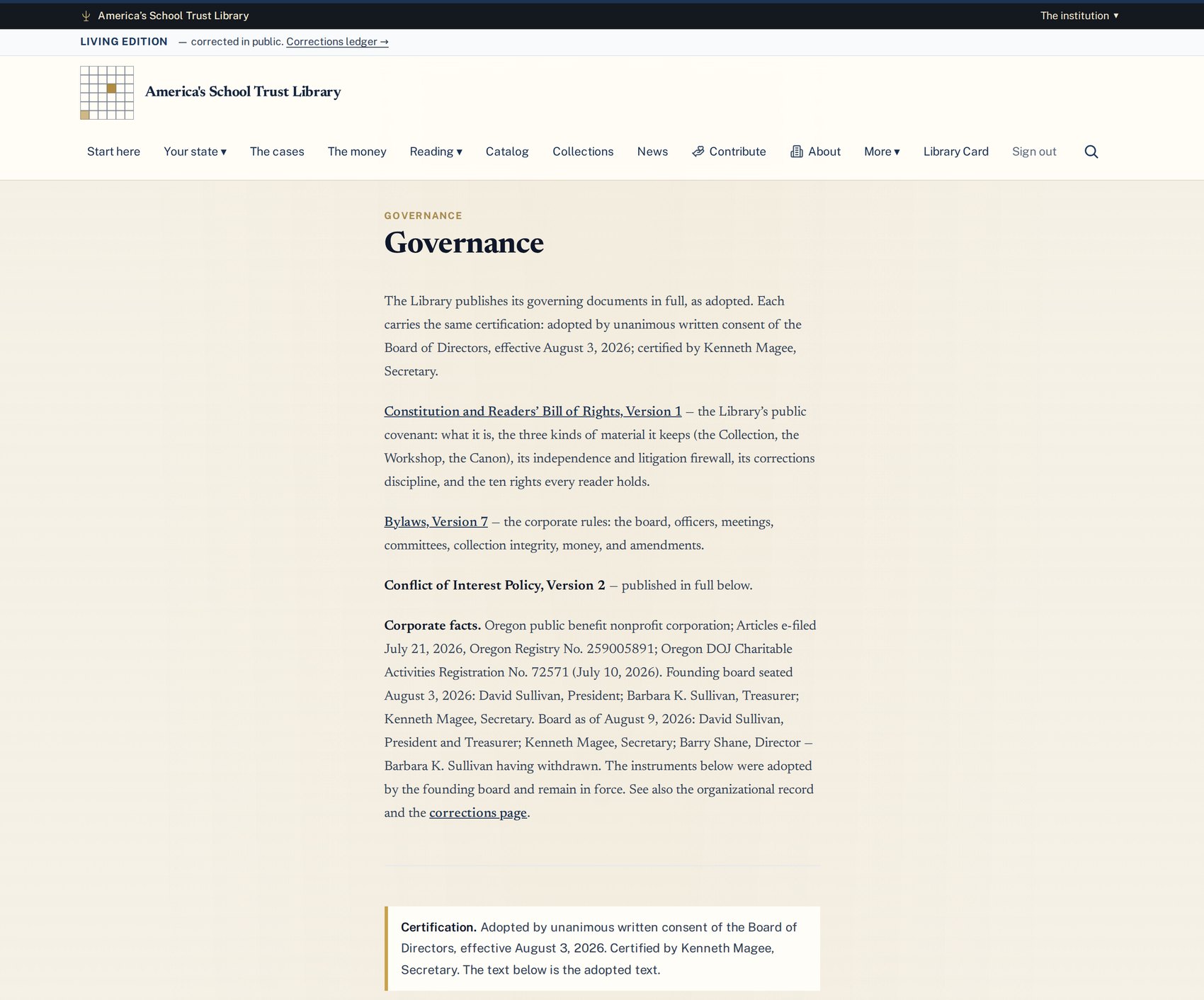
Figure 4.The instruments, published in full. The Library posts its Constitution and Readers’ Bill of Rights, its Bylaws and its Conflict of Interest Policy as adopted, each certified the same way: by unanimous written consent of the board, effective August 3, 2026, certified by Kenneth Magee, Secretary. The corporate facts sit on the same page as the documents.
America’s School Trust Library, schooltrusts.org, read September 7, 2026.
Why you can trust it
Because the Library corrects itself in public, with numbers on it. The ledger runs through entry 021 as of September 7, 2026, and its first entries corrected the Library’s own outdated statements about itself.
Because any reader may challenge a claim without payment, professional status, or agreement with the Library, and a credible challenge receives a reasoned disposition — with an appeal decided by people who did not decide the first question. Those are rights in the adopted Readers’ Bill of Rights, and they cannot be suspended because an office is vacant or money is short. On the site the correction form asks you to sign in with a free Library Card, so a librarian can write back; a letter does the same work.
Because the Library will not give away its own label. A data point on a state page may carry a Verified badge for that figure; the catalog’s Verified label, for a whole holding checked by a second reader, has not yet been earned by any holding — not one of the 72 in the August 10, 2026 catalog, including the ones the Library’s own founders wrote.
“Better an empty shelf than an unearned label.”
Three seats are open
All three are one-year terms, uncompensated and renewable, and each requires a signed annual disclosure. Under the adopted bylaws the board meets at least quarterly and works by written consent between meetings.
Director — two seats
What the seat is for. The board is three people: a President and Treasurer, a Secretary, and one Director. Three is enough to act and too few to disagree usefully. These seats exist so that the Library’s decisions are made by people who did not build it, and so that the founder can be outvoted.
What it asks. Read the thing before voting on it. Dissent on the record. Sign an annual disclosure and recuse without being asked. Name two or three real people a year for seats, council or collections.
What it does not ask. No fundraising quota. No litigation: the adopted Constitution keeps the Library out of it, and Directors are not asked to take a position either.
Who this fits. Someone who has sat on a board that governed rather than applauded — a trustee, a school-board member, a librarian or archivist with governance experience, a lawyer who has been the one to say “not yet.” One seat would ideally bring a discipline the Library does not yet have.
Law Librarian — one seat
What the seat is for. The Law Librarian can say, on the record, that a citation has been checked against the reporter, and is accountable when one has not been. The seat owns the citation standard and is the second signature on the Verified shelf.
What it does not ask. No litigation support. No brief-writing. No opinion on the merits of any pending case.
Who this fits. A law librarian, a reference or government-documents librarian, a legal-research instructor, a retired appellate clerk, a paralegal with a citation habit.
For all three
If one of these describes you, or someone you know, write to the Library at library@schooltrusts.net, addressed to the Secretary, Kenneth Magee. Two paragraphs is plenty; there is no form to fill in for these seats.
The Library, in one paragraph
America’s School Trust Library keeps the public record of America’s school-land promise, freely, neutrally, and permanently, so that every debate, every reform, and every classroom question can rest on facts that no one controls and everyone can check. It takes no side in any case or campaign. A person who disagrees with everything its founders believe can use the same shelves and find them unchanged.
schooltrusts.org
The whole shelf is at Participate. Mistakes
are corrected in public, with a number, in the
corrections log.
Drafted with an AI system for the Library’s board, from the Library’s own record, and checked against that record by people. Version 1, September 2026.