Welcome to America's School Trust Library. Explore the history of land
set aside to support public schools and the records of how states manage
it. The Library brings together books, maps, financial reports, legal
documents, and news so you can see what was promised, what the land
earned, and what each state makes public. This tour shows you where to
begin.
School Trusts
Compare states and State land maps
Use Compare states to explore differences in school trust lands, funds,
and public records. Use State land maps to find available maps and see
what each state publishes about the location of its trust lands.
Compare school trust funds and payments to schools across states.
Trust finances shows how well each figure is supported by sources and
makes gaps in the available financial information clear.
Browse Books & documents for reading organized by topic, including
history, laws, and research. For information about a particular state,
choose Find your state under School Trusts in the menu.
The Writing Room is open to readers. Browse a draft handbook on
school trust law; The Forgotten
Forever Gift to Public Schools, a history; Who Steals from
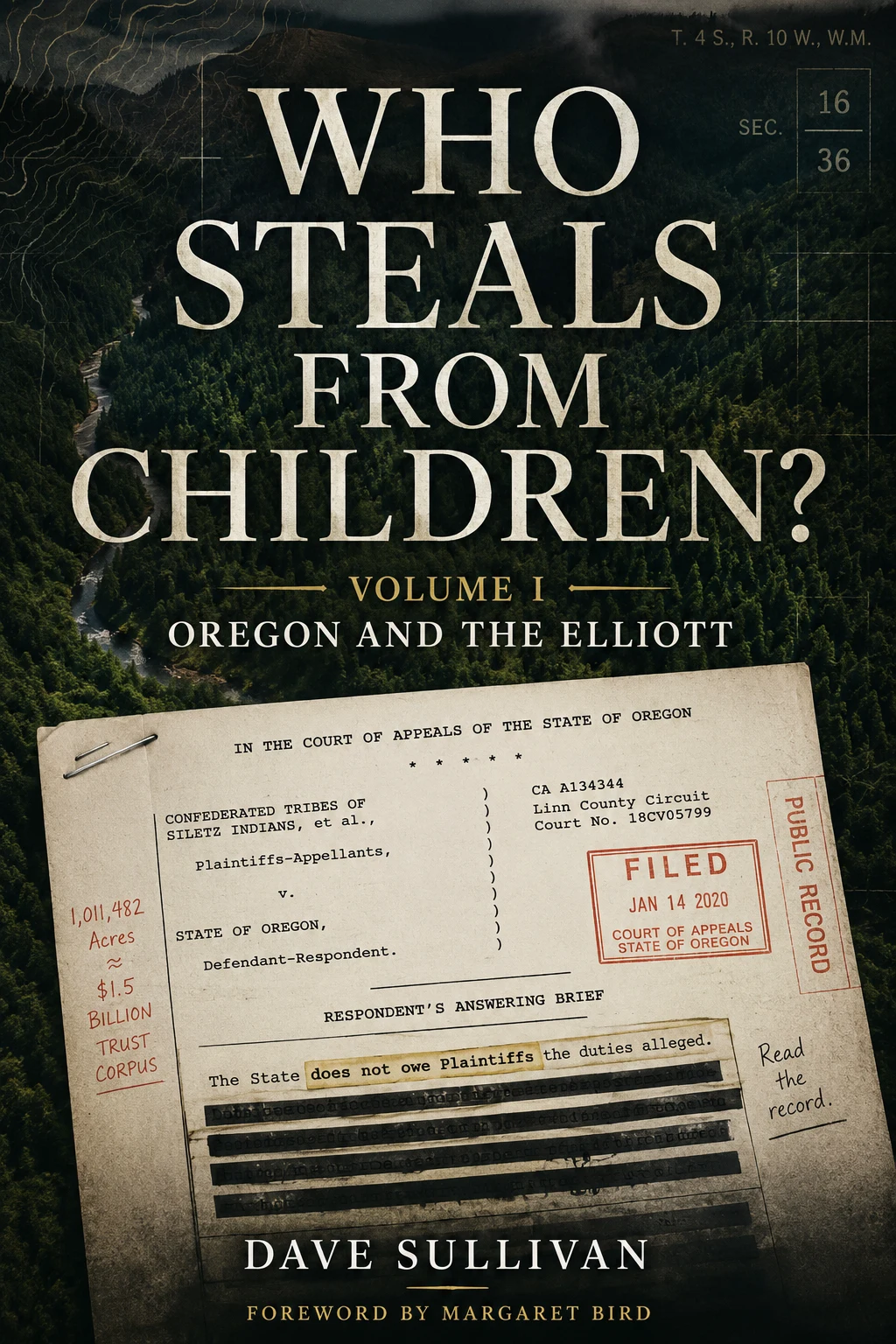
Children, the Oregon record; and Stewards of the Republic,
ideas for the future. Read essays on building institutions that
support public schools for generations.
School trust news follows developments in school trust lands and funds,
including court filings, hearings, and settlements. Commentary shares
contributors' views on what the records show. A free Library Card lets
you track your reading and contribute to the Library.
Three book-length works carry the Library's argument: the historical record, the diagnostic frame, and one state's case file taken through to judgment.
The schoolchildren of 1859 were promised an endowment. So were the
schoolchildren in classrooms today. So are the schoolchildren for whom
the corpus was pledged in perpetuity — the ones who will be alive in
2150 and 2250, when the trust is supposed to still be earning.
America's 240-year school-trust record is the only worked existence
proof we have of what a multi-generational fiduciary commitment
requires, and what it loses when the requirements are not met.
The Library exists to make that record findable, and to put it in the
hands of the people now designing the next forever-institutions —
climate trusts, sovereign wealth funds for the unborn, AI-targeting
authorities, longevity escrows, compute reserves. They are designing
in the present tense. The school-trust record is the evidence they
need.
The Library's argument runs in two halves. The first half is the
diagnosis: what goes wrong, and why, when an aspirational trust is set
adrift. The second half is the architecture: what holds the trust on
course when it is built right, and who has to be standing watch for
the architecture to keep working.
The diagnosis — without anchors, the ship drifts
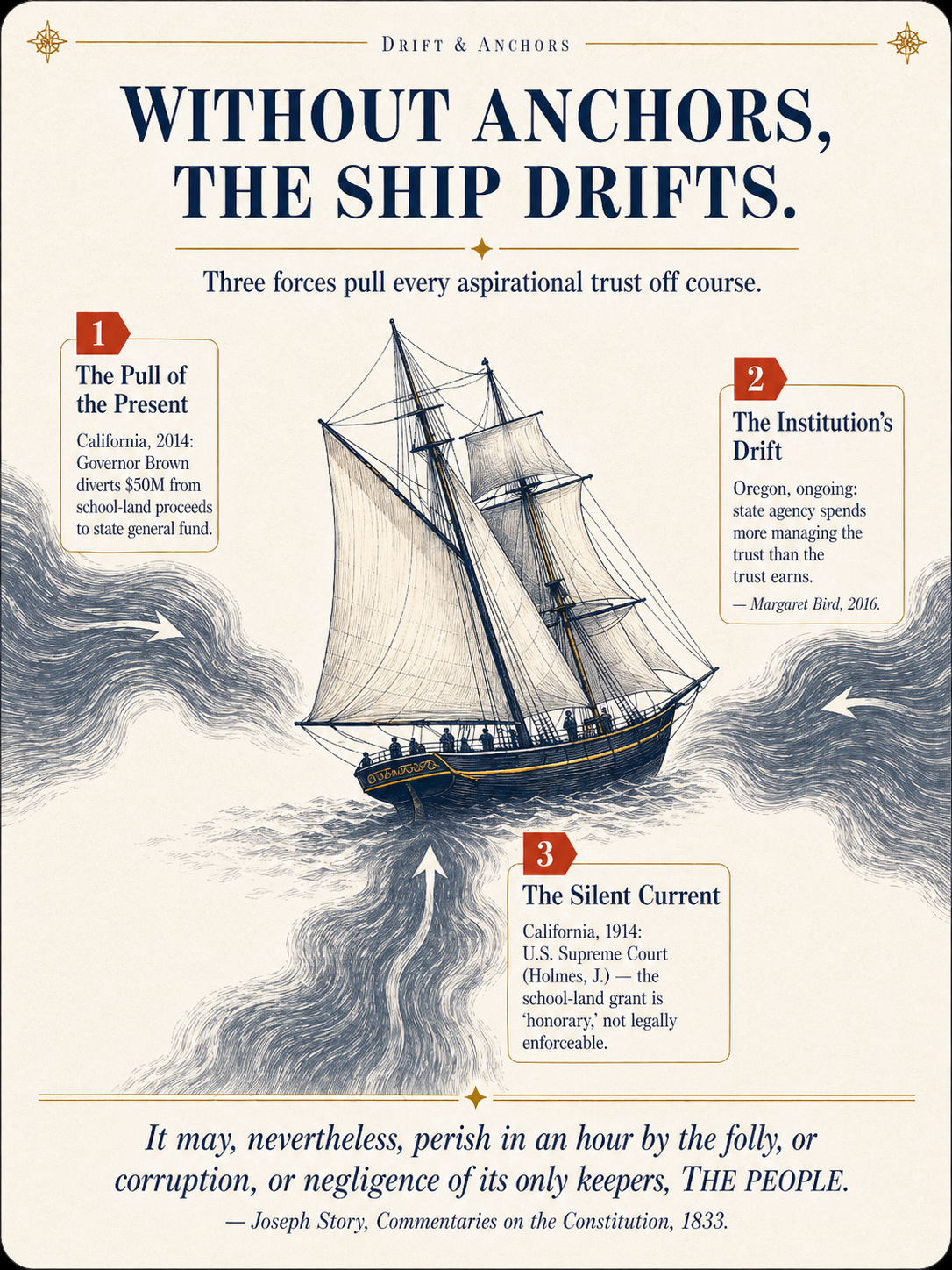
Without anchors, the ship drifts. Three forces — The Pull of the Present, The Institution's Drift, and The Silent Current — pull every aspirational trust off course.
Every trust the country has built across two centuries — school
trusts, conservation trusts, statutory funds for future generations —
has had to make headway against three steady forces. Each force is
invisible in any one budget cycle. Each is decisive across the
lifetime of the trust.
The Pull of the Present is the legislator's
understandable hunger to deploy the corpus now rather than honor the
compact for later. California, 2014: Governor Brown directed roughly
$50 million in school-land revenue away from the State School Fund
and into the State General Fund. The decision was administrative. The
corpus shifted; the beneficiaries lost; the next year's budget closed.
The pull works because every trustee's political reward function runs
on this year's news, and the beneficiaries who lose are not yet old
enough to vote.
The Institution's Drift is the slower failure: a
managing agency that, year by year, begins to spend more administering
the trust than the trust returns. Margaret Bird, in her 2016 testimony
to the Oregon State Board of Education, named the threshold: "You
are spending more managing the trust than the trust earns for the
schools." That is no longer stewardship. It is consumption of the
corpus by the apparatus charged with protecting it.
The Silent Current is doctrinal — the slow legal
redefinition under which a trust the framers wrote in commanding
language is treated, a century later, as a polite suggestion.
Alabama, 1914: Justice Holmes, writing for the U.S. Supreme Court in
Alabama v. Schmidt, called the school-use promise an
"honorary obligation" — not federally enforceable. The
doctrine changed without anyone moving the corpus. The corpus simply
lost its legal handle.
These are the three currents the Library names, and the three the
historical record shows in operation across fifty admission-era
trusts. Joseph Story saw the same currents from the other end of the
country two centuries ago: "It may, nevertheless, perish in an
hour by the folly, or corruption, or negligence of its only keepers,
THE PEOPLE."
That sentence is the spine of Volume I.
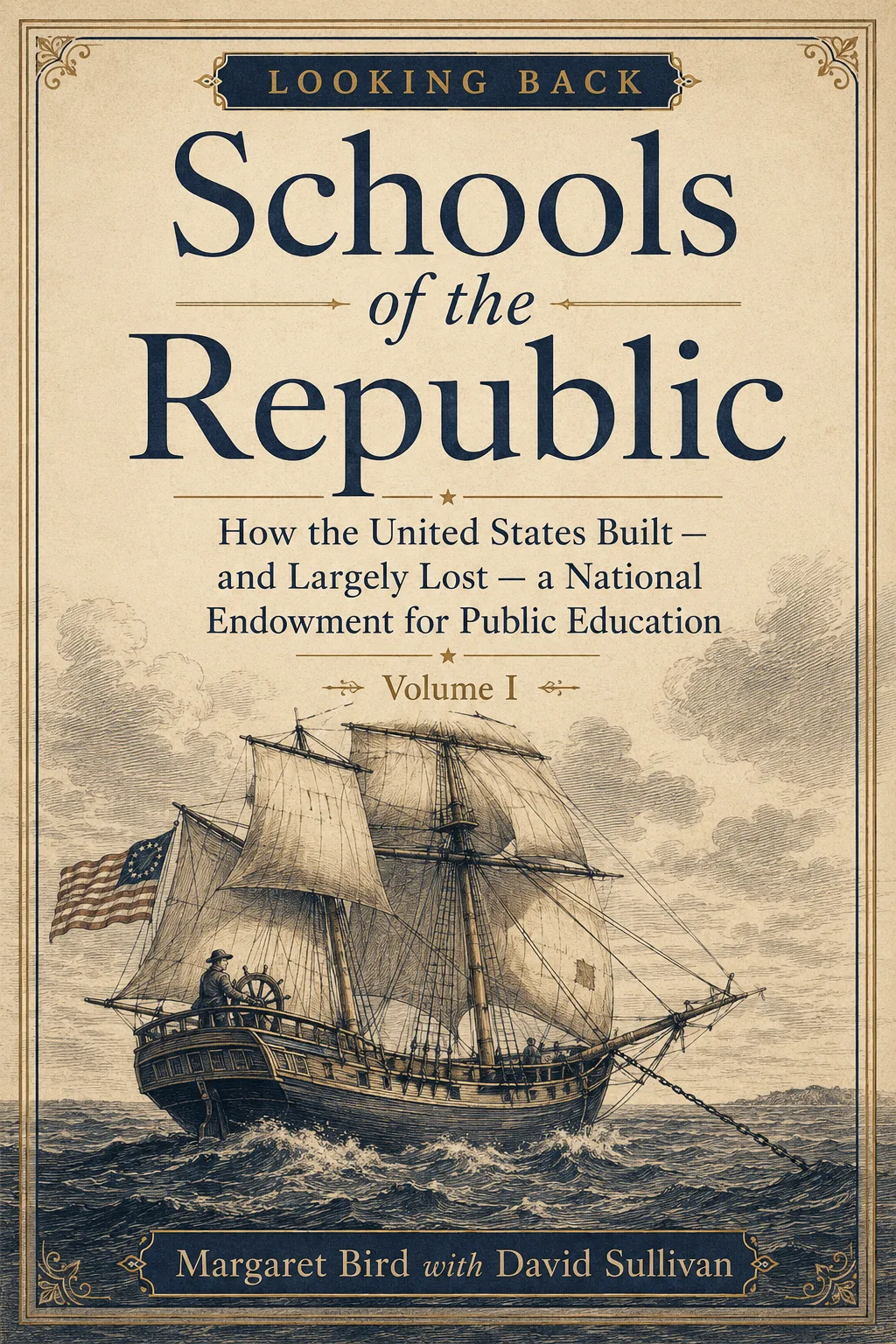
Volume I · LOOKING BACK
The Forgotten Forever Gift to Public Schools
How the United States built — and largely lost — a national endowment for public education.
Margaret Bird with Dave Sullivan · Six chapters of synthesis · ~250 pages.
Volume I is the historical record. Six chapters trace the school-trust
experiment from the 1785 Land Ordinance through the 1787 Northwest
Ordinance, the antebellum doubling of grants from one section per
township to two, the Reconstruction western stack, and the 1910 New
Mexico–Arizona Enabling Acts that mark the federal architecture's
high-water mark. The chapters name principals — Manasseh Cutler, Rufus
Putnam, Joseph Story, Sandra Skousen, Margaret Bird herself, the
trustees who held and the trustees who let go — and they name the
cases that determined what "in trust" meant in actual courtrooms:
Sherman v. Buick; Cooper v. Roberts; Lassen;
Branson; Skeen.
The fifty state dossiers, elsewhere in this room, hold the
per-state evidentiary detail. Volume I tells the story the
per-state record adds up to.
The architecture — anchors hold only when a crew stands watch
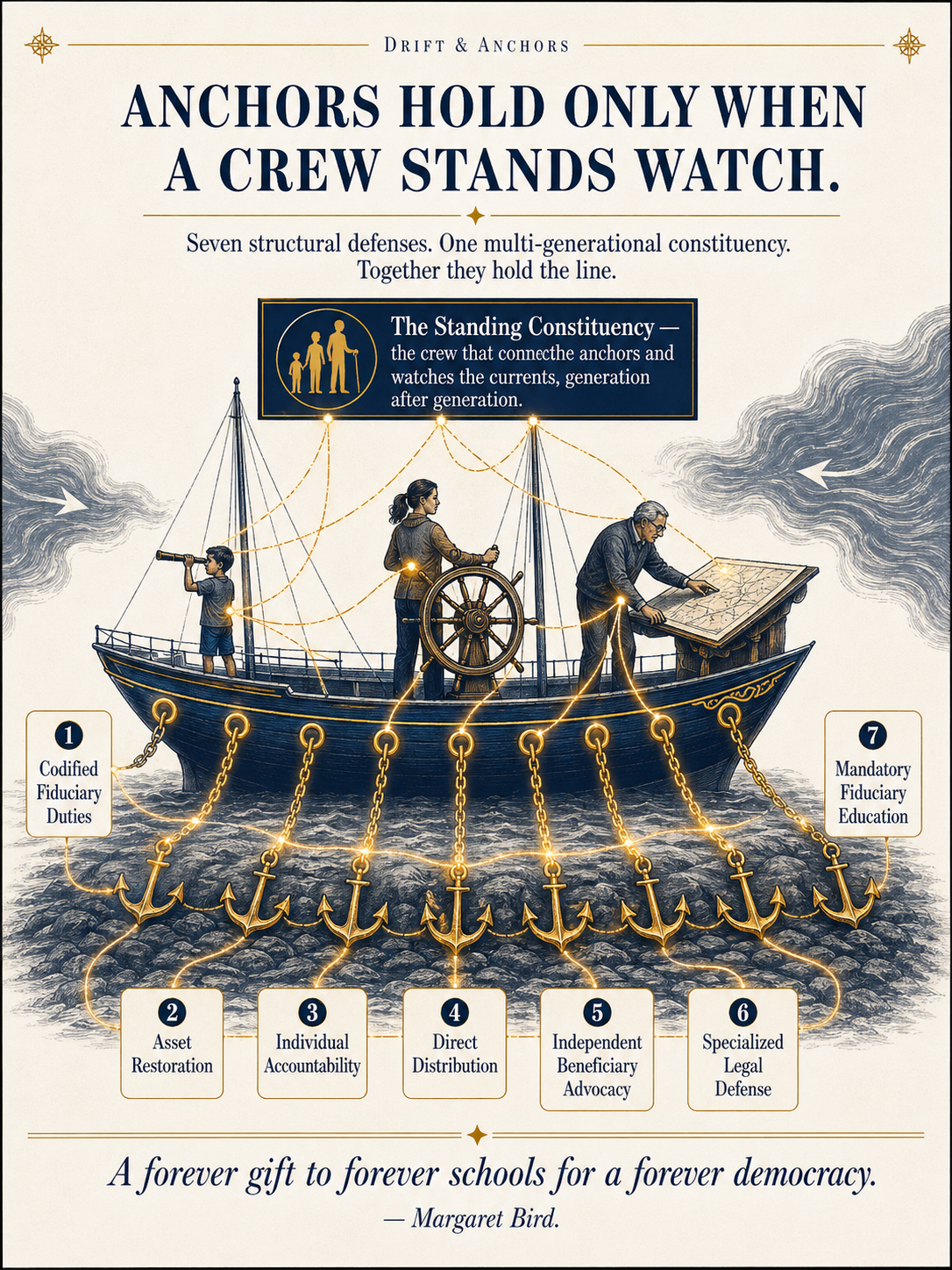
Anchors hold only when a crew stands watch. Seven structural
defenses chain the ship to the seabed; above the deck, a
multi-generational crew stands watch.
The diagnosis names the currents. The architecture answers them.
Volume II names seven structural anchors that the record proves are
necessary, and one constituency without which the anchors will not
hold.
The seven anchors — each one a structural defense that the
school-trust record shows is both necessary and operable:
Codified Fiduciary Duties. The duties of loyalty,
prudence, and impartiality written into statute and constitution in
language a court can enforce, not relegated to administrative rule
a future trustee can rescind.
Asset Restoration. Statutory authority and routine
procedure for putting back into the corpus what has been taken out
— including diversions discovered decades after the fact. Without
restoration, every breach becomes a permanent loss.
Individual Accountability. Personal liability for
trustees who breach. Trust law has always carried this; modern
administrative practice has largely walked away from it. The record
shows the walking-away.
Direct Distribution. Trust earnings reach the
beneficiaries — every parent, teacher, and principal in every
school — not the general fund, not the managing agency's overhead.
Direct distribution is the move that builds the constituency.
Independent Beneficiary Advocacy. An office or
institution funded by the trust whose only job is to speak for the
beneficiaries against the trustees when their interests diverge.
The Attorney General is structurally the wrong office for this; the
record shows why.
Specialized Legal Defense. Counsel trained in
fiduciary law, funded out of the trust, with standing to defend the
corpus in court. Without it, the beneficiaries cannot enforce their
own grant.
Mandatory Fiduciary Education. Trustees are taught
what their duties actually are before they are seated, and audited
periodically against those duties. The trustee who does not know
the standard cannot meet it.
These seven would themselves suffice — if they ran on auto-pilot.
They do not. Every one of them can be hollowed out by drift, captured
by an administrator, or quietly repealed in a busy session. What
keeps the seven anchors holding is what the second panel calls
the Standing Constituency: a multi-generational crew
of citizens, parents, teachers, principals, journalists, advocates,
watchdog officials — across every party, across every term — who
treat the architecture as binding and who notice when it is being
weakened.
This is the central insight the school-trust record adds to
fiduciary law: architecture alone, without a constituency, drifts;
constituency alone, without architecture, has no leverage. Together
they hold the line. That constituency-as-defense is the argument
Stewards of the Republic carries.
The constituency is built one way — Margaret Bird's way, learned in
Utah and proven over a generation. "Increase the revenue to
schools, get it directly to every single school where the parents,
the teachers, and the principal are deciding how the money is
implemented. And all of a sudden, you have built a huge
constituency." Utah shows what that discipline can build: a trust
constituency that notices diversions and pushes back. The pattern repeats wherever the
four conditions — codified duties, restoration, individual
accountability, direct distribution — are met together.
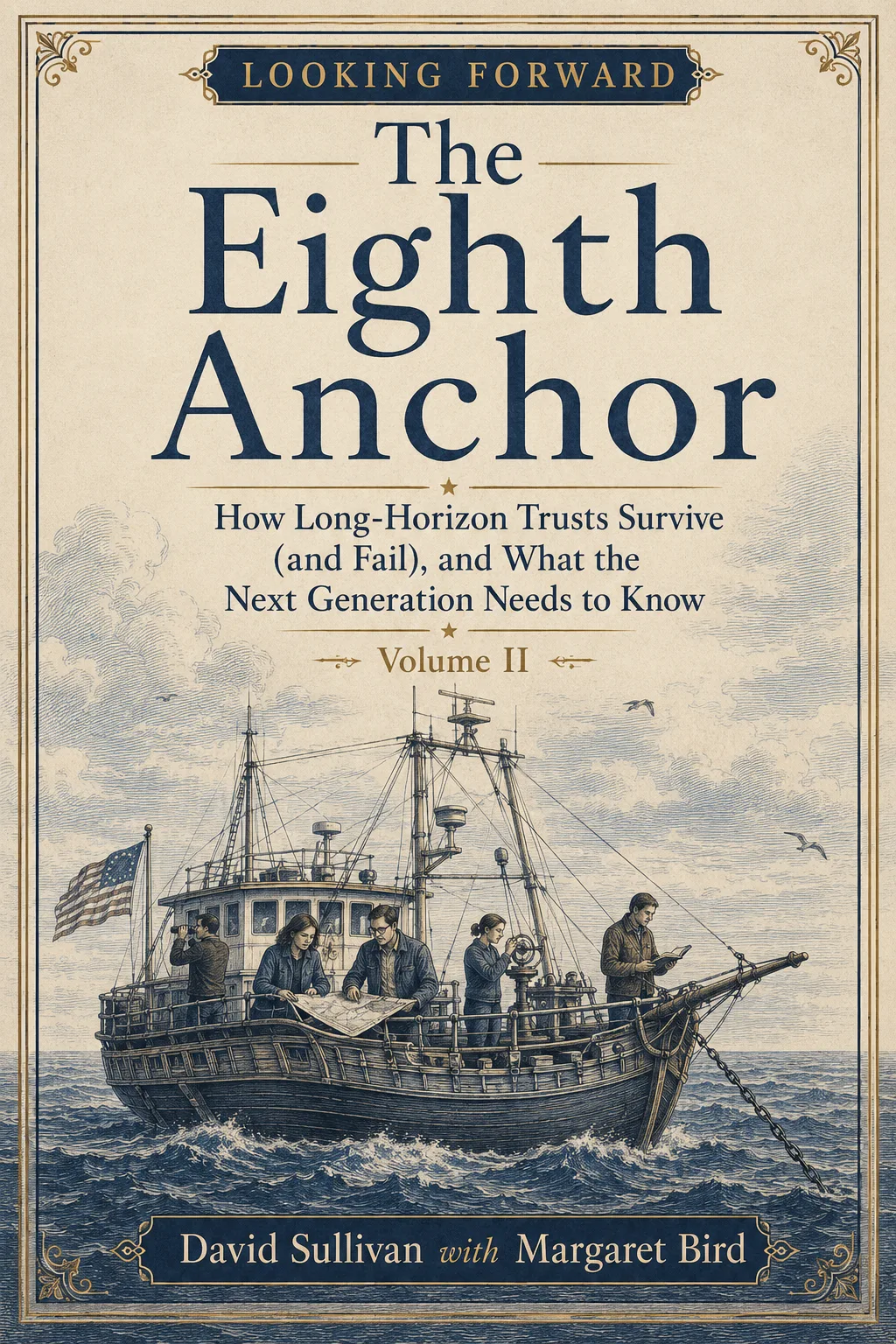
Volume II · LOOKING FORWARD
Stewards of the Republic
How long-horizon trusts survive — and fail — and what the next generation needs to know.
Dave Sullivan · Prologue plus eight sections · ~150 pages.
Volume 1 is co-authored by Margaret Bird and Dave Sullivan —
Margaret's career fighting for school trusts pulls her gaze
backward, into the empirical record; Volume 2 is Dave Sullivan's
alone — his background in information systems pulls his gaze
forward, into what the next fiduciary institutions will need to
hold.
Volume II is the diagnostic frame that the historical record
produces. It opens with the school-trust experiment as the only
existence proof we have, walks through the four faces of drift, lays
out the seven-anchor counter-architecture in detail, names the
AI-era forever-trusts now arriving at the architects' tables, and
closes with a direct letter to those architects asking each one the
question the school-trust record makes unavoidable: where is the
watchful crew in your institution?
The two volumes are designed to be read either way. The record
first, if you want the proof. The frame first, if you want the
argument. They meet in the middle.
The first two volumes name what holds a multi-generational trust
together and what breaks it. The third book takes the diagnosis to a
single state's case file. The State of Oregon has spent thirty-five
years removing a billion-dollar working trust asset — the Elliott
State Forest — from the Common School Fund. The schoolchildren of
Oregon are the named beneficiaries. The author writes from inside the
litigation as the lead plaintiff. On July 24, 2026 the Coos County
Circuit Court granted the State summary judgment in No. 24CV38372,
holding that the State owes no legally enforceable fiduciary duty,
and canceled the trial that had been set for August 18–28, 2026. The
Library takes no position on whether the ruling was right.
Who Steals from Children is the Library's series-in-progress.
Volume 1 is the first case file. Future volumes will follow as each
state's record is assembled.
Volume III · THE OREGON RECORD
Who Steals from Children: Volume 1 — Oregon and the Elliott
One state's case file, taken through to judgment. The diagnosis at work against a billion-dollar working trust asset.
Volume III is the first of the Who Steals from Children
series, a state-by-state record of school-trust breaches that
are happening in the present tense. Volume 1 is Oregon: the
thirty-five-year removal of the Elliott State Forest from the
Common School Fund, told from inside the case by the lead
plaintiff. A first-person, scene-grounded account. Documentary
record woven in as the author encountered it. Boxed insets carry
the underlying statute language, the relevant court opinions,
and the numbers — so the reader who wants the doctrine can find
it without slowing the narrative for the reader who does not.
Where Volumes I and II diagnose, Volume III sets the diagnosis
against a single state's record. On July 24, 2026 the Coos County
Circuit Court granted the State summary judgment in No. 24CV38372,
holding that the State owes no legally enforceable fiduciary duty,
and canceled the trial that had been set for August 18–28, 2026.
The schoolchildren of Oregon are the named beneficiaries.