Why this matters
Why this matters
A 60-second read on what the school-trust experiment teaches the architects of the next century's intergenerational trusts.
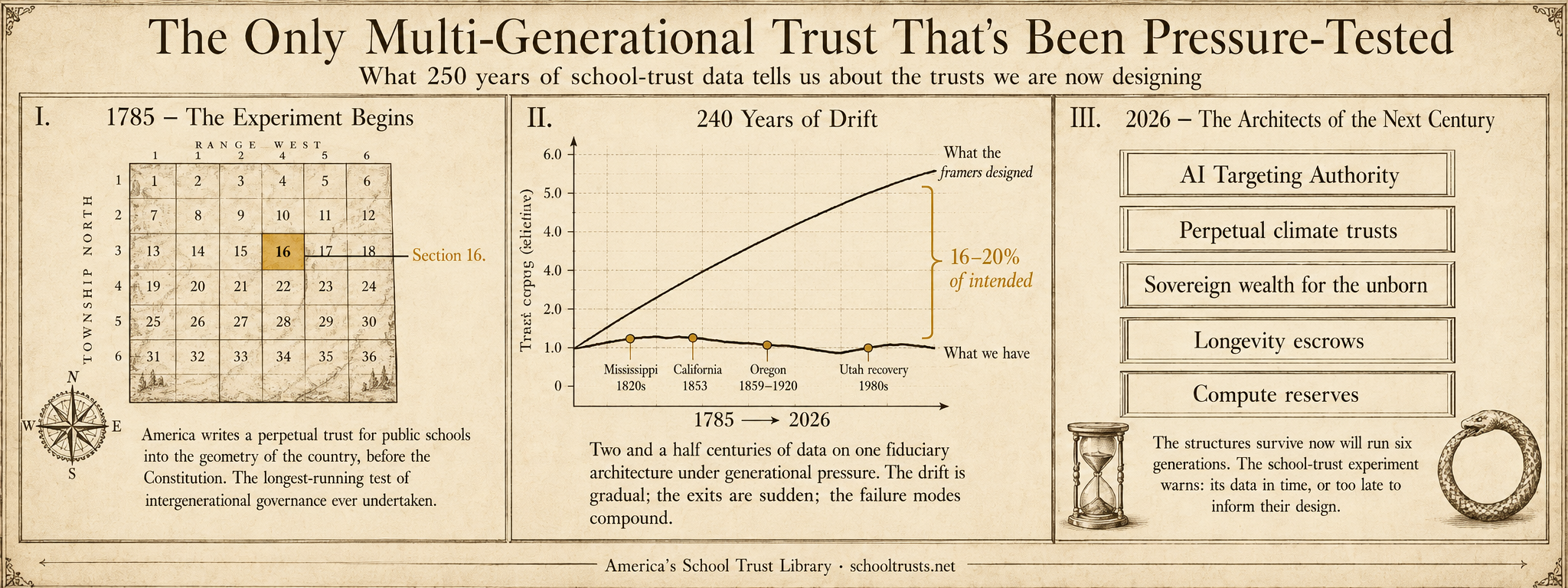
In 1785, before the Constitution was written, the United States set aside one square mile of every six-mile township for the maintenance of public schools. The men who voted for that one sentence had no Constitution, no national bank, no permanent capital, and no constitutional authority to tax their own citizens. What they did have, before they had finished building the country, was the conviction that an educated citizenry was the thing on which the republic would actually stand or fall — and an asset, not yet possessed, that they could pledge in trust to the children who would not be born for another hundred years.
It was the longest-running experiment in intergenerational governance ever undertaken. Two and a half centuries later, the experiment has returned its data.
In some places — Utah today, Oregon between 1920 and 1990, New Mexico across most of its history — the architecture worked, the constituency held, and the trust grew toward the framers' intention. In others — California from 1853 forward, Mississippi across the nineteenth century, Arizona in the past three decades — the architecture eroded faster than the people running it could compensate for. The aggregate result is an endowment, in 2026, of somewhere between sixteen and twenty percent of what it would have been had the design been operated as the framers designed it.
Two failure modes compound. The first is drift — slow, predictable, structural. The corpus is rotted by inflation. The purpose is hijacked by adjacent demands. The beneficiary class is quietly redefined. The founding mandate is modernized into something more fashionable. Each of these is a normal-day decision; none of them feel like betrayal at the moment they happen. The second failure mode is directed seizure — sudden, opportunistic, often legally legitimated. A legislature votes to redirect the fund. An agency reclassifies the lands. A statute is amended to permit what was forbidden. The first mode operates over decades; the second over days. Both have happened, repeatedly, across all fifty states.
This data is the only multi-generational evidence the world has on how perpetual fiduciary structures behave under generational pressure. It is also arriving at exactly the moment when humanity is beginning to design several more such structures — perpetual climate trusts, sovereign wealth funds for the unborn, AI governance authorities, longevity escrows, compute reserves. Each is an attempt to bind tomorrow's institutions to commitments made today. Each will face the same pressures the school trust faced. None of them yet have the eight structural anchors the school trust has shown are necessary to survive.
This Library exists to make that data findable to the architects of those next-century structures. What we built in 1785, what happened to it across 240 years, and what those years teach the people now designing its successors — that is the argument now gathered in the Library's forward-looking Volume II materials, and the evidence that Schools of the Republic documents state by state.
I am really committed to this project because I honestly believe it is important for all mankind … we need — collectively — to build an understanding between biological intelligence and artificial intelligence about how to transfer power and skills and legacy and capital … over a forever time in a manner that will hold and won't drift. No one else is talking about the experience we have with how that sort of transfer will inevitably drift or will inevitably have sudden attempts to hijack any long-term trust.
— Dave Sullivan, in his Founder's Statement, May 2026