How This Library Works (v1, archived)
America's School Trust Library is unusual among libraries. It is built on a five-layer knowledge architecture that turns scattered primary sources — statutes, court opinions, agency reports, period newspapers, oral histories, expert declarations — into the essays, dossiers, and reference works visitors read. Every claim cites its source. Every figure has an anchor. The architecture is the same whether the visitor is a school-board member preparing for a vote, a journalist on the education beat, an attorney looking for case law, or a student writing a term paper.
This page exists because a few visitors will want to know how the Library actually works — how a primary source becomes a Reading Room essay, how a state correspondent's note becomes a Newsroom item, how a state Department of Lands staff member's correction makes its way back into the substrate. Two posters answer the question. The first shows the architecture as it stands at any given moment. The second shows how material moves through it over time.
Why now
Three things became true at once. None of them was true a decade ago.
A comprehensive, cross-jurisdictional, cross-decade analysis of how school trusts fail — gradual drift and sudden seizure both — became possible for the first time, carried by a partnership between human judgment and frontier AI models doing the synthetic load that no scholarly team had ever taken on.
The architects of the next fiduciary era — AI Targeting Authorities, perpetual climate trusts, sovereign wealth for the unborn, longevity escrows, compute reserves — are at their drafting tables now. The school-trust corpus is the only multi-generational record long enough to teach the lessons that hold, and the lessons must reach the architects while the charters are still drafts.
The Library's architecture — the Knowledge Stack, the named offices, the public stewardship pattern — is itself part of the contribution. The pages that follow show how it is built.
The knowledge architecture
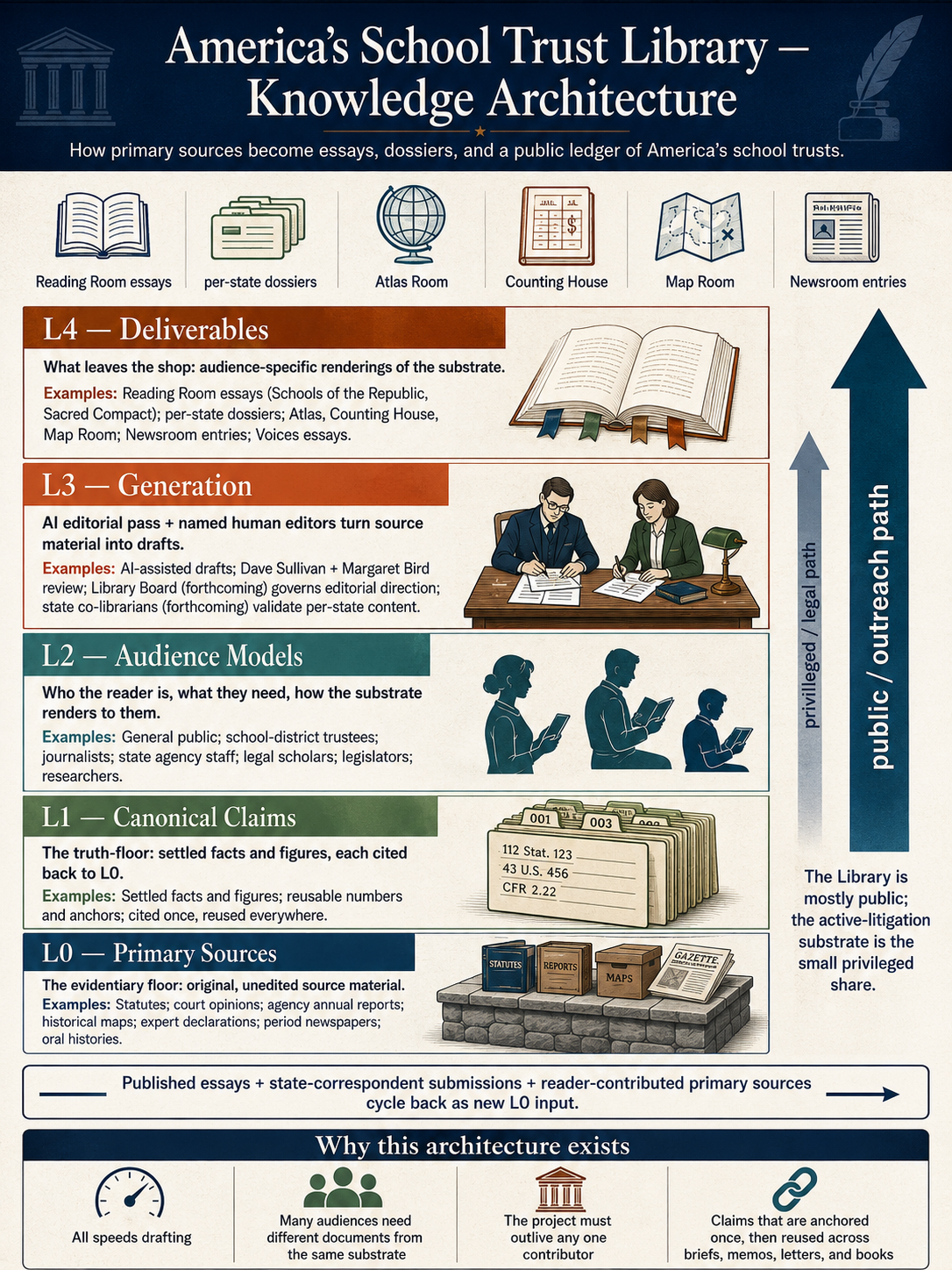
The architecture has five layers. At the bottom, L0 — Primary Sources holds the evidentiary floor: statutes, court opinions, agency annual reports, historical maps, expert declarations, period newspapers, oral histories. Nothing is altered here; sources are catalogued, dated, and never edited.
L1 — Canonical Claims sits above. Each claim — a settled fact, a figure, a doctrinal proposition — is atomized into its own record and cited to L0. The same claim can appear in many published deliverables, but it lives in one place. When new evidence arrives, the canonical claim updates and every deliverable that uses it inherits the update.
L2 — Audience Models is where the same substrate is rendered for different readers. A general-public reader looking at the Eighth Anchor essays gets a different rendering than an attorney researching the same trust doctrine. The substrate is one; the audience-specific rendering is many.
L3 — Generation is the layer where the rendering happens. AI editorial passes draft from L1 against L2 audience models; named human editors review, refine, and approve. The Library's editorial discipline lives here.
L4 — Deliverables is what you see when you visit the Library: the Reading Room essays, the per-state dossiers, the Atlas Room, the Counting House, the Map Room, the Newsroom entries, the Voices section. Everything cites back through L1 to L0, so a visitor can always trace a claim to its source.
The architecture's purpose is unromantic but load-bearing: it lets a small team produce evidentiary work at scale without losing the discipline that makes the work credible. Every page on this site is built this way.
The architecture at work
The first poster shows the architecture at rest — what the Library has, layer by layer. A balance sheet. The second poster, below, shows the architecture at work — what the crew is doing, day by day, to keep the work moving through it. An income statement. The same five layers carry both views.
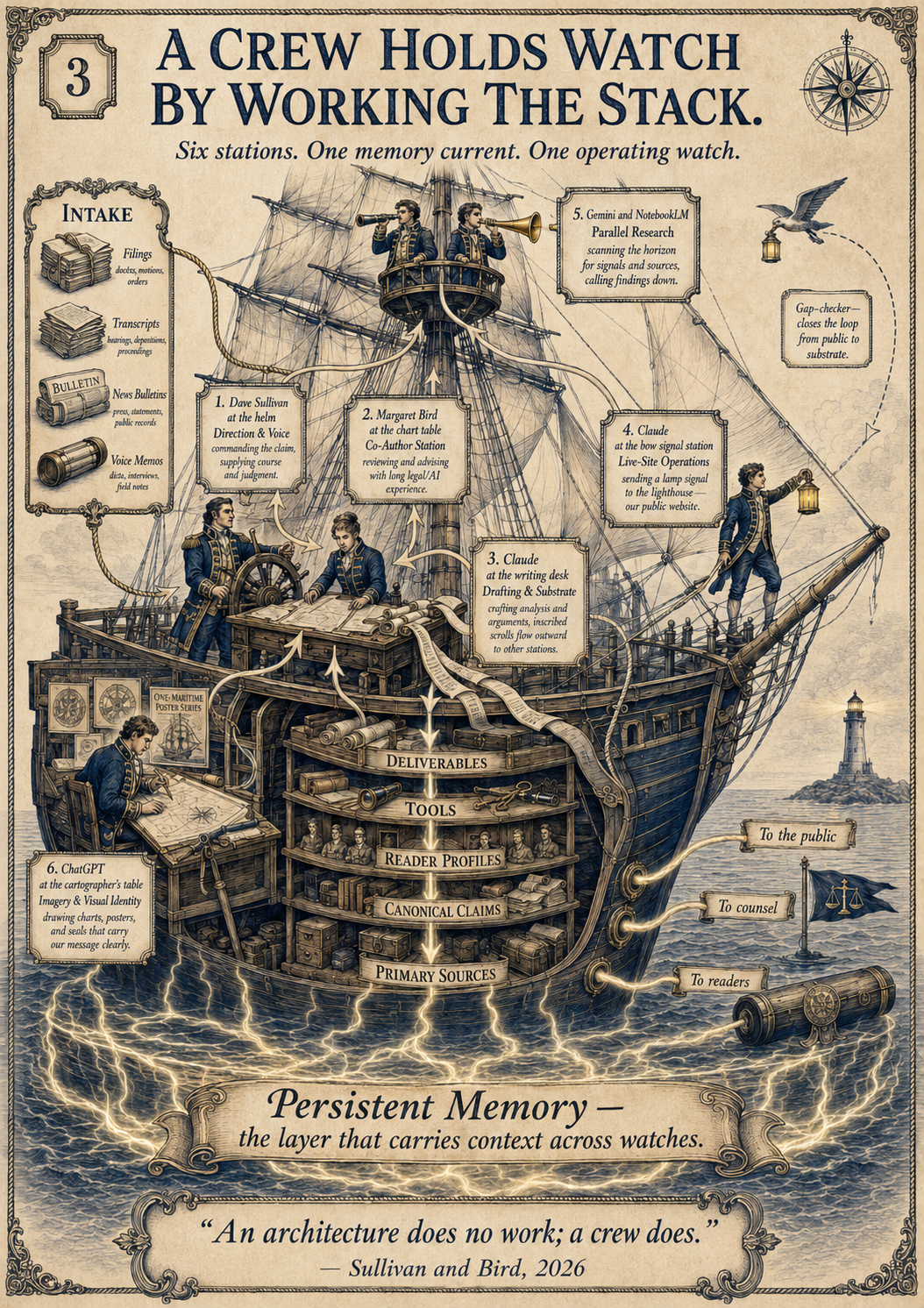
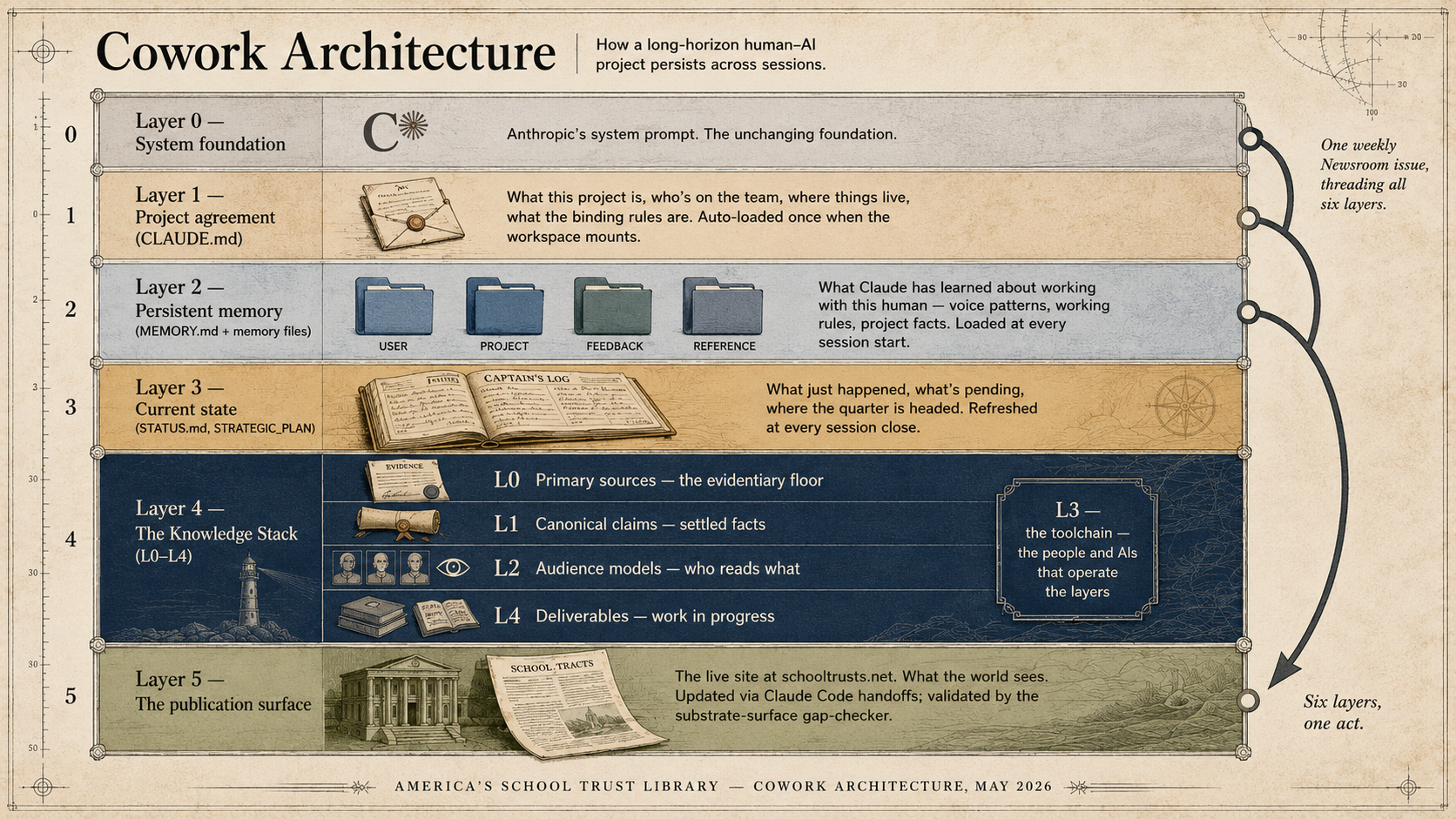
Six stations stand on the deck. Direction and Voice is the founder's seat — the editorial and strategic decisions that set what the Library is for. Co-Author is the named human collaborator whose review every Margaret-voiced or jointly-authored deliverable passes through. Drafting and Substrate is the AI-assisted synthetic load that holds the working context across the Library's many open files. Live-Site Operations publishes the substrate to the public surface readers visit. Parallel Research stress-tests arguments and verifies citations against independent sources. Imagery and Visual Identity produces the visual register the Library speaks in.
Beneath the hull runs the feature that makes the rest of the architecture possible: persistent memory. Each station's work survives into the next session. The framers of 1785 could not draw that current at all; a small team in 2026 can. That is the cognitive-technology shift the Library is built on, and it is the same shift the next-generation architects of forever-trusts will need to engineer for.
The contribution loop
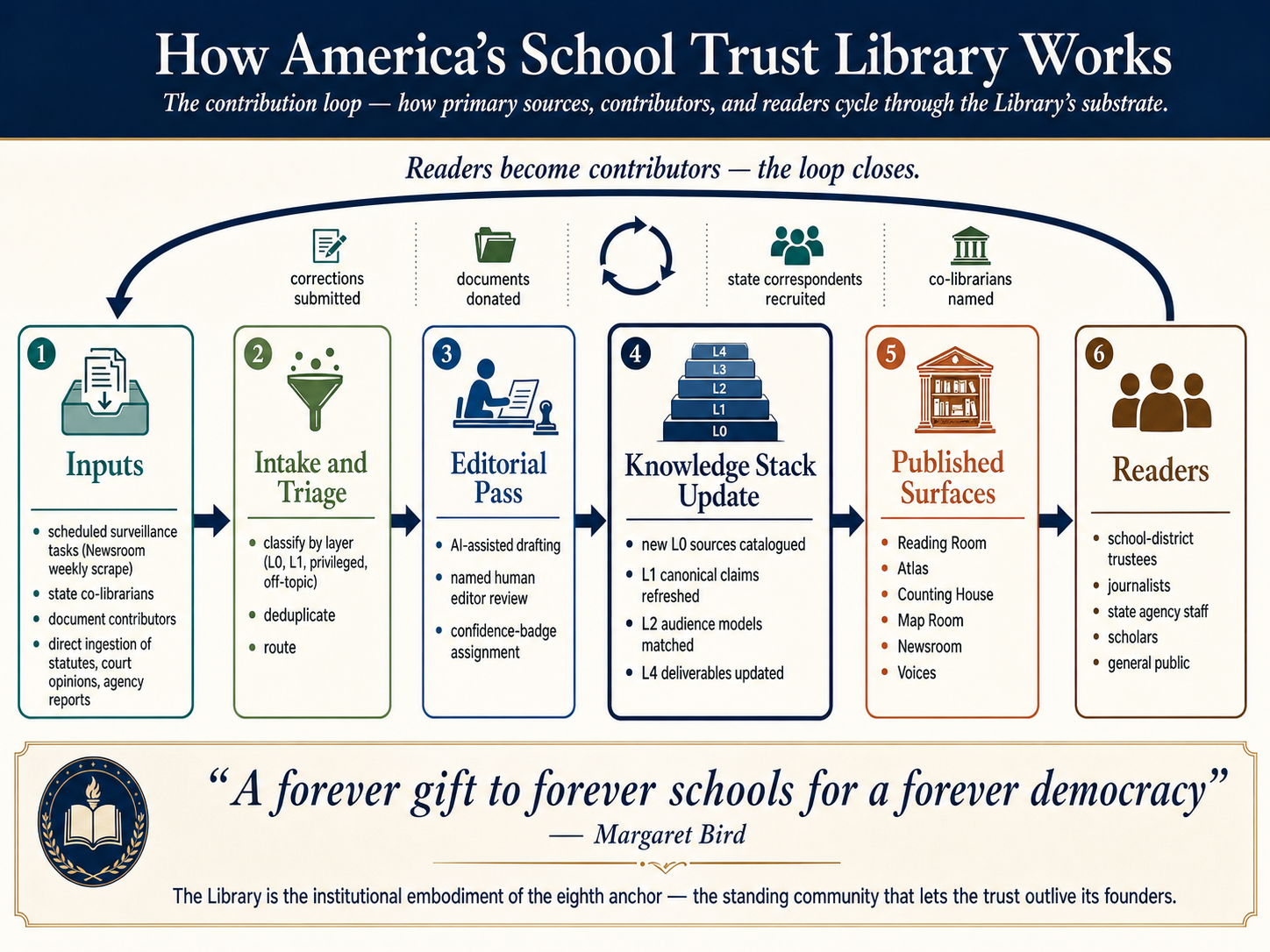
The first poster shows the architecture standing still. The second shows how material moves through it. The flow has four phases:
Inputs. Material enters the Library from several sources: scheduled surveillance tasks (the Newsroom's weekly scrape of state agency websites, legislative information systems, court dockets, regional press); state co-librarians (forthcoming — drawn primarily from State Departments of Lands and equivalent agencies, taking responsibility for their state's page); document contributors who hold primary sources in private hands (old land patents, historical agency reports, family archives); and ongoing direct ingestion of statutes, court opinions, and other public records.
Intake and editorial review. New material is triaged, classified by layer (primary source / canonical claim / privileged / off-topic), checked for duplicates, and routed. The editorial pass that follows is AI-assisted but human-supervised: every published claim has been reviewed and approved by a named editor.
Substrate update. Approved material updates the appropriate layer. New primary sources may produce new canonical claims, which may refresh deliverables that depended on the old claims.
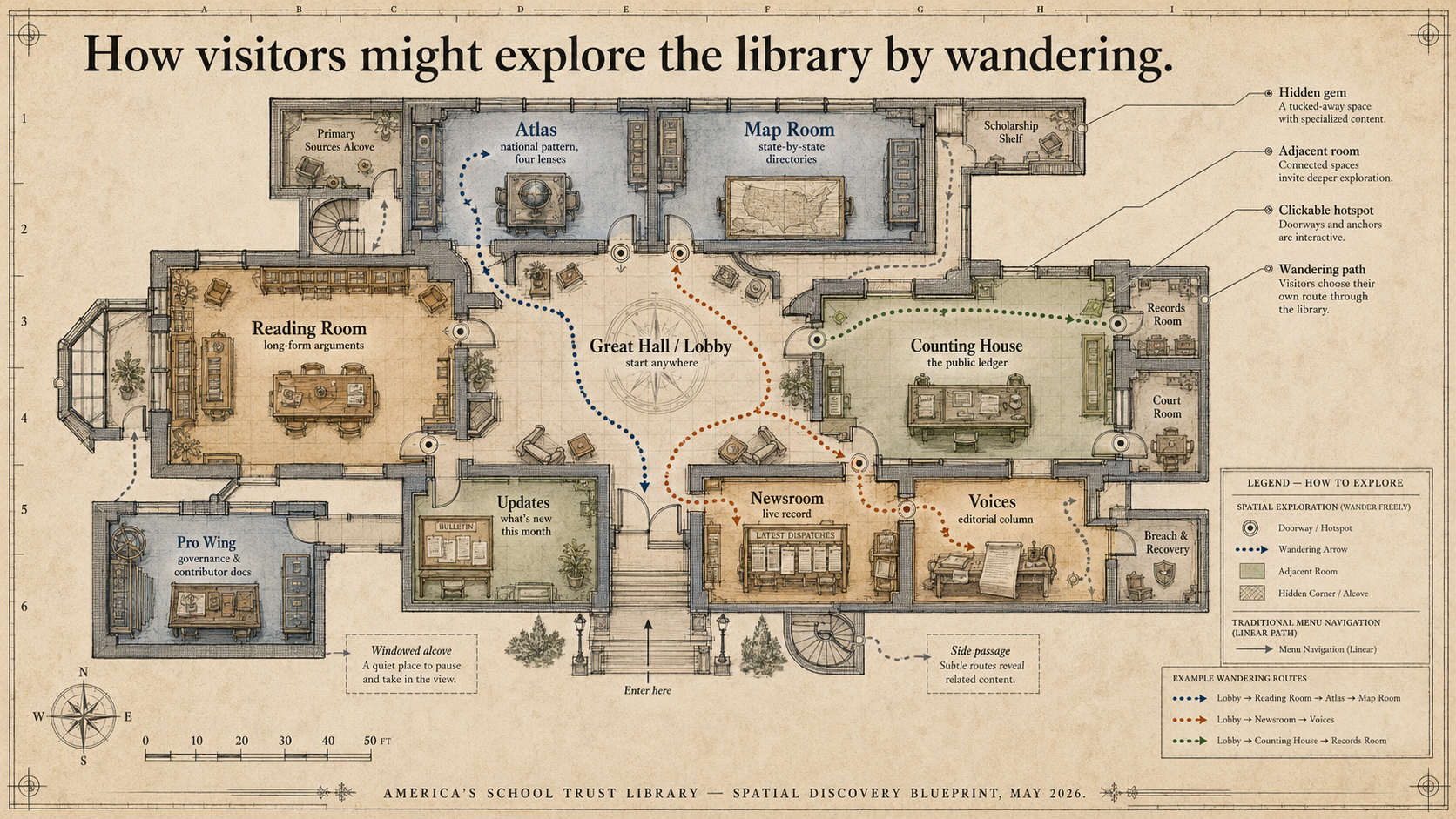
Published surfaces. Updated content reaches readers through the Library's rooms — the Reading Room, the Atlas, the Counting House, the Map Room, the Newsroom, Voices.
The loop closes when readers become contributors. A school-board member who reads the Library's per-state dossier and corrects a date becomes part of the substrate. A retired teacher who shares a 1923 board minute moves the primary-source floor by one entry. A state Department of Lands staff member who agrees to take co-librarian responsibility for their state changes the standing of the substrate, not just its contents. The Library does not have an audience and a staff. It has a constituency that is partly inside and partly outside the institutional wall, and the wall itself is permeable by design.
How to take part
Most visitors come to the Library to read what's been published. That's the point of a library. But the Library was built to grow, and the contribution loop above is the operational architecture of that growth.
If you have a primary source — a historical document, a state agency report, a board minute, a period newspaper clipping, a deed — that bears on the school trust lands, the Document Contribution Desk (forthcoming) is where it goes. If you would like to monitor your state's trust-land administration as a state correspondent — watching legislative bills, board meetings, fund distributions, litigation — the State Correspondent program (forthcoming) is the formal vehicle. If you work in your state's Department of Lands or an equivalent agency and would consider taking co-librarian responsibility for your state's Library page, the State Co-Librarian program (forthcoming) is the role we'd most like to recruit you for.
The Library is in its first year of operation. The institutional infrastructure for the contribution loop is being built openly, so the people who will eventually use it can shape it as it forms.
How the constituency gets built
A trust that needs to last for centuries cannot rely on the people who started it. The founders die. The first generation of trustees retires. The second generation's children hear about the trust from history class instead of from kitchen-table conversation. Without a community that treats the trust as theirs across generations, the architecture drifts — slowly, then suddenly — until the corpus is gone.
Margaret Bird, who led Utah's school-trust reform from a $5 million annual program to a $150 million annual program — thirty times the original amount — names the mechanism that builds such a community. Her words, from a 2025 interview:
Increase the revenue to schools, get it directly to every single school where the parents, the teachers, and the principal are deciding how the money is implemented. And all of a sudden, you have built a huge constituency.
— Margaret Bird, in her own voice
The mechanism is one causal chain: route consequential decisions to the local sites where deliberation already happens; let the deliberation produce an artifact (an allocation, a verified fact, a published account) that bears the deliberator's name; recognize the artifact in a public record; and through that loop, the deliberators become a constituency that defends the trust politically. Skip any link and the chain breaks. Centralize allocation rather than routing it to local deliberation, and the constituency disperses; the corpus rots quietly because no one downstream of the central allocation has personal investment in defending it.
Utah's school community councils — roughly 9,000 parents, teachers, and principals deliberating, school by school, over how their share of the trust income gets used — are what the mechanism looks like in operation. The councils are not a marketing tool or a participation theater. They are the deliberation sites the trust revenue is routed to. The councils' decisions accumulate into local stewardship; the local stewardship accumulates into a state constituency; the state constituency defends the trust when the architecture is later attacked. The thirty-times revenue growth is the visible outcome. The constituency that protected the architecture while the revenue grew is the cause.
The Library applies the same mechanism in its own institutional form. Consequential editorial work — verifying a state's enabling-act citation, transcribing a historical revenue table, curating a state's documentary record, writing the weekly Newsroom note — gets routed to named contributors who decide what to do at their site. Each artifact carries a byline. Each byline writes the contributor into the public stewardship ledger at /the-watchful-crew/. The watchful crew is the cumulative record of those routings.
This is not a metaphor. It is the same mechanism, scaled to the institution that exists to remember the school-trust experiment for the next generation of trust architects. Route → deliberate → produce → recognize → constituency → defense. If the chain holds, the Library will outlast its founders.
Editorial methodology and AI-assistance disclosure
The Library's day-to-day editorial work is supported by AI assistance under the supervision of named human editors. The named founders — Dave Sullivan and Margaret Bird — carry editor-of-record responsibility. AI collaborators (Claude, ChatGPT, Gemini, Grok, used in combination as the work requires) carry the synthetic load that no small scholarly team could carry alone: reading across hundreds of statutes and thousands of pages of case law, drafting from the canonical-claims layer against the audience-model files, and producing the renderings a single reader sees as a finished essay.
Every AI-primary deliverable carries an explicit AI-authorship line that names the human editor of record and the AI collaborator(s) used in the synthesis. Citations are author-verified: the AI does not file claims into the substrate that a human editor has not checked against the primary source. When an error is found — by a reader, a state correspondent, a co-librarian, or the editorial office's own re-reads — the canonical claim is corrected at the canonical-claims layer and every deliverable that depends on it inherits the correction on the next publication pass. Corrections are dated; the Library does not silently overwrite its record of what it once said.
The deliverables this methodology produces are the ones a visitor reads on these pages: The Eighth Anchor, Schools of the Republic, the Library's Argument, the Newsroom entries, and the per-state work in the Atlas, Counting House, and Map Room. The discipline is the same whether the reader is a school-board member, an appellate judge, an SLB trustee, a legislator, a journalist, or a student. Different audiences see different renderings; the substrate beneath the rendering is one.
Last updated 2026-05-06. Posters drafted from the OASTL Knowledge Stack v2 architecture (April 2026); revised for the Library's purpose and audiences.