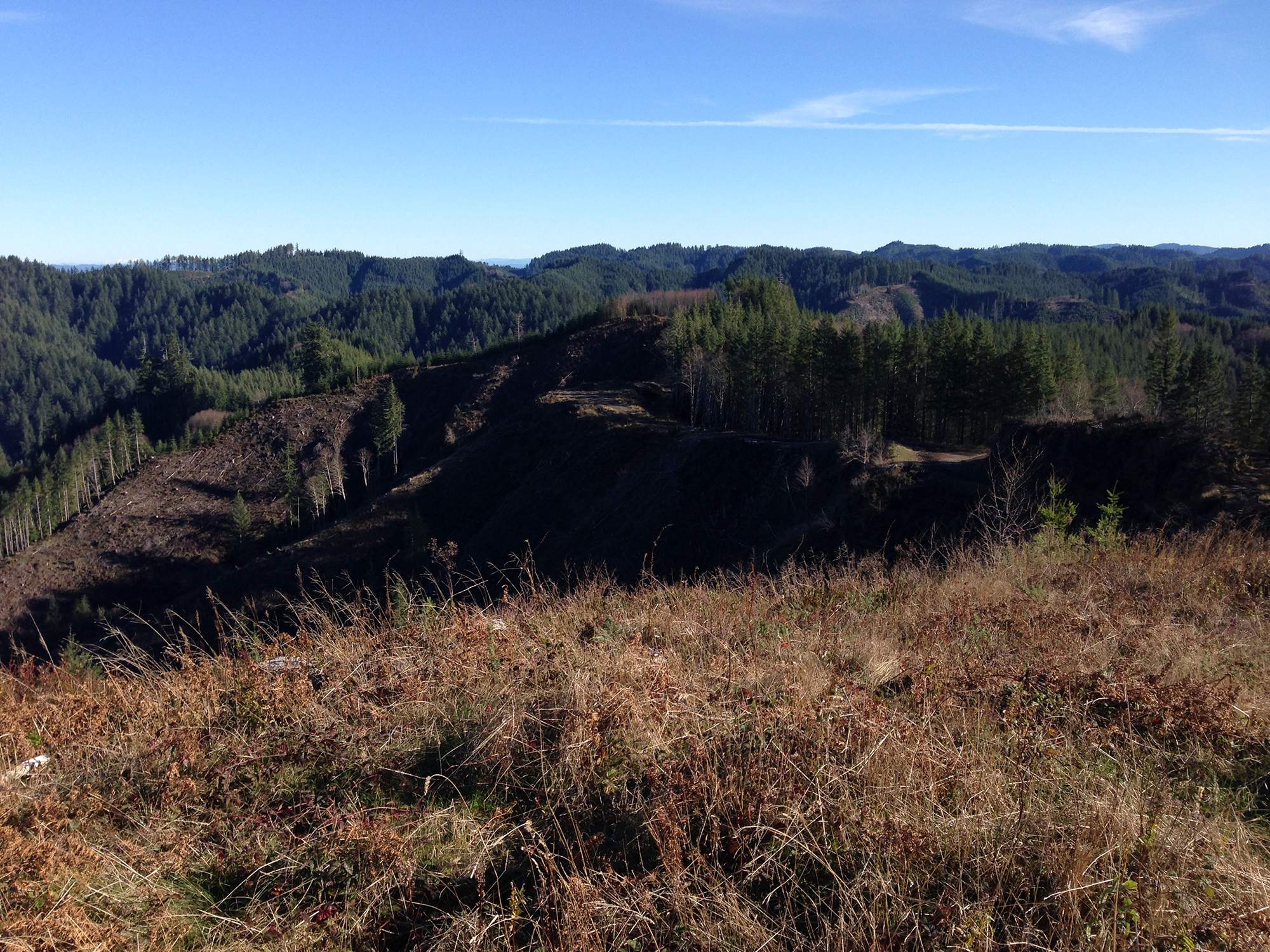
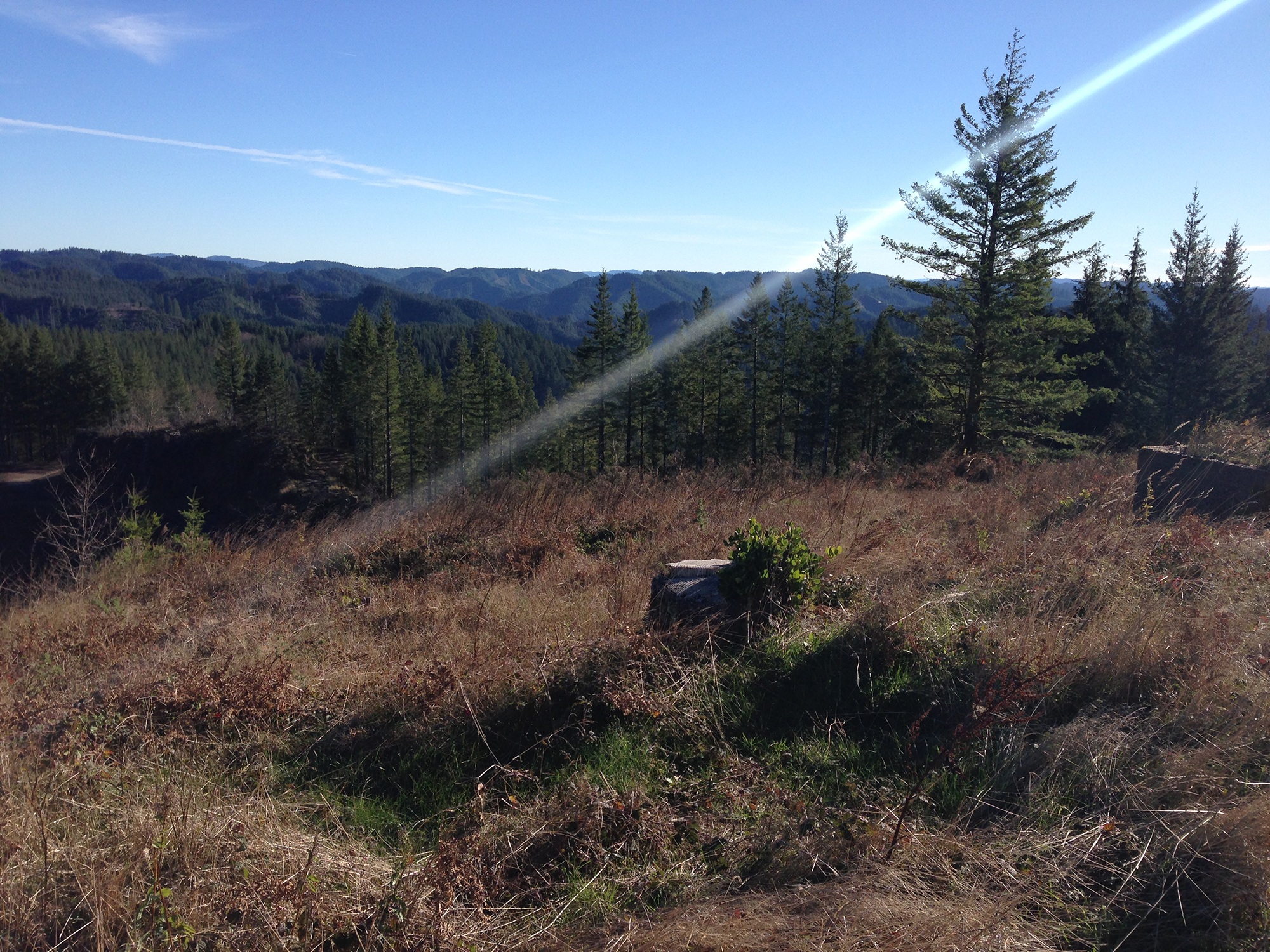
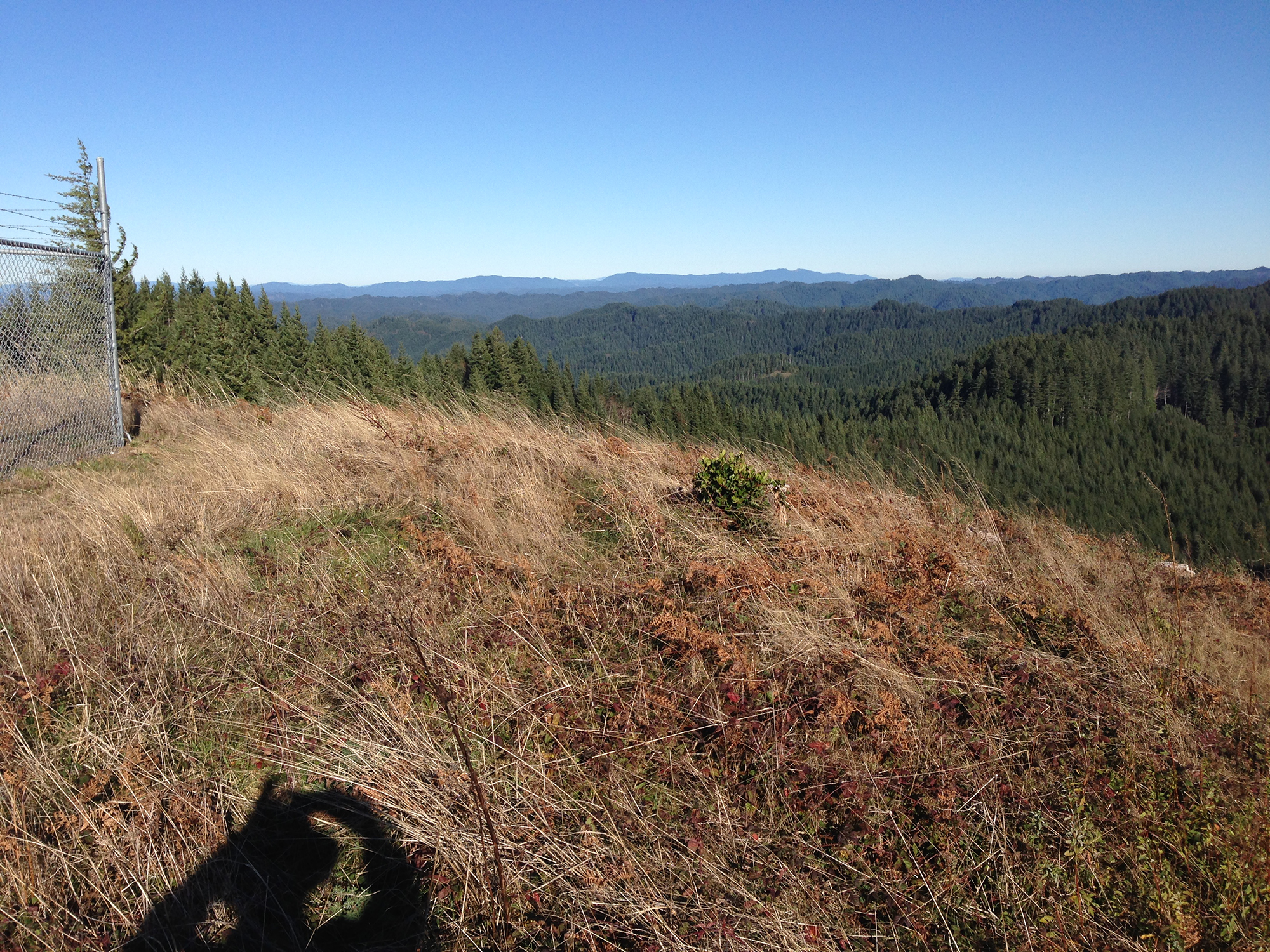
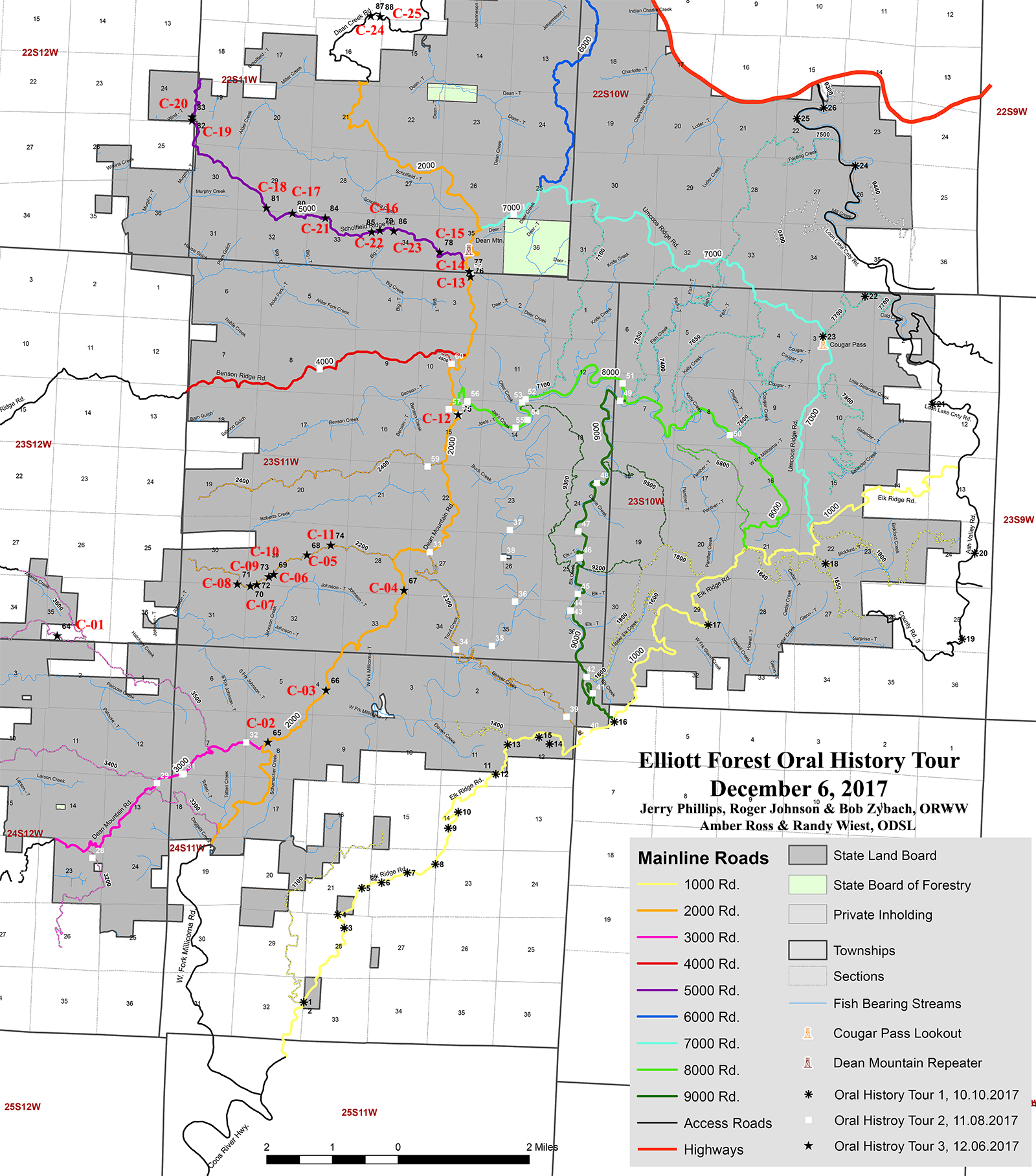
A recorded interview from Bob Zybach's Elliott State Forest oral history project, made December 6, 2017 on 7 tape sides and printed as a 171-page transcript, with his own stop-by-stop index.
Transcript
Pages are numbered as Bob Zybach printed them. Each page number is a
permalink.
printed page N is on PDF page N + 2
Some speaker labels on this transcript were recovered from the typography
of the printed page rather than printed as names; those attributions are
inferred.
p. 1 Tenmile 9-A 2:22 Tenmile Lake, Tree Planting & Boomer Colonies
Tenmile 9-A 2:22 Tenmile Lake, Work History & Boomer Colonies. No Photos.
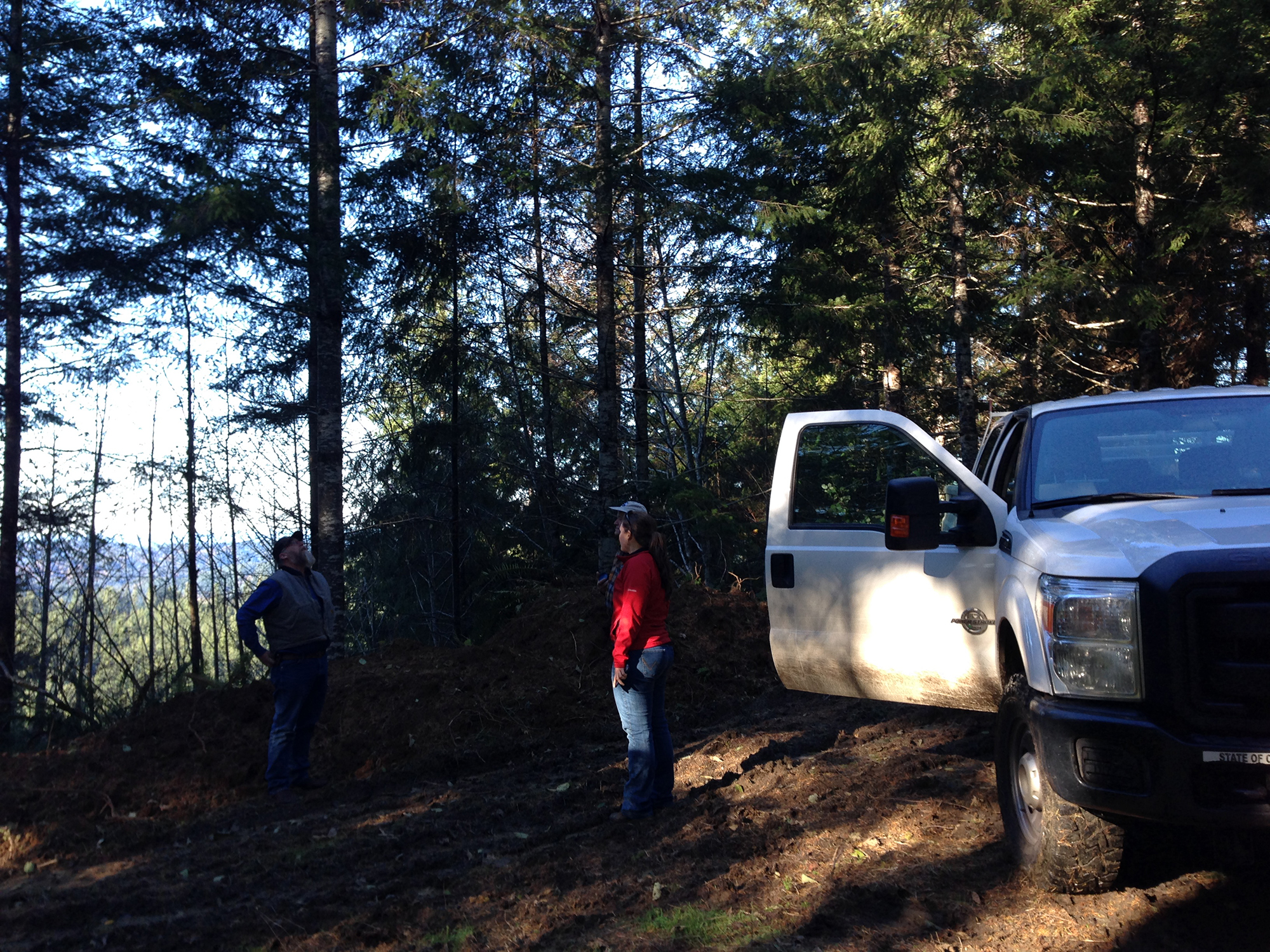
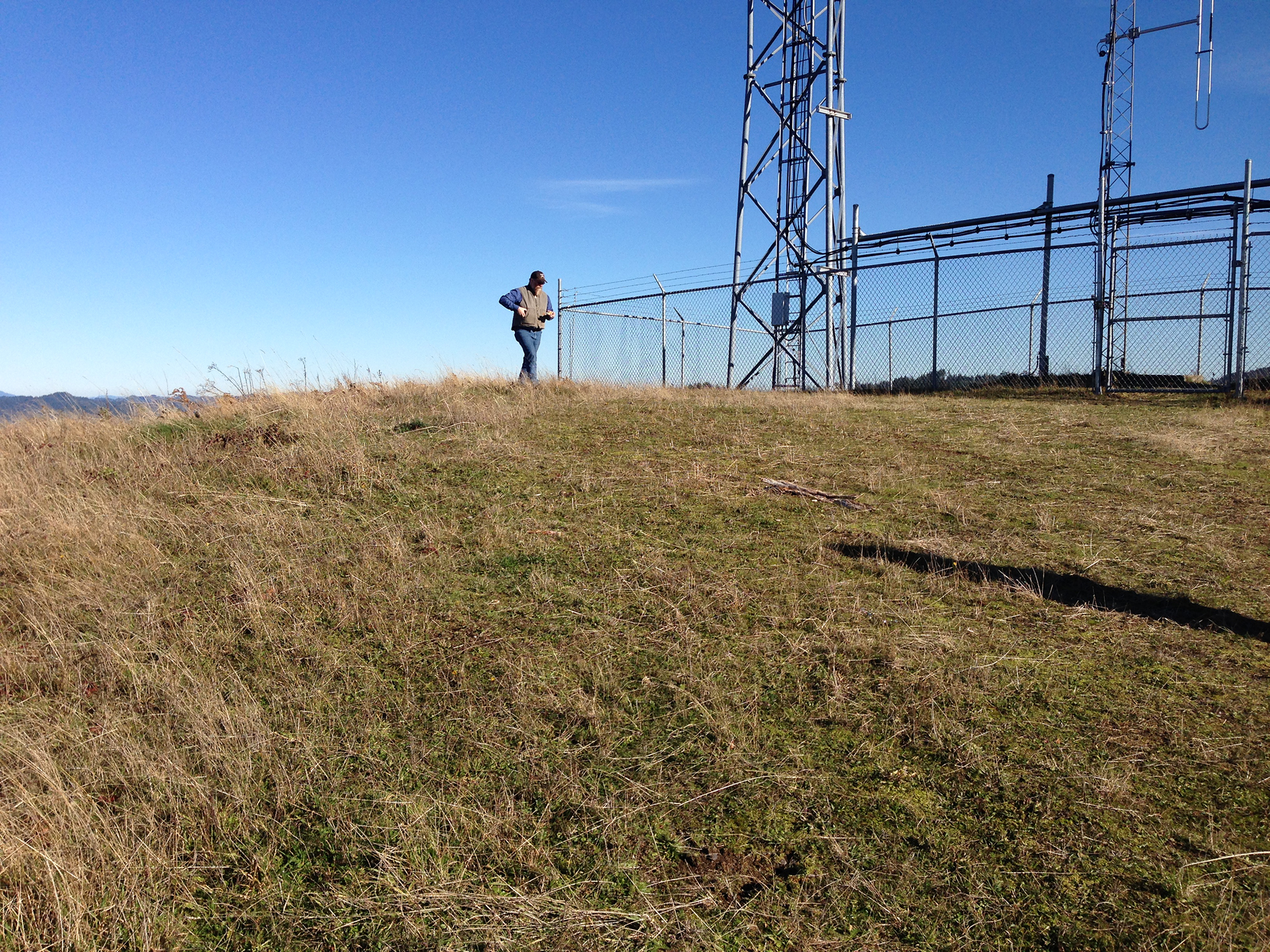
Tape 9-A. Interview with Jerry Phillips and Roger Johnson by Bob Zybach, with Amber Ross and Randy Wiest while touring the Elliott State Forest on December 6, 2017. Part 1. Adams Ridge, Tenmile Butte Salmonberry & Columbus Day Storm (47:42)
Bob Zybach:
Before we get started, Amber and . . .
Roger Johnson:
This is it. Right here.
Randy Wiest:
Oh, right here? Yep, sorry.
Bob Zybach:
. . . Randy and Jerry have already agreed on tape. We got that this will be recorded and transcribed. You'll have a chance to look at the transcription, if there's anything that needs to be corrected or removed or edited in some way.
Roger Johnson:
Okay.
Bob Zybach:
Then it's apt to go anywhere. It won't be used commercially. It'll be used mostly on the internet for educational purposes. And hopefully research purposes too, so is that agreeable to you?
Roger Johnson:
Sure.
Bob Zybach:
And for the record, what's your last name?
Roger Johnson:
Johnson.
Bob Zybach:
Roger Johnson, okay. So we're all in agreement. And you're being recorded right now.
Roger Johnson:
Okay.
Tenmile. 2:22 Tenmile Lake, Work History & Boomer Colonies. No Photos.
Bob Zybach:
Roger, real briefly, you've done reforestation work on the forest for almost 35 years?
Roger Johnson:
I started October 31st, 1983.
Bob Zybach:
Wow.
Roger Johnson:
After other events.
Bob Zybach:
Jerry, repeat the part here, we're going up to Adams Ridge?
p. 2 Jerry Phillips:
We are.
Bob Zybach:
That had been thinned out as part of the pre-1975 thinning program?
Jerry Phillips:
Yeah, that's right.
Roger Johnson:
Okay.
Bob Zybach:
These trees are how old, about?
Jerry Phillips:
Oh, 130.
Bob Zybach:
Oh, okay. So this is Coos Bay second-growth?
Jerry Phillips:
Yes, well, essentially, but this side is also known as third-growth.
Bob Zybach:
Third-growth, okay.
Roger Johnson:
Stay on here, take a right here.
Jerry Phillips:
Well Adams Ridge itself, of course was never part of a state forest, because no Elliott land ever lay in Range 12.
Bob Zybach:
Uh-huh.
Jerry Phillips:
This will be in Range 12.
Bob Zybach:
Yeah.
Jerry Phillips:
It was some of the land that we acquired from BLM through selection, back in about '61, around there. It was land that the federal government owed to us. It was selection. It was part of like, 6,000 acres of that.
Bob Zybach:
Uh-huh.
Jerry Phillips:
We chose -- I mean the State Land Board chose -- to have it here, instead of up a draw somewhere.
Bob Zybach:
Uh-huh.
Roger Johnson:
A couple miles past that park.
Jerry Phillips:
So in a sense, it has the same history, as the land that the State Land Board sold, to Elkside Lumber.
p. 3 Bob Zybach:
Uh-huh. When the State Land Board sold it, that was the sale three years ago or something?
Jerry Phillips:
Yeah.
Bob Zybach:
Oh, okay. So this went from BLM and changed to this -- in lieu of school lands -- added to the state, to Elliott's forest, and then thinned out once, and then sold.
Jerry Phillips:
That was the case. It was, well, some was thinned and some wasn't.
Bob Zybach:
Uh- huh.
Jerry Phillips:
Because this is a fully stocked land. Of fir, good fir. The fact is, I guess it's true across all forests, you instinctively choose certain places that you like to look at, and it's so beautiful, that you don't want to clearcut.
Bob Zybach:
Uh-huh.
Jerry Phillips:
Before your time.
Bob Zybach:
So you're all right, in a few years, if they clearcut it?
Jerry Phillips:
Oh yeah.
Bob Zybach:
(Laughs) I think we asked that on an earlier stand about that size: "Has it been thinned out?"
Roger Johnson:
That's right.
Bob Zybach:
The decision now would be different than twenty and thirty years later. Roger, did you get any formal education in reforestation or forestry?
Roger Johnson:
An Associates from Southwestern Oregon Community College.
Bob Zybach:
Uh-huh.
Roger Johnson:
I went to OSU for a year but really couldn't afford to stay there.
Bob Zybach:
Ahh (negative).
Roger Johnson:
Then I got a job with the state, restocking surveys, planting inspections, and that kind of stuff.
Bob Zybach:
Uh-huh.
p. 4 Jerry Phillips:
That's the hard work.
Bob Zybach:
Before we started doing these tours here, the last time I was on the Elliott was '69 or '70.
Roger Johnson:
(Laughs) It looks different, doesn't it?
Bob Zybach:
Yeah. My memory's kind of vague back then too. I was mostly doing Weyerhaeuser work and then I did BLM contracting in the 70s and so, further south.
Roger Johnson:
Yeah, I did plant trees on the Weyehaeuser Coos Bay Tree Farm.
Bob Zybach:
Who did you plant trees for at that time?
Roger Johnson:
I planted for Weyerhaeuser for the most part, for a small contractor out of California.
Bob Zybach:
Uh-huh.
Jerry Phillips:
Straight ahead on this street.
Bob Zybach:
Weyerhaeuser had union crews in those states.
Roger Johnson:
Did they?
Bob Zybach:
Yeah, they did time studies on my crews in . . . 1974? They were just getting rid of them about that time, but I was working up in the Grays Harbor area.
Roger Johnson:
Yeah. The crew I was working on had openings because the guys they had working for them got caught by immigration.
Bob Zybach:
Ah-ha.
Roger Johnson:
They weren't allowed in the States.
Bob Zybach:
I remember the first Mexican tree planters.
Roger Johnson:
Oh yeah?
Bob Zybach:
Yeah. (laughs) About 1968 in Idaho.
Roger Johnson:
Yeah we used the Shutter Creek [Correctional Institution] crews to do some planting and a lot of trapping over the last twenty years.
p. 5 Bob Zybach:
Uh-huh. There's a deer. Now when you're talking about trapping, you're talking about boomer?
Roger Johnson:
Yeah, mountain beaver. Yeah, in the ‘70s they pretty much devastated a lot of the early plantations in the Forest. When I arrived there they were processing 10,000 acres. Stands that hadn't been successful through there. Something to do with mountain beaver and salmonberry.
Bob Zybach:
10,000 acres?
Roger Johnson:
Yep.
Bob Zybach:
On the Elliott?
Roger Johnson:
Yep.
Bob Zybach:
Wow. We did lots of boomer trapping up in Lincoln County but the populations of boomers that I've seen, the heaviest anywhere, are the Elliott . . .
Roger Johnson:
Yeah.
Bob Zybach:
. . . and Lincoln County.
Roger Johnson:
I think [Township] 23 [Range 10] in the Elliott has the highest population in the world.
Roger Johnson:
Wow [sees parked vehicle]. That’s been parked there for a couple of weeks. We don't know where they’re headed though.
Bob Zybach:
They had really extensive notes on the boomer damage, and even one damaging a surveyor worker!
Roger Johnson:
Yes.
Jerry Phillips:
I think they were first noted by Lewis and Clark.
Roger Johnson:
(Laughs)
Bob Zybach:
Well, the Indians were wearing them as robes, so that's what we were having the discussion before -- whether the boomer -- whether they were persistent; and when we went in to plant, because of the conversions [industrial alder to fir projects], we were finding on the Yaquina River and stuff, that basically they set out these colonies, and these colonies didn't have fir in the first place.
p. 6 Jerry Phillips:
Boomers survive just fine on sword fern.
Bob Zybach:
Yep.
Jerry Phillips:
Because they were planning for those hurricanes.
Bob Zybach:
Yeah.
Jerry Phillips:
To them it was like pepperoni pizza! (laughter)
Roger Johnson:
That's what it seems like they must, when the trees are young, they get rid of them, and then they persist.
Jerry Phillips:
They'll climb trees.
Roger Johnson:
Yeah.
Jerry Phillips:
For a while.
Bob Zybach:
Yeah. For a foot or two.
Jerry Phillips:
I'd say . . .
Roger Johnson:
Ten.
Bob Zybach:
Ten feet?
Roger Johnson:
For a whistle tree.
Bob Zybach:
Wow.
Roger Johnson:
Yeah.
Bob Zybach:
Boomers could climb ten foot in a tree?
Roger Johnson:
Yep, strip all the limbs off and top it.
Bob Zybach:
Wow. So their basic strategy is to keep from being shaded out so they got food.
Roger Johnson:
Yeah.
Bob Zybach:
You can live under that condition, a fairly wide space probably. But . . .
Roger Johnson:
Mm-hmm (affirmative). If they're totally closed in, they have nothing to do except chew the bark off the roots of trees.
p. 7 Bob Zybach:
So they can persist in a fairly closed canopy?
Roger Johnson:
Not for very long.
Bob Zybach:
Yeah, I've never seen them there.
Roger Johnson:
They starve to death after a while.
Bob Zybach:
So these patches in which you went in to plant, and they had to be replanted, weren't solid stands of fir before, they were boomer colonies?
Roger Johnson:
They may have been a Douglas fir with alder. Hardwoods lose their leaves, then they seem to be better habitat.
Jerry Phillips:
Right along the West Fork they have a colony.
Bob Zybach:
Uh-huh.
Jerry Phillips:
They're really not far from the Elkhorn Ranch, but they've been there forever. It's completely alders.
Bob Zybach:
Aha. So there are openings in the forest, and wildlife habitat openings, that have been persistent because of the boomer colony.
Jerry Phillips:
Well, there's an interaction there.
Bob Zybach:
That was one thing I talked to my contacts was about boomer colonies, and then Jerry was saying part of the reason is all the bobcat trapping and coyotes and stuff that would be their enemies, but possibly the Indians . . .
Jerry Phillips:
Yep.
Bob Zybach:
. . . must have eaten them -- but they also, we know they skinned them for their hides and prized them.
Roger Johnson:
Yeah.
Bob Zybach:
It seems like these might be hunting grounds that maybe -- thinned the populations and kept them down?
Roger Johnson:
I don't know for sure on that.
Randy Wiest:
Go right?
Roger Johnson:
Yeah, stay right.
p. 8 Randy Wiest:
Okay.
Roger Johnson:
And then it will be the stand in the field there.
Randy Wiest:
Okay.
Roger Johnson:
Stay on the main road from there up. It's at the top of the hill basically.
Randy Wiest:
Okay.
Roger Johnson:
You asked a question I just realized. I don't know, do you know how the Indians actually, did they shoot them with arrows? How did they catch them?
Bob Zybach:
Probably by hands and rocks and arrows. They had traps.
Roger Johnson:
They're really hard to see.
Bob Zybach:
Yeah.
Roger Johnson:
They come out mostly at night.
Bob Zybach:
Yeah.
Roger Johnson:
They must have trapped them somehow.
Bob Zybach:
Yeah, that would be . . . I would guess over a several thousand year period that they had every way possible of getting them.
Roger Johnson:
Yeah, I suppose.
Bob Zybach:
Every once in a while, you'll see them out scurrying around.
Roger Johnson:
Yeah.
Bob Zybach:
Like, they're going through their colony and that disturbs them or something.
Roger Johnson:
Not usually.
Bob Zybach:
No, but occasionally.
Roger Johnson:
I've seen one or two in the day -- and that's Tenmile Lake off to the right.
Bob Zybach:
Tenmile Lake?
p. 9 Roger Johnson:
Yeah, it flooded. That Shutter’s arm of Tenmile Lake flooded real bad. It backs up into the draw there in the winter when it rains a lot. I've seen one or two [boomer] in the daytime, but that's why I was asking how they got them because I don't think that you're going to see them in the day time enough to get any.
Bob Zybach:
This right here, one thing we've found working with the Coquilles, with Don Ivy . . .
Roger Johnson:
Mm-hmm (affirmative).
Bob Zybach:
. . . we've found out that they're basically, the boundary line between the different tribes, and even the language groups, was the head of tidewater.
Roger Johnson:
Really?
Bob Zybach:
So, at tidewater, we've accounts going back to the 1820s, people didn't seem to move in the daylight so much as they did with the tides.
Roger Johnson:
Yeah?
Bob Zybach:
Because they're moving in and out with the canoes on the tides.
Roger Johnson:
Yeah?
Bob Zybach:
So operating in the middle of the night was nothing unusual for them. Then on the other side, above tidewater, it was all daylight and dark like we do today. But in the tidelands it was all driven by the moon.
Roger Johnson:
Wow. I suppose if they actually kept going out in the moonlight at night? I guess that might be right. If you're patient enough to sit there long enough, they won't smell you.
Bob Zybach:
They had elk dogs too.
Roger Johnson:
Yeah.
Bob Zybach:
So they could have hunted with dogs. They made lots of good traps. They could have definitely used traps.
Roger Johnson:
Yeah. Yeah, a dog could catch them.
Bob Zybach:
Yeah. Now we call them elk dogs, though, we don't call them boomer dogs.
Roger Johnson:
Well. Probably more valuable than elk in some ways.
p. 10 #C-01 9-A 15:22 Sukurski’s Bamboo to Adams Ridge
Stop C-01 9-A 15:22 Sukurski’s Bamboo to Adam’s Ridge
Bob Zybach:
(Laughs)
Roger Johnson:
What do you think the chances were that they ate the mountain boomers they caught?
Bob Zybach:
I would guess there's a 100% chance of that.
Roger Johnson:
Yeah.
Bob Zybach:
There would be no reason that they wouldn't that I can think of.
Roger Johnson:
I had a couple of foremen tell me they found and ate one in a crew one time and they tasted okay. [unintelligible cross-talk 14:50 to 15:00]
Bob Zybach:
As long as they get cooked!
Roger Johnson:
Yep.
Bob Zybach:
Because ground squirrel is actually pretty good.
Roger Johnson:
Mm-hmm (affirmative).
Bob Zybach:
I tried possum once, it was okay.
Roger Johnson:
Hmm.
Bob Zybach:
Never tried boomer.
Roger Johnson:
Omnivorous animals, they eat anything and everything I think. I bet that bamboo back there, they ate it.
Stop C-01. 15:22 Sukurski’s Bamboo to Adam’s Ridge
Bob Zybach:
Oh, you know that was one of the . . . the bamboo there at Sukurski’s house?
Jerry Phillips:
Yeah.
Bob Zybach:
They planted that, what was the name of that family?
Roger Johnson:
The Muffetts
Bob Zybach:
Was that who planted the bamboo?
p. 11 Jerry Phillips:
They came along later.
Roger Johnson:
Did they? Okay. The Peterson's were here before the Muffetts.
Amber Ross:
Do you want-
Bob Zybach:
There's supposed to be bamboo and there's supposed to be a myrtle grove and there's supposed to be an apple orchard. All in this area here.
Roger Johnson:
Mm-hmm (affirmative). I noticed there's poplar back there.
Bob Zybach:
Uh-huh.
Amber Ross:
I didn't know if you wanted a picture of that Bob, or? We're in private land, so.
Bob Zybach:
No, not . . . I think there's, damn, now I wish I'd brought my notes -- and my right notebook.
Roger Johnson:
(Laughs)
Bob Zybach:
Oh, well. Is there any bamboos within the boundaries of the Elliott?
Roger Johnson:
I haven't seen any.
Bob Zybach:
How about apple trees, like on the left side?
Roger Johnson:
I've seen well, one ranch with apple trees. Really there's not many others out there.
Jerry Phillips:
Now those would be those that we saw down at Elkhorn Ranch.
Bob Zybach:
Yeah. We got those sets of nice pictures of them and good discussion.
Jerry Phillips:
There's probably a few down around Mill Creek.
Bob Zybach:
Ah-ha. Where the sawmill was, right?
Jerry Phillips:
Yeah.
Bob Zybach:
There's none on the west side that you can think of? There's a bunch of little homesteads up through here. How about daffodils? We know there was at the School Teacher’s Cabin. Those are almost always a sure sign of an old cabin.
Jerry Phillips:
That’s the truth. There was a handful there near the one where she lived.
p. 12 Bob Zybach:
Now, one thing, we've had two fern patches. I kept assuming they were bracken fern, which could be tied to the Indians. But then I found out at the Fern Cabin they were picking almost exclusively sword fern. But you know of any bracken fern patches on the Elliott?
Roger Johnson:
There's bunch of them on the east side but it has to be open.
Bob Zybach:
Uh-huh.
Roger Johnson:
They don't grow very well in the timber. There may be some on the edges of the trees. There’s some over in the Salander Creek country.
Bob Zybach:
Salander Creek? That's where the Fern Cabin is I think.
Jerry Phillips:
Yes it is.
Roger Johnson:
We go to the left at this sign.
Bob Zybach:
It sounds like between the boomer patches, and the salmonberry, and some alder restoration, and the bracken fern prairies that there's been a fair amount of the forest that's been converted from an earlier vegetation pattern to Douglas fir.
Jerry Phillips:
Plus, there's the river. It's got priorities. Get rid of anything there that was not fully stocked with fir to where it should be. And there isn't incentive.
Roger Johnson:
Stop. You got to take a right here.
Randy Wiest:
Okay.
Roger Johnson:
There are exceptions to that. In the early days they did harvest and then they did aerial seeding.
Bob Zybach:
Yeah.
Roger Johnson:
There's a number of those places around the forest, maybe eight or ten units, but they're mostly alder.
Bob Zybach:
Uh-huh. They're converted from Doug fir to alder?
Roger Johnson:
I don't know if there was Doug fir to start with, there might have been.
Jerry Phillips:
They were either very lightly stocked, or they're hardwoods, because the rest of that had no value. The whole idea was to get rid of it.
p. 13 Bob Zybach:
We're on the west slope here and we were on the north slope and we're noticing we're getting into a lot of scotch broom.
Roger Johnson:
Yeah.
Bob Zybach:
There's hardly any on the north side so --
Jerry Phillips:
Wherever it's Umpqua River rock, it has scotch broom in it.
Roger Johnson:
Yeah. You grade the roads, it goes into the ditches and you spread it around that way.
Jerry Phillips:
Yeah.
Bob Zybach:
So that's probably the source of all this scotch broom and why it's on the Umpqua side and not the Coos side.
Jerry Phillips:
That's right.
Amber Ross:
I know and . . .
Jerry Phillips:
Whenever you haul the rock in, that’s a problem.
Bob Zybach:
Is that the stand we're talking about here?
Roger Johnson:
No, that's all the way up the ridge, a few miles up.
Bob Zybach:
A lot of myrtle out there too, and huckleberry.
Roger Johnson:
Red cedar. Everything you can imagine.
Bob Zybach:
Now that's something. On Indian Point, Joe's Ridge, Huckleberry Point all have been pretty solid stands of huckleberry that are getting taken over by the fir. Do you know any on the west side here that were solid huckleberry?
Roger Johnson:
Most of the ridgetops on the west side have some, if not pretty heavy stands.
Bob Zybach:
Oh, great. Uh-hah.
Roger Johnson:
That's why I quit hunting on the Elliott. I'd lay on the ground and look at the elk feeding up the hill.
Bob Zybach:
Huh.
p. 14 Amber Ross:
(Laughs)
Roger Johnson:
You could see their feet underneath the huckleberry brush and when you stood up you couldn't see anything but huckleberry.
Bob Zybach:
Wow.
Jerry Phillips:
That's how we crawled on the ground to do a quick inventory. We used bear tunnels.
Bob Zybach:
Ah-hah.
Jerry Phillips:
Crawled through the bear tunnels.
Bob Zybach:
Elk leave pretty good trails through the huckleberry too, don't they?
Jerry Phillips:
Sure do.
Bob Zybach:
Almost like tunnels in some spots.
Jerry Phillips:
Is this . . . This is kind of weird. This looks kind of like a furrow.
Bob Zybach:
Wow. So this is Adam's Ridge?
Roger Johnson:
Yeah.
Jerry Phillips:
This is it.
Bob Zybach:
And this is private now?
Roger Johnson:
No. Or is it?
Jerry Phillips:
No.
Amber Ross:
No, we're on state land.
Bob Zybach:
Oh.
Roger Johnson:
Private state land, right there.
Bob Zybach:
Ah-huh.
Jerry Phillips:
Now it’s not Elliott, but it's not private either.
Bob Zybach:
Oh, okay.
p. 15 Jerry Phillips:
It was in-lieu selection land from BLM.
Bob Zybach:
Uh-huh.
Jerry Phillips:
1961.
Bob Zybach:
So, this would be county-level cost sharing?
Jerry Phillips:
No, it's on state land, in cooperation and with the Elliott. From '52.
Bob Zybach:
Uh-huh. But when there's income, it doesn't go to the school fund does it?
Roger Johnson:
Yes it does.
Bob Zybach:
Oh, it does? Okay. Jerry, if you were managing today, would you put this up for sale?
Jerry Phillips:
Oh yeah.
Bob Zybach:
Okay.
Jerry Phillips:
I'd have said we'd save some of the sales until the last.
Bob Zybach:
Uh-huh.
Jerry Phillips:
Not a lot, but a few spots. This is one. Access is so good you can come up here anytime.
Bob Zybach:
Yeah.
Roger Johnson:
Up ahead there's some of these pioneer roads up these ridges for some reason. [Turns out this was done for inmate fire-trailing practice. RJ]
Bob Zybach:
Uh-huh.
Amber Ross:
Okay.
Roger Johnson:
I'm not sure if they went that way, but I think that one up there, they went up the ridge. They're building a bike trail or it's got to be a road, I don't know which. [Same fire-trail practice, with Department of State Lands approval. RJ]
Bob Zybach:
Uh-huh. Most of the ridgeline's, so far as I can tell, are main Indian trails.
Roger Johnson:
Yeah.
p. 16 Bob Zybach:
Then when there's huckleberries and myrtle, that was kind of important to them.
Roger Johnson:
Yeah. Somewhere around here they cut a road up the ridge.
Bob Zybach:
Wow.
Roger Johnson:
I'm glad they got it this far up.
Bob Zybach:
I think this is like all the ridgelines on the west slope, kind of the Tenmile Lake area . . .
Roger Johnson:
Yeah.
Bob Zybach:
There's a lot of people in that area there, so you can easily walk up the ridgeline to harvest huckleberries.
Roger Johnson:
Mm-hmm (affirmative).
Bob Zybach:
Is the policy still to convert the huckleberry and the . . .?
Amber Ross:
That one?
Roger Johnson:
That's one of them. The other one --
Amber Ross:
Can I take a couple of pictures?
Roger Johnson:
Yeah. This is activity . . . I don't know what was done. I didn't get it. [More fire-trail practice. RJ]
Bob Zybach:
Uh-huh.
Roger Johnson:
My first thought was some of these pioneer roads that go up there . . . but that doesn't make sense either because they'd have to get permission.
Jerry Phillips:
It looks like we got off here a little ways. We put cables in there.
Roger Johnson:
Jerry, do you remember what this was thinned to?
Jerry Phillips:
Oh it --
Roger Johnson:
On a certain level?
Jerry Phillips:
Forester's choice, is what we called it. It has always been to suppress the understory first.
p. 17 Roger Johnson:
Okay.
Jerry Phillips:
It goes up and down, depending on the fir on it, but the intervening goal is to suppress the competition.
Roger Johnson:
So you're cutting snags and . . .
Jerry Phillips:
. . . and small diameters.
Roger Johnson:
Mm-hmm (affirmative). Okay.
Jerry Phillips:
And if you join in . . . that's what you said, about 10,000 [board feet] to the acre is thinned.
Roger Johnson:
Yeah.
Jerry Phillips:
And 40,000 feet in the stand, and that's about 10,000 of it. It's not everything.
Roger Johnson:
So you're leaving about 30 and this is . . .
Jerry Phillips:
Right.
Roger Johnson:
He's probably looking at more of like maybe 60 or 65,000 now?
Jerry Phillips:
That's a long time, because that's 40 years ago.
Roger Johnson:
Yeah. It really shifted a lot of volume then?
Bob Zybach:
It seems like you'd be adding, what? Maybe 800 feet a year?
Roger Johnson:
Yeah, I'm not a --
Jerry Phillips:
In theory was, anyways. That's one of their theories.
Bob Zybach:
Uh-huh.
Jerry Phillips:
It's in dispute. The theory that we operate was, you're taking existing growth . . .
Bob Zybach:
Yeah.
Jerry Phillips:
. . . and redistributing it . . .
Bob Zybach:
Yeah.
p. 18 Jerry Phillips:
To a better grade.
Bob Zybach:
Right.
Jerry Phillips:
What would increase those? Just distribute that growth to the better ones.
Bob Zybach:
Yeah. Hasn't most the research on that shown that there's maybe a three- or five-year adjustment period when there's kind of a shock to being opened up?
Jerry Phillips:
Something like that.
Bob Zybach:
And after that, they have an accelerated growth. That was the theory but it seemed like they were also showing that to be true.
Roger Johnson:
The dominants wouldn't be as shocked as others when you open it up because they are already getting most of the sun.
Jerry Phillips:
That's right.
Bob Zybach:
Uh-huh.
Jerry Phillips:
To the intermediates, because it was already too late.
Roger Johnson:
Yeah.
Bob Zybach:
Uh-huh. It seems there's wide spacing because there's only 10,000 feet coming out that the majority of these trees must have been dominate or co- dominant.
Jerry Phillips:
They were.
Bob Zybach:
Oh, okay.
Jerry Phillips:
Just think, you have all those years of natural thinnings . . . that encourage growth early on.
Bob Zybach:
Uh-huh.
Jerry Phillips:
I know that these are all empirical situations.
Bob Zybach:
Uh-huh.
Jerry Phillips:
You might recall Bulletin 201 [McArdle and Meyer 1949]?
Bob Zybach:
I don't know what you're --
p. 19 Jerry Phillips:
You've never heard of Bulletin 201?
Bob Zybach:
No, not by that name.
Jerry Phillips:
It was originally written I think in the '40s [1930]. It was a study trying to state the scientific knowledge about Douglas fir at that time, but the managers never heard of it.
Bob Zybach:
Uh-huh.
Roger Johnson:
Bike trail? [More fire-trail practice. RJ]
Amber Ross:
I have no idea. That's a pretty steep slope in there.
Randy Wiest:
Yeah. It's almost like they're clearing for a survey for something.
Amber Ross:
It went on a line for a while.
Randy Wiest:
No.
Bob Zybach:
Amber, I'm kind of stuck all up in the middle here a little bit, can you use your camera to take photos?
Amber Ross:
I could, yeah.
Bob Zybach:
That'd probably be the most efficient.
Roger Johnson:
This is more what caught my attention, it runs almost straight back up that ridge, and it's about six or eight feet wide, which is wider than a surveyor’s line I think.
Jerry Phillips:
Yeah.
Amber Ross:
From here?
Roger Johnson:
Up the other way here. I walked up to the top of the hill and that one's been brushed out to the top of the hill and then it turns around a corner.
Amber Ross:
Oh, sure.
Randy Wiest:
Is there?
Roger Johnson:
I was kind of looking around because somebody cleaned off around this cedar up here too. This little spur here has cedar fallen across it.
Amber Ross:
Okay.
p. 20 Bob Zybach:
It's sure a beautiful stand of trees.
Roger Johnson:
Yeah.
Bob Zybach:
What's there? (Laughs)
Jerry Phillips:
You're looking at it.
Bob Zybach:
Yeah.
Roger Johnson:
It is right there.
Amber Ross:
Yeah, we'll come back and look at this tomorrow.
Roger Johnson:
The first time I got there, the ridge hadn't been cleared off around the trees like it is now. Somebody knew how to cut it around the other tree, and then cut the limbs off.
Roger Johnson:
What is your plan on it?
Amber Ross:
I'll contact the managers tomorrow.
Roger Johnson:
Yeah. Mark [Huff, Titan-Kelly LLC] is going to need information on all this stuff. This road's gotten a little worse over the last few months, too.
Amber Ross:
Well, it's the wet season right?
Roger Johnson:
Yep. It gets good drainage though, but still we've got to get good drainage.
Bob Zybach:
It doesn't look like there's been any failures or anything.
Jerry Phillips:
Nope.
Bob Zybach:
Now, Roger, there used to be this objective to get everything growing Douglas fir pretty much. Is that still the objective?
Roger Johnson:
Oh, let's think. Somewhere in about '93 we decided we're going to do more diversity and start planting about 70% Doug fir and 30% plants that are other seedlings, mostly hemlock and western red cedar.
Bob Zybach:
Uh-huh.
Roger Johnson:
That's cedar's more valuable so it leaves that at about 50% of the mix. As you go further east on the forest the elk become more of a problem. Red cedar’s there on the west side. They're kind of rethinking whether that was the right choice. Sometimes the stand will get chewed on for seven or
p. 21 #C-01 9-A 32:05 Tenmile Butte Salmonberry & Umpqua Road Rock
Stop C-01 9-A 32:05 Tenmile Butte Salmonberry & Umpqua Road Rock. No Photos.
Roger Johnson:
eight years before it gets past the elk's reach. They're free to grow after that.
Bob Zybach:
Uh-huh. It sounds like it's all conifers. Is there any alder you're planting or is there any strategy for maintaining open areas like Peavine Ridge or anything like that?
Roger Johnson:
Alder we have not planted except in the Phellinus pockets. There's three or four of those around. We stopped aerial spraying and red alder about 1996.
Bob Zybach:
Uh-huh.
Roger Johnson:
We haven't done any thinning of alder in the last seven to ten years so there are a lot of pockets of alder coming in around the forest in different places.
Amber Ross:
You thinned alder?
Bob Zybach:
So you have done alder thinning though?
Roger Johnson:
We thinned the alder in the Phellinus pockets. Most of what we did was an attempt to get stands of Doug fir started.
Bob Zybach:
Uh-huh.
Roger Johnson:
For the last ten years or so when the alder prices spiked and then they have to decide if they're going to spend the money to cut something down that might be something of value later.
Bob Zybach:
Uh-huh. But then if you do harvest alder, is the strategy to convert to Douglas fir or to retain the alder?
Roger Johnson:
The strategy is to put everything Doug fir and let the alders come up and decide whether you want to keep it where it comes up.
Bob Zybach:
Uh-huh.
Stop C-01. 32:05 Tenmile Butte Salmonberry & Umpqua Road Rock. No Photos.
Randy Wiest:
Where we going?
Amber Ross:
Hmm?
Roger Johnson:
Are you looking for that salmonberry patch? Go this way.
Jerry Phillips:
Yeah, to the right.
p. 22 Randy Wiest:
To the right.
Jerry Phillips:
To your right.
Amber Ross:
Is it visible, does it still exist?
Jerry Phillips:
This way it's well in view.
Roger Johnson:
Does the salmonberry patch still exist or are we going to be looking at a stand of Doug fir?
Jerry Phillips:
Well, I assume it's in a stand of Doug fir . . .
Roger Johnson:
Okay.
Jerry Phillips:
. . . although I'm sure that salmonberry doesn't just go away. I'm not sure if we've ever sprayed it or not.
Roger Johnson:
We've never killed salmonberry totally anywhere.
Jerry Phillips:
Yeah.
Roger Johnson:
It comes back as soon as we treat it.
Jerry Phillips:
I assume we'll still see it.
Bob Zybach:
Okay.
Amber Ross:
We can go turn around.
Randy Wiest:
Can we turn around up there?
Roger Johnson:
Yeah.
Bob Zybach:
That's one of the things we've been discussing is the salmonberry: Does it spread on its own or is it like huckleberry, kind of persistent; or does it keep getting restricted?
Roger Johnson:
Salmonberry has a root system that has a bud every half inch and it can be up to 30-40 feet per plant, so once you get it in the light, it just blows up.
Bob Zybach:
Uh-huh. Does it spread?
Jerry Phillips:
The birds of course, eat the berries. It's does seed.
Bob Zybach:
But can it . . .?
p. 23 Roger Johnson:
If you clearcut the west side of this forest en masse . . .
Bob Zybach:
Uh-huh.
Roger Johnson:
. . . you would have at least 65% of the forest in salmonberry, there isn't a doubt about it.
Bob Zybach:
So is that a persistent pattern that gets released? Or is it like, you open it up and then it spreads?
Roger Johnson:
Most of the forest there's really patches of salmonberry.
Bob Zybach:
Uh-huh.
Roger Johnson:
As soon as you open up, it gets real healthy.
Bob Zybach:
Yeah.
Roger Johnson:
It's not that it's spreading, it's kind of there with roots . . .
Bob Zybach:
Okay.
Roger Johnson:
. . . in a lot of places.
Bob Zybach:
It's kind of like dormant, it goes dormant?
Roger Johnson:
Yeah.
Bob Zybach:
Okay, a lot of the bulbs will go dormant 40 or 50 years.
Roger Johnson:
It's not that it's staying dormant. It has little pieces sticking up like that, that aren't obvious when you look at it. They're ready to take off. They persist where light gets through the canopy.
Bob Zybach:
One reason we're looking at this and discussing it is this is one of the thickest patches on the ridgeline on the forest.
Roger Johnson:
Mm-hmm (affirmative).
Bob Zybach:
And that's the question: If it's persistent, that means that people were probably using the salmonberry 200 years ago -- but if it's just spreading?
Roger Johnson:
Yeah.
Bob Zybach:
That would mean that since you started logging in it, you would . . .
p. 24 Roger Johnson:
No, it was here.
Bob Zybach:
Oh, okay.
Roger Johnson:
That’s one we couldn't kill it or freeze it out.
Bob Zybach:
Ah-hah. Salmonberry and boomers sometimes co-exist close to water, but on ridgelines I wouldn't think that would be . . .?
Roger Johnson:
I don't think there's any place we haven't found a boomer in something.
Bob Zybach:
Even high?
Roger Johnson:
Ridgetops.
Bob Zybach:
Wow.
Jerry Phillips:
That's right.
Roger Johnson:
Just about everywhere.
Bob Zybach:
They've got to be within 50 or 100 feet of water don't they?
Roger Johnson:
You know, they seem to get water somewhere anyway.
Bob Zybach:
Uh-huh.
Roger Johnson:
I don't know if they're seasonal or if they move from top down with the weather or not.
Bob Zybach:
Oh. That would make sense. So in the winter they could be up on the ridgeline.
Roger Johnson:
Mm-hmm (affirmative).
Bob Zybach:
And then in the summer move down.
Roger Johnson:
Right. I don’t think they would move very far -- but in some part of their run they go through, of course, a water source.
Bob Zybach:
Uh-huh.
Amber Ross:
So, where's the patch going to be?
Jerry Phillips:
On the right hand side.
p. 25 Amber Ross:
From where again?
Bob Zybach:
This is where the salmonberry was?
Jerry Phillips:
I'd go a little further in there.
Bob Zybach:
Now this is Tenmile Ridge?
Jerry Phillips:
Tenmile Butte.
Bob Zybach:
Tenmile Butte, okay.
Jerry Phillips:
This had all the homesteaders.
Bob Zybach:
Is that a homestead?
Jerry Phillips:
This whole area.
Roger Johnson:
Might as well stop here and turn around here. Turn around, yeah. Not the other way though.
Roger Johnson:
Himalayan blackberry was brought in by the pioneers too, and it's a bit of a problem.
Jerry Phillips:
That's right.
Bob Zybach:
Yeah.
Jerry Phillips:
It was sold: “Guaranteed to grow!”
Amber Ross:
Bob, let me know what areas of interest you want me to collect photos of.
Bob Zybach:
Okay. I think this is definitely one. Tenmile Butte salmonberry patch. We've had a lot of discussion on it.
Roger Johnson:
You want to get out here?
Bob Zybach:
Not necessarily. We've been getting out in spots and taking photos but the recorder . . .
Roger Johnson:
. . . stays here?
Bob Zybach:
Well, this is a Black Friday special deal. The other one I had was from the ‘90s, it was operating real good until it stopped.
Roger Johnson:
Not going to record the sound outside?
p. 26 Bob Zybach:
I cut that out. It won't record for a very long distance. And then it's tough to get in and out in this [vehicle], isn’t it Jerry? (Laughs)
Jerry Phillips:
Mm-hmm (affirmative). It is. (Laughs)
Bob Zybach:
When I took the first pictures there was a couple spots where we couldn't really spend time, like Indian Point. That's why I came back up on the following weekend.
Roger Johnson:
Mm-hmm (affirmative).
Bob Zybach:
To get photographs and did a little fishing and stuff.
Roger Johnson:
See, we weren't always successful in the early days. We didn't get fir in and we had all those patches.
Jerry Phillips:
They missed their chance.
Amber Ross:
Did you do that last one?
Roger Johnson:
Yeah, back there on that last ten acres you can see a whole bunch of alder.
Amber Ross:
Oh.
Roger Johnson:
Before modern herbicides starting being, some of the older herbicides weren’t really effective.
Amber Ross:
Mm-hmm (affirmative).
Roger Johnson:
It was products like Krenite that didn't do much for the salmonberries.
Bob Zybach:
You got salmonberry here but you've also got scotch broom and Himalayan blackberries.
Roger Johnson:
Yeah. The scotch broom and Himalayan has not really been here until the last 20 years. It’s all just arriving.
Bob Zybach:
Ah-hah. So it's real recent.
Roger Johnson:
Real recent. They were down in the bottom from the homesteads. But it's moved up slope with the roads and birds and everything.
Bob Zybach:
Uh-huh.
p. 27 Jerry Phillips:
On this part of the forest, almost all of the crushed rock came from local quarries, so we mustn’t forget that. Hauled in from Reedsport. Umpqua rock. And that’s where the scotch broom is coming from.
Bob Zybach:
Uh-huh.
Roger Johnson:
If you drive by those [rock] piles at Reedsport you'll still see stacks of them.
Jerry Phillips:
Yep.
Roger Johnson:
This is what it looks like after I sprayed through here last year.
Bob Zybach:
Wow.
Amber Ross:
Uh-huh.
Bob Zybach:
You mean the road sides too?
Roger Johnson:
Yep.
Bob Zybach:
Wow.
Roger Johnson:
It would be a lot more solid if I hadn't been controlling it.
Bob Zybach:
What are the specifications now on reforestation?
Roger Johnson:
Well . . .
Bob Zybach:
Do you do it on a grid or micro-sites, or what kind of spacing do you use today?
Roger Johnson:
Spacing varies. For a while we were planting a nine-foot spacing in which there's 538 trees per acre.
Bob Zybach:
Yeah.
Roger Johnson:
For many years, they did ten-by at 436. A couple years back we came up a little short of trees so went down to 11-by at 360.
Bob Zybach:
Uh-huh.
Roger Johnson:
You can be successful at all of those, your likelihood of being successful with red cedar and hemlock in the mix is probably better at 9-by.
Bob Zybach:
Uh-huh.
p. 28 Roger Johnson:
If you're using mostly fir, about 10 or 11 is what works. It depends on where you're going with the stand. If you're going to harvest it at 40 years and more trees are needed out there than we do for 130 years.
Bob Zybach:
What density per acre at a 130?
Roger Johnson:
I really can't tell you.
Bob Zybach:
Was it higher?
Roger Johnson:
80 or 100, easy.
Bob Zybach:
Okay.
Roger Johnson:
We left beyond the Carlson Hillside. Yeah, take a right. Nobody grows trees at 130 years anymore.
Bob Zybach:
If you're going at 40, what's the stem count at 40 that you're looking for?
Roger Johnson:
Industry seems to want 450 per acre.
Bob Zybach:
Wow. 450 at 40 years of age?
Roger Johnson:
Yeah.
Bob Zybach:
Wow.
Roger Johnson:
The target age is 65.
Bob Zybach:
In Lincoln County Georgia-Pacific clearcut one of my plantations at 22 years.
Roger Johnson:
Really? Fir?
Bob Zybach:
On the 1000 Line out of Toledo.
Roger Johnson:
Huh.
Bob Zybach:
I was shocked. It was a conversion from grassland to plantation with Doug fir plug-1 seedlings.
Roger Johnson:
Mm-hmm (affirmative).
Bob Zybach:
We never had any problem with Swiss needle cast.
Roger Johnson:
Well, I know we have had incidences . . .
p. 29 Amber Ross:
Mmm?
Roger Johnson:
. . . with Swiss needle cast.
Bob Zybach:
Oh, okay.
Roger Johnson:
We never had it disappear down here, but up there --
Bob Zybach:
We had a lot of trouble planting hemlock stock. It takes special stock to transplant it.
Roger Johnson:
Mm-hmm (affirmative).
Bob Zybach:
How do you work around that?
Roger Johnson:
It seems to, if you take care of it, you need to plant it faster than you did Doug fir. You need to have it at an the early part of the cycle to get it in the ground sooner.
Bob Zybach:
Uh-huh.
Roger Johnson:
Other than that, if you get it planted right, it grows fairly well.
Jerry Phillips:
When the weather's right.
Roger Johnson:
The wind's been blowing, it's been raining, something's coming down.
Amber Ross:
Yeah. [illegible speaking/tape beeping 42:03 to 42:23]
Roger Johnson:
. . . Douglas fir is cheaper than the other, and if you get it in at the right time, it provides them a lot of chewing but not for the deer or elk.
Bob Zybach:
Huh!
Roger Johnson:
Doug fir only gets chewed on the first year or so for the most part because it’s harder on them. Whereas, red cedar they'll chew on for six to seven years. I was looking awhile back thinking where we were doing successful with red cedar, and I noticed we were being successful with red cedar where we were used Big Game Repellant [BGR] on them.
Bob Zybach:
Uh-huh. We just started using it toward the end of my career, and we were calling it “BGR.”
Roger Johnson:
Yeah.
p. 30 Bob Zybach:
We didn't know if that worked or not.
Amber Ross:
What's that made from?
Roger Johnson:
Well there are a number of things. They make it out of chicken eggs, they make it out of animal blood.
Jerry Phillips:
Guts.
Roger Johnson:
You know.
Randy Wiest:
Something smelly.
Roger Johnson:
Yeah, and it has to taste bad. There's probably hot sauce in a Mexican restaurant, that seems to do just fine with some folks, that might work around here. No one else likes it. It’s like throwing money away. I always liked to think the Elk spoke with a Spanish accent. (Laughs)
Jerry Phillips:
(Laughs)
Bob Zybach:
They like the flavor.
Roger Johnson:
Si, si, senor!
Bob Zybach:
Yeah, we were just trying it, we didn't know if it was going to be successful or not but we did the staking-and-tubing, and bud-capping and different strategies.
Roger Johnson:
The blood product seems to work best.
Roger Johnson:
They really don't want to be around it.
Bob Zybach:
They're vegetarians, so . . .
Amber Ross:
Right.
Bob Zybach:
Anything that smells like dead meat kind of repels them I think.
Roger Johnson:
I always wondered if it was attracting bears to eat it! (Laughs)
Bob Zybach:
There you go. They seem to be only a problem on larger trees. Do you have any problems with bears here?
Roger Johnson:
We haven't had problems with bear here. It’s been north of Umpqua and south of Coquille that they’ve been having problems.
p. 31 Bob Zybach:
Uh-huh.
Roger Johnson:
And it seems to be moving this way but so far we haven't had problems.
Amber Ross:
Huh!
Roger Johnson:
We've tried to keep the bear population from the houses and attacking residents.
Bob Zybach:
Uh-huh. How about the cougar and bobcat populations, are those coming back?
Roger Johnson:
I don't know that there's any shortage of either one of those.
Bob Zybach:
Uh-huh. So, they are back.
Roger Johnson:
I've seen two or three bobcats on different days at times, but you see them every few months and you'll see one and then you'll see two in one day.
Bob Zybach:
Uh-huh.
Roger Johnson:
Bears are the same way. You see them every so often.
Bob Zybach:
Has that increase in cat populations, has that had any effect on the boomer population does it seem?
Roger Johnson:
I don't think it does. It helps but I don't think it's something that we count on.
Bob Zybach:
Uh-huh.
Roger Johnson:
Maybe that's why we don't have as many animals on the east side of the forest because they've all settled west.
Amber Ross:
What was the reason?
Roger Johnson:
He's asking about bobcats, cougar, and coyotes, and stuff that prey on mountain beaver.
Amber Ross:
Okay.
Roger Johnson:
And I'm thinking, where are we on that? The only place we don't have a lot of those is right on the edge.
Bob Zybach:
Why do you think that is?
p. 32 Tape 9-A End 9-A 47:29
Roger Johnson:
I have no idea.
Bob Zybach:
Uh-huh. Jerry, when they had the blow-down from the Columbus Day storm --
Jerry Phillips:
Mm-hmm (affirmative).
Bob Zybach:
Then they had, the real serious damage on Elliott was on the west side.
Jerry Phillips:
Primarily.
Bob Zybach:
Close to the ocean.
Jerry Phillips:
Primarily.
Bob Zybach:
But then Weyerhaeuser had a lot of damage too, and they're inland.
Jerry Phillips:
Yep. They didn't have . . . it was mostly on the west side.
Bob Zybach:
Oh, okay, same thing then?
Jerry Phillips:
Uh-huh.
Roger Johnson:
These western slopes have a lot of shallow soil areas and stand rot in some places where they didn't have any roots to hold on in that kind of a wind. It's the only day I've ever seen dirt blow sideways with the wind.
Bob Zybach:
(Laughs)
Amber Ross:
Wow.
Bob Zybach:
So you can remember Columbus Day.
Roger Johnson:
I can remember Columbus Day Storm.
Bob Zybach:
I can too. I was at a high school in Portland with powerlines and falling trees.
Roger Johnson:
I think that's our third hurricane. Up to that day, we'd been tying baggies to rocks with string and throwing it in the air. It was a parachute back then. We lost all of our baggies that day. (Laughs)
Bob Zybach:
Ah-hah. (Laughs)
Tape 9-A End. 47:29
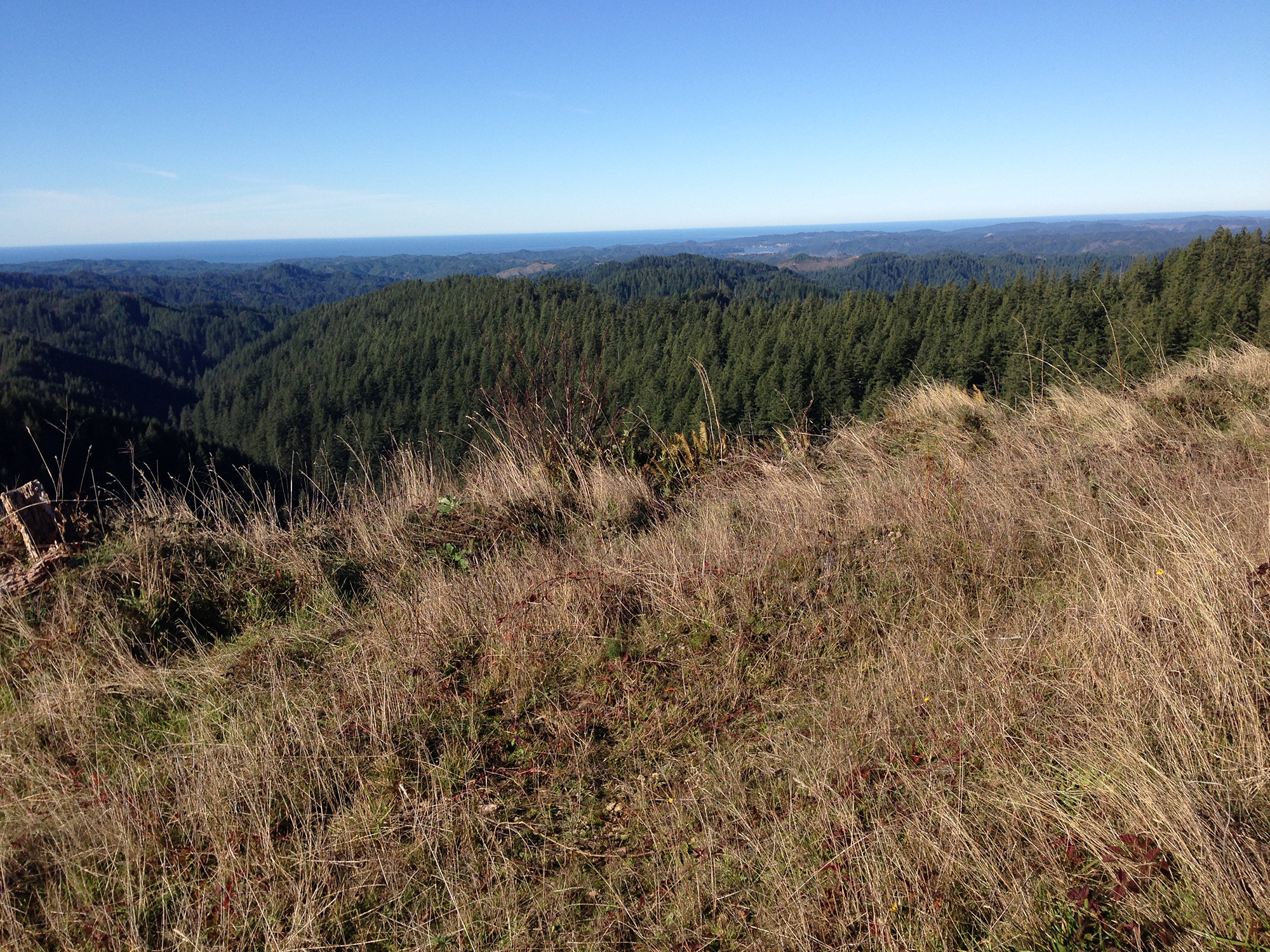
p. 33 #C-02 9-B 0:33 Sullivan Ridge (2), Mexican Treeplanters & Bears
Stop #C-02 9-B 0:33 Sullivan Ridge (2), Mexican Treeplanters & Bear Stories
Tape 9-B. Interview with Jerry Phillips and Roger Johnson by Bob Zybach, with Amber Ross and Randy Wiest while touring the Elliott State Forest on December 6, 2017. Part 2. Sullivan Ridge, Trail Butte Scotch Broom & Weed Control (47:24)
Roger Johnson:
. . . you ought to see the tree down right here along the road.
Amber Ross:
So this is recent?
Roger Johnson:
Yeah. Well, last June . . .
Bob Zybach:
What's the . . . I can't believe there's a -- [inaudible: tape noise 0:16 to 0:27]
Roger Johnson:
Yeah.
Stop #C-02. 0:33 Sullivan Ridge (2), Mexican Treeplanters & Bear Stories
Bob Zybach:
What's the name of this . . .
Jerry Phillips:
That's the Sullivan Ridge.
Bob Zybach:
Oh, Sullivan Ridge?
Jerry Phillips:
The Sullivan Creek is a tributary to Larson Creek.
Bob Zybach:
Uh-huh (affirmative).
Bob Zybach:
Lionel’s [Youst] has given us permission to put all three of those books online, on the website.
Jerry Phillips:
Good.
Bob Zybach:
Just put one up last night. Also, we got the 1908 diary of George Gould, that took four or five hours to scan, but we put it online last night.
Jerry Phillips:
I'm glad for that. The communication between the on-the-ground surveyors and the GLO office are very interesting because they're being personal decisions. It's just between people like this have to be taught.
Randy Wiest:
Holy cow! This [road] is curvy.
Roger Johnson:
Welcome to my world. Mark [Huff, Titan-Kelly LLC] asked me to drive this road to home every night. I said no. (Laughter)
p. 34 Randy Wiest:
All our roads in eastern Oregon are straight, so this is a good balance.
Roger Johnson:
Three times a month is more than enough.
Bob Zybach:
I really miss traveling in the woods every day. I thought when I went to school that I'd be spending a lot more time in the woods. Just the opposite.
Roger Johnson:
Well, you know, you have those moments where something happens and you look around and realize the beauty you're in. Some of them are ridge top moments and some of them canyon bottom moments when you go out and cross that waterfall.
Bob Zybach:
We used to have what we had called a “contemplating life” moment, when you almost get hit by a tree or barely your get your truck around a landslide.
Roger Johnson:
Or they drive you in a van.
Bob Zybach:
Who does most of the planting now? Is it local contractors or is it . . .?
Roger Johnson:
This year is going to be a local contract. Last year was Medford, the year before was a guy -- five years before that, four or five years in a row, it was a guy out of Salem.
Bob Zybach:
What was his name?
Roger Johnson:
Fremont Forest Systems, was a five-year contractor. Escalante Reforestation was the guy last year, and this year it looks like ride tree services.
Bob Zybach:
I'm guessing Medford and Salem are Mexican crews?
Roger Johnson:
Yes.
Bob Zybach:
Okay.
Roger Johnson:
And some of the guys on ride tree services are too, but I don't know.
Bob Zybach:
And everybody knows that a good portion of those people are all illegal?
Roger Johnson:
Do they?
Bob Zybach:
Well, they tried to cover it up but I think it's common knowledge, isn't it?
Roger Johnson:
Well, you know, some of them were brought in by a new process. They have a visa -- work visa -- that they seem to be able to get the state
p. 35 Roger Johnson:
department to approve people coming across the border to work. I don't know if that's going to continue with the new administration or not. And yes, there were some illegals on crews over the years. There were some criminals on crews over the years.
Bob Zybach:
Yep, I used to belong to Associate Reforestation Contractors, and so we did a little bit of an investigation on some of the labor we employed [in the 1970s]. 100% of the Mexican crews were illegal and some of the owners were illegal, and they were being counted as “diversity employees” by the Forest Service in central Oregon: “oh, we got a diverse employment force.” We got -- except they called them colored people [“people of color”] or something.
Roger Johnson:
I was never told that I should check that out. We should take a left if we’re going down Sullivan.
Bob Zybach:
It was a real problem and it ended up pretty much destroying the reforestation industry as we knew it by having illegals come in and low bid and . . .
Roger Johnson:
Yeah. Well . . .
Bob Zybach:
Got rid of all the locals.
Roger Johnson:
I started just as that was happening and there weren't a lot of white guys that were willing to work that hard.
Bob Zybach:
Well, we didn't have any trouble. I had guys work twelve, fifteen years [inaudible, odd noise 00:05:40]. [inaudible: tape noise 5:39 to 6:22]
Bob Zybach:
Exactly. It's just like farm crops.
Roger Johnson:
They're paying a lot right now to keep the crews together.
Bob Zybach:
Yep. Well, if they become legal there'll be a lot more payroll. There’s a whole lot of politics behind it, and the primary people that brought them in and maintained employment was the federal government. Private landowners weren't using them for a lot of years.
Roger Johnson:
Really?
Bob Zybach:
Well, it was a problem with insurance. Compensation insurance that a private land owner is liable. State and feds could care less.
p. 36 Roger Johnson:
Weyerhaeuser doesn't seem to worry about it.
Bob Zybach:
No, they had to finally give up. I planted five years in the '60s. I remember one Mexican tree planter and I hired several on my crew. They all had documentation. Weyerhaeuser turned me on to them and after two or three years, I found out their documentation was forged, and by that time they're friends and family and long-time employees.
Roger Johnson:
That's one of the things I heard. They had green cards and visas for some of these guys, but a lot's basically changed.
Bob Zybach:
Well, they had a whole industry. At Tacoma they had a lawyer that routinely issued phony IDs for those guys.
Jerry Phillips:
You can stop right about here. Somewhere around here, 10 feet away maybe.
Randy Wiest:
Okay.
Jerry Phillips:
And look to the left. That's why we were amazed that reforestation was so difficult. It looked to us like okay, this is all natural. It was a hundred square miles of just natural, fully stocked, fir regrowth. All we got to do is harvest, light a match, go home, and in comes a fully-stocked stand of young fir. And it turned out it wasn't that way.
Bob Zybach:
Were you leaving seed trees?
Jerry Phillips:
No. We're leaving just a clearcut, hundred acres here, hundred acres there, and really, it's not that simple. Up came salmonberry and thimbleberry and alder, and boomers. Then, oh, yeah! you got to go up there and do some planting -- and that was a real revelation. It seemed so simple. It wasn't just on our ground, it was the Siuslaw National Forest. The whole Siuslaw, clear to Corvallis, was one solid block of natural-grown fir.
Jerry Phillips:
Obviously, all you had to do was harvest the material and then watch it re- grow, you know? No, it's not that simple. We never did understand why. Never did understand why.
Bob Zybach:
We still don't, do we?
Jerry Phillips:
We know the fire was a huge part of that, but even when you burn a north slope or a west slope, it didn’t do anything regarding natural reforestation -- and yet here it was. A natural thing. So that I guess we never did fully understand.
Roger Johnson:
And probably never will.
p. 37 Jerry Phillips:
Probably never will.
Roger Johnson:
The size of the fire made a difference in that it killed a lot of stuff on its way through, so high, and you know the mountain beaver probably didn't survive as well as they do when we do a slash burn.
Bob Zybach:
But it seems like a killing fire would be a crown fire, so it seems like there'd be a lot of boomers could survive that.
Roger Johnson:
This was a ground fire. I'm pretty sure it burned all the way to the ground. Trees, there was probably enough under the old-growth stand that it was probably bark, snags and a lot of other things that it was a pretty hot fire.
Jerry Phillips:
I think so.
Roger Johnson:
And that probably helped the mountain beaver population . . .knock the mountain beaver population down. You have all the predators, if they survive the fire out there, hunting with less cover for the mountain beaver so year or two after the fire burned, they catch a lot more than normal.
Jerry Phillips:
We know that the fir has a good seed crop on an average every seven years. So if you go through a stand of five to six years and you have very little natural seed being grown. We would never fully understand, which is true, when you had to go out and plant.
Roger Johnson:
And stressed trees put on more seeds than unstressed trees. The ones that were in the fire would probably put a lot more seeds on. We don't stress many trees with our slash burning.
Jerry Phillips:
Absolutely.
Bob Zybach:
That's the thing that's confused me. Almost all the Coast Range was second-growth forest, then we had the earlier fires in the 1840s, then the 1868 fires. And then people came in and they kept burning the areas so they kept it open. And then they start not burn off all the ground and everything but I think boomers can survive those types of broadcast burns of light fuels.
Roger Johnson:
Yeah. Well, this will [inaudible, odd noise 00:11:41 to 11:52]. [inaudible: tape noise 11:41 to 11:52]
Bob Zybach:
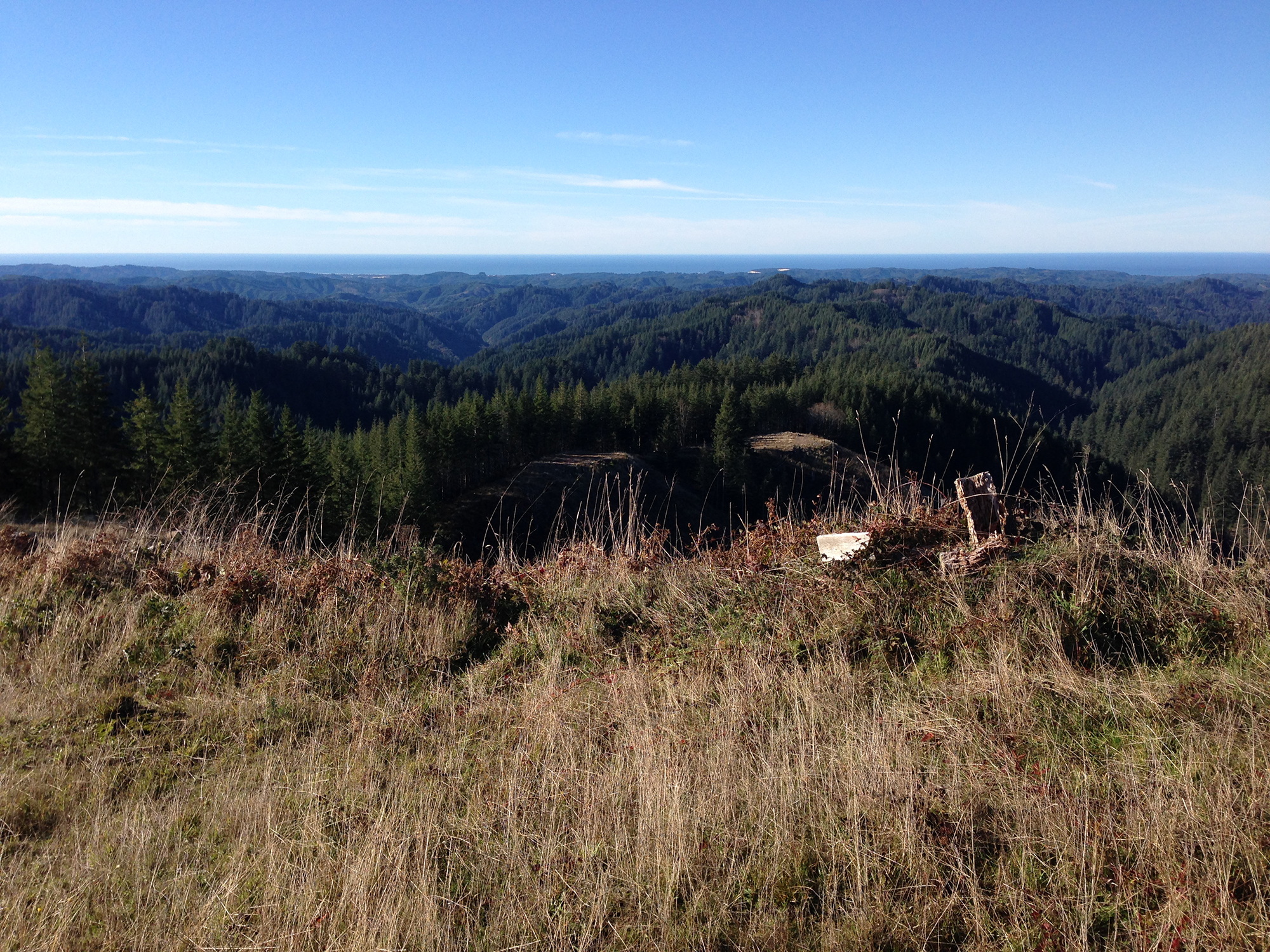
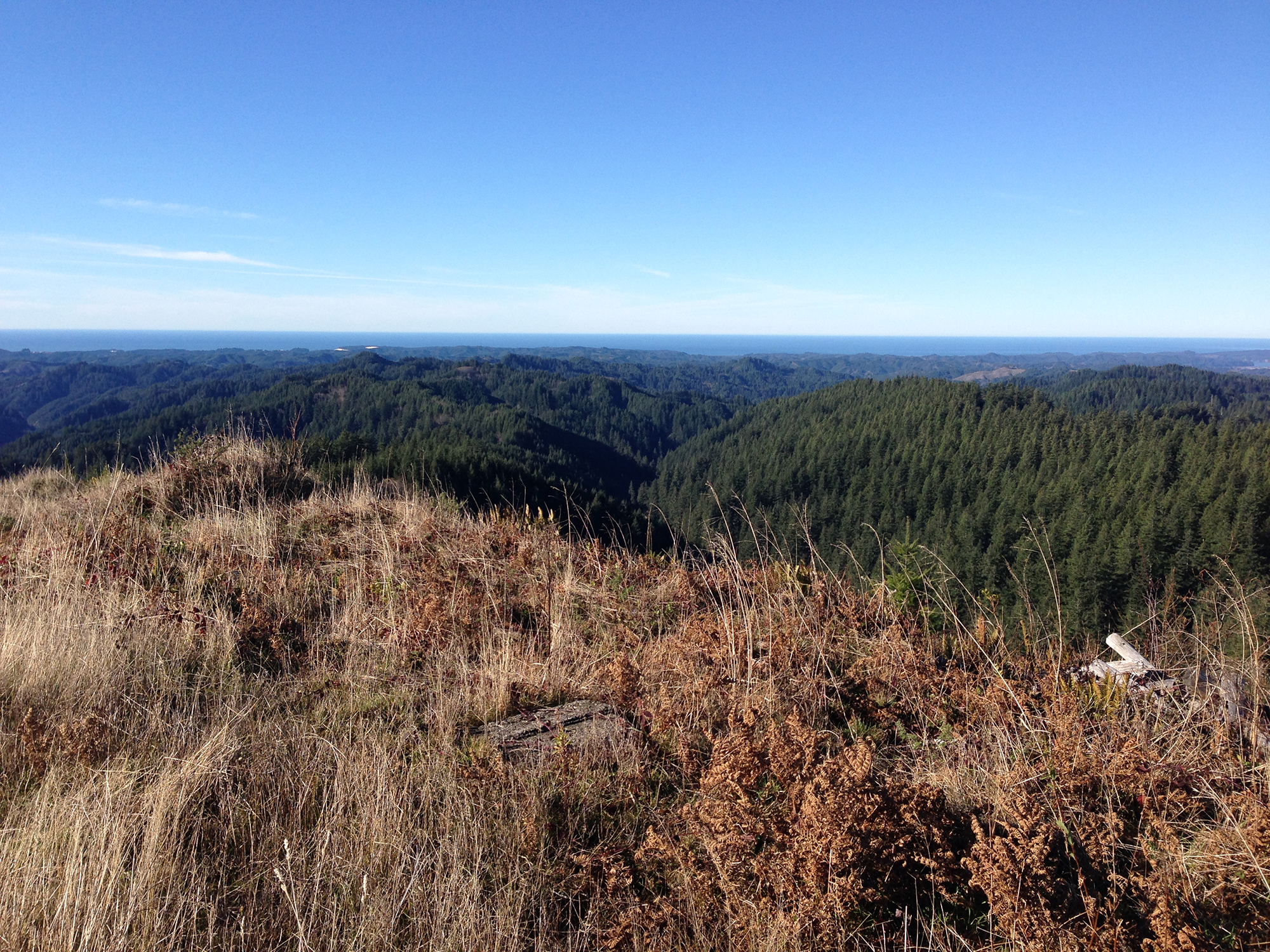
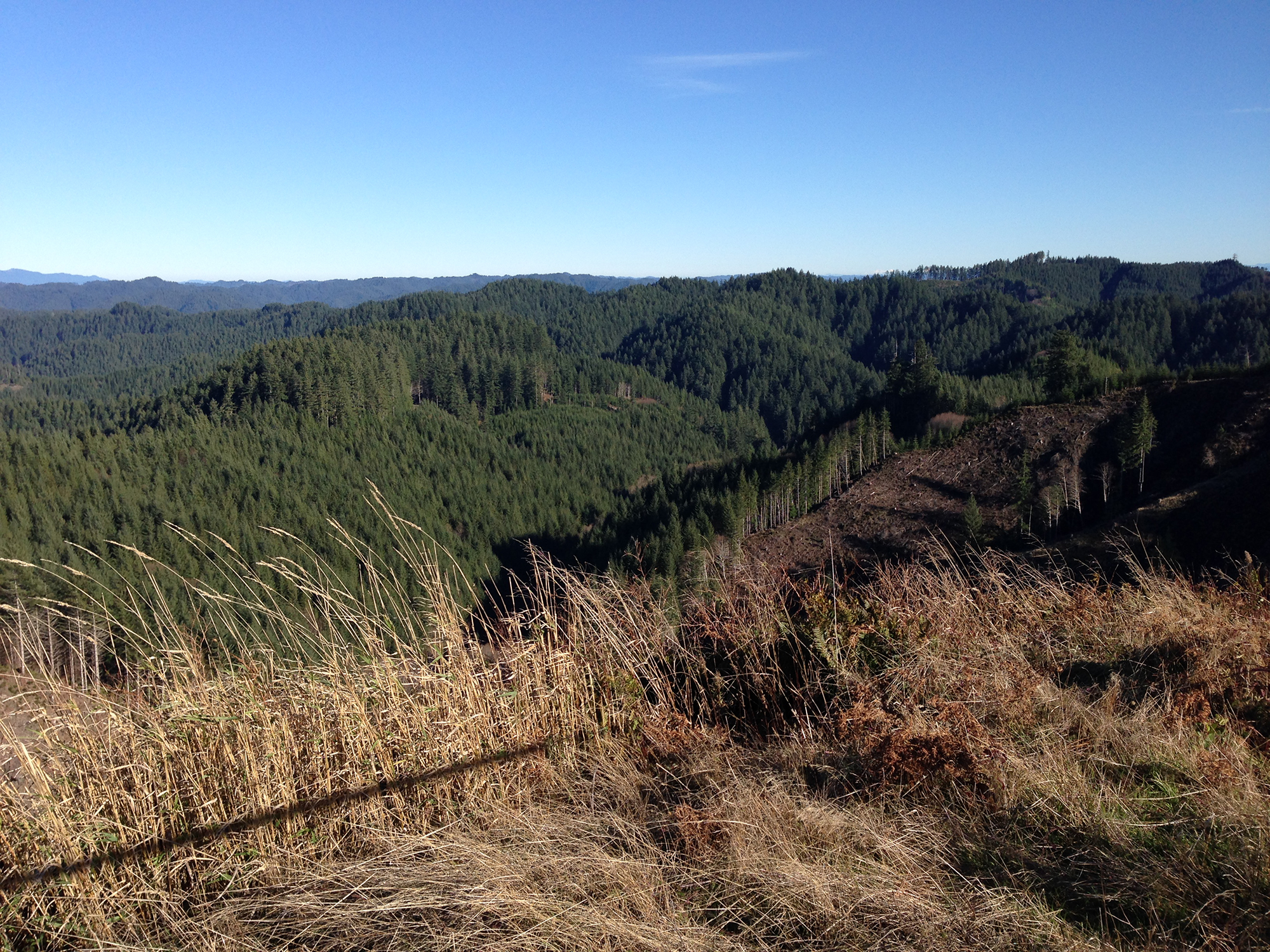
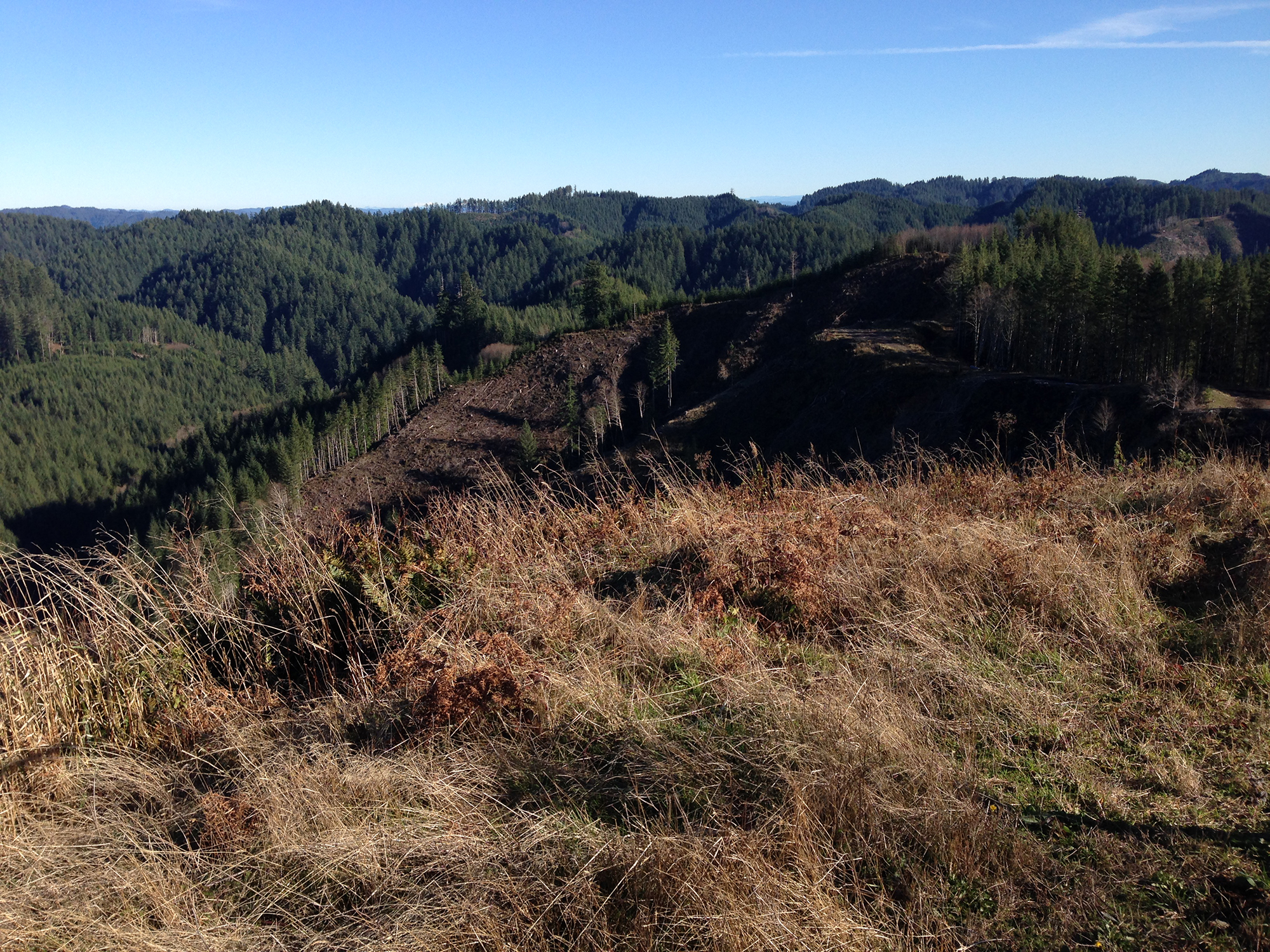
Boy, that's a beautiful view. On a clear day.
Jerry Phillips:
That's how it's like for a hundred square miles.
p. 38 Bob Zybach:
Yeah?
Roger Johnson:
Yeah. So what are the flowers doing right ahead on the head of the ridgetop there?
Bob Zybach:
Looks like the fatal accident location.
Jerry Phillips:
It looks like it could be.
Randy Wiest:
Somebody died, I think, in that.
Amber Ross:
Yeah, that's what I thought. I think I'm going to get out.
Randy Wiest:
We went that way last time, didn't we?
Amber Ross:
Mm-hmm.
Bob Zybach:
Have you ever noticed camas anywhere on the forest? It's a purple bloom that looks like a lily. They suspected it was a lily until a couple of years ago.
Jerry Phillips:
The Indians liked it.
Bob Zybach:
Yeah.
Roger Johnson:
I have not. You might have to point that one out to me.
Bob Zybach:
Okay. It'll be one of the first blossoms, right after trilliums.
Jerry Phillips:
It was supposedly one of flowers that was important.
Roger Johnson:
Really?
Bob Zybach:
Oh, yeah. That's for sure, and it still is. We were hoping that . . . the Willamette and the Umpqua valleys were full of them. In fact, the people from the lower Umpqua -- no, the Siuslaw people -- called the people from the . . . the Kalapuyans of the Willamette Valley, called them “camas people.” But there's stories of camas probably in Ash Valley. They say Loon Lake and a grizzly bear, but I don't know if there are any grizzly bears in this . . .
Jerry Phillips:
No, no, no . . .
Bob Zybach:
I think somebody mistook a large black bear for grizzly.
Jerry Phillips:
. . . no, no, no.
p. 39 Roger Johnson:
I know there are --
Jerry Phillips:
Maybe a combination of the two.
Roger Johnson:
Yeah. There were supposed to be some in California back in the 1800s but I don't know if any got this far west.
Bob Zybach:
Yeah, they had a lot of them. There's lots of . . .
Jerry Phillips:
In Yosemite.
Roger Johnson:
Yeah.
Bob Zybach:
. . . and the whole Sacramento Valley.
Jerry Phillips:
Those are true grizzlies in the California State Parks. If you enter a state park, there's a big sign saying, "Beware, there's grizzlies in this park."
Roger Johnson:
How big does a black bear get? I think I heard them getting up to 500 pounds.
Bob Zybach:
I shot one once that was about 220. It was young male, so probably 500 pounds would be about right. The story is that the Indians were at Loon Lake and they were out gathering camas, but a grizzly bear was out there gathering camas too, and scared the people off. But that's the only example I've heard of . . . of camas here, and Ash Valley would be an ideal location for them.
Roger Johnson:
I've been picking Himalaya blackberries before and the same kind of bear came by. That was exciting.
Randy Wiest:
You think pretty fast, then?
Roger Johnson:
No, you just kind of back up and wait, make sure he kept going. Take you out, if you think any of that.
Jerry Phillips:
You both know you're there, each other's there.
Roger Johnson:
Well, when he knows you're there either he leaves or makes it real obvious that he's there. (Laughter)
Bob Zybach:
There's hardly any attacks of black bears on people, though.
Jerry Phillips:
That's right.
Bob Zybach:
They're afraid of people.
p. 40 #C-03 9-B 16:20 Trail Butte (2), Dry Ridge (2) & Oral Histories
Stop #C-03 9-B 16:20 Trail Butte (2), Dry Ridge & Oral Histories
Jerry Phillips:
They don't want you to know they're there, because they don't want to be seen.
Roger Johnson:
The only ones are those that, if they have a cub, you can get into problem if they have a cub. That'll be . . . Chris Hollow one time jumped up on a stump to scare a bear away while he was doing stocking surveys, he yelled and hollered and the bear came for him, and he was running and just as he turned to run he saw little movements in front of the bear. So they had a cub with them and he came in with scratches all over his face from the blackberries when he ran through them. I don't know if he ever went back and got his hard hat or not.
Roger Johnson:
There's an old logging story about these guys driving up some road and a bear went across the road and they jumped out with a gun and the guy who stayed with the rig heard one shot, two shots, three shots and a long pause. Then a while later, a third shot and the guys come back to the rig and one says well, the first two or three shots was us shooting at the bear, and the last shot was the bear shooting at us. And then they dropped the gun for some reason.
Stop #C-03. 16:20 Trail Butte (2), Dry Ridge & Oral Histories
Roger Johnson:
Scotch broom keeps showing up in different places. I've never seen it like this.
Bob Zybach:
We were driving on the first day of the tour. We were just driving along, driving along, looking at all the trees, then came up on the ridge, to Umpcoos Ridge, and just right there -- as soon as we got up to the top, there it was. It's pretty easy to control, though, but . . .
Roger Johnson:
It takes forever once the seed gets started, though, because it lasts up to 80 years. You think you’ve got it under control or something, and 15 years later a plant comes up.
Bob Zybach:
Yeah. The thing is, to get the best control of all these things, it’s Doug fir, once you get it established.
Roger Johnson:
If it doesn't get enough light to grow. It takes care of it.
Bob Zybach:
Yeah.
Amber Ross:
Look at it here. That’s impressive.
Roger Johnson:
The other one that's out here that I haven't talked about yet is gorse.
Bob Zybach:
Okay. I didn't know you had gorse.
p. 41 Roger Johnson:
Yep. Not a lot of it, but then they keep popping up here and there. Japanese knotweed.
Amber Ross:
Oh, is there that out here, too?
Roger Johnson:
There's one spot that I found Japanese knotweed that I've been working on it for a couple of years now. I think I'm wining but, you know, the root system on that is so massive you have to keep it from getting light. Basically every time you see a little leaf pop up, you knock it back. It's great the first couple of years. The last time, I was down to a few leaves I took a hoe out and planned to up-root them.
Bob Zybach:
What's that double-pointed peak out there?
Jerry Phillips:
It doesn't have a name.
Bob Zybach:
It doesn't? I figured that'd be a landmark.
Roger Johnson:
If you went back far enough, you'd hit on Tenmile Butte.
Bob Zybach:
Does it have a double hump?
Roger Johnson:
I don't know.
Bob Zybach:
Okay.
Randy Wiest:
That's the wrong direction.
Jerry Phillips:
This is Johnson Creek, but it's not named for Roger.
Roger Johnson:
No. One of the other million Johnsons.
Bob Zybach:
Well, the Indian family on Indian Point, was Johnson.
Roger Johnson:
Were they?
Bob Zybach:
Yeah.
Jerry Phillips:
You're right.
Bob Zybach:
Yeah. I think I got that out of your book.
Jerry Phillips:
It's true. They still lived in Reedsport for a long time.
Bob Zybach:
And then they're up in Siletz country.
p. 42 Jerry Phillips:
Yeah, Siletz, yeah.
Roger Johnson:
The inmates brought a 4-track in here last year.
Amber Ross:
Mm-hmm (affirmative). That was those that were . . .
Roger Johnson:
Yeah.
Randy Wiest:
Yeah, looks like it.
Roger Johnson:
There's a soft spot down there. We needed to get trees across to plant the unit.
Bob Zybach:
Yeah, that whole myth about that the Mexicans come up and do the jobs that the white won't do or the residents won't do. That's always bothered me because anybody will do about anything if you pay them a reasonable wage.
Roger Johnson:
The first generation, that was true. I'm not sure even Millennials are willing to do just about anything to earn that.
Bob Zybach:
They don't have much of a work ethic. We used to hire kids from the rural areas and they had a work ethic, the Mexican kids had work ethics, but kids from the city -- that was pretty well drummed out of them.
Roger Johnson:
If you're not allowed to work until you're 18, you lose so much of what you had learned on the way up. I started when I was five.
Bob Zybach:
Yeah?
Roger Johnson:
Yep.
Bob Zybach:
A lot of rural kids, that's the way; a lot of them picked berries and now it's illegal; had paper routes and now it's illegal. So how do you get a work ethic if you're not allowed to work until you're 18?
Roger Johnson:
You don’t.
Bob Zybach:
And then how do you look at work if it's something that's illegal? You can't do it. It's like, "Uh-oh. I'm old enough. They could make me do it." It's been a real problem in the rural areas.
Roger Johnson:
A lot of this generation looks at the way that you make money as being, "Well, what's the easiest way to do things? Welfare is the easiest way."
p. 43 Bob Zybach:
That's probably true, unfortunately. Now there's some scattered stems around through there. That looks like an older . . . were those left as seed trees or a habitat or . . .
Roger Johnson:
Wildlife trees of some sort.
Bob Zybach:
Wildlife trees, okay.
Amber Ross:
Let me know if you want pictures.
Roger Johnson:
After the spotted owl was listed, we started leaving trees in places out in units, alder stands, small places.
Bob Zybach:
You know, Amber, if you can see can opening like right through here where you can get a few shots of the scattered stems we're talking about. That'd be really helpful.
Randy Wiest:
How about right through there?
Roger Johnson:
That's what happens when you don't cut it.
Bob Zybach:
That's exactly right. My ex-wife used to love clearcuts because she could see the ground. She's from South Dakota. Couldn't stand getting claustrophobic when we're driving between trees.
Roger Johnson:
We all have our little things, our disappointments. Mine is when I when I step on the brakes, and the brake speeds up.
Randy Wiest:
There's your spot.
Roger Johnson:
Yep. Can you take two or three, like a panorama? That'd be great.
Amber Ross:
Yeah.
Bob Zybach:
What ridge are we on here, Jerry?
Jerry Phillips:
Not sure. Might be Shake Creek, here.
Roger Johnson:
No, I think we're further south than that.
Bob Zybach:
Do you know the name of that creek?
Roger Johnson:
Not right off. It's just south of Vaughn ranch. Excuse me. It's out on the road. Yeah. Who's the other guy besides Mike Vaughn over here? The city counselor. I can't remember his name. Dave Gould, Mike Vaughn. This is Mike Vaughn's place, yeah.
p. 44 Bob Zybach:
You're trying to remember Gould's name?
Roger Johnson:
Yeah. I get the two. I have to remember both to remember who I'm talking about.
Amber Ross:
Johnson Creek . . . Schumacher Ridge . . .?
Bob Zybach:
Probably the name of that main drainage on there would be the . . .
Roger Johnson:
Well, the West Fork's down there.
Bob Zybach:
Oh, so we're looking at the West Fork right now.
Roger Johnson:
Yeah, the West Fork of the Millicoma.
Bob Zybach:
Okay. So we're on the north-south ridgeline here?
Jerry Phillips:
Dry Ridge.
Bob Zybach:
Oh, Dry Ridge. Okay.
Roger Johnson:
Call it Dry something. Jones Point is here, back here behind us. So you end up looking towards Jones Point.
Bob Zybach:
Ah-hah. But the base on there is . . . I've got a really nice camera, perfect, the panoramas and stuff. It's in my car, locked. And my correct notebook with my notes for the day is in my house, locked. This aging process is kind of humbling at times.
Jerry Phillips:
I’ll say it is. If I have to remember to do something the next day, I go out and put it in the car or tie it to the front doorknob. Either way.
Roger Johnson:
Make sure you step over it in the morning somehow.
Jerry Phillips:
That's right.
Bob Zybach:
I had my camera hanging from the backdoor and I put it in the back seat but I put it on the floor. And when we're shifting there . . .
Roger Johnson:
If you put it too far from the door, you can step over it.
Bob Zybach:
I had been bringing everything before, but then it's like in a box, and then it’s back in the box.
Jerry Phillips:
There's many distractions.
p. 45 Randy Wiest:
I call them squirrels.
Bob Zybach:
Is that an old logging road there?
Roger Johnson:
Yeah. That goes out to the point there and they harvested a unit on this side and that. Part of that where we were sitting at.
Randy Wiest:
Some potholes here that need attention.
Roger Johnson:
Dave's been very good about keeping this road in fairly decent shape.
Amber Ross:
We’re at the 2000 Road now.
Bob Zybach:
What's Bill's name, that you work for?
Randy Wiest:
Bill Ryan?
Bob Zybach:
Bill Ryan, yeah. Him and Jim Paul were at the last meeting and he was asking about you two, how you were responding to what you were hearing and seeing. I told him it’s like you were trapped in a box with dinosaurs. (Laughter)
Randy Wiest:
Oh, well.
Roger Johnson:
Hopefully they can squeeze the oil out.
Bob Zybach:
I didn't know if that was very accurate or not. I was kind of projecting.
Randy Wiest:
It does.
Amber Ross:
Well, we've learned a ton on these trips.
Randy Wiest:
Yeah, this is great.
Bob Zybach:
I did my master's on oral histories. The one thing we learned is there's things you learn by that method that you can't learn any other way. Then you got to document it.
Randy Wiest:
Yep.
Amber Ross:
Well, and some people just learn differently. And for me, hearing stuff out loud, I usually remember it quite a bit.
Bob Zybach:
Yeah. We used to do learning styles and people . . . some people can be lectured or read, and others like me, you have to show me. And then
p. 46 Bob Zybach:
there's the artistic people that are creative and there's just no chance. You're supposed to have some of those in with your group just for creative thinking. Just so you can . . .
Roger Johnson:
So they didn't cover my group. You have to learn by pain?
Bob Zybach:
I think that's the same group as me. You've got to learn by doing it. Somebody's got to show you and then you've got to do it and then you know it. If it's just written instructions, you don't have it.
Jerry Phillips:
Well, of course, hearing is the worst way to learn.
Amber Ross:
Is it?
Jerry Phillips:
Yeah. Hearing, seeing, and doing -- the three main ways that we learn. Hearing is the worst part. The least effective.
Bob Zybach:
Why is that?
Jerry Phillips:
This term selective hearing I think is the reason for that. We intentionally sometimes tune out the parts that we don't especially care about. We're hearing them, but they don't stay in. And about misinterpret . . . whatever it is, can happen too.
Bob Zybach:
Well, one thing about oral history that's different is it's not an oral history until it's been transcribed and then, as you've done and . . .
Roger Johnson:
Then it's a written history.
Bob Zybach:
Well, it's documented . . . and there's Lionel Youst and then Jerry. Both really good at blending photographs and maps along with eyewitness accounts and discussions. So you have those elements and then you get a really complete picture.
Roger Johnson:
I'm not a great communicator.
Bob Zybach:
Well, you've been doing great so far. I think a lot of people that work in the woods are not real social.
Roger Johnson:
Well, I tend to think about things, without saying anything.
Jerry Phillips:
And I'm not sure this is a good parallel, but in the woods, when the fire detection was almost all done by lookouts, every lookout had a [Osborne] Fire Finder in it and the person who was there would report seeing a fire on a certain transect on that Fire Finder. But the way . . . at an extended length of distance . . . and the way that it got down to the most accurate
p. 47 Jerry Phillips:
location was through crossing another lookout at right angles, hopefully, that would report the same fire on their Fire Finder for a particular location.
Jerry Phillips:
Then the first one is quite general, and the way this is similar to verbal communication, you have two people with different perspectives with the same manner for a chance for it to be true.
Bob Zybach:
Yeah. In oral history, they even got a word for it, it's called triangulation. So you can get three people; or bring in two people with a photograph; or one person with a photograph and a newspaper article -- you need three lines of evidence in order for it to be reasonably accurate.
Jerry Phillips:
Makes sense to me.
Bob Zybach:
That's why it's been so good about having a David and Roger, as well as you, and all of us discussing these things, rather than just one person who's just reciting from memory.
Jerry Phillips:
Yeah. It would be.
Bob Zybach:
And we're right on the location, which makes it a lot more specific as well.
Jerry Phillips:
I tried to say on the first part of my book, is that my apologies initially for those whose memories may be a little different, because there might be different views.
Bob Zybach:
I like some of your notes in there. The one on . . . that there's a lot of stories on the state land and exchanges but you would spare the reader. There might be a few of us that would miss those stories but for the most part . . .
Jerry Phillips:
Because it's easy to get wordy about something you're really interested in, excessively.
Roger Johnson:
It's where computers get useful.
Jerry Phillips:
And I appreciated that on almost all the research-type publications, that they gave it an abstract.
Bob Zybach:
Yeah?
Jerry Phillips:
Yeah, just read the abstract. Good!
Randy Wiest:
Yeah. Read that, read the conclusion, and be done with it.
p. 48 #C-04 9-B 31:33 Land Exchanges, ESA Ologists & Weed Control
Stop #C-04 9-B 31:33 Land Exchanges, ESA Ologists & Weed Control
Bob Zybach:
Yeah, pretty much. Unless you want to replicate it, then you just read the methodology.
Randy Wiest:
Right.
Stop #C-04. 31:33 Land Exchanges, ESA Ologists & Weed Control
Amber Ross:
So, Jerry, you didn't write a summary of the land exchanges in the book? Did you write a summary of the land exchanges?
Jerry Phillips:
I did not. I was very tempted to but I thought to myself that even though it was a fascination to me throughout 20 years of actually creating those, no one else would care, so I didn't ever put it into verbiage.
Amber Ross:
Definitely a history of how the forest formed.
Randy Wiest:
Yep.
Jerry Phillips:
A lot of really very interesting person-to-person action, and we initiated all of them, through the office there. Nobody ever requested one, but we created them all.
Bob Zybach:
Oh, so you instigated all those?
Jerry Phillips:
All of them.
Bob Zybach:
Wow.
Jerry Phillips:
100%.
Bob Zybach:
Wow.
Amber Ross:
That is incredible.
Randy Wiest:
Make a left?
Roger Johnson:
Should be straight ahead.
Bob Zybach:
So you were involved in these plantations from here? These look like maybe 10, 12 years old?
Roger Johnson:
Yeah, that one too. This one has . . .
Bob Zybach:
Oh, on the left here.
Roger Johnson:
Yeah.
p. 49 Bob Zybach:
Okay.
Roger Johnson:
That's 1989 or '90. Something like that.
Bob Zybach:
What do you think should be done next on that? A pre-commercial thin, or a commercial thin, or a clearcut?
Roger Johnson:
It’s probably getting a little old to do it, except to clearcut. A little bit of redwood in the buffer on that side and a little bit of redwood down here.
Bob Zybach:
Now those older trees that we're looking at down below there, is that 135- year old or is that some of the older --?
Roger Johnson:
That's a residual whatever. It probably 130. There's 30% cedar in the stand behind us, too.
Bob Zybach:
Wow. Were any of the natural stands as high as 30%?
Roger Johnson:
Probably not.
Bob Zybach:
It seems like a lot.
Roger Johnson:
But it was spread out through the whole forest, not just in locations. Some of that stuff got cut out by cedar bolt cutting, and now it's kind of disappearing.
Bob Zybach:
So this year's plantation stats will be on a grid and it'll be 11-foot spacing?
Roger Johnson:
10 by.
Bob Zybach:
Oh, 10-foot spacing. Okay.
Roger Johnson:
Yeah. We have 12 out of 75,000 are going to be [inaudible 00:34:20].
Bob Zybach:
Uh-huh (affirmative). A little cedar? Have you ever worked with plug-1 stock?
Roger Johnson:
Yes.
Bob Zybach:
What do you think of it?
Roger Johnson:
It's really good but it's a little on the expensive side. Getting close to $500 a thousand [seedlings].
Bob Zybach:
Wow. We had about 95% or 96% survival with it and then we could widen the spacing out to 12 and 15 foot and it's saved us money. The stock
p. 50 Bob Zybach:
was more expensive, but the maintenance and the plantation work was cheaper.
Roger Johnson:
We would do very well with that here if we had enough soil.
Bob Zybach:
The other thing, we shifted to micro-site densities so we were looking at 200 stems an acre or 300 stems an acre. The first choice was on the downhill side of a stump, and then if they were closer than four foot together, then we didn't plant one. So they had to be at least six feet away and not more than about 18, and if there's like 19, we put another tree somewhere in the middle and that just had great survival and could reduce deer damage.
Roger Johnson:
That's what we asked them to do, into the exceptions we made. The exception should be 14 by at the widest, and that's to be expected out there.
Bob Zybach:
Towards the end of it we started doing pre-commercial thinning at four to five years of age.
Roger Johnson:
Really?
Bob Zybach:
It worked out really well.
Randy Wiest:
This the route?
Roger Johnson:
Where are you going?
Amber Ross:
So Bob, the ridgeline roads that go west are Johnson Ridge, Robert's Ridge, Benson Ridge, Scholfield, and then Dean. Dean I think would be our exit. Is there any of those that's on a high priority?
Bob Zybach:
Well, we're going to exit on Dean's and we'll do Scholfield and Johnson Ridge. We haven't done that, have we?
Amber Ross:
This is the Johnson Ridge here.
Bob Zybach:
Okay. I think, Jerry, you know better than me. I didn't bring my map today but it seems like Johnson, Dean's, Scholfield, if we hit those three ridgelines, we’ve hit the key parts, haven't we?
Roger Johnson:
Well, I think so. We did Benson a number of times.
Bob Zybach:
Okay, and then how about . . . yeah, we did that going out the other day. And then how about the riparian areas? We'll be along riparian area on
p. 51 Bob Zybach:
Scholfield Creek, won't we? And that's where a bunch of salmonberry was.
Jerry Phillips:
Well, not really.
Roger Johnson:
That’s not on state land.
Amber Ross:
No. It’s on private.
Jerry Phillips:
A state owned road drops right down into the Walker Ranch. It's straight down there so there’d be no riparian that we own.
Roger Johnson:
You can do a little bit of riparian along the 8000 if you want to stop there.
Amber Ross:
I think we’ve done the 8000.
Bob Zybach:
How about going into Walker where the three C's . . . where . . . will we be going down into that?
Jerry Phillips:
It all comes below where the CC's camp was, downstream from it. So it's all private land in there.
Bob Zybach:
Okay. And so the Walker Ranch is private land still?
Jerry Phillips:
Mm-hmm (affirmative).
Bob Zybach:
Oh, okay.
Jerry Phillips:
Because it was like three homesteads, and we acquired the other two for a fee. It was long ago. It was in the '40s, so you go through a bunch of maple, residual maple, pretty much and all that.
Bob Zybach:
The one person that I would like to talk to, where the previous recorder broke and I got to go back on, is a McClay from the Loon Lake area. But then he's also descended from the Walkers -- so the first female lookout, he's got a photo of her there, which is a Walker. And then the Walker Ranch, he's got pictures of that and we talked about that quite a bit. So if we can go through that area, that would be good, or is that out of the way too much?
Jerry Phillips:
It is. They changed a lot of locks on the gates down to his Walker Ranch and normally, if you turn left, you're on the county road. But you're talking about the time trying to get up Scholfield Creek and I don't know if it's open through there or if it's been maintained. I don't know who would maintain it. We wouldn't because we don't use it.
p. 52 Amber Ross:
We don't have access that way.
Bob Zybach:
So it sounds like the Walker Ranch, we don't need to . . .?
Jerry Phillips:
Yeah, I wouldn't put any emphasis on that at all.
Bob Zybach:
Okay. Because McClay, that's the main thing I was reporting from him was . . . or one of the main things was Walker Ranch, so we can get that with him.
Jerry Phillips:
Yeah.
Bob Zybach:
Okay.
Amber Ross:
So we can go this way a ways.
Jerry Phillips:
This road here was built primarily to access with the cable thinning on the left-hand side.
Bob Zybach:
So this is one of the Columbus Day Storm roads?
Jerry Phillips:
About that time. And then we have this road on a balloon logging site.
Bob Zybach:
Oh, so that'd be Faye Stewart?
Jerry Phillips:
Mm-hmm, right. And they pretty much brought the logs down at first, downhill into the bottom of Johnson Creek.
Bob Zybach:
So this is where they were doing the balloon logging?
Jerry Phillips:
There were two sites. This is site number two. The first one it was on Johanneson Creek, and that was an inadvertent one, we didn't plan it that way, but Faye Stewart did plan it that way, and he got away with it.
Amber Ross:
Roger, we shouldn't have a problem turning around here.
Roger Johnson:
You have about three miles. There's the number that's certainly that's on it. Can't remember what I said on it. I'll tell you when I think we ought to turn around.
Amber Ross:
That will be appreciated. Thank you.
Bob Zybach:
We've been driving through an awful lot of nice timber.
Roger Johnson:
There's an awful lot of nice timber on the west side.
p. 53 Randy Wiest:
Yes, there is.
Roger Johnson:
There's some nice timber on the east side.
Bob Zybach:
At least the north system, seems to be a bit patchier on the east side.
Roger Johnson:
Yeah. Well, more work's been done in the last 20 years on the east side.
Jerry Phillips:
When the HCP was in operation, that was . . . one of the basis for it was three different watersheds and each had a name, each portion has their name, and the assumption there was that you shouldn't drop the overall canopy of timber below a certain figure -- 40%; whatever it might be.
Jerry Phillips:
So at that point, it was judged that we had cut pretty heavily in the Tenmile . . . the whole Tenmile watershed. So therefore we were to lay off our logging here, and we're still laying off, obviously because of that. So we had a lot of heavy timber on the left-hand side the last couple of miles and that's there largely because of that self-imposed prohibition that goes down to Johnson Creek on the other side. A lot of the priority was to not log the timber, that we had a self-imposed prohibition against it.
Roger Johnson:
A lot of the over-rotation basically was on the east side.
Amber Ross:
In the last HCP, wasn't it set at like a 250-year rotation on the west side of the forest?
Jerry Phillips:
I don't know that. I wasn't here. I was involved in it, I don't . . .
Roger Johnson:
Each basin had a little different plan of the percentage of habitat kept and the percentage to be harvested, and there were variations between each basin and so on. 250 years on some of them, might have been 230.
Amber Ross:
But obviously the intent was not for harvest, based on that.
Roger Johnson:
Yeah. It was to keep the habitat at a level that the biologists were happy with.
Jerry Phillips:
And I feel like if you're an “ologist” you had a heavy hand.
Bob Zybach:
That was interesting to watch the Fish and Wildlife Department take over management of the forest, pretty much.
Jerry Phillips:
Yes, it was.
p. 54 Bob Zybach:
It was like just watch that transition. It's like watching the transition to illegal aliens planting trees. You just watched it happening. It's hard to believe it was happening and then it happened.
Amber Ross:
Well, the Endangered Species Act is the number one management tool they have now, right?
Bob Zybach:
Yeah. EPA's in there a little bit.
Jerry Phillips:
It's pretty much a social decision. It's not based on economics or science, primarily it’s based on feelings.
Roger Johnson:
It depends on whose feelings they consider.
Bob Zybach:
Riparian areas on Mill Creek are invested with -- is that reed canary grass?
Roger Johnson:
It probably is. There's a little bit of canary grass back on the 2000.
Bob Zybach:
It's just flooded with it, and Himalayan blackberry. So what are the thoughts on that? It doesn't look like there's been any effort to . . .
Roger Johnson:
No. Nobody's working on it. Himalayan blackberry's still on the incline on the forest, trying to keep becoming more widespread than it already is. Reed canary grass, a little bit out of the west end of the 3000 last year, trying to keep it . . . and keeping trees coming up through it, but that's the only place, really. Mostly successful in keeping the trees alive through the dry part of summer, but that's all it really did affect.
Bob Zybach:
It seems to me that the . . .
Roger Johnson:
It’s still in the experimental stage (laughs).
Bob Zybach:
It seems like the only true biological control for a lot of these so-called weeds is a nice canopy of Douglas Fir.
Roger Johnson:
Mm-hmm (affirmative).
Jerry Phillips:
Yes, it is. Yes, it is.
Bob Zybach:
They keep talking about biological control. They kept talking about moths and things like that. It seems like Douglas fir is the obvious one.
Roger Johnson:
Well, all those biological controls go through life cycle systems, too. Tansy's not that, really . . . well, 15 to 20 years ago, but now it's back.
Amber Ross:
With a vengeance.
p. 55 Tape 9-B End 9-B 47:42
Roger Johnson:
After the moth populations crashed.
Jerry Phillips:
I'm always fascinated by seeing pictures of Southeast Asia and of Europe where there's virtually no brush. Just a barren forest floor. My memory is of all the years we worked out here, crawling through heavy brush. And that's not how it is in the southeast states or in Europe.
Bob Zybach:
Part of Europe . . . I was in Switzerland, looking at their reforestation work there in the 70s, and there was somebody out there mowing between the trees. A little bit pickier about their understory than we are.
Roger Johnson:
That happens in Georgia and Florida, too, I'd suspect.
Bob Zybach:
You have to have flatter, sloping land for it . . . and shorter growing season . . . Well, in Georgia, though, it wouldn't be shorter.
Roger Johnson:
Mowing in this country would be real life.
Bob Zybach:
Yeah, right. We used to actually use our chainsaws to mow through blackberries --
Tape 9-B End. 47:42
p. 56 #C-05 10-A 0:26 Johnson Ridge Huckleberries & Balloon Logging
Stop #C-05 10-A 0:26 Johnson Ridge Huckleberries & Balloon Logging
Tape 10-A. Interview with Jerry Phillips and Roger Johnson by Bob Zybach, with Amber Ross and Randy Wiest while touring the Elliott State Forest on December 6, 2017. Part 3. Johnson Ridge Huckleberries, Balloon Logging & Gorse (47:24)
Stop #C-05. 0:26 Johnson Ridge Huckleberries & Balloon Logging
Bob Zybach:
Did you mark that last spot back there at the intersection?
Amber Ross:
Where we just stopped?
Bob Zybach:
Yeah. That'd be right where we changed the tapes at the intersection of Johnson Ridge and . . . Where'd the other road go, back there at that last intersection?
Jerry Phillips:
That's Dean's Mountain.
Roger Johnson:
May have been the 2000.
Bob Zybach:
Okay, so that's -- we've been on that section of road before?
Jerry Phillips:
We've been on it.
Bob Zybach:
Oh, okay.
Randy Wiest:
The last time we came up.
Amber Ross:
I think I've been on it.
Jerry Phillips:
I've been on the same one.
Bob Zybach:
I've been listening to these tapes at home. I've been plotting where they are on the map that you gave me. We're really covering the ground really well.
Amber Ross:
[crosstalk] . . . I really think so.
Randy Wiest:
You might want to move . . .
Amber Ross:
Yeah, and I'll send you the GIS points too and you can . . .
Bob Zybach:
I think when we get done, and that's why I was asking who I should report to. I'll do a summary and make sure that the photos and recordings and then these notes of the recordings that we make – that aren’t right on the Forest – then I’ll do another one with Jerry and Bob Jacobson and David and have to go back and see David McClay, so there's probably at least two or three more recordings in our plans, interviews that are planned. I'll
p. 57 Bob Zybach:
get everything out. I got to get those digitized, but then they'll be easy to use.
Bob Zybach:
I was kidding about the dinosaurs but the three of us in the backseat here have a combined well-over a hundred years of reforestation experience.
Amber Ross:
Yep.
Bob Zybach:
It's a little bit scary.
Roger Johnson:
Yeah. If I didn't have a sense of humor I'd be retired.
Jerry Phillips:
Well, even with those years of combined experience . . .
Bob Zybach:
What was that?
Jerry Phillips:
. . . even with those years of combined experience, it doesn’t mean you know everything about it.
Bob Zybach:
Nope.
Jerry Phillips:
Always, what I liked about the study of forestry --
Roger Johnson:
I think this would be a good place to turn around now.
Randy Wiest:
Okay.
Roger Johnson:
Should be another wide spot like that if you want. You can turn around up there too.
Randy Wiest:
It doesn't matter to me.
Roger Johnson:
What does Bob want to do?
Bob Zybach:
I’m seeing everything I want to see, it's all new to me. And we're discussing all the key points on the shrubs and the plants and the animals, so . . .
Roger Johnson:
A little further out this road is where I was laying the ground looking at the elk. I think that was about 1975.
Bob Zybach:
So it was a heavy huckleberry patch? Oh, okay, well that'd be good.
Jerry Phillips:
That's up the ridge.
p. 58 Bob Zybach:
If we can get them on the map, then we can go back and one thing I'm trying to do is hopefully go back to about an 1800 veg[etation] pattern, so having known where all the huckleberry and the peavine and the flags and those things are, is kind of key.
Roger Johnson:
Yeah. Anywhere, if you walk down here, you'll probably run into huckleberries.
Bob Zybach:
That's the curious thing, it’s on the west side, and then that’s --
Jerry Phillips:
On the ridges.
Bob Zybach:
-- on the ridges, and the ridgeline trails, and where the Indians would walk, and then coming up from Tenmile with its fairly heavy populations of people, it just makes sense.
Jerry Phillips:
And birds spread them here too.
Bob Zybach:
I think the main thing isn't so much as spreading the huckleberries, but keeping an open canopy, so if there's people there, they're burning, they're picking, they're cutting or doing something to maintain the berries. [crosstalk]
Jerry Phillips:
. . . when huckleberries grow to the top of the snags.
Bob Zybach:
Those were red huckleberries though, weren't they?
Jerry Phillips:
That were 30 feet up. Those were all blue.
Bob Zybach:
Oh, wow. So we know those have birds.
Jerry Phillips:
That's true.
Amber Ross:
Is there another wide spot beyond here?
Roger Johnson:
Oh, there should be one more.
Bob Zybach:
This is the huckleberry area you were talking about, through here?
Roger Johnson:
This is huckleberry ridge top up here. You've got to . . . makes it harder to walk on.
Jerry Phillips:
The ridge is hard to do, so the best is to follow the elk where they leave their trails.
p. 59 Bob Zybach:
And it seems like we're having the discussion before whether Indians or elk being the first to establish the ridgeline trails and I think you were right. I think the Indians connected the dots, and made them contiguous trails; from Point A to Point B, the elk could care less about that. But then I think it probably went from the elk like you say to the Indians to elk again.
Jerry Phillips:
Elk just stayed on the trail.
Roger Johnson:
Or jumped over it.
Jerry Phillips:
Or jumped over it if there was a log in the way, depending on how big it was.
Roger Johnson:
If it's a ten-footer they didn't jump over it.
Bob Zybach:
Well, there’s lots of stories about the Indians just burning trees out of the trail.
Roger Johnson:
Yeah.
Bob Zybach:
Probably the next turn-around would be good, huh?
Randy Wiest:
Yeah. We have a couple miles yet.
Amber Ross:
No. End of the road there.
Bob Zybach:
So, Amber, can we get at the next turn-around or stop, can we get another photo or two? We've got to get Roger to be the human scale, but I could probably do that with my camera.
Roger Johnson:
We're not at head-hitting speed (laughter). For a geology tour one time in high school, I was sitting in the backseat of a school bus and the driver didn't see a rock, and I hit the ceiling. [crosstalk]
Bob Zybach:
Now, is this it here? Is this one here a plantation or . . .?
Jerry Phillips:
It is. It’s a plantation.
Bob Zybach:
Oh okay. So this is the balloon logging from Faye Stewart. And followed it up with the plantation. It looks really well stocked. Is it that way all the way down?
Roger Johnson:
Pretty much.
p. 60 Jerry Phillips:
Yes, yes it is.
Bob Zybach:
Sure, good.
Roger Johnson:
This is your turn-around here. Actually, you can go one more if you wanted to, it's only a little bit down and then there's a spot where the road forks and there's a gate. That might be better maybe.
Randy Wiest:
Okay. Which one?
Roger Johnson:
The lock had been broken by protesters.
Jerry Phillips:
Civility. That’s what we need: locks and civility.
Bob Zybach:
Yeah?
Jerry Phillips:
There’s two or three hundred miles of this, roads like this.
Bob Zybach:
Wow.
Jerry Phillips:
Roads along all of these ridges.
Bob Zybach:
And they're all stable, they haven't washed out or anything.
Jerry Phillips:
There have been very few.
Roger Johnson:
There's some maintenance going on.
Jerry Phillips:
But there just hasn't been much.
Amber Ross:
I was going to ask if those are . . .?
Roger Johnson:
Yeah that's kind of where they’re at on it.
Bob Zybach:
I had a Mitsubishi, 240-Z, made for off-road driving. But it looked like a regular sedan, but it had fifteen inch tires, 5-speed, and good clearance and I took it on roads like this.
Roger Johnson:
You can pull into the spot here.
Bob Zybach:
Can we get a photo here?
Randy Wiest:
Well, I can back up here and we can get out. You want to take a picture?
Bob Zybach:
Yes. Could we, please?
p. 61 Amber Ross:
Which direction would you like?
Bob Zybach:
Well, I think about any, because we've got the photo point here, and there's a couple ways between the trees where we can get some landscape, I think.
Amber Ross:
You want those to . . .?
Bob Zybach:
And maybe with the reprod behind us, that 50-year-old reprod; having the truck in there for scale would be really good, too.
Randy Wiest:
Back up a little bit?
Amber Ross:
We’ll let Randy start to back it up to turn around.
Bob Zybach:
If you get stuck we could document that too.
Roger Johnson:
Don’t make it an historical landmark!
Amber Ross:
That’s a pretty view from here, with that rock out there.
Roger Johnson:
Probably one of the last timber sales here.
Bob Zybach:
Was it? We're just a little beyond the 50-year-old reprod now.
Roger Johnson:
It’s probably more than 50. Probably ten more than that. That clearcut probably wasn't cut to . . .
Bob Zybach:
So it's probably a replant, then? So you went directly from the balloon logging to hand planting?
Roger Johnson:
No, the balloon logging is on the other side and then the hand planting was on this side. Probably '87 or '84.
Bob Zybach:
Are we getting out here?
Randy Wiest:
I guess, yeah, do you want the pictures?
Jerry Phillips:
Yeah. The balloon logging was about 1961, so probably ‘63.
Bob Zybach:
That would be 54 years then.
Jerry Phillips:
53.
Bob Zybach:
I wanted to get kind of an aerial of . . .
p. 62 #C-08 10-A 14:26 Johnson Ridge Roads, Indian Allotments & Maps
Stop #C-08 10-A 14:26 Johnson Ridge Roads, Indian Allotments & Maps. No Photos.
Bob Zybach:
[Distant voices and laughter 11:50 to 14:15]
Bob Zybach:
We’ll probably have another stop after this one, won’t we? Jerry, you want something to eat?
Jerry Phillips:
I'll be fine thanks.
Stop #C-08. 14:26 Johnson Ridge Roads, Indian Allotments & Maps. No Photos.
Bob Zybach:
Is that the map right there?
Jerry Phillips:
It is. You know what’s interesting is, this series of sections of it, before the State owned it and they made their selections.
Bob Zybach:
So that would be right before 1930 when the State made the selections?
Jerry Phillips:
It was around 1920 sometime. And then, the answer was . . . in the 1920s, when we prioritized it with the State and some of it was private land at the time. You can see the trails on it.
Bob Zybach:
Made at that time? Oh, the trail's right there. Oh, wonderful. And also the cabin.
Jerry Phillips:
That's right. You see the cabin there.
Bob Zybach:
Wow. So some of those you've got photographs of, that were still there.
Jerry Phillips:
Yeah. They were then.
Bob Zybach:
Wow, this is pretty nice.
Jerry Phillips:
Maybe those copies still exist.
Bob Zybach:
Probably. [Distant voices discussing map, Indian Allotments 15:35 to 16:20]
Bob Zybach:
I have no idea. Jerry, you never had anything in your book about the Indian allotments, did you?
Jerry Phillips:
No.
Bob Zybach:
Yeah, I don't remember reading anything, and I took some notes and I don't remember seeing any.
Jerry Phillips:
No.
p. 63 Bob Zybach:
Do you know anything about the Indian allotments? I know quite a bit about them on other areas of the land, but not around here. I’m surprised to find out they even had them here.
Jerry Phillips:
They weren't places where anybody would want to live, some of them were just, you know, uninhabitable.
Amber Ross:
A lot of them were rock outcrops?
Jerry Phillips:
Probably, or in a village. Where the Johnson family lived was one place.
Bob Zybach:
That's why I'm interested, is because a lot of the allotments, they have the families go in there and specifically select them, but this wasn't a reservation so it's a different situation here.
Jerry Phillips:
Right.
Bob Zybach:
We've been pretty darn lucky on the weather, except even with the hail, but today it's been great as far as being able to see out and . . .
Jerry Phillips:
You know what I think is the original was colored.
Bob Zybach:
Well, they've got a code down there for the different volumes but then they don't extend it up into the map, so there's nothing to go to the key right there.
Jerry Phillips:
These are types for drawing the line here.
Bob Zybach:
The type lines? I don't see any coding on them.
Jerry Phillips:
No. The lines on this.
Bob Zybach:
Oh, okay, but they don't have it coded on this. They just have the boundaries.
Jerry Phillips:
This 25,000 acres of non-merch, they were just too small and those must have been colored. And then certain type lines.
Bob Zybach:
This is derived from the original type map of the . . . or, this is the basis of the original type map.
Jerry Phillips:
Yes, it was.
Bob Zybach:
Yeah, 'cause I've already got the numbers down. Wow. Has this been duplicated that you know of?
p. 64 Jerry Phillips:
Not that I know of.
Bob Zybach:
The only way that I've been able to duplicate these real well is to take my camera and set it up and get good lighting on it and take a picture but that never seems to come out as good as a scan. But scanners don't --
Jerry Phillips:
That’s what I would like to do, right there.
Bob Zybach:
Yeah, they got good descriptions. I love these old maps and cruises. Wow, right down to pages and diameters. “100 trees per acre,” wow. “It'd have to seed itself to make it commercial. Someone could make a commercial stand of timber, lumber in 50 years . . . alder or . . .” At that point, they got a lot of recent burns they just come up into alder and reprod.
Jerry Phillips:
And it’s all burned.
Bob Zybach:
Yep, yeah. Well, we've got to figure out a way to get a good duplication on that.
Jerry Phillips:
Yeah. You're welcomed to borrow it.
Bob Zybach:
Oh, I am? Okay. I'll take total care of it.
Jerry Phillips:
I know you will.
Bob Zybach:
And that way we can get it online with the --
Jerry Phillips:
I assume you have copies and pictures of the Elkhorn Ranch?
Bob Zybach:
Yes. And some of them I got from David. I got the original glass plates, and we scanned those and so those are ready to go online now. In fact, I put a lot of them online, about 20, but I only numbered them because I want to talk to David and make sure I got the captions right before I load them up. I've been building a history site in the background with yours and David's, and Youst’s books and photos and maps but I haven't . . . I put them online but I haven't connected the dots yet, so nobody can go to them if we don't tell them where it is.
Jerry Phillips:
I brought along three or four of those pictures. I'll just make sure you had all the ones that I had.
Bob Zybach:
Oh good, good, good. If we can scan from the original negative or from the photo and put it online, it comes out a whole lot better 'cause you can take a little photo and you scan it and you put it up on a screen you can see things that people haven't seen since they took the photo.
p. 65 Jerry Phillips:
For being 120 years old, those pictures are very good quality, very good quality.
Bob Zybach:
Yep. They each had their own darkroom there. She had her own camera in the 1880s that could take a high quality picture.
Jerry Phillips:
They were!
Bob Zybach:
Yep. Those glass plates, give them a time exposure and they did really good work.
Jerry Phillips:
Yeah. [Darius] Kinsey’s are awesome. You know those logging pictures in the 1880s, he had to go around with his tripod camera, a 10-foot tripod and he'd get those guys to pay what it cost to take those pictures. I don't know how many he printed, it must have been a lot, but those are great pictures.
Bob Zybach:
Yep. My great-uncle -- who became my step-grandfather; he married his brother's widow, who was my grandmother -- he was a big Kinsey fan, and he had all of his books. I inherited a few of them, like "This is Logging" and that type of thing.
Jerry Phillips:
I read that one.
Bob Zybach:
Yep. Yeah. Those are incredible history, and he took better photos than this [iPhone] will take. He actually took better photos than my big camera will take. ‘Cause he just used all the best equipment. And that's like the Osborne's too, they had the haul that in with the pack horses. I think those Osborne cameras, I can't remember what they weighed but I think with just the base component would be about 30 pounds, and they had the tripods and everything else, and the plates that they had to carry with them, so . . .
Roger Johnson:
I've never had a dead battery quite this long.
Amber Ross:
So we're going to stop at the balloon logging site on the way?
Bob Zybach:
I think perhaps another quarter mile, half mile? [crosstalk 00:24:24]
Roger Johnson:
I think it's something like that . . . when you start down that hill there . . .
Randy Wiest:
. . . go down slowly.
Roger Johnson:
Yeah.
Bob Zybach:
Amber, if you can take the picture with the truck in it so we've got a scale that would be just great.
p. 66 Amber Ross:
Okay.
Randy Wiest:
With the pickup on the road, right? (laughter)
Bob Zybach:
Theoretically. I think we're close to the plane crash . . . no, we already passed the plane crash site.
Amber Ross:
So what's the story behind that, the plane crash?
Bob Zybach:
What was it, World War II?
Roger Johnson:
No, sometime in the ‘50s.
Bob Zybach:
‘50s or early ‘60s maybe.
Jerry Phillips:
Well, this guy got into a fight with his girlfriend, got mad and went to the local airport and he got in his little Piper single-engine plane and flew east. He got to about Scottsberg, and it was too foggy, there was too much clouds so he turned around to head back home again, and he didn't quite make it. He flew over Palouse Ridge and then flew right into a canopy of Douglas fir tops there, and down he went.
Amber Ross:
Because of the fog?
Jerry Phillips:
Because of the fog and I don’t know if there was any moon or not, but that can happen to anybody who flies too low, he didn't make it. We had a timber sale right along on the top of the ridge and one of our timber sales guys saw a wheel sticking up out of the brush. If it hadn't been for that, it'd still be there, on the ground.
Randy Wiest:
And he was still in it?
Jerry Phillips:
Oh yeah.
Roger Johnson:
They found him in the early 70s, I think.
Bob Zybach:
This is reprod through here, isn't it?
Roger Johnson:
From the balloon logging.
Bob Zybach:
From the balloon logging?
Jerry Phillips:
Mm-hmm (affirmative)
Bob Zybach:
So I guess anywhere through here, or maybe up there a little bit.
p. 67 Randy Wiest:
Take a picture back this way, or this way?
Bob Zybach:
Well, just so you want to get the truck and the size of the trees in there.
Jerry Phillips:
This was obviously, I think a 1965 plantation. This blew over as result of the Columbus Day wind storm, so that was October '62 right here. And I sold the logs in '63, and it was harvested in '64, and the plantation in '65.
Bob Zybach:
So we're on a Columbus Day Storm road, and they balloon logged uphill or downhill?
Jerry Phillips:
Balloon logging was downhill.
Bob Zybach:
So the landing was down there in the flat.
Jerry Phillips:
The logging was down in the junction.
Roger Johnson:
We are just above the fork of Johnson Creek.
Bob Zybach:
So the fork in Johnson Creek is kind of a landmark?
Roger Johnson:
2100 was down that side of the canyon, and 2200 was at the fork. And the road at the bottom went up quite a ways, I don't know how far it went.
Jerry Phillips:
A mile and a half at least.
Bob Zybach:
Did they have to build any new road at all for the balloon logging?
Jerry Phillips:
Yes, the did. They had to put what they called barriers on them.
Bob Zybach:
Roger, have you done much fishing or hunting on in forest? You said you you'd done elk hunting.
Roger Johnson:
Just elk hunting. Spent a lot of money. Didn't even have any luck. (laughter)
Jerry Phillips:
I think if you're hungry enough, and you keep at it . . . but if you're not really hungry, well then you lose it.
Roger Johnson:
At some point, buying beef was less expensive than killing it.
Jerry Phillips:
It is.
Amber Ross:
So I'm not familiar with the term balloon logging, can you explain it a little bit?
p. 68 #C-10 10-A 31:25 Columbus Day Storm, Huckleberries & Gorse
Stop #C-10 10-A 31:25 Columbus Day Storm, Huckleberries & Gorse
Jerry Phillips:
Well, I’m not sure of the concept when it was invented. This was called a V-Balloon shaped like this, and the first I ever heard of was on Deception Creek and Deception Creek is on a Willamette Pass road, I don’t know exactly where but there is a sign on the highway, and that was a US Forest Service timber sale that was all downhill logging; and there's a yarder that moves the balloon, and primarily uphill, and then there's choker setters that put chokers on the logs and then they balloon those downhill with gravity, you know, and the logs are unloaded down at the bottom and put on trucks. Balloon logging downhill had the obvious disadvantage of heavy winds. You had to shut down if there's heavy winds, storms, mechanical problems -- I heard that even vandalism went on. But we eventually found out that on Johanneson Creek, that’s a fork of Dean's Creek, we had a lot of blowdown – it was second-growth and a poor market – and that was balloon logging.
Stop #C-10. 31:25 Columbus Day Storm, Huckleberries & Gorse
Bob Zybach:
Can you get a picture out the window there? That shows a different diameter next to the road too.
Jerry Phillips:
This is a 50-year-old plantation.
Bob Zybach:
Now here's something. They've got some of these places that they were planning for 250 years rotation. These are 50 years old, and in 1962, when they were 70 years old, they blew over. So what are the chances of getting a stand of trees in this forest on the west slope here, anywhere near 250 years of age?
Jerry Phillips:
Well, it was on account of the windstorm. It was a tropical typhoon that came from Guam, clear across the Pacific and landed in northern California. And it went up the west coast to Vancouver Island, so that's not even kind of a routine storm, not that it couldn’t happen again, it could, but it was a meteorological phenomenon.
Bob Zybach:
They had one in 1889, similar, but the deal then was there was no wind or something that doesn't blow some good, so the good was that they had a lot of wood down in their area. But that killed quite a few people. I think it hit a school, one of the trees did. So that you have these storms, you could call them hundred-year storms, but they happen every so often. But they happen more often than 250 years. That's why I’m curious when they try to set up a long rotation on the trees between landslides and windstorms and wildfire and bugs and disease.
Jerry Phillips:
Very hard for them to read without a thousand-year picture of any place out here.
p. 69 Bob Zybach:
Yeah.
Jerry Phillips:
It would be very interesting, I believe, but we don’t have that. So what we have is only a supposition.
Bob Zybach:
Yep.
Roger Johnson:
Even that's normal, we only have pockets now. Anything older than the hurricane had to survive that.
Jerry Phillips:
Is that still on?
Roger Johnson:
I think it’s still on.
Bob Zybach:
Yeah, uh-huh.
Jerry Phillips:
The wind blew through here in swaths. So it would be like, I’d say, this big and 60-, 100-, maybe 200-feet wide. Swaths -- so that everything that was within that swath, blew down. And what was outside those swaths, nothing went down. Or then everything went down, blew over. So if you weren’t there . . . I don't know how to explain that.
Roger Johnson:
Sounds like a domino effect.
Amber Ross:
Mm-hmm (affirmative).
Bob Zybach:
If it's just in certain areas, and knocking them down, could it be that the wind is getting channeled into those areas and leaving the other areas once it knocks down an area, kind of like a hole in the bucket or something?
Jerry Phillips:
I really don’t know how to explain it. That sounds pretty analogous. So out here you now have a stand obviously that should be salvaged, because most of it was down. By estimates, there was nothing of value on the ground. So there were a number of stands that have quite a bit of blowdown but it was mostly still standing, so we tried to shut our eyes and just hoped the beetles wouldn't get them.
Bob Zybach:
So you left a lot of the windfall in place . . .
Jerry Phillips:
Absolutely.
Bob Zybach:
. . . just so you wouldn't have to disturb the other part of the stand.
Jerry Phillips:
We had to hurry up the logging we figured for about five years here. Now if you have an allowable cut, say a million feet to cut anyways; probably different to this day, whatever the figure is -- that number changes on
p. 70 Jerry Phillips:
storms and economics, labor strikes, all kinds of things. So unless you look at what really happens, you end up like this for a very good reason.
Bob Zybach:
Well they had the harvest levels, that chart there on the Elliott, shows right there were logging started and where the Columbus Day storm hit and when it was kind of caught up and when you were able to get to a more regular cutting schedule. When the spotted owl hits, of course it just drops off.
Jerry Phillips:
So you are, of course, in forest management you have to plan for the future. So you know, you know that it's going to be. . . I don't want to call it a “best guess,” but it's the best you can do to forecast it.
Bob Zybach:
They call that an informed speculation.
Jerry Phillips:
(laughs) Well, because it's all you can do.
Bob Zybach:
Yep.
Bob Zybach:
That's what got me on the plans, is Mount St. Helens. Weyerhaeuser had all these plans and all this forest and then the mountain blew up and that was that. All the plans didn't matter. What's happened here hasn't been a volcano, it's been one, a wildfire, and then a windstorm, and then the Endangered Species Act. Each one of those has caused big, massive changes in the forest. I think that's why there's such an opportunity here to study owls and murrelets because this is a unique piece of property. School Trust Land, for one, the law’s explicit, and it's all second growth, so theoretically the litigation isn’t there.
Jerry Phillips:
To the truly environmental radicals, they say . . .
Roger Johnson:
Stop for a sec. See that huckleberry in the field? That's what we talked about earlier, cropping up in weird places.
Bob Zybach:
Those used to be -- How old is this stand, about 130?
Jerry Phillips:
Yeah, about a 130.
Bob Zybach:
Can we take a picture out of the window here, Amber? We don't need a truck or anything, they've got different sizes there. Almost all the ridgelines north and south of here that I’ve studied were almost all of them bare, with Indian trails on them so there were natural firebreaks there and it's because they had huckleberry and peavine.
Roger Johnson:
I'd be working around the huckleberry, and it’s pretty hard to get a trail through there.
p. 71 Jerry Phillips:
(laughter)
Bob Zybach:
I think that the trails, in salmonberries in particular, I think that those trails are pretty well set. You pick it one year, then the next year, then you've got your family going in there two or three times.
Roger Johnson:
You're walking it up and down and making trail. See down here a little? Huckleberries all through there.
Bob Zybach:
Oh yeah, yeah. It seems like to me that the ridgeline that we're looking at is fairly solid huckleberry and then it's moving downhill into the openings.
Jerry Phillips:
There’s no way of proving that, but it’s one way to look at it.
Bob Zybach:
That would seem to be one possibility now, wouldn’t it?
Roger Johnson:
I'm not sure how soils and water impact the rest of it. It’s been a dry year for fir.
Bob Zybach:
Well one thing is growth, and huckleberries aren't exactly the same thing. You always see them growing by the ridge. The acorns drop and then they roll downhill to start getting these big thickets from the old oak savanna. And it's all downhill projection and you don’t see anything moving uphill. And if these are all along the ridgeline, and it looks like there's lots of berries and huckleberries and everything, and all the animals eat them, and so it would seem to make sense, anyhow that they were like spreading downhill from the ridgeline.
Roger Johnson:
Scotch broom, Himalayan blackberry, a lot of things seem to work that way. Got a little discouraged a couple years ago when I walked into a unit on the east side and it had the Himalayan blackberry.
Bob Zybach:
I remember I was on Mill Creek on the Siletz just out of Logsden we saw our first gorse plant. That was a big deal. And nobody knew what it was. When we found out what it was, it was like “wow.”
Amber Ross:
Where in the forest is the gorse?
Roger Johnson:
Right there, on the active stuff, mostly on the north end. 76-50 road west to . . . but it's mostly on the north end. We've had it scattered over the years, all the way from, by Allegany. Some on the 3500 a couple of years ago that we caught earlier and they were just ready to seed, and if the seed would have come in and then be germinated it would be worse. You hit it early enough, it sure saves you a lot of problems. The last one I found was on the 7-6-50 where I'd never seen one before.
p. 72 Jerry Phillips:
They will survive in there.
Roger Johnson:
They were apparently down there where the 2000 leaves Allegany . . . so I doubt there's any that went from there.
Bob Zybach:
I think that because of Georgia-Pacific up there [Lincoln County] that there's a few people in the [Coos County] forestry program who knew all too well about gorse. That was a big deal when we found it.
Roger Johnson:
Yeah, because they would know about it down in Bandon.
Bob Zybach:
Randy or Amber, are you familiar with the Bandon fires?
Randy Wiest:
I am not.
Bob Zybach:
Well, the whole town burned up about 1913 or '15, when a guy brought in . . ..
Jerry Phillips:
In ’36.
Jerry Phillips:
'36, but there was a Bandon fire right around World War I as well and it was caused by gorse.
Bob Zybach And then it burned again in '36. That was the big Bandon fire, that was in
Randy Wiest:
Is that right?
Jerry Phillips:
Well, it was started by somebody.
Bob Zybach:
Yeah, it was started by somebody.
Jerry Phillips:
And gorse is flammable.
Bob Zybach:
Somebody clearing a field or something, I think.
Jerry Phillips:
That sounds about right. And humans brought it in from Ireland.
Bob Zybach:
They even know the name of the guy that brought it.
Randy Wiest:
And why did he bring it?
Roger Johnson:
His wife loved it.
Bob Zybach:
Same with Digitalis.
Randy Wiest:
Foxglove.
p. 73 Tape 10-A End 10-A 47:24
Bob Zybach:
Yep. Same with Himalayan blackberry. But that was brought up. That was Burbank, in California.
Randy Wiest:
Well, what we're bringing in now, in a hundred years they're going to say the same thing about us.
Bob Zybach:
Well, they won't know our names. We know the name of the guy that brought the gorse.
Randy Wiest:
That’s true.
Bob Zybach:
The interesting thing with the Endangered Species Act that I don't quite get is that they think that there's some kind of condition in the past, that they can recreate the past conditions, that they will. . . somehow there used to be more of whatever animal it is they want to protect, in the older condition. But then they don't create older conditions. They create closed- canopy fire bombs. It's like, well wait a minute, the older conditions are not what you get by walking away.
Roger Johnson:
If you're going to do it, you've got to go in and change it.
Bob Zybach:
Well, you've got to research.
Roger Johnson:
If you do it by going the other route, it takes so long and all of that hazardous stuff you risk.
Bob Zybach:
Yeah, but you've got to go back to the original theory. The original theory isn't borne out by reality. It's, the theory is: “a stable, non-declining, even- flow, naturally functioning ecosystem” and if you just get the hell out and it will develop there and the spotted owls will just flock in.
Roger Johnson:
You know, they trap the units to kill off the mountain beaver and you’re never going to get rid of the mountain boomer
Randy Wiest:
(laughter) That's guaranteed.
Roger Johnson:
Guaranteed.
Tape 10-A End. 47:24
p. 74 #C-12 10-B 0:10 Boomer Trapping, Lamprey Eels & Dry Ridge
Stop #C-12 10-B 0:10 Boomer Trapping, Lamprey Eels & Dry Ridge. Photos (3): 146; 147; 149
Tape 10-B. Interview with Jerry Phillips and Roger Johnson by Bob Zybach, with Amber Ross and Randy Wiest while touring the Elliott State Forest on December 6, 2017. Part 4. Lamprey Eels to Dean Mountain (2) & Scholfield Waterhole (47:26)
Stop #C-12. 0:10 Boomer Trapping, Lamprey Eels & Dry Ridge. Photos (3): 146; 147; 149
Bob Zybach:
Jerry was telling me how many you trapped out of different areas. Can you remember any numbers?
Roger Johnson:
Well, top numbers were probably in the range of 15 per acre.
Bob Zybach:
Wow, 15 per acre.
Roger Johnson:
Some of the older units, we're having to build newer.
Randy Wiest:
Because they own Coors.
Roger Johnson:
I wonder if you can do a study on that, you could figure out something about the society by what brand of beer they drink.
Randy Wiest:
Or what's on sale at Safeway.
Roger Johnson:
This is a cedar stand.
Bob Zybach:
Oh, you can see the reprod there. Did cedar grow in broken patches, through the forested area?
Roger Johnson:
Probably not.
Bob Zybach:
Just scattered through the understory?
Roger Johnson:
Along springs and different places, some of the root sprouts. Lots on the ridgeline.
Bob Zybach:
How about myrtlewood groves? Jerry showed us where there's one on the ridgeline, but how about on the riparian areas?
Roger Johnson:
I don't remember seeing these groves in the riparian areas.
Jerry Phillips:
The one I was telling you about was on Murphy Creek.
Bob Zybach:
Right, but the ridgeline?
Jerry Phillips:
No, it's a sliver at the bottom.
p. 75 Bob Zybach:
Will we see Murphy Creek today?
Jerry Phillips:
No.
Bob Zybach:
Okay.
Jerry Phillips:
It's hard to see Murphy Creek.
Bob Zybach:
Okay.
Jerry Phillips:
At least, not by airplane.
Bob Zybach:
So Murphy Creek does have a myrtle grove?
Jerry Phillips:
It's a large one . . .
Bob Zybach:
Camp Creek has a large one.
Jerry Phillips:
. . . on lands that we've acquired through exchange.
Bob Zybach:
Has that grove been converted or is it still . . .?
Jerry Phillips:
No, it's still the way it’s always been.
Bob Zybach:
Wow.
Jerry Phillips:
It’s in a place where the fire couldn’t touch it.
Roger Johnson:
And if it's in the bottom it never will be touched.
Jerry Phillips:
That's right.
Bob Zybach:
Almost invariably, when we've done research on it, the myrtle groves along the riparian areas are almost all seasonal campgrounds, for gathering nuts, or down south for fishing for eels and of course, for --
Roger Johnson:
Lamprey?
Bob Zybach:
Yeah.
Roger Johnson:
The largest school I ever saw was in Johnson Creek.
Bob Zybach:
So you have seen them on the forest?
Roger Johnson:
Actually it was just below the forest. Right where the county road is. Biggest I'd ever seen before.
p. 76 Amber Ross:
Oh, and if you see them when they're big, they go out to sea for like two or three or four years at a time and then come back. But by then they're seven years old or more. They spend the first couple years of their life buried in the underground, in the water. Burrowing.
Roger Johnson:
So those things you're calling eels, and the larvae would probably be the same thing.
Bob Zybach:
Yeah, I did a oral history with a group of tribal elders in the Siletz and I called them day's eels or night eels. And so we checked to see if they were different species of eels, but just different age groups. Eel Creek down at Tenmile, I mean, that was an Indian fishing camp for eels, a major food item.
Randy Wiest:
I like to eat.
Bob Zybach:
Have you ever eaten an eel?
Randy Wiest:
No.
Bob Zybach:
They are really bad tasting.
Randy Wiest:
You just didn't prepare it right.
Bob Zybach:
No.
Roger Johnson:
They don't taste like chicken?
Bob Zybach:
No, they are real fishy and grainy and not good.
Roger Johnson:
Taste buds are like the eye of the beholder, different taste buds.
Bob Zybach:
Well, it's like caviar or something, yeah, it's an acquired taste. Some of the tribes, some of the Indians, preferred eel over salmon. Because salmon was so common and ordinary over a long time.
Jerry Phillips:
Eel is how hungry they are.
Roger Johnson:
They didn't get as much.
Bob Zybach:
Eels were greasy and stuff, too. High fat content was important.
Jerry Phillips:
I guess the Indians up around in the Columbia, they preferred to eat dog instead of salmon.
Bob Zybach:
Well.
p. 77 Jerry Phillips:
They like salmon, but dog's a little better.
Bob Zybach:
I remember Lewis and Clark got in a fight with one Indian because he was mocking them for eating dogs. They were raising dogs for wool and Lewis and Clark preferred dog over elk.
Jerry Phillips:
Yep, they did.
Bob Zybach:
But some of the Indian tribes thought it was real primitive to be eating dog, they didn't think that was right. Like eating children, or something.
Bob Zybach:
Well, I’ve talked to several people about the eel runs and you’re the first one that has verified them, that's been recent. They’re still there.
Jerry Phillips:
The guy who didn't cook eel badly, you cross over Lamprey Creek, named for lamprey eels. That's the old name.
Bob Zybach:
Coquille is from Skwakol, which is the Chinook name for eel. They had a, in 1851 or 52 somebody went in, one of the first white parties to go into upper Coquille River and the Indians were gathered where Myrtle Point is, hundreds of them, harvesting eels.
Randy Wiest:
So it was like the county fair to them.
Bob Zybach:
Yeah, yeah. So there's a park down there, too, I can't think of the name of it right now [Laverne County Park]. It's got a myrtlewood grove in it, old- growth, falls, and that was another spot where they would gather for eels.
Jerry Phillips:
I'm not sure if that's an endangered species yet, but it just might be one.
Bob Zybach:
I think them and mountain beaver deserve to be endangered more than spotted owls. If you want to go on actual danger and limited range.
Roger Johnson:
Some of us are trying to plant trees and prefer you not go there. I don't know if we can come up with a [protective] tube to keep the mountain beavers out.
Bob Zybach:
Yeah, we stake-and-tubed lots of trees and they would get all the branches on the side, climb up to the top, and pick the top off.
Roger Johnson:
Yeah, I've seen them cut a hole in the tube and take the tree out.
Amber Ross:
Enough for Robert's Ridge, or go up to Scholfield?
Bob Zybach:
Did we go out Robert's Ridge before? It seemed like we were on at least a portion of it.
p. 78 Amber Ross:
Yeah, just not very far.
Jerry Phillips:
That's where I was trying to show you the myrtle grove.
Bob Zybach:
Oh, right. But we only went out just a short distance.
Jerry Phillips:
It's probably gone.
Bob Zybach:
Yeah, but it was a bench below us there.
Jerry Phillips:
Right.
Bob Zybach:
The only thing we've lost on the recording is Balti's home site and then some of the discussion of spawning gravel as we were moving. And when we hit the Old Maid's Cabin, we were good again. So from Gould's Lake to Old Maid's Cabin, that was the tape I screwed up.
Jerry Phillips:
Ah, yes.
Bob Zybach:
But fortunately it wasn't a major stop or anything else. We did Robert's Ridge and the Divide Camp and all that, and Dean's Mountain and -- was it called Mud Lake Waterhole, or Muddy Waterhole?
Jerry Phillips:
Muddy Flats, it seems like.
Bob Zybach:
Muddy Flats, okay, ‘cause we did get two or three different names on that. I wanted to . . .
Jerry Phillips:
It was the Dean’s Mountain water source.
Amber Ross:
We can stop there if you want to redo the photos that you had rained on at Dean Mountain.
Bob Zybach:
Dean Mountain? Is that very far out of the way?
Amber Ross:
Nope, that's right on the way.
Bob Zybach:
That would be wonderful, now I really wish I had my other camera. Except I'll know where the location is and this actually does take pretty decent pictures. I had a 35 mm. camera for about 30 years, I took thousands of photos with it, and somebody stole it. So I went over to digital and I've never gone back. Digital in the first few years wasn't very good. But now, these old cameras are better than the 35 mm.
Randy Wiest:
Your cellphones now take phenomenal pictures.
p. 79 Bob Zybach:
Yeah, mine's a five [iPhone], it's an older one. I hardly could use it for two or three years. I've done one or two videos on it and it's taken a few hundred photos and it takes very nice photos.
Randy Wiest:
It does.
Bob Zybach:
Jerry, that picture I took of you and David and Wayne at the [Jerry Phillips] reserve there? That came out real well.
Jerry Phillips:
Oh, I'm glad.
Bob Zybach:
And that was with a phone. That's why, have you gone to the website, the Elliott website they put up?
Jerry Phillips:
No, my computer crashed a while back. It’s not fully functioning yet.
Bob Zybach:
Uh-oh. But you're getting emails?
Jerry Phillips:
I am.
Bob Zybach:
But you can't use the links to go on to the website?
Jerry Phillips:
Not yet.
Bob Zybach:
Oh, okay. I was going too send you some more links, but I'll wait for you to get there.
Bob Zybach:
Now how old is this reprod here; 25-, 30-years old?
Roger Johnson:
1988.
Bob Zybach:
So it would be 29, yep. And where are we right now?
Roger Johnson:
Dry Lake used to be right here. You could take a trail over here. You got Benson Creek down that draw.
Bob Zybach:
And we went along Benson Creek, didn't we? Or just the ridgeline?
Jerry Phillips:
Just the ridgeline.
Bob Zybach:
Okay.
Roger Johnson:
These ones have had a lot of scotch broom grown in over the years, too.
Bob Zybach:
Looks like there's an old loggers camp or hunters camp there, too.
p. 80 #C-15 10-B 12:10 Planting Specs, Dean Mountain & Unhappy Owls
Stop #C-15 10-B 12:10 Planting Specs, Dean Mountain & Unhappy Owls. Photos (37): 1490; 1491; 1492; 1493; 1494; 1495; 1496; 1497; 1498; 1499; 1500; 1501; 1502; 1503; 1506; 1507; 1510; 1512; 1515; 1516; 1519; 1525; 1535; 1536; 1537; 1538; 1539; 1541; 1546; 1547; 1548; 1549; 1550; 1551; 1552; 1553; 1554
Roger Johnson:
Mm-hmm (affirmative).
Jerry Phillips:
This is Dry Ridge, and there's . . . yeah, the CC’s spike camp on some of these flats.
Bob Zybach:
One thing I keep forgetting about, the tree progeny test sites on the forest. Will we go by any of them today?
Roger Johnson:
There's one on Sullivan Ridge and one on Larson, off the 2000.
Jerry Phillips:
That’s on Totten Creek. And the third one is over there on Cougar Ridge.
Roger Johnson:
Yeah. So, no, they're all behind us.
Bob Zybach:
Okay. I don't have my notes. They'll have to go in my memory.
Roger Johnson:
Me too. I've spent enough time in progeny test sites, I remember where they're all at.
Bob Zybach:
Ah, while, I'd like to get them on a map or location and track them by aerial photos or something of that nature. On the Yaquina, me and a neighbor set up our own progeny test sites on our own land, but I wasn't able to afford to keep them long enough.
Jerry Phillips:
Well, we did one thinning.
Stop #C-15. 12:10 Planting Specs, Dean Mountain & Unhappy Owls. Photos (37): 1490; 1491; 1492; 1493; 1494; 1495; 1496; 1497; 1498; 1499; 1500; 1501; 1502; 1503; 1506; 1507; 1510; 1512; 1515; 1516; 1519; 1525; 1535; 1536; 1537; 1538; 1539; 1541; 1546; 1547; 1548; 1549; 1550; 1551; 1552; 1553; 1554
Randy Wiest:
Stay left?
Roger Johnson:
Stay left, if you want to go down to the 8000.
Amber Ross:
If we’re going to Dean Mountain, we don’t have that far.
Bob Zybach:
Have we been by this point before?
Amber Ross:
Yes.
Bob Zybach:
Okay, and I think we got a good discussion of this alder; this is the one that hasn't changed for forty or fifty years and I got a nice photo of it. And was that, was the intersection back there was that --?
p. 81 Jerry Phillips:
Joe’s Ridge.
Bob Zybach:
Okay, but was that where the Divide Camp was?
Amber Ross:
Yes.
Bob Zybach:
And so there's a spring just off to the right there, a little bit.
Jerry Phillips:
Yeah, there was a softball field.
Randy Wiest:
Is that where that was at?
Jerry Phillips:
Yep, this is Dry Lake.
Bob Zybach:
But that's back there a little ways?
Jerry Phillips:
Just a little ways.
Amber Ross:
Maybe there was a cabin that's fit that description. The 8000 road and --
Jerry Phillips:
There were some CC cabins there.
Amber Ross:
Yeah.
Randy Wiest:
Do we want to eat lunch? It's noon?
Bob Zybach:
We're pretty close to the lookout, aren't we? Or are we going there or not?
Jerry Phillips:
We're going towards there.
Amber Ross:
Just a few miles.
Bob Zybach:
Should we have lunch there, maybe?
Randy Wiest:
Works for me.
Amber Ross:
The lookout is a smidge past the Scholfield turn, but we can stop up there and hang out and then backtrack back and go out Dean Creek.
Bob Zybach:
It's pretty recent, this reprod through here. Probably five or seven years old?
Roger Johnson:
Probably five. Five and six.
Bob Zybach:
So this is one of the most recent logging jobs?
p. 82 Roger Johnson:
No, we have some stuff that we haven't planted yet and 400 acres from last year.
Bob Zybach:
Are these supposed to be riparian trees there or something?
Jerry Phillips:
Yes. Very expensive.
Roger Johnson:
Yeah, a lot of money sitting there.
Bob Zybach:
Yes there is. What's it doing?
Roger Johnson:
It's supposed to be shading the stream, so the water temperature in the main stream doesn't go up in the summertime.
Bob Zybach:
[Mike] Newton did a lot of research on that and they showed that if you take that right down to the stream bank, the stream temperature doesn't go up. That's the theory, but that's --
Roger Johnson:
Others disagree with him on that.
Bob Zybach:
Well, they do, but they don't have anything backing them up, there's no measurements anywhere.
Roger Johnson:
I can't argue with that (laughter). That's not the most expensive buffer we’ve got.
Jerry Phillips:
They don't differentiate between which side of the creek it's on, either.
Bob Zybach:
Nope. North side of the creek doesn't give it any shade and they don't take into account the lack of transpiration. And that's a big deal. Even where the blackberries grow up they'll dry up a stream in the summer.
Jerry Phillips:
You are right.
Randy Wiest:
There’s that pallet.
Bob Zybach:
That's what happens when you do forestry from a computer.
Roger Johnson:
So you move that pallet around you'll get really confused.
Randy Wiest:
You will. Yeah. What really messes me up is when they move it somewhere else.
Amber Ross:
A lot of this is all planted on this side.
p. 83 Bob Zybach:
So the 400 acres this year, you'll plant to hemlock and Doug fir, at ten-foot spacing?
Roger Johnson:
The initials this year are only 72 acres and yeah, we'll be on percentage. Mostly Doug fir but some western hemlock, some cedar. There's the company land, five units where they're planning it; we'll put more trees back in for sure.
Bob Zybach:
What's your survival rate on hemlock?
Roger Johnson:
You know, I've never tracked it -- straight ahead. I've never tracked it and it varies so much from year to year, depending on how you treat it. I planted some last year that I thought wasn't going to do very well and it did fine as far as I can tell. It was a unit up on Monday and down to the buffer, so we put in hemlock around the buffer.
Amber Ross:
Interesting.
Roger Johnson:
They don't have an issue with shade, but they're not a lot better than Douglas fir for trying to grow in salmonberry and stuff like that.
Roger Johnson:
Salmonberry kills almost everything you put under it. The only possible exception might be red cedar.
Jerry Phillips:
Spruce might.
Roger Johnson:
Spruce might, if you get enough sunlight, yeah.
Amber Ross:
But wouldn't you spray the salmonberry, prior to planting?
Roger Johnson:
Where you can, yes. But if it's in a stream buffer, then you can't do that.
Amber Ross:
Got it.
Bob Zybach:
With the helicopter, the buffer is wider.
Bob Zybach:
We did spot treatment by hand. In a lot of places it's cheaper than a helicopter.
Roger Johnson:
Really?
Bob Zybach:
That's what we would do, mulch it, spray it, and burn it. Maybe do a follow up spray or, hardly ever need a replant once we got our systems down.
p. 84 Roger Johnson:
It was pretty good until the state nursery closed and they started bringing in contractors to grow trees for us.
Bob Zybach:
We established the quality of those trees compared to Georgia-Pacific or Weyerhaeuser’s.
Roger Johnson:
Seemed like they saved their special stuff for us, being the state.
Bob Zybach:
That's probably true. And there's a lot of giveaways at the end of the year and people are planting off-site seedlings.
Roger Johnson:
Yeah, we had this one manager who'd take over his own business from time to time instead of this manager whose employees wouldn't, so he decided to do it himself. He didn't understand that you have to do things when you have to do it. So he didn't do some of the steps or doing it at the wrong time, and lost a lot of trees. 1500 out of 100,000 will last longer, that were big enough.
Bob Zybach:
Wow. That was our problem with the 2-0s from the [D.L.] Phipps Nursery. They were real small, and we just found out that it was way more costly to try to baby undersized seedlings or poor seedlings to create a free-to-grow state than it was just to start with a good seedling in the first place.
Roger Johnson:
There was a point from about 1985 on that they got pretty good at what they did. They had occasional problems, but you get an awful lot of stock out of there if you get a nice one and set it in the ground. The specs were good.
Bob Zybach:
Yeah, that was the other thing. If we didn't have good site-prep to grow good quality seedlings. So we had it down to a pretty good science until everything went gunny bag; until the spotted owl flew in; until they created buffers.
Roger Johnson:
Well, one of the early things they found out; if a tree was as big as your thumb it might have a limb left on it that a mountain beaver would go up to the top and get some more. Anything smaller than that, you'll chew off at the very first limb.
Bob Zybach:
We had to stake-and-tube, or stake-and-carton were boomer was. Did you ever use staking-and-tubing or staking-and-cartoning?
Roger Johnson:
Staking-and-tubing we did when I first got here. Then they went to free- standing tubes and we didn't put a stake in there.
Bob Zybach:
Did you have trouble with maintaining the tube?
p. 85 Roger Johnson:
There was some issues, but we didn't usually maintain it. The issues were the elk would drag them down the hill, as long as they'd leave us the tree.
Bob Zybach:
The thing that surprised me, I'd be at progeny test sites and I staked and tubed them and I came back 20 years later and some of the trees were almost totally girdled by the tubes. The tubes didn't break down like they said they were supposed to.
Roger Johnson:
The first round of tubes didn't break down and they looked at the yellow plastic in the sunlight. I've seen some of those on a previous plantation -- that big there is just too restricted for plastic.
Bob Zybach:
Yep, I've seen a few like that. But they never did, those were supposed to break down in two or three years, but they didn't.
Roger Johnson:
Depends on the amount of sunlight they get. You get a good tree, it'll shade the sun away and it lasts a long time.
Bob Zybach:
That's precisely what happened.
Roger Johnson:
After this next run at your left, it's blocked, has a gorse patch down there that I haven't gotten to in the last year or two. Somebody made it so I couldn't get a 4-track down it, we had other priority work, I didn't walk down there.
Bob Zybach:
What ridgeline is this right here?
Roger Johnson:
Oh, that's a spur ridge, I don't know the name of that one.
Jerry Phillips:
It's with Scholfield.
Roger Johnson:
Got a bit of an east wind up here.
Amber Ross:
Yep.
Roger Johnson:
Weather's looking good through next Tuesday.
Jerry Phillips:
That's what brings the clear weather in.
Amber Ross:
Won’t rain at all!
Jerry Phillips:
That's Oregon weather.
Bob Zybach:
What creates the temperature inversion in the Willamette Valley is the fog.
Roger Johnson:
Do you want to get out here? Do you want to eat here?
p. 86 Amber Ross:
Yeah, let’s go a little further.
Jerry Phillips:
Yeah, that way.
Roger Johnson:
That'll take you to Dean Mountain.
Amber Ross:
Or we could eat and then we'll drive that way, we'll do a little backtracking, but.
Bob Zybach:
Well, last time we came up here the visibility was about 30 feet.
Roger Johnson:
You'll see further today.
Bob Zybach:
Yeah.
Roger Johnson:
The stand down the hill and we pruned that, there's something. Get some clear wood out of it and keeps you from thinking of going out on a loss.
Bob Zybach:
So you've done pruning up here on the stand?
Roger Johnson:
Quite a few.
Bob Zybach:
Has that improved the value of the trees?
Roger Johnson:
Our economist in 1987 told us we were getting some exercise but that's all we could get out of it. So we quit doing that.
Bob Zybach:
Well, economists are pretty notorious for making poor predictions. I wonder if they turned out to be true.
Roger Johnson:
I have no idea. I think one of the things you have to wait long enough -- this might be a good spot right here -- you have to wait long enough to find out what you made money with. I think you're going to cut with the value.
Bob Zybach:
Why don't we go up to the tower? Then I can get the shots that replicate the Osborne's.
Roger Johnson:
Do you have keys?
Bob Zybach:
They got keys.
Amber Ross:
We should grab a key.
Roger Johnson:
So this is what I have trouble dealing with.
p. 87 Amber Ross:
It should be the same lock.
Roger Johnson:
Really?
Amber Ross:
Yep.
Roger Johnson:
Didn't used to be.
Amber Ross:
We've got a nest under here, too.
Roger Johnson:
One of the early trappings for the International Scout came up over the weekend. Probably for the same reason.
Bob Zybach:
Wow.
Randy Wiest:
Oh, okay.
Roger Johnson:
It’s kind of windy at the top.
Bob Zybach:
Last time we were up here you couldn't see any of this.
Roger Johnson:
Beautiful view.
Bob Zybach:
Yeah.
Roger Johnson:
If you know which one, you can see Roman Nose from here.
Bob Zybach:
I take the pictures then I go back later and look at the map and see what I'm looking at. I’ve taken about 25 or 30 of the Osbornes on the lookouts and then gone in and labeled them, the different landmarks above them, and then put them online, so that everyone can see them and see what it looked like, back then.
Bob Zybach:
It's pretty irritating in a way. You go and you get good old maps, like Jerry’s got there, and Osborne photos and the General Land Office surveys, and they don't match the spotted owl projections. Here's how it used to be, here's what we’re trying to create, and here's how we're going to do it. And if you've been around very long ago, that's all nonsense, and then after a while it's not.
Roger Johnson:
The thing is, they took what they thought the spotted owl needed and then multiplied it by ten times to figure how much they needed for him and make sure that nothing went wrong with the claim.
p. 88 Bob Zybach:
We've all been here since day one, and they didn't need second-growth forest -- and now what they're trying to protect is second-growth forest. They changed the rules somehow.
Jerry Phillips:
The ologists said that, these owls now they're here, but they're unhappy. They want to go back to the Weyerhaeuser old-growth, but they're sitting here unhappily.
Bob Zybach:
With stories from --
Jerry Phillips:
You don't want unhappy owls.
Roger Johnson:
They know that because they've got a frown on their beak?
Jerry Phillips:
I think that's it.
Bob Zybach:
I think they know that because they have an agenda on the plate. They've been very successful.
Roger Johnson:
They have.
Bob Zybach:
So this is the first time you've been up here in a while, Roger?
Roger Johnson:
Um, I walked this last year around the back side posting the spray paint check. And I was down on that point, looking to stand over probably in May.
Bob Zybach:
Last time I was here was the first time I'd ever been here and the first time -- Jerry, you said you hadn't been here in 20 or 30 years.
Jerry Phillips:
Yeah.
Roger Johnson:
This is one of the first places I was on the forest had to get a load of tubes out of here one time. [crosstalk]
Roger Johnson:
It's always interesting being up here a moment before daylight and seeing the fishing boats out there with those huge lights shining.
Bob Zybach:
Ah-hah.
Amber Ross:
This is a view, huh?
Roger Johnson:
It's blowing 30.
p. 89 #C-17 10-B 28:20 Scholfield Waterhole & Road Numbers
Stop #C-17 10-B 28:20 Scholfield Waterhole & Road Numbers. No Photos.
Randy Wiest:
You can really see the forest and the trees out there, can’ you?
Amber Ross:
Mm-hmm (affirmative).
Stop #C-17. 28:20 Scholfield Waterhole & Road Numbers. No Photos.
Roger Johnson:
On your left, when we planted it last year -- so it has probably kept doing okay..
Bob Zybach:
How about on the right here? Jerry, do you know something . . .?
Jerry Phillips:
Hmmm?
Roger Johnson:
That was done before I got here, probably . . . probably sometime in the mid-70s would be my guess.
Bob Zybach:
It looks like a 50 or 60-year old plantation.
Bob Zybach:
Do you have to take time off work to do this, Roger, or is this just part of your job?
Roger Johnson:
I don't know (laughter). We didn't discuss it. But I know I've been working more hours than they intended this year.
Bob Zybach:
Are you the sole employee for reforestation?
Roger Johnson:
Mm-hmm (affirmative). The original plan was that I'd work about 320 hours and I probably had it in last month, easy. It was way beyond that point.
Bob Zybach:
320 hours total?
Roger Johnson:
Normally.
Bob Zybach:
Wow.
Bob Zybach:
What are your thoughts on the state not managing it anymore?
Roger Johnson:
I don't have a political answer to that.
Bob Zybach:
The tape is going, but you will have a chance to . . . I usually warn you before I ask for an opinion. (laughter)
Roger Johnson:
Amber, what's my opinion on ODF not managing it anymore?
Bob Zybach:
Ask Randy, he is the master.
p. 90 Randy Wiest:
Of no opinion?
Bob Zybach:
Of no opinion: “I don't have enough information at this time.”
Amber Ross:
Well, Roger, there's nothing you can do about it, it's up to the landlord.
Roger Johnson:
I was not interested in retiring at that point, but you know. It just came about that way.
Bob Zybach:
So on a personal level, you'd want to keep working the way it was?
Roger Johnson:
I could do with two or three more years. It would have made it more comfortable when I retired, financially.
Bob Zybach:
You and Jerry and Marv Rawley are very few of the people I've talked to anymore that did their whole career basically on one forest.
Roger Johnson:
Yep. Well, I had work I did in forests before here.
Bob Zybach:
But 35 years, a good portion of your career.
Roger Johnson:
Yeah.
Bob Zybach:
You feel fortunate that you've been able to spend all that time here, or . . .?
Roger Johnson:
Oh, I loved most of it. Yes.
Bob Zybach:
Ah-hah. It seems to be the opinion of people who have worked a piece of land until they knew it real well.
Roger Johnson:
I did some logging for seven or eight summers before I started. Then I was with the Forest Service for two summers . . . and so far nobody I've ever worked for said they wouldn't hire me back!
Bob Zybach:
Ah-hah. Department of Forestry.
Roger Johnson:
Well, I think I'm getting too old for them. I think if I had been 30 they would have offered me a position in the agency. When you get over 60, people look at you, “You want to work yet? Why?” (laughter).
Bob Zybach:
I went back to college so I wouldn't have to retire.
Roger Johnson:
Yeah?
p. 91 Bob Zybach:
I made more as a tree planter than I did as a researcher. By a ways.
Jerry Phillips:
There's not many reforesters in their forties. Working full time in reforestation, in this country.
Bob Zybach:
Nope. Yep, that’s true.
Jerry Phillips:
‘Cause your knees and your back will eventually give out.
Roger Johnson:
Why I'm doing better in a truck.
Bob Zybach:
There you go. Well, then you can use mechanized equipment, on a flat like they do in the south.
Roger Johnson:
One of the employees was down there and asked one of their guys, '”How come your sales boundaries are so far off the ground, ten feet in the air?” “Well, that's how deep the snow was when we posted it.”
Bob Zybach:
We did a pre-commercial thinning unit on hemlock, outside of Tacomah [Washington] on Weyerhaeuser, and all the trees were real bushy up to about ten, twelve foot and then they're just dead. Just level. That's the level of snow and then they had rabbits up there eating the tops off year after year. It was one of the weird looking area.
Roger Johnson:
Snowshoe hare?
Bob Zybach:
I don't know, that's what they told us, rabbit damage from the winter.
Roger Johnson:
This is the waterhole up here, too.
Bob Zybach:
Now which waterhole is this one?
Roger Johnson:
I think we called it Scholfield Creek Waterhole.
Jerry Phillips:
Yep, it is.
Bob Zybach:
Did we stop here before?
Amber Ross:
No.
Jerry Phillips:
No.
Bob Zybach:
Can we get a reading here, Amber?
Amber Ross:
Yeah, we can take a quick look at it.
p. 92 Bob Zybach:
All of these ridgelines and the waterholes are lining up north and south for hundreds of thousands of acres. You can just tell right where people camped out and the travel routes to get in between these areas. It's kind of surprising; they're rarely ever more than three or five miles apart. About an hour apart, worst case.
Roger Johnson:
Are you doing a history of pre-European civilization?
Bob Zybach:
What's that?
Roger Johnson:
Are you doing a history of pre-?
Bob Zybach:
That's pretty much what I focus on, is . . . well, if Amber can take the picture, I don't have to move.
Roger Johnson:
We noticed anything here, we assumed there may be water here. No bass. (laughter)
Bob Zybach:
Thank God.
Roger Johnson:
One of the biologists from Fish and Wildlife asked me, “Do you have any fish in these waterholes?” And she was looking for herbicide sources and I said, “Not unless they can walk or fly.” (laughter)
Bob Zybach:
A lot of the Cascade lakes were fish-free, and then they hiked them in, on purpose.
Roger Johnson:
Yeah. Fishermen.
Jerry Phillips:
They can't live on the river, so they do it every year. Hiking into the high lakes.
Bob Zybach:
Yeah, well, the Cascades, some of those lakes have fish in them. Now what's this waterhole called again?
Roger Johnson:
I think it's Scholfield.
Jerry Phillips:
Its Scholfield.
Amber Ross:
And Scholfield has an L in there?
Jerry Phillips:
That is the historic question, Amber, going back 60 years: should it or shouldn't it?
Randy Wiest:
It just washed up an r.
p. 93 Jerry Phillips:
It's a portable size.
Roger Johnson:
Do you want to waste an l or not?
Randy Wiest:
‘Cause you only get so many l's in your life, and you don't want to use them all up.
Bob Zybach:
They use the l on the north side of town, and take it out on the south side.
Jerry Phillips:
There's a book called [Lewis] Macarthur's book of [Oregon] Geographic Names that's helpful, ‘cause he gives you the reason.
Bob Zybach:
Yeah?
Jerry Phillips:
It's interesting how often in Oregon, little towns were named for the first name of some guy's wife.
Bob Zybach:
Yeah. Marys Peak.
Jerry Phillips:
Josephine County.
Bob Zybach:
That's a daughter, though.
Jerry Phillips:
There’s a bunch of them.
Bob Zybach:
Yeah. That's funny, you cross the Columbia and you go up to Washington, and it's mostly Indian names.
Jerry Phillips:
There are up here.
Bob Zybach:
And you come down here and, except for the rivers, very few Indian names.
Jerry Phillips:
Some, but not as many.
Bob Zybach:
Not nearly as many. And a lot more white settler names in western Oregon.
Jerry Phillips:
Some of them in Oregon were post mistresses.
Jerry Phillips:
You look at the left hand side, this was a big alder patch.
Bob Zybach:
Oh, so this has been converted?
Jerry Phillips:
Been converted into fir.
p. 94 Bob Zybach:
That looks pretty successful.
Jerry Phillips:
Big Creek had a lot of that here.
Bob Zybach:
My crews did a lot of alder conversion over a ten- or twelve-year period in Lincoln County and a little bit in Washington. That's the main thing we did.
Roger Johnson:
Did we make money on the timber sale, if it was an alder conversion?
Jerry Phillips:
Barely. About ‘61 alder became, it had a positive value on the appraisal sheet, but not much. Maybe a dollar.
Roger Johnson:
I remember going out with the timber inventory team and they were counting them a dollar a tree. That was in ‘86.
Bob Zybach:
In the 30s, alder was worth more than Douglas fir.
Roger Johnson:
Really?
Bob Zybach:
Well, if it was same diameter. They would use them for furniture at B. P. John’s in Portland, and stuff like that. Or firewood or whatever. Doug fir just didn't have any value to it.
Roger Johnson:
Alder, the last time I looked, it was anything over twelve inches 900 dollars a thousand.
Bob Zybach:
Alder?
Roger Johnson:
Alder.
Bob Zybach:
Wow.
Roger Johnson:
So it's value went up pretty drastically the last couple of years. But you only grow half as many thousand board feet to the acre.
Bob Zybach:
Of course, you can get there quicker. And it's got an entirely different product.
Bob Zybach:
My great uncle was a timber cruiser and he bought a section of hemlock up by – I can’t think of the town’s name [Centralia], it’s up past Brush Prairie {Washington], near the Olympia area.
Amber Ross:
Hmm! (startled)
Roger Johnson:
Something fell off.
p. 95 Amber Ross:
Can you get it back? [crosstalk, recorder turned off/on]
Jerry Phillips:
. . . just kind of fell in the line, that 1100, 1200, it's all just, it was just called “rational.” But as far as the 2000 -- it's an important road, too, that's the old Dry Ridge Road -- but the others, 5-, 6-, 700; those are all just arbitrary. No reason for them.
Bob Zybach:
What was the reason they decided to do that, then?
Jerry Phillips:
I don't recall ever hearing that discussion. It was after I retired.
Bob Zybach:
Oh, so they hadn't numbered the roads?
Jerry Phillips:
No.
Bob Zybach:
So they've been numbered since 1990.
Jerry Phillips:
That's it, since 1990.
Bob Zybach:
Wow. So what road are we going down, is this still the old --
Jerry Phillips:
Scholfield Ridge.
Bob Zybach:
Okay. Well, your career straddled going from the names to the numbers.
Roger Johnson:
Yeah.
Jerry Phillips:
Then, too, the high school kids starting stealing the signs that had names on them. Taking it home, putting it in their garage or bedroom, wherever it was.
Roger Johnson:
Just kind of a trophy.
Jerry Phillips:
He wasn't interested in stealing the 1200 or 1530 or something like that. I kind of liked the names.
Bob Zybach:
Well, I know in the Valsetz area Boise-Cascade kept putting up signs. The roads are just like this here, if you don't know them, they all look the same. But the locals were stealing them because they didn't want people coming in there. It wasn't high school kids, it was loggers.
Randy Wiest:
People fishing back at the lake.
p. 96 Bob Zybach:
The [Siletz] gorge there, you can get into the lake from Dallas, but from the gorge side . . . or have you ever been to the Valley of the Giants?
Randy Wiest:
Oh, yeah.
Jerry Phillips:
I have not.
Bob Zybach:
I went up there the first weekend they designated that, just to see what they were doing. I haven't been back there in probably 20 years though; quite a few times.
Jerry Phillips:
How big a piece of land is that?
Bob Zybach:
Not very big, it's like 40 or 80 acres. Like Jerry's Private Reserve. Just about the same. More of a bench, more sloping, bigger trees. But they’re probably up to 500 years old, I think. The biggest one in there fell over, after they designated it.
Bob Zybach:
It was the same thing; Boise-Cascade drained the lake.
Jerry Phillips:
They used to have a joke for a while: they should stop designating the biggest one because then it will fall over. It's happened three or four times.
Bob Zybach:
Finnegan's Fir; the spruce out of Seaside.
Jerry Phillips:
Yep. But here’s kind of a typical pole stand. They had peelings of pole pilings, but then you couldn't get in some parts around the curves; we had tight corners and curves.
Roger Johnson:
And then you cut the corner you could make? Back then we had a guy sitting in the back of the rig, driving the back axle. Haven't seen one of those in a few years.
Bob Zybach:
There’s a lot more diversity out here than I expected.
Roger Johnson:
Jerry, do you know why this is called Twin Sisters, up here?
Jerry Phillips:
You know, I never heard. Although people who lived at the mouth of Smith River over there, I got acquainted with some of them. And you can see that, from where they live. It was kind of a ridgeline aberration, and it may have been named by people up there.
Roger Johnson:
It had two little peaks on it?
Jerry Phillips:
Yeah, they were not prominent. But from a distance, they were recognized.
p. 97 Tape 10-B End 10-B 47:26
Roger Johnson:
We probably flattened it out a little bit when we cut the trees out.
Jerry Phillips:
But we had never named anything for them, because they're not prominent.
Bob Zybach:
How about that clearcut down over there? That looks pretty recent.
Roger Johnson:
That's one we planted last year. In Scholfield: Part 51 and Part 52. We found out last week that I reversed the sides. I don't know if anybody else got that. Hopefully they hadn't done any work on it.
Bob Zybach:
There's a nice patch through here. This the 130-year-old stuff again? That is remarkable, how it all came in solid fir like that; pretty solid.
Roger Johnson:
Mm-hmm. (affirmative)
Jerry Phillips:
Because the ground had to have been cleared enough that the seeds could provide a seed bed. If you had a fire, that killed all the trees, but it didn't clear the ground, you wouldn’t have a seed bed.
Bob Zybach:
Yeah. It looks like there's repeat fires. So the 1840 fire, we don't know what the extent was.
Jerry Phillips:
We do not know that.
Bob Zybach:
So the 1868 could have been a reburn, in a way.
Jerry Phillips:
I think part of it was.
Tape 10-B End. 47:26
p. 98 #C-19 11-A 0:13 Forest Aesthetics, Myrtle & Old-Growth Diversity
Stop #C-19 11-A 0:13 Forest Aesthetics, Myrtle & Old-Growth Diversity. No Photos.
Tape 11-A. Interview with Jerry Phillips and Roger Johnson by Bob Zybach, with Amber Ross and Randy Wiest while touring the Elliott State Forest on December 6, 2017. Part 5. Scholfield Ridge Myrtle, Old-Growth Diversity & Politics (47:26)
Bob Zybach:
Okay. Thank you.
Jerry Phillips:
Mm-hmm (affirmative).
Stop #C-19. 0:13 Forest Aesthetics, Myrtle & Old-Growth Diversity. No Photos.
Bob Zybach:
We got 10 hours recording in the last two trips.
Roger Johnson:
Yeah.
Bob Zybach:
We've got over three hours today. That's a lot of transcription.
Roger Johnson:
You know more than you wanted to know.
Bob Zybach:
Eh, I'm always curious. That's why I like seeing the same pieces of ground at different times of the year. Different flowers are in bloom.
Roger Johnson:
Mm-hmm. (affirmative)
Bob Zybach:
Different weather conditions. Different road conditions. Different visitors. Different leaf colors. Just always changing.
Roger Johnson:
You have to come here on a really rare occasion to find everything's frozen over and the roads all iced, though. We do get some snow once in a while, but I know I remember once in all those years driving up a ridge and having the chains on, the whole road was a sheet of ice.
Jerry Phillips:
To me, some of my best pictures of trees are from a distance.
Bob Zybach:
Uh-huh.
Jerry Phillips:
I take it in the late afternoon, with the sun shining directly on them from the west.
Bob Zybach:
Yeah.
Jerry Phillips:
Somehow that enhances it, the coloration. It's beautiful.
Bob Zybach:
Different elevations and different aspects form the tree’s appearance, but when I was doing photo inventories we would try to plan it with the sun real well. So we could get the east sun on certain slopes and then the
p. 99 Bob Zybach:
setting sun on other slopes and that was actually part of our strategy. Of course when you do a panorama, half of it your pointed into the sun and the other half you’re pointed away.
Jerry Phillips:
Oh yeah.
Bob Zybach:
But that's one reason on the Osbornes; sometimes they took two days to set those pictures and get one set of light and then spend the night and take two pictures the next day
Jerry Phillips:
It makes sense.
Bob Zybach:
Yep. And sometimes they didn’t and the photos are pretty bad. The had good quality photographers.
Roger Johnson:
Yeah in this country there's cedars scattered all on it; some other places like the east --
Jerry Phillips:
More myrtle in this area too.
Roger Johnson:
Yeah.
Jerry Phillips:
This is the end of all Myrtle.
Bob Zybach:
Uh-huh. So as we get closer to the ocean there's . . .
Jerry Phillips:
Yeah, that's where it's near, known as.
Bob Zybach:
How far up does myrtle go up the coast? It goes quite a way inland towards Elkton there.
Roger Johnson:
Yeah I don't know the answer to that.
Bob Zybach:
But I haven't seen it much north of here.
Jerry Phillips:
Presumably it goes over to Myrtle Creek.
Bob Zybach:
Yeah.
Roger Johnson:
Unless the wife's name is Myrtle. (laughter)
Bob Zybach:
Yeah.
Jerry Phillips:
I was over near there last night, but my great-granddaughter, who plays on the Coquille basketball team, was playing Douglas High School. And it
p. 100 Jerry Phillips:
was a dang close game, it was a one-point game, then finally Coquille pulled ahead, won by about five points.
Bob Zybach:
Wow. So your great-granddaughter's a basketball player?
Jerry Phillips:
She is, yes. 15-year-old, five-foot-eleven basketball player.
Bob Zybach:
Wow.
Amber Ross:
That is something.
Jerry Phillips:
And she is good.
Amber Ross:
Wow. Impressive.
Jerry Phillips:
She's got her free throws down too. She does alright.
Bob Zybach:
My great-granddaughter's about three feet tall and learning to run pretty good. I'll teach her how to bounce a basketball, probably next year.
Amber Ross:
How far we got to go?
Roger Johnson:
Couple of miles yet.
Jerry Phillips:
I think these stands in here all grew up after the homesteaders moved out of there, probably.
Bob Zybach:
Uh-huh. And that would have made the ground bare and perfect for seed.
Jerry Phillips:
South slopes burned real good.
Bob Zybach:
Yeah. Burning and grazing. Did they have any goat farmers in here?
Jerry Phillips:
I don't know of any. Now Trail Butte, the answer's yes, they did.
Bob Zybach:
I used to live in Eddyville, the “mohair goat capital of the world.” More goats up there than people in the '20s, and then they started using rayon instead of mohair in Ford cars and that was that. The industry just died.
Roger Johnson:
They made really rotten tires.
Jerry Phillips:
They sure did.
Roger Johnson:
They sold them on new cars and had to be replaced.
Bob Zybach:
What's that?
p. 101 Roger Johnson:
Rayon, the tires.
Bob Zybach:
Oh.
Roger Johnson:
Tended to get holes in them pretty easy.
Bob Zybach:
That's odd how that worked. Eastern Lincoln County was basically a goat farm for upholstery for Ford. And then they changed to synthetics.
Bob Zybach:
So this clearcut on the left –
Jerry Phillips:
Right out on the range line. The range line separates private ground from the Elliott.
Amber Ross:
Yep.
Bob Zybach:
There's a lot of stumps sprouting out there. Is that the myrtle?
Jerry Phillips:
The myrtle's coming up.
Bob Zybach:
That's what it looks like. Deep green. Roger, are they preserving myrtle in any spots or encouraging it in any way?
Roger Johnson:
There's no plan to cut any of it. Douglas fir tends to outgrow it, eventually. I've never intentionally wanted to kill myrtlewood as long as it’s there.
Bob Zybach:
See that brings me back to the question of if the Doug fir's going to take over myrtle, which it does -- to have that myrtle there means that somebody had to keep it there. They had to keep the Doug fir out.
Roger Johnson:
Myrtle will survive underneath on a scattered canopy.
Bob Zybach:
Yeah, but I mean the solid groves of myrtle.
Roger Johnson:
Yeah. It is possible that somebody had decided to get firewood there and did everything around it.
Bob Zybach:
I'm thinking more like 200 years ago.
Jerry Phillips:
This is one of our last patches of old-growth fir. We sold this once, then the buyer said "oh darn." They wouldn't fit their mill, so we traded it for another piece of timber.
Roger Johnson:
It was too big to go through their mill?
Jerry Phillips:
Yep.
p. 102 Bob Zybach:
Now this is older than 130 isn't it?
Jerry Phillips:
Oh yeah. This is 200-year-old stuff.
Bob Zybach:
Uh-huh. So actual old-growth.
Jerry Phillips:
Actual, yeah.
Roger Johnson:
It survived because it was too big to go through the mill.
Jerry Phillips:
And off on the left hand side of it here, that's the Wind Ridge, this is old- growth fir, cedar, and hemlock and spruce.
Bob Zybach:
Oh wow!
Amber Ross:
You going to stand by that tree then? (laughter)
Roger Johnson:
Yeah, the one down there.
Jerry Phillips:
This one here is just good to look at.
Bob Zybach:
Yeah.
Roger Johnson:
This is an average old-growth alder here.
Bob Zybach:
That's actually an alder?
Roger Johnson:
Yeah, that's an alder.
Bob Zybach:
I did a lot of slashing of 100-, 120-year-old alder for Publishers and for Georgia-Pacific.
Roger Johnson:
Yeah.
Bob Zybach:
That's dangerous.
Roger Johnson:
Yep. Especially if it's hollow.
Bob Zybach:
Yep.
Roger Johnson:
I was cutting an alder one time for dad, and I straightened up for some reason and about that time the top came out and landed right behind me and pushed me, like this.
Jerry Phillips:
Oh.
p. 103 Roger Johnson:
I went, “oh!”
Bob Zybach:
I got whacked by a dead cherry top once.
Roger Johnson:
Yeah?
Bob Zybach:
Lucky I didn't break anything. Just missed my head.
Roger Johnson:
Yep.
Bob Zybach:
I didn’t see it. It just came falling out of the air, and then all of a sudden – wham!
Roger Johnson:
All of a sudden it's pushing you against a tree and you don't know where it came from.
Jerry Phillips:
This is the environment we’re coming up on.
Bob Zybach:
Slow down here just a little bit?
Randy Wiest:
A wee bit. We can pull off right up here.
Bob Zybach:
I don't know if we have to pull off, but Jerry was talking about on the left here, there's spruce in that stand.
Jerry Phillips:
There's spruce right here. See it here.
Bob Zybach:
Wow. Oh yeah. Oh wow, a pretty large spruce.
Jerry Phillips:
Oh yeah.
Bob Zybach:
So over here, and this is before the 1868 fire --
Jerry Phillips:
Yes it is. The fire quit. It touched the stuff here, but fire does not like spruce and hemlock. There's not enough moss or pitch, so it dies out.
Bob Zybach:
Same with cedar, pretty much too isn't it?
Jerry Phillips:
Fire stopped here, it did not go towards Reedsport from here.
Amber Ross:
Huh.
Bob Zybach:
So this is the boundary, but look at the diversity. Well, you were pointing that out before, there is hemlock in the older stands, but after the '68 fire there's no hemlock.
p. 104 #C-20 11-A 10:25 Spotted Owls, Site Prep, Wood Heat & Turkeys
Stop #C-20 11-A 10:25 Spotted Owls, Site Prep, Wood Heat & Turkeys. No Photos.
Jerry Phillips:
Well there wasn’t any seed source there.
Bob Zybach:
Wow.
Roger Johnson:
You need healthy hemlock.
Jerry Phillips:
On both sides of the road here, this is all old-growth.
Bob Zybach:
Wow.
Jerry Phillips:
Genuine old-growth.
Bob Zybach:
And real diversity for conifer.
Jerry Phillips:
Mm-hmm. That’s right.
Bob Zybach:
So if somebody was trying to recreate old-growth conditions here they'd be looking at more variable in the conifer.
Jerry Phillips:
This is probably kind of like what the ideal would be.
Roger Johnson:
Mm-hmm (affirmative).
Jerry Phillips:
Mixed species, mostly conifers.
Bob Zybach:
Yeah.
Jerry Phillips:
They should be good for another hundred years.
Stop #C-20. 10:25 Spotted Owls, Site Prep, Wood Heat & Turkeys. No Photos.
Roger Johnson:
Is the open stand more susceptible to barred owl predation of the spotted owl? [silence]
Roger Johnson:
Did I pick the wrong audience? (laughter)
Bob Zybach:
I gave a presentation in Oregon State that was really poorly received in which I called barred owls hoot owls and pointed out that there's more diversity between a Swede and a Pygmy than there was between a barred owl and a hoot owl. It was really poorly received. Nobody laughed the whole thing. Then I gave the same presentation to Fish and Wildlife Department two years ago. My reputation has never recovered. They didn't like hearing that.
p. 105 Roger Johnson:
A sense of humor is not well accepted at that agency.
Bob Zybach:
There's more evidence of barred owls and spotted owls producing viable young than there is a predation of barred owls against spotted owls. That story is like a one-time incident, the one person that had an agenda and they all go "Okay, well."
Roger Johnson:
Nobody wanted to hear it.
Bob Zybach:
Then they go $125,000,000 to go barred owl hunting.
Roger Johnson:
Yep.
Bob Zybach:
And they're the most common brown-eyed owl in North America. And their name is hoot owl. So when we have the Goulds hearing a hoot owl in Elliott Forest in 1910, I think that's the very earliest documentation of a spotted owl in Oregon. Earliest one I could find before, when I wrote a paper on it, was 1917.
Jerry Phillips:
I've never heard that.
Bob Zybach:
I just read it just a month or so ago that they were hearing a hoot owl. And barred owls weren't here yet.
Jerry Phillips:
So when the CCs built this road, for this first part here, they didn't have to get any easements, because this was federal ownership. This is lieu- selection land.
Bob Zybach:
So this was BLM when they're building it?
Jerry Phillips:
Uh-huh.
Bob Zybach:
Though BLM wasn't around yet.
Jerry Phillips:
It was called Public Domain.
Bob Zybach:
Yeah. So this was traded off before BLM was formed? I think BLM was formed in '36 or something?
Jerry Phillips:
This was a 1961 acquisition. Through lieu selection.
Bob Zybach:
Oh, okay. I didn't realize it was that late.
Jerry Phillips:
But there's a range line out here. Some was one and some was the other.
Bob Zybach:
Uh-huh.
p. 106 Roger Johnson:
Round here's the end of ownership.
Bob Zybach:
So now we're in private land?
Amber Ross:
Not according to my map.
Roger Johnson:
Really? Can I see your map?
Amber Ross:
Yes. I think our last turn around there before we hit the trees.
Roger Johnson:
Wow. I thought there was nothing compared to . . . Are you looking for us at the Elliott map?
Amber Ross:
Oh, you know what, this might . . . Oh, no. We're in. On this one, I'm sure.
Roger Johnson:
We should be right there.
Amber Ross:
You mean as far as like on the agenda?
Bob Zybach:
You get old and you'll have to take your glasses off to read anything. Laugh now Randy, but it's true.
Randy Wiest:
I do that now.
Roger Johnson:
You're right, I'm wrong.
Amber Ross:
I know. Is there somewhere we --?
Randy Wiest:
Doctor tells me I'll need bifocals in a few years.
Bob Zybach:
Don't do it! I had bifocals, I had really serious neck problems. Just take the glasses off when you're not driving.
Amber Ross:
Let's not. Is this where it's posted Roger?
Roger Johnson:
There's a sign all the way at the bottom. I haven't seen one coming from the top down here. There's only one at the bottom where you can see from the highway.
Amber Ross:
Yep. Let's see . . .
Randy Wiest:
Okay. Let's see here.
Bob Zybach:
Amber I can't use GIS. I'd like to get copies of them, but can we get a few printouts on certain layers?
p. 107 Amber Ross:
Sure.
Bob Zybach:
Okay, good. Are you taking text notes at all as we go or just marking with some kind of code or something?
Amber Ross:
You know, I use a few word descriptors.
Bob Zybach:
Okay, so can those be printed on a layer as well?
Amber Ross:
Yeah.
Bob Zybach:
Oh okay.
Amber Ross:
Yeah, you can collect attributes with points.
Bob Zybach:
I found an article I've written for the Journal of Forestry in 1996 about GIS (Zybach et al. 1995). That's about as much as I knew about it at the time and I haven't learned anything since.
Roger Johnson:
As long as you didn't say "this'll never go anywhere."
Bob Zybach:
What was that?
Roger Johnson:
As long as you didn't say "this'll never go anywhere," you're probably okay.
Bob Zybach:
Ah ha!
Amber Ross:
Yep, we can do anything with it now.
Bob Zybach:
So, slowly . . .
Jerry Phillips:
We're close to where the roads were built.
Bob Zybach:
Yeah.
Bob Zybach:
Let's see, are we done?
Amber Ross:
You need to copy that.
Bob Zybach:
Dave's going to lend it to me and I'm going to scan it and it'll go into the . . . I’ll get it online for one.
Amber Ross:
Laminate it.
Jerry Phillips:
Yeah. He cares about this road. It was built that way, starting with a trail.
p. 108 Bob Zybach:
Uh huh.
Amber Ross:
Sorry about the potholes out here.
Roger Johnson:
What's that?
Amber Ross:
Sorry about the potholes.
Roger Johnson:
Oh I know about them.
Jerry Phillips:
But the road was built tight along the ridgeline, from where Walker Ranch is.
Bob Zybach:
Oh, there's where Walker Ranch is. So where are we right here now?
Jerry Phillips:
We're over here.
Bob Zybach:
Oh, okay.
Jerry Phillips:
We're down that road.
Bob Zybach:
Okay, got it.
Bob Zybach:
So if we kept going through to private land, this is where we would have hit Walker Ranch?
Roger Johnson:
Yeah.
Bob Zybach:
Okay.
Amber Ross:
Yeah, and the road in the bottom is completely private.
Bob Zybach:
Ah-hah. I know a question I have for you, Amber, on my actual notebook.
Amber Ross:
Yes?
Bob Zybach:
When Jerry and I were talking about the 1951 Vincent Creek fire, and then I looked online for pictures and then I sent you that notation, I came across something you had done.
Amber Ross:
Oh.
Bob Zybach:
For the Forest History Society.
Amber Ross:
I don't know if that was me.
p. 109 Bob Zybach:
Is there another Amber Ross working for the . . .?
Bob Zybach:
It was notations to a photo collection. The person was unknown. It was 2009 or 2010 and they had some pictures of the Vincent Creek fire.
Amber Ross:
Nope, that wasn't me.
Bob Zybach:
Hmm.
Amber Ross:
The only forest work I would have done in that time would be north, for the valleys in Tillamook.
Bob Zybach:
So that email that I sent you was real cryptic.
Amber Ross:
Yeah that was interesting.
Bob Zybach:
But it was an Amber Ross.
Amber Ross:
Yeah.
Bob Zybach:
Huh. Well maybe somebody stole your identity.
Amber Ross:
Seems like it could be a common name.
Roger Johnson:
And they're online publishing everything you ever wanted them to publish.
Bob Zybach:
Well, it was odd. There was the Forest History Society Archive and they had it online and they had a description of the collection, which was some photos. They didn't know who the name of the person was, so I did a search and Google wasn't too good at that time, and came across this Forest Service guy that was operating in the early 1990s. It was probably him, but he was too young to have taken the 1951 photos.
Roger Johnson:
Whoa! (large pothole)
Roger Johnson:
I'm okay.
Randy Wiest:
We're out of potholes, I'm going to hit you with a branch here pretty quick!
Amber Ross:
Wow that was --
Roger Johnson:
The window was up.
Amber Ross:
How many?
p. 110 Roger Johnson:
I think probably 16 miles, a little over.
Amber Ross:
Not that far.
Roger Johnson:
If I had to walk it, it would be 80.
Randy Wiest:
If I had to walk I'd be laying in the bottom of it.
Bob Zybach:
If I had to walk it I'd need a pretty darn good explanation.
Roger Johnson:
Right.
Bob Zybach:
That'd be like a life threatening thing or something.
Randy Wiest:
Good.
Roger Johnson:
Somebody on the ridge top with a gun.
Bob Zybach:
Something like that.
Roger Johnson:
They did a pretty aggressive site prep on this.
Bob Zybach:
That was an interesting thing on the site prep. They used to do high lead logging and they really wanted to rough up the soil.
Jerry Phillips:
Right.
Bob Zybach:
And then they did the balloon logging just so that they wouldn't mess up the soil at all.
Jerry Phillips:
Well that was the result, but . . .
Bob Zybach:
That wasn't the reason?
Jerry Phillips:
. . . that wasn't the goal, no.
Bob Zybach:
Oh, okay. But it changes the site prep, when you have high lead logging you can go in there and plant pretty easy if it's cleaned up, but when there's slash everywhere --
Jerry Phillips:
That was one of my concerns. Too much pure slash.
Bob Zybach:
But if you follow that with a broadcast burn, then you've got a pretty ideal condition.
Jerry Phillips:
One event that . . . burning has a cost to it.
p. 111 Bob Zybach:
Yeah.
Jerry Phillips:
You don't want to go into that step, with that cost, unless you have to.
Bob Zybach:
Uh-huh.
Jerry Phillips:
So if you're clean logging, we've found that you don't have to.
Bob Zybach:
Right.
Jerry Phillips:
You still do a little bit, mostly piles of slash.
Bob Zybach:
Uh-huh.
Jerry Phillips:
The landings and that.
Roger Johnson:
Unfortunately, the stuff that they're doing is wanting to leave more debris on the ground -- is pretty slashy anymore.
Jerry Phillips:
Yep. Got in the way.
Bob Zybach:
Did you ever do any scarification here?
Jerry Phillips:
Yep, a little bit. In one place I think of, on Tenmile Butte Road.
Bob Zybach:
Okay. The one we came up earlier.
Jerry Phillips:
The west end.
Bob Zybach:
Yeah.
Jerry Phillips:
Yeah. But we were not on that part.
Bob Zybach:
I don't think there's ever any terracing done was there?
Jerry Phillips:
No. We got a high lead one time. I got a barrel of concrete, and yarded it up and down the hill.
Bob Zybach:
On the balloon logging?
Jerry Phillips:
No, this is when there has been a re-log. We acquired in a land exchange, and it had a lot of trash in it from the high grade one year earlier, so we tried a scarification. I think Greg Kreimeyer and I would say it worked, of course there was a cost to it.
Bob Zybach:
Yeah. But no machine scarification?
p. 112 Jerry Phillips:
No.
Bob Zybach:
That's the first time I've ever heard of that way of doing it.
Jerry Phillips:
It was an idea.
Bob Zybach:
Like one of Roger's experiments.
Jerry Phillips:
You got to do them.
Bob Zybach:
Yeah.
Amber Ross:
The shadows.
Randy Wiest:
I know.
Roger Johnson:
They're starting to get to the point where they can actually operate machines on these really steep slopes now.
Bob Zybach:
I've seen them, where they get the hydraulic pads and . . .
Roger Johnson:
Mm-hmm (affirmative), and the cable attached so they don't blow down the hill. Spool 'em out and spool 'em in.
Bob Zybach:
Scarification and a good quality broadcast burning are two of the very best methods of site prep.
Roger Johnson:
Yeah, you have to provide the slash to get to the next tree planting spot, when you see a spot you can fill in a tree. All kinds of advantages.
Bob Zybach:
It seems like there's a poor situation for broadcast burning here.
Roger Johnson:
Well . . .
Bob Zybach:
Because of the steepness of the slope.
Roger Johnson:
You get into situations where the burning doesn't burn too good, or you wait a day too long and it won't burn at all. It's crazy.
Jerry Phillips:
That's right.
Roger Johnson:
I tried to burn that unit across the canyon out there one day and at 11:00, it wouldn't broadcast.
Bob Zybach:
Uh huh.
p. 113 Roger Johnson:
So me and my crew went to Ash Valley and burned piles for the rest of the day, and at 3:00 I went back and lit up a piece of the upper slope and it broadcast burned.
Bob Zybach:
Ah- ha!
Roger Johnson:
The humidity difference between the fog just lifting out and the afternoon sun made enough difference for it to really burn some wood.
Bob Zybach:
We used to do --
Roger Johnson:
So you got to get the timing right.
Bob Zybach:
But then the timing now is dictated a lot by smoke.
Roger Johnson:
Yep.
Bob Zybach:
People when we started broadcast burning we’d have to wait for an east wind for a north slope, controlled with spray, and then we're lucky. But we could always time morning, afternoon -- we could always go out when the situation was right, and then they started dictating smoke, whether it . . . then you get the wet day, now you can burn and you can't, so it's . . .
Jerry Phillips:
Then afterwards you got to babysit with it until it's out. Because I mean, man hours of labor
Bob Zybach:
Yep.
Roger Johnson:
Well the best way to do is catch the day before you get that major rain storm.
Jerry Phillips:
Yep, that's right.
Roger Johnson:
And if you can burn the south slope in the fall and then get the north slope in June, end of June.
Bob Zybach:
What was the reason for that?
Roger Johnson:
Well, you burn off the south slope so you don't have a major fire, then you burn the north slope when it's dry enough in June.
Bob Zybach:
Oh, okay. 'Cause it's dry. Yes, that's why we had to spray it with a desiccant and wait for an east wind. Then that became illegal and then the cost went way up and the quality went way down.
Roger Johnson:
Yep.
p. 114 Roger Johnson:
I had a unit one time with an inmate crew, and they worked up to the hill and barely burned and they got it to smolder, and the fog lifted and the sun came out and I tried it when they were there, because their hours were set.
Bob Zybach:
Yep.
Roger Johnson:
Didn't work.
Bob Zybach:
Yeah.
Roger Johnson:
The sun came out that afternoon, I was across the canyon in a place I couldn't see at that point, and I hear this roaring sound.
Bob Zybach:
Uh-huh.
Amber Ross:
Oh no.
Roger Johnson:
It burned after the inmate crew left, so I'm sitting watching this fire going "Oh, I guess we're okay then." And it burned about 60% of what I would have burned. Plus I always want it all burned.
Jerry Phillips:
Yes.
Bob Zybach:
We used to have pretty good luck when there was a lot of preparation to do it right. Once they started regulating it, people stopped doing it. It was too bad.
Roger Johnson:
Up towards Portland, it's really hard to do anything. Medford and Eugene shut us down. On a day like today you might have an inversion there and they didn’t want that.
Bob Zybach:
in Eugene you can't even set a fire in your fireplace today. It's against the law.
Roger Johnson:
It was yellow yesterday, I think.
Bob Zybach:
Today they got a temperature inversion and they shut off fireplaces.
Randy Wiest:
You can't heat your home?
Bob Zybach:
Nope. If you're a poor person you can go and apply for a permit to burn.
Jerry Phillips:
Only source of heat.
Bob Zybach:
I lived in Eugene with my last girlfriend for about a year, and she had a home with a fireplace and that was the sole source of heat, and we just
p. 115 Bob Zybach:
said screw 'em, let them try to give us a ticket for heating. Freezing weather and it was illegal for us to heat. It was like . . . now they got a permit system. That was six or eight years ago.
Jerry Phillips:
They're opening a warming center downtown.
Bob Zybach:
What's that?
Jerry Phillips:
They're opening a warming center downtown. That's pretty good. It's cold out.
Roger Johnson:
Depending what you do with a warming center. It's got a pretty huge fireplace.
Bob Zybach:
Yeah. They just started doing that about eight or ten years ago. I was living there and they didn't know what they were doing. They'll come and get us, and we'll put up a good argument.
Roger Johnson:
If you're blatant about something sometimes you come across around the fringes.
Bob Zybach:
We weren't avoiding getting in trouble. We were kind of hoping we would because it was such a stupid thing. What are you doing? We're heating our house, it's below freezing outside.
Bob Zybach:
Why don't you use oil heat? We don't have it. Why don't you go buy some electrical heaters? Why don't you pay for them? We were looking for some kind of confrontation because it was crazy.
Roger Johnson:
You wanted an argument you could win.
Bob Zybach:
Yeah. You can't win an argument like that in Eugene, but at least you can let them know what you think. Put a little common sense into the discussion. But it is pretty bad there, in Cottage Grove you go higher up the hill. It was frosty this morning, there were patches on . . . they were having auto accidents. Temperature inversion is a real thing there.
Roger Johnson:
Yesterday morning it was 31 at my house, by the time I got to Reedsport it was like 40. And on the North side of the hill, the cold air flows right down that mountain.
Bob Zybach:
Wow. I left my house this morning probably high 20s. 26, 28 I would guess.
Roger Johnson:
I don't remember some of these potholes from when I drive to work.
p. 116 Bob Zybach:
You're not the one leaving all those beer bottles are you?
Roger Johnson:
No. He's aiming at them, is all.
Randy Wiest:
Trying to get the ones I missed on the way in.
Bob Zybach:
Ah.
Randy Wiest:
Equal opportunity potholes.
Roger Johnson:
You can’t make them feel neglected.
Randy Wiest:
Right.
Bob Zybach:
Well, I used to drive on them smoother because the lower parts rather than hitting them abrupt or sliding into them. But then my crew would be yelling at me, same reason.
Roger Johnson:
See the myrtlewood here in places?
Bob Zybach:
Yeah.
Roger Johnson:
One of the reasons I was told we were going to manage myrtlewood was it's one of the favorite habitats of the wood rat, which is one of the favorite foods of the spotted owl.
Bob Zybach:
Wow. Well, myrtle nuts were one of the favorite foods of people.
Roger Johnson:
Never eaten any of those.
Bob Zybach:
Spotted owls?
Roger Johnson:
No, myrtle nuts.
Bob Zybach:
I've only had a couple. You got to roast them. Indians call them pepper nuts now. Spicy.
Roger Johnson:
Just for the record I've never eaten spotted owl either.
Bob Zybach:
Go to Sweet Home where you can get a spotted owl burger. At the Cedar Shack. They've had them there for about 20 years.
Roger Johnson:
Made from kangaroo, no doubt.
Bob Zybach:
I'm guessing beef. But it says spotted owl.
p. 117 Randy Wiest:
Got it. (pothole)
Amber Ross:
Nailed it.
Bob Zybach:
It’s one of the few places I put in a Yelp ad. Just for the menu.
Roger Johnson:
Spotted owl burger is the best spotted owl burger in the country.
Bob Zybach:
Yep.
Randy Wiest:
So is sage grouse; right in there too.
Amber Ross:
It's illegal to shoot.
Roger Johnson:
In season.
Amber Ross:
Okay.
Bob Zybach:
Those are my favorite eating birds. I wish they'd do grouse and not wild turkeys. Or pheasant.
Roger Johnson:
Is there any good eating in a wild turkey?
Bob Zybach:
I don't know.
Randy Wiest:
The breast is all I eat from a wild turkey.
Bob Zybach:
One of the few animals I haven't tried.
Roger Johnson:
From what I've seen, you shouldn't have any battle with a turkey.
Bob Zybach:
I've seen pretty large flocks along the Sacramento and along the Umpqua at South Fork.
Jerry Phillips:
Yeah, that's where they are.
Bob Zybach:
I hate 'em.
Roger Johnson:
They're kind of a hazard if you're driving and one gets in the road.
Bob Zybach:
I don't dislike them personally. I dislike the fact that we're spending all that money bringing in a target for people that like to shoot turkeys, which are mostly people from the south, not very many of them, and we're neglecting grouse and native birds while we're doing it.
Roger Johnson:
So you came up, you’ve told Fish and Wildlife about this?
p. 118 #C-22 11-A 32:48 More Myrtle, Politics, and Section 36
Stop #C-22 11-A 32:48 More Myrtle, Politics & Section 36. No Photos.
Bob Zybach:
Yep, yep. And the Chinese pheasants and the chukars. They're for one purpose only.
Amber Ross:
Hmm!
Bob Zybach:
Old-growth. And a bunch of old-growth alder.
Roger Johnson:
Yep. Supposed to die out at 70 years I've been told.
Jerry Phillips:
That what you've been told?
Roger Johnson:
And they’re hanging on for 50 years after that, more or less.
Jerry Phillips:
It’s interesting . . .
Roger Johnson:
And that's pretty far.
Bob Zybach:
It doesn't seem to grow much after --
Stop #C-22. 32:48 More Myrtle, Politics & Section 36. No Photos.
Roger Johnson:
Here's a little myrtle.
Bob Zybach:
Yeah, oh yeah, wow.
Bob Zybach:
Can we get a picture of that Amber and a mark on the map? See that's how I imagined the fir would invade a myrtle grove.
Randy Wiest:
Myrtle on the ridgeway here. Pretty close.
Bob Zybach:
So this would be regularly traveled.
Randy Wiest:
I'm going to get close to the edge so you can dive easier.
Roger Johnson:
Pick you up at the bottom.
Randy Wiest:
I'm here to help.
Bob Zybach:
Look out for that first step.
Roger Johnson:
And before we say we'll pick you up at the bottom, ask if there's a road there.
Bob Zybach:
Exactly.
Amber Ross:
He might need a pen.
p. 119 Roger Johnson:
Yep.
Bob Zybach:
We got some pretty good words, haven't we Jerry?
Jerry Phillips:
I think so.
Bob Zybach:
And I think we discussed about everything.
Jerry Phillips:
I believe we have.
Bob Zybach:
Covered in detail. This will look real well next to your book. Because your book kind of introduces everything and now we're bringing it up to date 25 years later, and we're getting a lot of different opinions on it.
Jerry Phillips:
As it should be.
Bob Zybach:
Yeah. Well, if we get it done right and get a website on there it will be there for thousands of years hopefully. As long as civilization goes. That will be the big difference.
Jerry Phillips:
If the conversation is kept on a civil basis, if people listen to each other and try to tune out the lobby groups, I think that this should work.
Roger Johnson:
First thing that needs to be there is some respect.
Jerry Phillips:
That's right. You have to have that.
Bob Zybach:
I think the problem though is the Republicans and the Democrats. You go into the Republican party and there's two different sides. You go in forestry and you got two different sides anymore. The Fish and Wildlife people were gaining control of our forests over the forestry people, but then they integrated them and now the forestry people are the Fish and Wildlife people.
Jerry Phillips:
There's a lot of that.
Bob Zybach:
There's a lot of habitat printouts and of math.
Jerry Phillips:
As it's being taught in school.
Bob Zybach:
And the reason being, some people have been fairly honest, it's a lot cheaper to do modeling than it is to do field work. And that's a whole lot of the reason they've been teaching modeling, but I think they've gone way over board. And they've given it too much credit. The models don't match what we're seeing. And if they can't predict the past there's no way they
p. 120 Bob Zybach:
can predict the future. So that's why they're all failing. It doesn't do us any good.
Bob Zybach:
We're moving west aren't we?
Amber Ross:
East.
Bob Zybach:
Oh we're moving east.
Jerry Phillips:
A little bit south east.
Bob Zybach:
Wow. That's a lot of myrtle through here.
Randy Wiest:
These are old-growth potholes, that's for sure.
Roger Johnson:
They weren't here last year.
Amber Ross:
They weren't?
Bob Zybach:
There's been a whole lot of myrtle for the last quarter mile.
Roger Johnson:
Yeah.
Bob Zybach:
And see there? There's the point I wanted to ask about or talk about, the fir are in here, and they're old-growth fir, but they're scattered.
Jerry Phillips:
And living.
Bob Zybach:
And around the perimeter.
Jerry Phillips:
And living.
Bob Zybach:
Yep, yep.
Bob Zybach:
So it looks to me like they're invasive. The myrtle was there first. Rather than the myrtle moving into a fairly open canopy of fir, it looks to me like fir invaded the myrtle grove.
Roger Johnson:
Could we age it, the myrtle?
Jerry Phillips:
Not easy.
Roger Johnson:
Check it and see.
Bob Zybach:
Well, the thing is they do all that basal sprouting, so you can have a real old myrtle and it's just like a bigleaf or something.
p. 121 Jerry Phillips:
A maple.
Roger Johnson:
If you'd ask me I'd have said the fir came in and then the myrtle were advantageous through the openings and then came in there. It's probably cyclical with them, like you said though, that they'd fall over and then the sprouts come up out of the stumps.
Bob Zybach:
Here's where what you're saying I would kind of agree with, is that you've got a big thick group of fir here and we got a --
Roger Johnson:
Mm-hmm. (affirmative)
Bob Zybach:
-- and they're tall and large, and the myrtle are kind of pointing up towards the openings. But back there we were seeing a myrtle stand pretty well straight up without any fir and wide spacing.
Roger Johnson:
Umm . . .
Bob Zybach:
I would think that the myrtle would be there before the fir. So we got totally different opinions and we're civil.
Bob Zybach:
We were talking about civility when you guys were out.
Roger Johnson:
Speak for yourself. (laughter)
Roger Johnson:
There's a myrtlewood at mom and dad's that's probably a 100, 120 feet tall.
Bob Zybach:
Wow.
Roger Johnson:
Fairly straight up. It has four branches that go up like that.
Bob Zybach:
So you're a local boy.
Roger Johnson:
Yeah.
Bob Zybach:
Did you grow up in Coos Bay or Hauser?
Roger Johnson:
Hauser.
Bob Zybach:
Oh wow.
Bob Zybach:
See, Hauser would have been a fairly heavily occupied area 200 years ago, 300 years ago.
Jerry Phillips:
Well the Indians were there.
p. 122 Bob Zybach:
Yeah. It's right at the head of tidewater too. Just like Allegany or --
Jerry Phillips:
Or Dellwood, or Mapleton.
Bob Zybach:
Or Myrtle Point.
Roger Johnson:
Well, the Bowen clan was pretty prevalent back then.
Bob Zybach:
Bowen’s? Was that your ancestor?
Roger Johnson:
No, that's the Coos guy, the ex-Chief of Coos.
Bob Zybach:
Oh.
Roger Johnson:
Edgar Bowen.
Bob Zybach:
Oh.
Roger Johnson:
Kind of from Hauser though, I think.
Bob Zybach:
My argument would be that instead of having a variegated pattern to the forest, it kind of, they used to call it. . . I can't think of what I'm talking about. Polygons, kind of moving across the landscape. For you to have the variability across the landscape where it would be like early seral stage and later seral stage . . . “shifting mosaic!” But I've never ever observed that. All I've ever observed is that there was a real static pattern of camas and flags and Doug fir and myrtle. And they were discreet and maintained that way. Prior to white settlement.
Roger Johnson:
I think what you'd see if you look at a 500 or 1,000 [year] period is that those would move.
Bob Zybach:
How?
Roger Johnson:
As one overstory decays and falls to the ground the next one or a fire come through. It can change areas that way.
Bob Zybach:
But, Jerry and I were having this conversation – Oh, what’s this stand right through here? It looks like a plantation.
Jerry Phillips:
40, 46 years old.
Roger Johnson:
45 years old. Yeah.
Bob Zybach:
And is this state land?
p. 123 Roger Johnson:
Yeah. It's so dense it probably should be thinned.
Jerry Phillips:
It was by that big alder patch.
Bob Zybach:
See how the lower limbs are hanging on at this age?
Roger Johnson:
Mm-hmm (affirmative)-
Bob Zybach:
It doesn't happen in the Cascades like that, just on the coast.
Roger Johnson:
Huh.
Bob Zybach:
They don't shed their lower limbs very quickly a lot of the time for some reason. I think because people were gathering firewood, because they were picking berries, because they were setting fires. Fire was daily in the environment. The ridge lines were open. And then you find the camping areas next to water, then you find edible plants next to those areas. I think they were fairly static patterns that were maintained by people rather than the --
Roger Johnson:
Yeah. You know, the tribes camped some place. They'd build a camp, keep up camp. Totally.
Bob Zybach:
Yeah. I think they camped everywhere is the deal. Kind of like the trappers except there's dozens or hundreds of them instead of a handful.
Roger Johnson:
Yeah.
Bob Zybach:
I think the population was a lot bigger about 300 years ago, and then diseases came in and decimated everybody.
Roger Johnson:
Be interesting to go back and see that. Kind of hard to imagine backwards from this point.
Bob Zybach:
Most of my research has been focused on 200- to 300-year-old forest conditions.
Jerry Phillips:
Well, Don Ivy is someone who should know quite a little bit about that. He and my daughter went to high school together.
Bob Zybach:
Yeah.
Jerry Phillips:
And I have a lot of respect for that guy. I like him.
Bob Zybach:
Yep.
p. 124 Jerry Phillips:
He and I have served on three different boards together. I know him fairly well.
Bob Zybach:
Yeah.
Jerry Phillips:
He, I think would be believed.
Bob Zybach:
Yep. Well, the research I did for the Coquille tribe was done with Don as my co-signer.
Jerry Phillips:
Yep.
Bob Zybach:
Or, “co-author.”
Jerry Phillips:
He should be good.
Bob Zybach:
Yep. He did. He encouraged a lot, but he was surprised at some of the findings and pretty pleased with them. But then it became politicized, and then that creates problems.
Jerry Phillips:
Yeah.
Bob Zybach:
Is this state land here? Off of here?
Jerry Phillips:
Oh yeah.
Roger Johnson:
That man's parked here to see.
Jerry Phillips:
West Fork.
Bob Zybach:
Ah-ha.
Jerry Phillips:
Deer Creek.
Amber Ross:
Hey Jerry, or Roger. I got a question for you, okay? There's a piece of Board of Forestry that's right in the middle, but it's a section 16 or 36.
Jerry Phillips:
Yes it is. 36.
Amber Ross:
36. Which originally-
Jerry Phillips:
[Township] 22 [S., Range] 11 [W.].
Amber Ross:
Uh huh. So I'm just curious how the Board of Forestry ended up with a section 36?
p. 125 Jerry Phillips:
That is a good story about that. That may have been the first piece of land acquired by the Board of Forestry. In the whole state.
Bob Zybach:
Wow.
Amber Ross:
Huh.
Jerry Phillips:
See that happened in 1936, and that's just when that started. See most state land, or State Board of Forestry land, was acquired in '39, '40, '41. That time period. 'Cause that’s Tillamook County, Clatsop County, Columbia County, like that. In the early 1930s you probably know that most all Western Oregon counties had huge acreages, that were tax delinquent. Douglas County had 140,000 acres that were tax delinquent. And of course that meant every year, Douglas County -- I'm just focusing on Douglas County right now -- Douglas County owed the State Board of Forestry a certain amount of money per acre. Which at the time was probably like two cents and acre, for fire protection. But they couldn't pay it. They had no money. So they decided in 1936 to offer that section of timberland within the Elliott Forest -- that was deliberate -- in lieu of paying their fire patrol taxes for those years.
Amber Ross:
Hmm.
Jerry Phillips:
So it was tax delinquent. Same thing happened in other places. In Coos County, also. On Marlow Creek, south end of the forest, that came from Coos County. They traded county-owned land, county-owned tax delinquent land, for their fire patrol taxes.
Amber Ross:
Okay.
Jerry Phillips:
In that case, in Douglas County there were three different fire districts. The DFDA district, the Douglas County fire patrol, Western Lane fire patrol, and Coos. Because all three of those districts were delinquent in their taxes to Douglas County. Tax delinquent grounds. So that's how that happened, and if you look right there in the middle of your map, at the upper end, that section there.
Amber Ross:
That's about 60.[?]
Jerry Phillips:
Most of that we bought. I say the Board of Forestry purchased from private owners, who were tired of owning it. It had no access, couldn't produce anything, and a little bit of it was county owned. So that's the history of those two sections in the book I’ve written about Douglas County.
Amber Ross:
Oh.
p. 126 Tape 11-A End 11-A 47:26
Bob Zybach:
What's the reason the state didn't trade or designate those properties to School Trust land once they had it all blocked off like that?
Amber Ross:
It was the Board of Forestry owed.
Jerry Phillips:
The debt was to the Board of Forestry.
Bob Zybach:
Uh-huh. But with all that horse trading that you did and everything, it seems like it would be worth it to get a more consistent ownership pattern or management pattern on it.
Amber Ross:
Well, they were --
Tape 11-A End. 47:26
p. 127 #C-23 11-B 0:11 Allowable Cut, 1927 Prices, TV & Cell Phones
Stop #C-23 11-B 0:11 Allowable Cut, 1927 Prices, TV & Cell Phones. No Photos.
Tape 11-B. Interview with Jerry Phillips and Roger Johnson by Bob Zybach, with Amber Ross and Randy Wiest while touring the Elliott State Forest on December 6, 2017. Part 6. Allowable Cut, Forest Dynamics, Dean’s Ridge & Johannessen Creek (47:21)
Jerry Phillips:
. . . the logic to it, when you look at the whole.
Stop #C-23. 0:11 Allowable Cut, 1927 Prices, TV & Cell Phones. No Photos.
Bob Zybach:
But when you've got isolated ownerships with the different management constraints to it that are inside the larger forest, doesn't that restrict your management options?
Jerry Phillips:
No. I don't think so. Not at all.
Bob Zybach:
Just the money distribution after it?
Jerry Phillips:
Exactly.
Bob Zybach:
Oh okay. So the forest is still managed as a single forest?
Jerry Phillips:
Absolutely.
Bob Zybach:
But if it was . . .
Jerry Phillips:
Disregard the differences.
Bob Zybach:
But then you would have to look at the 50 million board feet that your target would be on the other lands.
Jerry Phillips:
That's right. There's a figure, see when we began, the allowable cut in the Elliott Forest was 32 million from Land Board lands and 4 million from Board of Forestry lands.
Bob Zybach:
Oh I see.
Jerry Phillips:
So 36 million total.
Bob Zybach:
So when you were shooting for the 50 million foot figure, was that a combination of both ownerships?
Jerry Phillips:
That was. It was.
Bob Zybach:
Oh, okay. Okay.
Jerry Phillips:
Sure was. Uh-huh (affirmative).
p. 128 Bob Zybach:
I didn't realize that. I thought that had been designated specifically for the school lands.
Jerry Phillips:
Now I don't recall ever hearing a separate figure for the Board of Forestry lands during that timeframe. All I recall was the original . . . in '55.
Bob Zybach:
Well at the southern end, the Board of Forestry owns quite a bit of that part of the Elliott too, doesn't it?
Jerry Phillips:
Where?
Bob Zybach:
The southern part of the Elliott.
Jerry Phillips:
I was just saying that a bit ago that that's the Coos County part, and that there was a . . . I think it was 6000 acres, at that south end of Marlow Creek. That was county owned and they couldn't pay tax either to the fire patrol, to the Board of Forestry. So they deeded that six-, I think it was 6000 acres, to the Board of Forestry in lieu of those taxes.
Bob Zybach:
Is that a rhodie? A rhododendron?
Roger Johnson:
Yeah. There you go.
Bob Zybach:
That's the first one I've seen since we've been out here.
Jerry Phillips:
Yeah about . . .
Roger Johnson:
In the Elliott” In this area?
Bob Zybach:
We're getting into rhodie country now? Or I just haven't paying attention.
Roger Johnson:
There's a lot on the east side too.
Amber Ross:
So we're heading down towards Dean Creek, so this will be our road out.
Bob Zybach:
Roger, do you know anybody that fishes in the Elliott at all up the West Fork of the Millicoma? Up like Larson Creek or any of that? Or the Umpqua tidewater?
Roger Johnson:
Chris Hall used to do a lot of that.
Bob Zybach:
Who is that?
Roger Johnson:
A guy I used to work with. Chris Hall. He does a lot of salmon fishing mostly I think. Well probably steelhead too.
p. 129 Bob Zybach:
But on land, but not by boat?
Roger Johnson:
I think he used to do both.
Bob Zybach:
Oh.
Roger Johnson:
There were a few rainbow and cutthroat in the streams when I was growing up and we’d catch those once in a while.
Bob Zybach:
I'm interested in the yield that you saw. The coho runs. The sea-run cutthroat and the really massive runs. The coho run in Tenmile used to be one of the largest ever known.
Roger Johnson:
There was actually a cannery at Tenmile for a while.
Bob Zybach:
Wow.
Jerry Phillips:
Amber, the value of anything in those days was so low that they, that you shake your heads when you hear about it. I had a birthday a few months ago and one of my granddaughters did a nice thing. She made two big blackboards and put a bunch of facts on there that were true on the year I was born.
Amber Ross:
Oh, wow.
Jerry Phillips:
And it was really quite interesting. So we're talking about 1927. So bread was two and a half cents a loaf. Gasoline was about two and a half cents a gallon, and the timberlands we're talking about that was changing hands, do you know where Windy Creek is? Do you have any idea where Windy Creek is?
Amber Ross:
I don't.
Jerry Phillips:
You haven't heard of it. Down by Canyonville.
Amber Ross:
Okay.
Jerry Phillips:
The State Board of Forestry bought about, must be like 300 acres of timberland down there at that time. This is about 1936, for a dollar an acre.
Amber Ross:
Unbelievable.
Jerry Phillips:
That was the going price for cut-over timberland. In that case it still had quite a bit of residual timber on it also. But it was, the owners got tired of
p. 130 Jerry Phillips:
owning it. They couldn't see any more value to it, so they sold it for a dollar an acre.
Amber Ross:
Wow.
Jerry Phillips:
At the same time, the State Board of Forestry bought six hundred acres up on Smith River, north of Reedsport. Again this cut-over timberland with some residual timber on it, for a dollar an acre.
Bob Zybach:
Starker Forest got started in around that time with similar prices.
Jerry Phillips:
Yes, he did. And when my wife and I decided to build a house, in Coos Bay, we looked around for some land we could buy to build on and Coos County had a little bit of land, again this is county owned tax delinquent land. They had 21 lots in one place there for 100 bucks a piece.
Amber Ross:
Wow.
Jerry Phillips:
For each building lot. Nobody wanted to buy 'em. They were on the market. No, nobody wanted those. Because they're sloped the wrong way from the road. They slope down the hill to the road, so that didn't appeal to anybody. I went and looked at 'em. There was no road, no road, no phone, no water. Just old logged over land. And I bought two of 'em.
Amber Ross:
Perfect.
Jerry Phillips:
200 bucks. And built a house on it and it's still there. And it worked out really well. But that's how prices were in those days.
Amber Ross:
Yeah.
Jerry Phillips:
See in today it seems incredible but, yeah a dollar a gallon, a dollar a pound, a dollar an acre. Whatever it was, land did change hands at those prices.
Amber Ross:
Yeah.
Jerry Phillips:
People say to me, "Why didn't you buy all 21?" Because I didn't have any money.
Roger Johnson:
How long would it . . .
Jerry Phillips:
I worked for the state of Oregon.
Roger Johnson:
How long would it take you to make that $2100?
p. 131 Amber Ross:
Yeah.
Jerry Phillips:
Well when I was born, the average annual income in America was 1400 bucks a year.
Randy Wiest:
Wow.
Jerry Phillips:
1472 bucks. The average annual income.
Amber Ross:
Wow.
Jerry Phillips:
So I figured if, when we started to work on the Elliott Forest, this is 1956, we worked from daylight until the sun went down. It was just for four days with 40 hour weeks.
Amber Ross:
Right.
Jerry Phillips:
And I figure it worked out to a dollar an hour.
Bob Zybach:
Good pay.
Jerry Phillips:
But I was married to a very economical girl. Who had born and raised on a sheep ranch over in Eastern Oregon. She never had any indoor plumbing or running water or electricity. So she was born and raised to live on very little.
Amber Ross:
Huh!
Jerry Phillips:
So she was willing to up with me earning very little. And we made it, and raised five kids and it turned out okay, but today those numbers seem ridiculous.
Amber Ross:
Right. The scale has changed.
Jerry Phillips:
And I'm not saying those were, times were better or worse than now. I'm just saying they were very different.
Bob Zybach:
I'm a lot younger than you Jerry, and I can remember when the first televisions came in. Everybody used to listen on their porch to the radio. And my grandparents, I remember when they first got telephones. There have been just amazing changes.
Jerry Phillips:
Yes. Yes there have.
Bob Zybach:
Now we got Internet and cell phones and it's a huge difference.
p. 132 Roger Johnson:
Wait a minute, you had porches?
Bob Zybach:
What's that?
Roger Johnson:
You had porches?
Bob Zybach:
Yeah. (laughs)
Jerry Phillips:
Well just simply television and cell phone recently, have changed our lives.
Roger Johnson:
Yeah.
Amber Ross:
Yeah.
Bob Zybach:
Oh yeah.
Jerry Phillips:
Have changed our lives.
Bob Zybach:
And nobody predicted it.
Jerry Phillips:
TV and cell phones.
Bob Zybach:
And nobody predicted it. Any of it. That telephone, television just changed your whole social structure.
Jerry Phillips:
Absolutely. Absolutely.
Bob Zybach:
How you organize your house and . . .
Roger Johnson:
Can't live without those commercials.
Randy Wiest:
How do you learn anything without commercials?
Roger Johnson:
Also that is biased education, that’s what that is. You can learn anything watching commercials.
Bob Zybach:
I'm . . . what do they call that? People that do the television surveys?
Randy Wiest:
The Nielsen whatever.
Bob Zybach:
The what?
Randy Wiest:
Is it the Nielsen rating?
Bob Zybach:
Polling. Nielsen rating, yeah.
p. 133 #C-24 11-B 12:51 Forest Dynamics, Dean’s Ridge & Historic Roads
Stop #C-24 11-B 12:51 Forest Dynamics, Dean’s Ridge & Historic Roads. No Photos.
Roger Johnson:
Okay.
Bob Zybach:
They pay me $25.00 every six months to find out that a guy that's about 70 that lives alone doesn't watch TV at all.
Randy Wiest:
Right.
Bob Zybach:
Yeah. I'm a demographic. I watch the Blazer games or Oregon State Beavers now and again if it comes up on my rabbit ears, if it doesn't, and I usually have it as a background noise and just check out the replays when I hear everybody cheering or booing.
Bob Zybach:
That was a remarkable change in just, the mid-50s when everybody got TVs and moved indoors and . . .
Jerry Phillips:
Yes it was.
Bob Zybach:
. . . it was a huge difference. And now cell phones like, just even what changes in the last 10 years with photographs and digital videos and all of that, it's just incredible.
Roger Johnson:
And all of us in Coos County got went until the mid-60s for television.
Bob Zybach:
Yeah. Well I lived in Eddyville. My kids are in their early 40s and they can remember when television came to Eddyville. We had a neighbor from Chicago that couldn't live without it. He had to put in a $1500 antenna system so he could get TV and so we chipped in on it. So my kids grew up watching Three's Company. That was great. (laughter)
Randy Wiest:
In a minute we get up the hill.
Roger Johnson:
Check your brakes.
Jerry Phillips:
In a way it was a different world.
Bob Zybach:
Totally different.
Randy Wiest:
Firewood.
Stop #C-24. 12:51 Forest Dynamics, Dean’s Ridge & Historic Roads. No Photos.
Bob Zybach:
That's what, rather than traveling around different places, I'd like traveling back and forth a through time for that reason. So that way I can go back to the 1800s and see what things were like and where people lived and what they ate and what they did.
p. 134 Amber Ross:
Hmm.
Bob Zybach:
And forest dynamics, I think that's a real problem. When people model the forest, they think it's pretty much the way they stepped in is the way it's always been. And then it's kind of static and then they build those assumptions into their models and then they . . .
Jerry Phillips:
Just what we're doing today, in this brilliant topic we're on . . .
Bob Zybach:
Yep.
Jerry Phillips:
. . . is just think -- in 1950s, the State Land Board, for this ground we're driving through, their goal was to maximize annual revenue to the kids’ School Fund. That was the goal. So it was pretty simple here on the ground. You harvested the oldest timber, for the best price you could get, did the least you had to for reforestation and road maintenance, and maximize annual revenue. Now today, they seem not to care. It doesn't matter if there's nothing per year. It just seems like that that's okay today. It wasn't okay then, but now it's okay, and so I kind of turn my head around several times to soak that up. It seems so different.
Bob Zybach:
And that's been the last 10 years.
Jerry Phillips:
And I'm not saying it's all good or all bad. It's just very, very different.
Bob Zybach:
Yeah.
Amber Ross:
Yeah I think the regulations that are in place now are so constricting.
Bob Zybach:
Yep.
Jerry Phillips:
You're right. You're right. They didn't create those. They were created.
Bob Zybach:
I think the problem is the restrictive conditions that are in place now are based on really bad science based on really strong agendas. People don't like logging, they don't like smoke, and so you got spotted owls as surrogates for people's aesthetics.
Jerry Phillips:
A lot fewer people relate to the woods in their work.
Amber Ross:
Right.
Bob Zybach:
Or recreation.
Jerry Phillips:
So their children don't see it because they never hear it talked about. And a few of them pick berries. A few of them go camping. The US Forest
p. 135 Jerry Phillips:
Service’s main TV ad is get your kids to “go out in the woods. The woods is a good place to go. Go out, leave the house. Actually leave the house and go out into the woods.” So that's very different than how it was.
Amber Ross:
Right.
Bob Zybach:
What's odd is those ads imply just what we're talking about, that say, “oh, I'd find ladybugs out in the woods.”
Jerry Phillips:
That's right.
Bob Zybach:
You find ladybugs in your garden or your house.
Jerry Phillips:
Or mushrooms, but it is what it is.
Bob Zybach:
You don't have to go out in the woods and look for a ladybug.
Jerry Phillips:
It's a whole different set of standards . . .
Bob Zybach:
Yeah.
Jerry Phillips:
. . . in our thinking. Our national thinking. There's not much we can do about it.
Amber Ross:
Yeah, because all of the industry now revolves around natural resources. It's all revolved around electronics.
Bob Zybach:
Real estate investment trusts.
Amber Ross:
Mm-hmm (affirmative).
Jerry Phillips:
Now that’s true, what you just said. That is a big deal because in the time, we were talking a moment ago by the way, each mill had his own timberlands. They didn't need to buy timber. They had had their own timberlands. That’s one of my favorite stories, my very favorite story is, I'm sure I told it before. In about 1940, Douglas County had 140,000 acres of tax delinquent timberlands. And they thought well they really should try to sell them and get them on the tax rolls. So they had an auction as the law required, on the steps of the Douglas County courthouse.
Jerry Phillips:
They offered the whole shooting match there, and there was only one person showed up to buy it. And that was Ken Ford, Roseburg Lumber. Ken Ford. And he said okay, he'd buy it. And the Douglas County chair said, "Okay, how you going to pay for it Mr. Ford?" He says, "Oh, I don't have any money, but some day when I get some money, I'll pay you." And they said, "Okay." And then he turned around and he borrowed money
p. 136 Jerry Phillips:
from Douglas County. They said, "Okay, we'll loan you some money." Isn't that a kick?
Amber Ross:
That's crazy. Well I know that the State Land Board used to do veterans loans or something like that.
Jerry Phillips:
Yes they did. Exactly. World War I Veteran's loans.
Amber Ross:
Mm-hmm (affirmative). And a lot of those came back to us.
Jerry Phillips:
Yes they did. And we've managed some from here; so it's scattered tracts, we've managed some. Yeah, they're all over.
Amber Ross:
Yeah, they're all over.
Jerry Phillips:
That was one of my sad . . . you know I've had a lot of things go the way I wanted them to over the years. That was one that did not. We had, I say we: that is, State Land Board. We had a square mile east of Coos Bay on Blue Ridge. A square mile that used to be sheep pasture that they kind of grew back into fir, pretty much anyway. Not real good stuff, kind of scattered and limby and young. And so I thought one of my great land exchange ideas was to exchange that ground to Sun Studs, over in Roseburg, for some ground that I would get a chance to buy. They didn't have anything we wanted. I thought if I could get them to buy 640 acres of ground that I wanted to have in the forest here, and so I persuaded the Butler Ore Company in Chicago to sell their ground, like 40-year-old fir, to sell their ground and they mailed out bid offers and, so I still didn't get one.
Amber Ross:
Mm-hmm (affirmative).
Jerry Phillips:
So I said, "Oh!" So I called Mason, Bruce and Girard there in Portland that we need to have a bid offer go to Sun Studs. They're the ones I'm trying to deal with here. So they got one to them and Sun Studs bought it. They bought that 640 acres of 40-year-old fir. “Thank you. Appreciate your doing that.” Now we'll get this trade going for our square mile of timberland on Blue Ridge and everyone signed it. Coos County Board of Commissioners approved of it and the State Land Board approved of it. Everybody approved of it, and then Sun Studs’ title company found a flaw in our title.
Amber Ross:
Oh!
Jerry Phillips:
I had run it through one title company here and they said our title is fine but that one title company, Sun Studs’ company, discovered that there were two deeds to that land, and our deed was, well it was Veterans. It was
p. 137 Jerry Phillips:
a Veterans title from World War I and the guy had stopped paying his payments to the Land Board, so the Land Board had clear title to it, and he also stopped paying for taxes to the county. And the county's deed was two weeks older than our deed.
Roger Johnson:
Oh.
Jerry Phillips:
Oh! We lost a 3-million-dollar piece of ground right there.
Bob Zybach:
Wow.
Jerry Phillips:
All because I proposed to trade it.
Amber Ross:
Goodness. That hurt.
Jerry Phillips:
That hurt. Losing 3 million bucks is painful!
Bob Zybach:
Lucky it wasn't your money.
Jerry Phillips:
Yeah, right. Yes it was. So yeah there's a lot of history out there. Most of it's good, but there's some that's less good.
Amber Ross:
Yeah, there's some interesting ownership; kind of weird deeds where we have like 1/3 interest.
Jerry Phillips:
There certainly are. Weird!
Amber Ross:
Or a partial interest in a mineral claim.
Jerry Phillips:
We had one or two of those.
Randy Wiest:
Or where they actually built a house on state land.
Amber Ross:
Right. Yeah, there was some . . .
Bob Zybach:
Where are we right now?
Jerry Phillips:
We're on Dean's Ridge.
Bob Zybach:
Okay.
Jerry Phillips:
We're going down Dean's Ridge.
Bob Zybach:
And we're back in the . . .
Jerry Phillips:
Through to Highway 38.
p. 138 Bob Zybach:
. . . 130-year-old stuff, aren't we?
Amber Ross:
Yeah, we're pretty close to the end of the ownership on this road.
Bob Zybach:
Oh, okay.
Jerry Phillips:
And we built this road in about 1964, something like that.
Bob Zybach:
Amber, what's the state's policy on historic roads? Because we got a network of historic roads here: Columbus Day Storm; CCCs.
Randy Wiest:
They on the registry?
Amber Ross:
Yeah?
Bob Zybach:
But has anybody volunteered it or given it any special designation or discussed it? Because it really should be on a registry of some type.
Amber Ross:
I don't think that discussion's been had.
Jerry Phillips:
Yeah, I've never heard of that brought up. Because there's, we have 28 miles of CC roads here. So those are historic, but I've never heard that topic brought up.
Bob Zybach:
Well you know, I've been on a couple of those historic boards and when you were working, it was 100 years. It had to be over 100 years old to be historic, and then they changed the rules, I think late 80s early 90s to only had to be 50 years old.
Jerry Phillips:
Exactly.
Bob Zybach:
Because I remember that made me historic that quick. Or almost. But so the CCC's roads . . . of course and then they got them associated with one of three things: an individual that's famous, an event that's famous, or a type of architecture or construction that is representative of the time. So here we've got the 3-Cs in the 30s. They're historic. It's not 100 years old, but it's over 50. Then we've also got the roads that you put in after the Columbus Day Storm, which is an historic event.
Jerry Phillips:
Yeah, right.
Bob Zybach:
3-C’s were an historic circumstance and they had their own building styles and that. So the two road networks are both over 50 years of age and they're both tied into events of national interest.
Jerry Phillips:
That's true.
p. 139 Bob Zybach:
But you need somebody to document it in order to do it and there's no advantage I don't think for the state to having historic properties and especially ones that aren't like the State Capitol or something.
Randy Wiest:
I think that there are limits on any improvements you can do on it.
Bob Zybach:
Well not necessarily. They've changed those laws around quite a bit.
Randy Wiest:
Oh have they?
Bob Zybach:
Yeah.
Randy Wiest:
Okay.
Bob Zybach:
That's what used to be, and it got ridiculous.
Randy Wiest:
Okay. That's good.
Bob Zybach:
Yeah. Now it's, they go on more like Jerry says, aesthetics and appearance and so you . . . but that was the big argument. If you've got an historic road, and it's got gravel on it, when you're driving over it, it pops. So that's part of the aesthetic, seriously.
Jerry Phillips:
(laughs) That's funny!
Bob Zybach:
It's true though. That's why it's funny. It's like, so you have popping gravel as part of the experience of driving on a gravel road. You can't put asphalt or concrete on it.
Jerry Phillips:
It's hard not to laugh.
Bob Zybach:
I know, but that's the type of regulations that we can do that with most of them.
Randy Wiest:
Tell them potholes are even an aesthetic part of the experience, too.
Bob Zybach:
Well, you know . . .
Randy Wiest:
Then you don't feel . . .
Roger Johnson:
And so you have them survive.
Jerry Phillips:
They have to.
Bob Zybach:
Right. Yeah.
p. 140 Randy Wiest:
So there's the dimension of your potholes in that.
Bob Zybach:
You get in an ivory tower environment and that becomes a true, serious discussion if you're not careful.
Roger Johnson:
You're going to have to hire somebody to manage pothole size.
Bob Zybach:
Yep. Well it was part of the aesthetic. It was part of the experience. A washboarded road or something, there would be discussion about . . .
Randy Wiest:
There would be!
Bob Zybach:
Yep. That's the reason all that stuff costs so much money. They had, they put in silverware – not silverware -- plates at Fort Vancouver and to make it authentic, they built authentic kilns, they gathered the materials from the same places, and I can't remember what it costs, but it turned out something like $50,000 for a table setting just to put 'em on display on a table in an historic structure.
Randy Wiest:
Yeah I've heard of 'em rebuilding buildings. Hand milling the wood, hand sawing, everything the same way they did.
Bob Zybach:
Well they've gotten away from that thank goodness.
Randy Wiest:
Yeah.
Bob Zybach:
You had to put in windows, which are real thin, from the 1860s, 1880s and then you lose all the heat. So they have, you know, insulated windows. I think that's where it started.
Randy Wiest:
Yeah.
Bob Zybach:
Where they started saying let's use some common sense here.
Roger Johnson:
Corruption happens -- the true cause every once in a while when you find some reason with it.
Bob Zybach:
Yep.
Amber Ross:
So this that we're in now is Board of Forestry.
Roger Johnson:
Correct. You didn't see the road sign back there?
Amber Ross:
I didn't.
Bob Zybach:
What did it say?
p. 141 #C-25 11-B 27:53 East Hakki Ridge, South Slough & Faye Stewart
Stop #C-25 11-B 27:53 East Hakki Ridge, South Slough & Faye Stewart. No Photos.
Roger Johnson:
There was an orange Carsonite on the roadside that said forest boundary.
Bob Zybach:
Ah.
Amber Ross:
Okay.
Roger Johnson:
I think that was what it was. It seemed to be in the wrong place to me, but what do I know? I'm not a surveyor. I couldn't make sense of it on the Elliott map I had.
Bob Zybach:
Amber, are they ever going to put road signs in again?
Amber Ross:
We would like to.
Roger Johnson:
What would you like it to?
Amber Ross:
Yeah. I need the . . .
Roger Johnson:
Probably never get back to a Scholfield Ridge Road and Johnson Ridge Road.
Amber Ross:
No, it would just be numbers.
Stop #C-25. 27:53 East Hakki Ridge, South Slough & Faye Stewart. No Photos.
Roger Johnson:
There's that Board of Forestry sale.
Bob Zybach:
They haven't even planted it yet, have they?
Roger Johnson:
No, it’s . . .
Jerry Phillips:
Or, I mean prepared it yet.
Roger Johnson:
They did pile burning last week. So they’re prepared.
Amber Ross:
[inaudible 00:28:07] or so?
Roger Johnson:
They did a Broadway [broadcast?] spray operation a month ago, a month and a half ago.
Bob Zybach:
You said there's lot of rhodie on the east side too?
Roger Johnson:
Mm-hmm (affirmative).
Bob Zybach:
I just didn't notice it when we were going through there. Maybe it was so common that I wasn't paying attention.
p. 142 Roger Johnson:
Fish logs.
Bob Zybach:
You're not kidding, are you?
Roger Johnson:
No. That’s what they’re for.
Jerry Phillips:
(laughs)
Bob Zybach:
I know.
Roger Johnson:
They are reserved for fish.
Jerry Phillips:
You were hoping he was.
Bob Zybach:
Well I knew he was probably telling the truth.
Roger Johnson:
Amber, I asked Olaf [Name?] the other day whether the racks that went to Tillamook, if pieces had come back to him or Coos, and I haven't got a response back yet.
Amber Ross:
The racks?
Roger Johnson:
Tree racks. For storing trees in coolers.
Amber Ross:
Oh. Yeah, are they not in the, they should be in here.
Roger Johnson:
Yeah. Well some of them went to Tillamook and Olaf [?] was planning on moving them back to Veneta assuming we needed them for the seedlings.
Amber Ross:
Recently?
Roger Johnson:
Last spring.
Amber Ross:
Oh. Okay. Let me talk to them.
Roger Johnson:
I was not happy when I found out Elkton sent those to Tillamook.
Amber Ross:
Right.
Bob Zybach:
Do they still have the nursery out of Elkton?
Roger Johnson:
IFA owns it.
Bob Zybach:
Oh.
Roger Johnson:
It's the same nursery, but it's, IFA running it instead of the state.
p. 143 Bob Zybach:
Have you noticed any difference in the quality of the stock?
Roger Johnson:
Not really.
Bob Zybach:
The state got pretty good towards the end there.
Roger Johnson:
From the mid ‘90s on, they were doing pretty good, up to and exceptional year sometimes they didn’t grow so well
Bob Zybach:
And so your stock is all 1-1, right?
Roger Johnson:
No. At Elkton they had trouble getting plugs to actually grow or to sprout some seeds, so a lot of what they did to them was 1-1’s. And then they started to grow really small plugs and out-plant them for plug-1’s.
Bob Zybach:
Oh. Yeah those, we were getting those from Phil Hahn, from Georgia Pacific. And we could put about 50, 60 trees to a bag and that about tore your waist off. They were heavy, but boy they were good quality stock. They would literally grow in the bag. I had some stored in the back of my shop and they started sprouting and growing.
Roger Johnson:
Right, go right over here. Unless you want go out in the timber sale. He owned maybe 30 acres of it. It's planted already. That's Dean Pihlstrom back there.
Bob Zybach:
How come you're not planting any spruce?
Roger Johnson:
There's not much of it on the forest.
Bob Zybach:
Oh.
Roger Johnson:
Some up north on the West Fork up there up there that we were out on Schofield last summer. One tree that I know about on the 14 on the 1000 we planted a little bit. I was told to stick with major planting species. They graveled this road up pretty good. I was really impressed.
Amber Ross:
Oh it looks nice.
Jerry Phillips:
It looks good.
Bob Zybach:
They did a nice job here. Who did this?
Roger Johnson:
This is the Board of Forestry.
Bob Zybach:
Who did the rock?
p. 144 Roger Johnson:
The rock? I can't tell you.
Bob Zybach:
They've got everything piled nicely. The road fixed up.
Roger Johnson:
This was the Hakki sale.
Bob Zybach:
That's got to be a Finnish name, isn't it?
Jerry Phillips:
H-A-K-K-I.
Bob Zybach:
That's Finnish, isn't it?
Jerry Phillips:
I think it is. If it's a double consonant it’s Finnish. One of these, it borders on the ground that Seneca bought.
Amber Ross:
Correct.
Bob Zybach:
Will we be going through that ground?
Amber Ross:
Yes.
Bob Zybach:
Oh, good.
Amber Ross:
For just a split second. The road dips in and then back out.
Bob Zybach:
When we get to that, could you take a reading on that?
Amber Ross:
Mm-hmm (affirmative).
Jerry Phillips:
Someday I hope to meet Kathy [Jones] with Seneca [Jones Timber Company] because I admired something she said very much and I want to tell her that. When they started attacking her, the crazies, she said, "Seneca does not need that timber. We have lots of timber. Seneca does not need that land. We have lots of land. Our position is that it's a matter of principal. It's a matter of principal. No one is going to frighten Seneca." When they were going to vandalize the mill and they were going to do all these different things. "Seneca will not be threatened." I want to someday tell her I really admired that statement.
Bob Zybach:
Well she called you on the phone didn't she, a couple months ago?
Jerry Phillips:
It was somebody who worked for her I think.
Bob Zybach:
Oh, it wasn't her directly. It wasn't a guy named Cameron Krauss, was it?
Jerry Phillips:
I don't think so.
p. 145 Bob Zybach:
Well that's good.
Roger Johnson:
This is the road out to that piece and I'm not sure we can get up there.
Amber Ross:
You can see that orange sign up there that says private and this is the land.
Bob Zybach:
So this is, so we're just now entering it?
Amber Ross:
You can see to the summit.
Bob Zybach:
Oh wow. So when they buy it, was it 320 or something?
Amber Ross:
It was something pretty big.
Bob Zybach:
Well it looks like maybe more. Well no, it looks like maybe slightly less. Let’s see where the section lines are over here.
Amber Ross:
The section line is here.
Bob Zybach:
Yeah.
Amber Ross:
So here’s another section over here.
Bob Zybach:
Ah-hah. So it looks like it might be 640.
Amber Ross:
Good question.
Bob Zybach:
Is it isolated? Is that why it sold or was it just around the perimeter?
Amber Ross:
It was around the perimeter. This right here is the Board of Forestry.
Jerry Phillips:
Let's see if you could . . .
Bob Zybach:
Oh, I see.
Jerry Phillips:
If you look at the left hand end of that, the left hand end, got 170, zig zag 160. So that’s a piece of ground that I acquired in a land exchange with Moore Mills. We had a big complex, really complex, land exchange with BLM to acquire 500 acres of ground for the South Slough Sanctuary, the South Slough Estuarine Sanctuary. And as that went -- can you see something coming that makes you a little angry? Just a little angry.
Jerry Phillips:
And so part of that whole transaction was that we got to choose about 400 acres of land that the sanctuary had out there to make the transaction stay whole in the eyes of the Land Board. Everybody agreed, okay, we could choose about 400 acres of ground out there that the Sanctuary owned. We
p. 146 Jerry Phillips:
made our choice. I spent, I don't know how many thousand dollars I spent. Probably $30,000 at least. I sent my engineers out there to locate all the property lines for that 400 acres that we believed that we got. And then when the time came, about a year ago, to harvest out there, the Sanctuary was in total denial of whatever happened. They never heard of that. We don't, we can't get that 400 acres. What are we talking about?
Jerry Phillips:
They were in total denial. So Norma [Kline]got stuck with the job of dealing with a frustrated Land Board how to solve that. But it's only going to solve through money, not through land. So the Land Board never was made whole for the transfer of its land base. So I thought well it's all internal within the Land Board on both sides. So I'm not going to get an ulcer over that, even though it was very dishonest on the part of that Sanctuary manager. Why, no he never heard of it! That wasn't happening.
Bob Zybach:
Wow. So this here on Seneca's part came as part of that trade?
Jerry Phillips:
Yes it was.
Bob Zybach:
Uh-huh (affirmative.)
Jerry Phillips:
For that Moore Mill trade.
Amber Ross:
I think their parcel total is 460 acres.
Bob Zybach:
460. A little lower than that, I was thinking.
Jerry Phillips:
If you live long enough, you run into some things that are very unfair.
Bob Zybach:
Well my experience is like you don't have to live very long.
Jerry Phillips:
Well you know, that is so true.
Randy Wiest:
Sometimes you get multiple opportunities.
Jerry Phillips:
So the whole question is that a hill you want to die on? No, it's not.
Bob Zybach:
Ralph Hull's first wife Margaret used to have a saying that no matter what happened that life isn't fair.
Jerry Phillips:
No kidding.
Bob Zybach:
Just stating the facts.
Jerry Phillips:
No kidding. This is called Sheps Canyon.
p. 147 Bob Zybach:
Sheps?
Jerry Phillips:
Sheps Canyon.
Bob Zybach:
Do you know who Shep was?
Jerry Phillips:
Well I think it was a dog.
Bob Zybach:
Oh wow.
Jerry Phillips:
And someone killed his dog.
Roger Johnson:
I guess it was his favorite hunting ground.
Bob Zybach:
Was it a hunting dog or . . .
Jerry Phillips:
I don't know that.
Bob Zybach:
Roger have you ever seen anybody go in and log any of the areas that you've reforested?
Roger Johnson:
I think we're just a little bit ahead of that now.
Bob Zybach:
Are you looking forward to it or dreading it?
Roger Johnson:
I'll probably retire before that. I don't care. I know Weyerhaeuser has got some stuff I planted for them.
Bob Zybach:
Yeah, yeah.
Roger Johnson:
It doesn't matter. I didn't plant it for me.
Jerry Phillips:
They say you should try not to personalize it.
Roger Johnson:
Yeah.
Bob Zybach:
Well that's fine. I've always wanted to be around long enough to see it get thinned and logged.
Roger Johnson:
I'd like to see it get logged.
Bob Zybach:
Especially on my own land. Yeah, well that was a thing but you would just see the . . . like you grow the corn, you want to pick the ears.
Roger Johnson:
Yeah.
p. 148 Bob Zybach:
So always had the sense of that going to . . . but then I went to, down the 1000 Line coming out of Toledo and they clearcut that after 22 years after I planted it. I was shocked. It was, I don't think I was upset, I was just like astounded.
Roger Johnson:
I've got some that's 22 years real shortly.
Bob Zybach:
We're going through a real old stand here. When was it thinned, Jerry?
Jerry Phillips:
Well it was once.
Bob Zybach:
But these are trees going back 200 years, aren't they?
Jerry Phillips:
Yeah.
Bob Zybach:
Okay. Oh yeah. See that's why I think that the Coos Fire to me looks more like it's like 125,000 acres than 300,000.
Jerry Phillips:
That's because you're only looking at the south side of the river.
Bob Zybach:
Yeah but if . . .
Jerry Phillips:
You got to go clear up towards Mapleton to include all of it.
Bob Zybach:
But I don't think a whole lot burned up north of the river in ‘68, but it did a little north of the Yaquina.
Jerry Phillips:
And then you see if the fire of ‘68 did.
Bob Zybach:
Well the mouth of the Siuslaw was the southernmost extent of the Yaquina Fire.
Jerry Phillips:
Okay.
Bob Zybach:
So the Coos Fire, the southernmost extent of that is pretty much Coos Bay.
Jerry Phillips:
Lakeside.
Bob Zybach:
Lakeside?
Jerry Phillips:
Lakeside and North Bend.
Bob Zybach:
So, and then of course there's the Umpqua, so from what I've seen the pattern of the fire almost exactly follows the Elliott. I mean it's pretty darn close.
p. 149 Jerry Phillips:
Pretty close.
Bob Zybach:
But then north of the Umpqua, I'm not seeing a whole lot of burn between there and the Siuslaw. Not 150,000 acres.
Jerry Phillips:
Well I never tried to determine where the north boundary was. When I was trying to draw that map, I was trying to do it based on personal observation. I never worked north of that, of what you see from Highway 38.
Bob Zybach:
Roger, the first time I talked to Jerry about fire was in 1988 or 89 researching him.
Roger Johnson:
Mm-hmm. (affirmative)
Amber Ross:
So we have left the Forest.
Bob Zybach:
Aha. Let's see, do we have one more stop at the, by Lakeside there. Is that on the way out? Did we figure that or did we take a different route?
Jerry Phillips:
Well you’d have to go back to it. About four miles of the highway.
Bob Zybach:
But is it worth it today with all of us here? Or is that something I should just drive back on my own to visit?
Jerry Phillips:
Well, and again, I'm not sure what there would be to see. If we did that, we'd go about four and a half miles up the east of Lakeside off the main county road, the paved county road. And then you come into a 20-acre patch of 140-year-old wood. Birthday 1870. We logged 60 acres of it. We kept that 20 for the county road travelers just to look at. We enjoyed looking at it. And it's State Board of Forestry timber.
Bob Zybach:
Not school trust land?
Jerry Phillips:
No.
Bob Zybach:
Okay.
Jerry Phillips:
So we turn in there, and the road goes down into it. Down towards south Tenmile Lake. And you go into about the second curve of that road and the spur road takes off from it going to a landing out to the west. And that is where the salmonberry patch was there. But we've planted trees all through it, so I don't know what he expects us to do now. Because we planted Monterey pine thinking that the main thing was to grow fast for the benefit of the neighbors.
p. 150 Bob Zybach:
Monterey pine, that'll take a wetter soil too, won't it?
Jerry Phillips:
Yeah. It never does where we live. It never does what we believe it will. Because it's a commercial tree.
Bob Zybach:
Right.
Roger Johnson:
It’s got really big limbs.
Jerry Phillips:
Crown Z. Crown Z planted it along Highway 101 and on Tahkenitch Lake. But it was a failure there. It was misshapen, it had no value.
Bob Zybach:
So this is Johannessen right here; that's Johannessen Road, Johannessen Creek.
Jerry Phillips:
That's where our first balloon timber sale was.
Bob Zybach:
Oh, okay. Amber if you want an article on that, I got one of the first articles I wrote on reforestation. The cover was balloon logging and it named some of the people doing it. It really was an historical thing they were doing.
Jerry Phillips:
Faye Stewart it was the instigator of that.
Bob Zybach:
I deal with his nephew now he's . . .
Jerry Phillips:
It was called the Flying Scotsman. That was the name of his company. It was Bohemia; he called it the Flying Scotsman. There was a colorful character.
Bob Zybach:
Yeah. You got any Faye Stewart stories?
Jerry Phillips:
That'd be one of them right there.
Bob Zybach:
What, the balloon logging?
Jerry Phillips:
Yeah. That's where we first got to know him.
Bob Zybach:
Bill Hagenstein and people like that tell stories but they usually involve whiskey and women. Out of town excursions. He was a larger than life guy I think.
Jerry Phillips:
He had a yacht down in Reedsport and he kept it in the harbor right there and if he liked you, he would take you out on his yacht.
Bob Zybach:
Did you ever go on his yacht?
p. 151 Tape 11-B End 11-B 47:21
Jerry Phillips:
I never did. We kept trying to change the rules in our contracts. You have to follow the rules. Oh! So when he built the Benson Ridge Road, for us, for our contract, he did it where he chose to put it. He said, "No, this is where it's supposed to go right here. See there. I'm on this ridgeline." No. No. He was going to build it where he wanted to, and he did. Which meant actually that it was a better location. We had to --
Tape 11-B End. 47:21
p. 152 OR 38 12-A 0:11 Burning Embers, Highway 38 & Scotch Broom
OR 38 12-A 0:11 Burning Embers, Highway 38 & Scotch Broom. Photos (2): 1558; 1559
Tape 12-A. Interview with Jerry Phillips and Roger Johnson by Bob Zybach, with Amber Ross and Randy Wiest while touring the Elliott State Forest on December 6, 2017. Part 7. Highway 38, Scotch Broom, Myrtlewood, Clear Lake (38:19)
Jerry Phillips:
. . . a major weather change can happen.
OR 38. 0:11 Burning Embers, Highway 38 & Scotch Broom. Photos (2): 1558; 1559
Bob Zybach:
Well, a fire can skip across a river like this [Umpqua] pretty darn easy.
Jerry Phillips:
Absolutely.
Bob Zybach:
Then the Columbia River this year, two miles. And they gave Oregon State $500,000 to study embers. Seriously.
Roger Johnson:
Study embers?
Bob Zybach:
Yep.
Randy Wiest:
Wow.
Bob Zybach:
That's $500,000. How far can an ember go? They found it wasn't the wind, it was the size of the branch that burned. So for half a million dollars . . .
Randy Wiest:
They confirmed the obvious.
Bob Zybach:
Yep. Yeah.
Randy Wiest:
Okay.
Bob Zybach:
Anything that anybody that had worked in the woods could have told you about embers.
Randy Wiest:
Right.
Bob Zybach:
For a lot cheaper than half a million dollars.
Randy Wiest:
Or anybody who's ever built a campfire.
Bob Zybach:
Yeah. Well, that's what they're doing on the murrelets. The big deal is that they're using up timber ground, but what they're actually doing is going out, spending millions of dollars to tag them out at sea to see if they can track them down to see where they nest. But a bird that flies 60 miles an hour can pretty much nest where it wants to.
p. 153 Randy Wiest:
Right. They'll be flying drones out there pretty soon.
Bob Zybach:
We're proposing that with the kids. But because of insurance reasons, and cost reasons, and because of people not being familiar with the woods and that, see if we can get high school kids to do inventories or cruises with drones. They love flying drones, they get digital and video off it, and then get all kinds of good information that 10 or 15 years ago was impossible. And kids working in the . . . walking along a creek now is almost impossible. No background in it.
Roger Johnson:
Yeah.
Bob Zybach:
And they don't study it at the school. That's the difficult part. Unless you take forestry, or fish and wildlife, it's not there in the curriculum. Here, can you put this in that side pocket too?
Amber Ross:
Sure.
Bob Zybach:
Thank you.
Jerry Phillips:
I got an allergy or something as a kid. There’s something along the road here I’m allergic to. (abrupt hoarse voice)
Bob Zybach:
I have the same thing. I'll drive along and I'll go through some --
Jerry Phillips:
For no reason.
Bob Zybach:
Yep. And also I'll start itching. My eyes will run, I'll be sneezing, and then go another five miles and it's over. I never get colds or flu and I keep thinking about the time I'm getting one it's the same thing. It's an allergy.
Jerry Phillips:
It is.
Bob Zybach:
And it goes away, and then I realize if it was a cold or flu it wouldn't go away when I moved.
Roger Johnson:
Must be your allergies keeping you from getting the flu then, right?
Bob Zybach:
It's something.
Roger Johnson:
Build up an immunity.
Bob Zybach:
Yeah. I always get things like cancer, cat scratch fever, and things like that in my family. They don't mess around, exactly. They don't get colds or flu. If it's not life threatening, I don't need to deal with it.
p. 154 Roger Johnson:
I'm pretty sure that's a good thing.
Bob Zybach:
I'm still breathing air, so.
Jerry Phillips:
Amber I have sunk so low, that I am going to go to a program the 15th of December.
Amber Ross:
Yeah?
Jerry Phillips:
At our art museum. And it's called Birds of the Elliot.
Amber Ross:
(laughter) Oh dear.
Bob Zybach:
That's sinking low, huh?
Amber Ross:
You should know them all, personally. I think I saw an ad for that.
Jerry Phillips:
Did you?
Randy Wiest:
Birds of the Elliot.
Amber Ross:
Yeah.
Bob Zybach:
That's a true story?
Jerry Phillips:
Oh yeah, it is.
Amber Ross:
I think that one showed up in October.
Bob Zybach:
Is it true you're going?
Jerry Phillips:
I think I am going to.
Bob Zybach:
Ah hah.
Jerry Phillips:
Well, I know in that area that my knowledge is pretty weak.
Bob Zybach:
Uh huh.
Jerry Phillips:
So alright, I might learn something there.
Roger Johnson:
30 years ago it would have been Birds of South Cape.
Jerry Phillips:
That's right.
Amber Ross:
Right, yeah.
p. 155 Bob Zybach:
I gave a presentation on murrelets to a congressional committee here in 1993 or '94 when they had that congress here at Coos Bay. Didn't do any good.
Amber Ross:
There’s a lot of trees on the road.
Bob Zybach:
That's why I just showed up just at nine. There's a stop here where they're clearing trees, one back behind us where bridge work has two speed traps.
Jerry Phillips:
Oh yeah.
Randy Wiest:
Wonderful.
Bob Zybach:
Yeah, usually I drive back and forth, and drive any speed I want, whatever the highway can handle, and pay no attention, but today they had it packed with cops. Last time through they had a cop killed.
Amber Ross:
On our way in yesterday there was a turned over semi.
Jerry Phillips:
I heard that.
Randy Wiest:
Yeah.
Amber Ross:
It looked pretty bad. It wiped out a good portion of the guardrail.
Bob Zybach:
Wow. Where was that at?
Roger Johnson:
That really sharp corner.
Amber Ross:
Really, yeah. The really sharp corner.
Randy Wiest:
It's super sharp, yeah.
Bob Zybach:
Oh that's where they were probably repairing it today then.
Jerry Phillips:
Did you know if the driver was okay or not?
Amber Ross:
There was a lot of vehicles with flashing lights.
Randy Wiest:
It looked like they were trying when we drove by they were trying to get him out. We couldn't see, but they had the medical staff and firefighters there and all that.
Roger Johnson:
What time did you come through?
Randy Wiest:
3 o'clock?
p. 156 Amber Ross:
Two-thirty, three.
Randy Wiest:
Two-thirty.
Bob Zybach:
AM?
Amber Ross:
PM.
Bob Zybach:
Afternoon. I came through this morning.
Amber Ross:
No they wouldn't pay us to drive later there.
Bob Zybach:
I used to always drive at night when there was no traffic or cops.
Roger Johnson:
Were there any vehicles in the corner yet on the highway?
Amber Ross:
Yeah.
Randy Wiest:
So he didn't just turn the corner too fast and go into the railing.
Amber Ross:
Yeah where --
Randy Wiest:
It looked like he went off the railing. He didn't hit anyone else.
Roger Johnson:
He didn't hit anyone?
Randy Wiest:
I didn't notice any other vehicles he ran into.
Roger Johnson:
It's just possible he went into the corner too fast.
Randy Wiest:
Yeah, that's what it looked like because it was right just after the corner started on the right side and the way the truck was sitting, you couldn't see it very well, but it looks like he just clipped it.
Amber Ross:
Clipped the wall.
Roger Johnson:
Clipped the wall. It would have been a bad corner to have a load shift on you, too.
Randy Wiest:
Yeah.
Amber Ross:
He may have just toppled over.
Bob Zybach:
Well that must have been the other . . . what they were doing today then. And this.
p. 157 Amber Ross:
Hmm. (amused) Locals?
Jerry Phillips:
That's what it looked like, maybe. (laughter)
Bob Zybach:
Yeah.
Randy Wiest:
Where's the cutters? They're all over there working on it.
Amber Ross:
It might be on their land.
Bob Zybach:
We're almost done with our third trip and everything has gone according to plan. That's a little bit scary.
Jerry Phillips:
How can that be?
Bob Zybach:
I don't know.
Roger Johnson:
Here's where the rock comes from. [large road rock piles along highway]
Amber Ross:
Oh, okay.
Bob Zybach:
Oh gotcha.
Jerry Phillips:
Oh my word.
Bob Zybach:
This is where the Scotch broom comes from.
Jerry Phillips:
Yep.
Amber Ross:
It’s all over the surface!
Randy Wiest:
You'd think the county would jump on that.
Amber Ross:
Yeah, it’s wicked.
Bob Zybach:
Wow.
Roger Johnson:
When they put the prison in they put a waterline up the hill, and we brought the rock and sand and the next spring the county is out there trying to find out where the rock went.
Randy Wiest:
Wonderful.
p. 158 Bob Zybach:
It's on the Olympic peninsula outside of . . . what do you call that, those initials? Port Angeles, P.A. I was in my pickup up above there along with some local Indian kids that were up there looking around and ran into some tourists, and a lady there and she was taking pictures of Scotch broom in full bloom. Asked if anybody knew what it was. She had been seeing it since Wyoming and she just loved it. (laughter)
Bob Zybach:
I told her it was a noxious weed. She was kind of disappointed.
Roger Johnson:
A couple of years ago I treated it and I couldn't see anything but yellow flowers. Just a stem with yellow flowers.
Jerry Phillips:
Yeah.
Roger Johnson:
I sprayed it a little extra.
Jerry Phillips:
Just like dandelions. Same thing.
Bob Zybach:
Do you have digitalis here?
Roger Johnson:
Yeah, foxglove.
Bob Zybach:
That used to come in on some of the plantations just like covered the whole thing.
Jerry Phillips:
I think, I thought of it as being a native plant.
Bob Zybach:
I don't think so. I think they brought it in for medicinal purposes.
Jerry Phillips:
Because that's one of the results.
Randy Wiest:
It's been around as long as I have.
Roger Johnson:
Yep.
Amber Ross:
Isn't it poisonous?
Roger Johnson:
Yep. You can if you eat it.
Roger Johnson:
I think there is a native variety of it but I'm not sure.
Bob Zybach:
It has always been my understanding that it was introduced, like dandelions.
p. 159 US 101 12-A 10:58 More Myrtle, Clear Lake & Jerry’s Books
US 101 12-A 10:58 More Myrtle, Clear Lake & Jerry’s Books. No Photos.
Amber Ross:
Huh!
Jerry Phillips:
They say the way the Europeans deal with that, they call dandelions wildflowers. So if you have a whole yard, why you have a whole yard of wildflowers.
Bob Zybach:
There’s digitalis. Well they grow them in their gardens for the greens.
Jerry Phillips:
And salads.
Bob Zybach:
Yep, and dandelion wine.
Amber Ross:
And tea.
Roger Johnson:
So you're saying dandelions can grow in the city, huh?
Bob Zybach:
I made dandelion wine once. It took 8 hours to pick them, and then you trim off the white part. It was beautiful, but it tasted like perfume. Astringent. It smelled nice. [crosstalk]
Bob Zybach:
I switched over to marigold wine. I can pick enough blossoms off of marigolds in about a half hour. A lot less labor intensive.
US 101. 10:58 More Myrtle, Clear Lake & Jerry’s Books. No Photos.
Bob Zybach:
You grew up in Hauser, and then your folks have got a really old myrtle there. Was it was a part of the grove?
Roger Johnson:
No it was just something that’s sporadic around there. There are a lot of myrtles in that area.
Bob Zybach:
Yeah that's why it's curious. There would have been a lot of Indians in that area just ahead of tidewater there. In the string of lakes connecting them to Tenmile. And to here.
Roger Johnson:
Mm-hmm. (affirmative) I suspect a lot of the Europeans moved in with the Indians.
Bob Zybach:
Aha. They had a big deal in 1930 to save the myrtlewood.
Jerry Phillips:
They did.
Roger Johnson:
What was threatening them back then?
p. 160 Bob Zybach:
Loggers and myrtlewood people.
Jerry Phillips:
That was the group that brought about a 20-acre myrtlewood grove on the South Fork of Coos River.
Bob Zybach:
Was that the Jackson? No, that's on Coquille.
Jerry Phillips:
I've never heard that name before. And they also bought 160 acres on the Winchuck – or, on the Chetco.
Bob Zybach:
From the state?
Jerry Phillips:
From private parties. Private owners. With that as the objective – to save the groves of myrtlewood. So when we started working in 1955 that was part of our inventory of land owned by the Board of Forestry.
Bob Zybach:
Aha.
Jerry Phillips:
Which means that we were tied in with the Curry County Board of Commissioners. The first thing we noticed was where the myrtle grove was, was a flat ground between the county road and the river. It was a flat ground with a major stand of myrtle. And it seemed like what they would do was turn it into a park.
Bob Zybach:
Yep.
Jerry Phillips:
But then across the river were slopes with kind of a residual stand of old- growth fir. So the executive decision was to log the old-growth fir to the discretion of the Curry County Board of Commissioners and to deed all the myrtle flat to state parks. See it is in fact [Alfred A.] Loeb [State] Park. L O E B. I think it was the overflow from the state park on 101. And it is kind of nice. It's a little ways up there, but it's kind of nice.
Bob Zybach:
There's three or four or five myrtle grove parks around.
Jerry Phillips:
That's the two that I know of. They were bought by the state myrtlewood people. We got it from them.
Bob Zybach:
And that's what they were doing. I think they did turn it over to the state for management. They were going around buying the last groves because so many of them have been eliminated. But where you've got the flat, and you've got the river, and you've got the myrtle . . . you've got everything but an Indian campground sign up front.
Jerry Phillips:
And good access.
p. 161 Bob Zybach:
Yep, by water, or by land. There's a local historical book, I can't remember the exact name, but it's something like Pigs of Tioga. Have you heard of that?
Jerry Phillips:
I have a copy it's called Tioga Pigs. Tioga Pigs.
Bob Zybach:
Tioga Pigs, yeah that's what it is.
Jerry Phillips:
Mm-hmm. (affirmative) It is based on the fact that myrtlewoods bear edible nuts and hogs like them. This guy had a herd of hogs and he kind of moved around, up as far as Tioga and down into Coquille.
Bob Zybach:
That was before the Save the Myrtlewood people -- they went from a pig food to basically fine furniture. And then they had most of them logged out for that reason, I think. Might have been the reason Save the Myrtlewood group got together.
Jerry Phillips:
Now I see that the myrtlewood company in Coos Bay is being sold.
Bob Zybach:
Aha.
Amber Ross:
Wow.
Bob Zybach:
Is that the big one there right on the way in --
Jerry Phillips:
Yep, right there.
Bob Zybach:
What's the reason they're selling it?
Jerry Phillips:
Oh, it’s hard to say. Well I'll tell you. It's owned by the . . . it's like Salvation Army. It's a kind of an employment group that tries to help people get jobs. They use it to help some people find jobs paying in myrtlewood auctions. And it no longer fit their company profile so they are selling.
Bob Zybach:
That was a pretty big concern for a lot of years.
Jerry Phillips:
Yeah. They sold myrtlewood and fudge. Odd combination, it’s just odd.
Bob Zybach:
Redwoods are the same way. You go down into the redwood country and they sell burls and fudge. One with a giant Paul Bunyan out front, that's one of their famous things is their fudge.
Jerry Phillips:
(laughs) I did not know that.
Roger Johnson:
So which one are they using to get you sucked in to it?
p. 162 Bob Zybach:
I think anybody with a dollar. They've got everything in there. They've got one of the finest Indian museums I've seen anywhere.
Jerry Phillips:
If you like fudge you're going to look at the wood. If you like wood you'll get the fudge.
Bob Zybach:
Amber, I think this is what we were looking down into [from Dean Mountain].
Amber Ross:
Yeah, this is Tenmile. I think.
Roger Johnson:
This is the water system for Reedsport.
Randy Wiest:
It's called Clear Lake.
Amber Ross:
Clear Lake. Oh, okay.
Jerry Phillips:
They have a pipe that goes through the ridge to supply Reedsport with its water.
Amber Ross:
The map says you were right. It's Clear Lake.
Bob Zybach:
Is this the one that we could see from up at the lookout?
Jerry Phillips:
No, that was Winchester Bay.
Bob Zybach:
Oh, okay. I was wrong. That didn't last long. You were in the car and we were debating what it was.
Jerry Phillips:
Okay.
Bob Zybach:
Winchester Bay was one of the options.
Amber Ross:
Yeah, it was one of the options.
Bob Zybach:
It's got an Indian name to it that's known. My friend Patty Whereat, that's one of her missions is to get the name of Clear Lake if she could figure out a way to give it the Indian name. Because it's fairly easy to spell and pronounce. It's got historical significance. Clear Lake is like Big Creek.
Amber Ross:
Alright yeah.
Jerry Phillips:
You've got 20 or 30 of them.
Bob Zybach:
Yeah.
p. 163 Roger Johnson:
There’s plenty of “Salmons.”
Bob Zybach:
Yeah, or Deer Creek, or Bear Creek or --
Amber Ross:
Right. There are 101 separate Bear Creeks in the State of Oregon.
Jerry Phillips:
(laughs) Is that right? I never heard that.
Amber Ross:
I think the water resources book that has the most common . . .
Jerry Phillips:
Oh!
Amber Ross:
Creek names.
Jerry Phillips:
Oh we have Squaw Butte, Squaw Creek, Squaw Ridge.
Bob Zybach:
Those are all going away.
Jerry Phillips:
All because of the Mohawks. Indians of Oregon didn't care about that at all, but the Mohawks did.
Bob Zybach:
When we were kids the name squaw was just like wife, or --
Jerry Phillips:
Girl.
Bob Zybach:
-- or girl, yeah.
Jerry Phillips:
A girl.
Bob Zybach:
Well, usually the girl was a princess, and her mom was a squaw. But it wasn't a disparaging term.
Jerry Phillips:
No! [crosstalk]
Roger Johnson:
Princess I can understand, but squaw is offensive.
Jerry Phillips:
You'll have to talk louder, I guess.
Bob Zybach:
A lot of the Cow Creek's are descended from Mohawks and Iroquois, they aren't descended from Cow Creek Umpquas.
Jerry Phillips:
I did not know that.
p. 164 Bob Zybach:
Yeah that's why they've all got French names. They moved in the area in the 1850's and '60's.
Jerry Phillips:
I asked one time, I asked Don Ivy, I said why do so many Coquille Indians have Spanish surnames? He said well, a lot of our Indian girls went down to Medford and married all these Mexican men down there. So now they had to have all these Hispanic last names.
Bob Zybach:
When I was working with the tribe the guy I was working with was Mexican, but most of them have more Indian blood than our Indians.
Jerry Phillips:
And most of them don't have hardly any. They maybe have 1/32nd or sixteenth.
Bob Zybach:
1/16th, yep.
Jerry Phillips:
I like to write small books and one was on my family history on my dad's side. And it was kind of fun. I spent some time on it. I really enjoyed doing it. When I got through with the whole book I said, okay now folks, after working nine generations I have to recognize I am only 1% Phillips. There was nine generations of women that were married to the family, I am 1% Phillips. But I have power that way because of the name. It's the only name I have. And so there it is.I couldn't figure out how to write an ancestry book and include nine generations in the book, I just had to do that. It is what it is.
Bob Zybach:
How many books have you written?
Jerry Phillips:
Five.
Bob Zybach:
Oh wow. So you've got the ancestry of your dad, you've got the history of the Elliott.
Jerry Phillips:
And one on my Danish grandparents, that's my mother's family.
Bob Zybach:
Yeah.
Jerry Phillips:
I like putting words together, and I like history. So it's kind of a natural fit. I think I'm all through.
Bob Zybach:
You don't think you're going to write any more books?
Jerry Phillips:
I don't thinks so. Nope.
Bob Zybach:
So you've got your mom's history, your dad's history, the Elliott history. What are the other two?
p. 165 Jerry Phillips:
One is my mother's parents and her family and all that came here from Denmark. I'm missing one somewhere here.
Bob Zybach:
I got two genealogies, and the Elliott history.
Jerry Phillips:
One's on me and one's on my wife, and then my mother's parents, and ended up throwing in the whole family.
Bob Zybach:
So you've written a personal history as well. An autobiography.
Jerry Phillips:
Yep.
Bob Zybach:
Well instead of, or in combination with, the interview regarding your personal history, it seems like -- are you willing to have that put online along with your book?
Jerry Phillips:
Oh, I'll have to look at it again and see. Probably so. There's nothing in there that I feel bad about.
Bob Zybach:
Well, and it adds a lot of context. When somebody is writing a history when you know what their history is, then you know a lot of what their bias is.
Jerry Phillips:
That's true. And we've all got them.
Bob Zybach:
Yeah. That's why I'm . . . Roger, after reading Jerry's book, and reading the Gould family book, and take careful notes and then go out and ask questions -- but most people usually, most are like you or me. They don't have that background, so you go out and then you ask and you're finding out, doing stuff in the beginning rather than --
Roger Johnson:
If you find out something on me online it's probably I still haven’t did it. (laughter)
Bob Zybach:
You don't get online very much?
Roger Johnson:
Not at all. Nothing has ever been written about me online.
Jerry Phillips:
I know a lot of folks say they would never write anything like that because nobody would care. That may be true, but I cared. (laughs)
Bob Zybach:
And it's surprising that those types of things people do care, but you don't know who they are or how many they are. They might be a descendant looking for family history. They might be a historian looking into Coos
p. 166 US 101 12-A 26:40 Tenmile Fishing & Phillips’ Family Histories
US 101 12-A 26:40 Tenmile Fishing & Phillips’ Family Histories. No Photos.
Bob Zybach:
County history. They just might be nosy. There's a lot of people that like to read biographies of local histories because they're generally curious about it. There's not much of a market, you'll never make the best sellers list but you do something that you and Lionel, and Rickard create that you can't find out any other way. And anybody that wants to know about the Elliott that doesn't read those books doesn't know anything about its history, basically. There's no way they could know. But if they read those books then they probably know more than they want to know.
US 101. 26:40 Tenmile Fishing & Phillips’ Family Histories. No Photos.
Bob Zybach:
When did we pass Tenmile? Back there a little bit? Do you know anybody that's ever fished in there or fished the creek?
Roger Johnson:
I think I used to have relatives, but they all fished in the lakes. Used to catch a lot of chinook salmon in there.
Bob Zybach:
It's got one of the largest coho runs in history. It used to be huge but now it's all been --
Jerry Phillips:
It has had a lot of steelhead too.
Bob Zybach:
Yep, and eels. Now it's got bass and bluegills.
Amber Ross:
This year they've got their first eel count back in the lake. In the Tenmile watershed. Tenmile Basin Partnership supposed to have some good information on that.
Bob Zybach:
Wow. They had a good report they put out about ten years ago, and then I pulled it up on a local, went to Tenmile talked to some people, and then they've never got back in touch. So there's an eel history this year, or an eel assessment?
Amber Ross:
Yes.
Bob Zybach:
Wow. I'll definitely follow up on that. If I had my notebook I'd write it down.
Jerry Phillips:
When you write a book, of course everyone doesn't necessarily write, but when you try to research what is doable plus your family, that x number of generations, is you find some really interesting things. That history that's what I was trying to search out just interesting things that are happening in my family history. You can't know very many of them, but you know a few.
p. 167 Bob Zybach:
That’s the difference between a family historian and a genealogist. A genealogist wants to know if they're 1/32nd this or that and they want to know their pedigree, but a family historian wants to know the interesting things.
Jerry Phillips:
Yeah, I want to know where they lived, what they ate, why they did what they did. What were some of the major things in their lives. Got one kinfolk back there in 1790 whenever it was and his name was Solomon. Solomon Phillips. And he was in the Revolutionary War and they were living in Maryland growing tobacco. That was the main crop everybody was growing there was tobacco.
Bob Zybach:
So they had to have slaves.
Jerry Phillips:
That they did. They had nine slaves. And we know what their names were. There's a whole list of them. We know what their dollar, not dollar, what their pound value was. Because it was written down.
Bob Zybach:
Wow. I'm guessing in 1790 the young women slaves were worth maybe $600 or $700?
Jerry Phillips:
They were. In English pounds. On the English pound they were.
Bob Zybach:
Oh. I followed the price of the slaves pretty closely up until Civil War. And it was pretty impressive how much they cost. But you had to have them for hemp or tobacco, or cotton. There was no way to be a farmer without slaves.
Jerry Phillips:
In the year when they died there was their property value list. What was the number one item of value do you suppose?
Bob Zybach:
For the slaves?
Jerry Phillips:
The most valuable thing that the land owners owned.
Bob Zybach:
Oh. Probably the slaves were their most valuable asset.
Jerry Phillips:
It was.
Bob Zybach:
If there were nine of them, the younger guys that were obedient were like a thousand, $1,200 when the market got up there. That was enough to buy a farm.
Jerry Phillips:
Then as an object, it was their feather bed.
Bob Zybach:
Their what?
p. 168 Jerry Phillips:
Their feather bed. That was the prized possession. So, oh, okay here it is. We'll will that to the old, of course, the oldest son. But besides that they were poor. They had a barrel of rusty nails and three or four horseshoes, and a couple or three hogs. They were physically poor. They had a swath of the land.
Bob Zybach:
But they had nine slaves so they had to be pretty wealthy to do that.
Jerry Phillips:
When they became 31 years old they give them their freedom. That was the law in Maryland. At age 31 they are free. So what they did was they stayed right there. That was their home. They knew how to get along there. They probably kept on working. They might have been paid. They might not have been paid, but there they were and then they adopted the family name. They became Phillips's. It's interesting to read about that stuff.
Jerry Phillips:
Here's little Suzie. Little Suzie is only five years old. She was quite young. She has another 26 years to serve yet.
Bob Zybach:
And they put them to work when they were four or five years old.
Jerry Phillips:
Yeah.
Bob Zybach:
Wow. We just passed your home there, Roger.
Roger Johnson:
Cool.
Bob Zybach:
Who lived there before your folks? Did your folks . . .?
Roger Johnson:
Somewhere in the middle it got sold. The grandparents owned it at one point.
Bob Zybach:
So you are third generation?
Roger Johnson:
Yeah and then it got sold and my dad bought it back.
Bob Zybach:
And it's always been in Hauser?
Roger Johnson:
No it's east of Hauser about a mile.
Bob Zybach:
Wow. When did your grandparents move in there?
Roger Johnson:
I don't know. I'm not sure.
Bob Zybach:
You're not a family historian.
p. 169 Roger Johnson:
I am not a family historian. (laughter)
Bob Zybach:
Those are Jerry questions.
Jerry Phillips:
Well it doesn't matter at all. Either you're curious or you aren't. It doesn't matter a tick.
Bob Zybach:
But like you say, it's interesting, it gives context, you understand a lot more about people and a lot more about the land and how they interrelated. That's something that's interesting.
Jerry Phillips:
I wanted to know why they left Denmark. Why would you leave? Danes are considered the happiest people in the world. Why would you leave? Oh well, it was different in those days. In 1890 they were employees.
Bob Zybach:
1790 or 1890?
Jerry Phillips:
1890.
Bob Zybach:
Oh, so the slave owners were not the Denmark people.
Jerry Phillips:
That's right. Different folks.
Bob Zybach:
Yeah? Well my grandfather came over from Switzerland about 1905. There was a lot of migration from Europe.
Jerry Phillips:
There was.
Bob Zybach:
And I think it was the money markets at the time. There was an international depression. Financial problems. I think there wasn't a lot of opportunities in a lot of European areas, especially for young guys.
Jerry Phillips:
But then, I’m not sure if it was a middle school or high school – the kids went for an interesting exercise. They had kids act out arriving at Ellis Island, and be assigned different roles. Some were doctors and medical inspections people; some were old and quite old; some were experienced in farming or whatever it was; some had nothing going for them. They had to have someone to vouch for them financially. You couldn't just show up and say, "Here I am." You had to have someone to say that they would back you up financially for, I don’t know, a year or whatever it was. And then so you were going to get rejected. Sent back to Europe. It sure was an interesting exercise.
Bob Zybach:
I didn't know that they returned people from there.
p. 170 Jerry Phillips:
They did. If grandma was sick or she had TB, back she went. So then probably someone had to go with her.
Bob Zybach:
Well Roger, I sure appreciate your time today.
Roger Johnson:
That's good.
Bob Zybach:
It was interesting and learned a lot.
Roger Johnson:
It was an interesting trip.
Bob Zybach:
Oh good.
Jerry Phillips:
Except there was a cold wind blowing on Dean's Mountain.
Amber Ross:
Yep.
Roger Johnson:
It's a pattern for sunny days this time of year.
Bob Zybach:
East winds?
Roger Johnson:
East winds.
Bob Zybach:
They'll keep the clouds down. No fog.
Roger Johnson:
Yep.
Jerry Phillips:
We learned even though the roads are in pretty good shape there are still a few mud holes out there.
Randy Wiest:
Yeah a couple potholes.
Bob Zybach:
And we're still debating whether the fir are invasive or the understory is.
Jerry Phillips:
There’s a reason for whichever you choose.
Bob Zybach:
Yep. Yeah.
Amber Ross:
There are still geologists that argue about whether Black Butte is younger or older than the Cascades, so.
Jerry Phillips:
(laughs) Thank you for saying that.
Roger Johnson:
And they always will.
Amber Ross:
Yeah.
p. 171 Tape 12-A End 12-A 38:19
Randy Wiest:
They're still trying to determine whether cows like water versus salt licks.
Bob Zybach:
Black Butte and Three Fingered Jack are supposed to be the same formations. One is on the west side and gets rain and the other is like that nice mound because it doesn't.
Amber Ross:
Yeah, Black Butte is outside the line of the Cascadians.
Jerry Phillips:
It sure is.
Amber Ross:
And they can't figure out why.
Randy Wiest:
Huh.
Tape 12-A End. 38:19
Bob Zybach did not print a citation string for the Elliott interviews. The
form above is assembled from his own project title and the title he gave
this interview; the short form is this library's, citing the printed page.