A memorial project's working record — the journals of 1828, the research that grew out of a newspaper article in 2000, and the marker, the stone and the four-day rendezvous that came of it in 2023.
This series is the working record of the 1828 Umpqua Memorial Project: the
documents a group of researchers assembled about what happened at the mouth
of the Smith River in July and October 1828, and everything they did about
it between 2000 and 2023.
Read an expedition journal, a company report and an Umpqua chief’s
account recorded by a company officer. Ask who spoke, who wrote, and
what each source can tell us.
What follows is the text of the creator’s own project page, printed as he
wrote it. The Library has not paraphrased him and has added nothing to it.
On July 14, 1828, 15 beaver trappers working for the Smith, Jackson & Sublette fur trading business and under the leadership of Jedediah Smith, were killed near the mouth of the Smith River, where it enters the Umpqua River. All of their horses, mules, guns, knives, trading goods, beaverskins, clothing, and supplies were stolen. Smith and three other men survived the attack and made it safely to Fort Vancouver, where John McLoughlin sent a Hudson’s Bay Company brigade under the direction of Alexander McLeod to retrieve the stolen property. The brigade, including Smith and his men, reached the mouth of "Defeat River" on October 28, where they found:
" . . the Skeletons of eleven of those Miserabl Sufferers lying bleaching in the Sun, after paying the last Service to their remains we continued forward and made the Coast . . ."
The 1828 Umpqua Memorial Project had its official beginning on July 20, 2000 with a front page headline article in The Reedsport Courier about a series of local events centered on the history of Jedediah Smith. Several photographs accompanied the text, featuring and quoting Jedediah Smith Society (JSS) member Wayne Knauf; Smith historian, James C. Auld; Smith impersonator, Al LePage; Portia Harris, Director of the Umpqua Discovery Center; and Tom Hedgepeth, Mayor of Reedsport. LePage was finishing a journey, Auld was giving a lecture, Harris was dedicating a painting, and Knauf was there to remember the men who had died and were buried there. According to the news account: "A prayer and wreath was cast in the water while the names of the slain trappers were read."
The following year Knauf was joined in his research by good friend and business associate, Don Whereat, another Smith enthusiast and Quuiich Tribal Historian. Whereat was local and field mapped the July 13 and 14 routes most likely taken by Smith and his men. In later years, fellow JSS member and field researcher Joe Molter joined in the effort, and on March 29, 2023, the "Smith, Jackson & Sublette Burial Site" was officially listed with the Oregon Commission on Historic Cemeteries. The following week, on April 3, the site was visited by members of the JSS 2023 Rendezvous and consensus discussion was that a monument or marker should be established to honor the dead buried there. The next day of the Rendezvous, at Champoeg, ORWW Director David Gould offered to donate a large stone for that purpose. This account is continued in the Reports link below. A listing of project Sponsors and other contributors is also being maintained as the memorial develops.
Bob Zybach, ORWW 1828 Umpqua Memorial Project, Oregon Websites
and Watershed Project, Inc. and NW Maps Co., 2023.
orww.org/1828_Umpqua_Memorial/. The
About.html page his index links to is not on the
server; the index above is the whole of his published narrative for this
project.
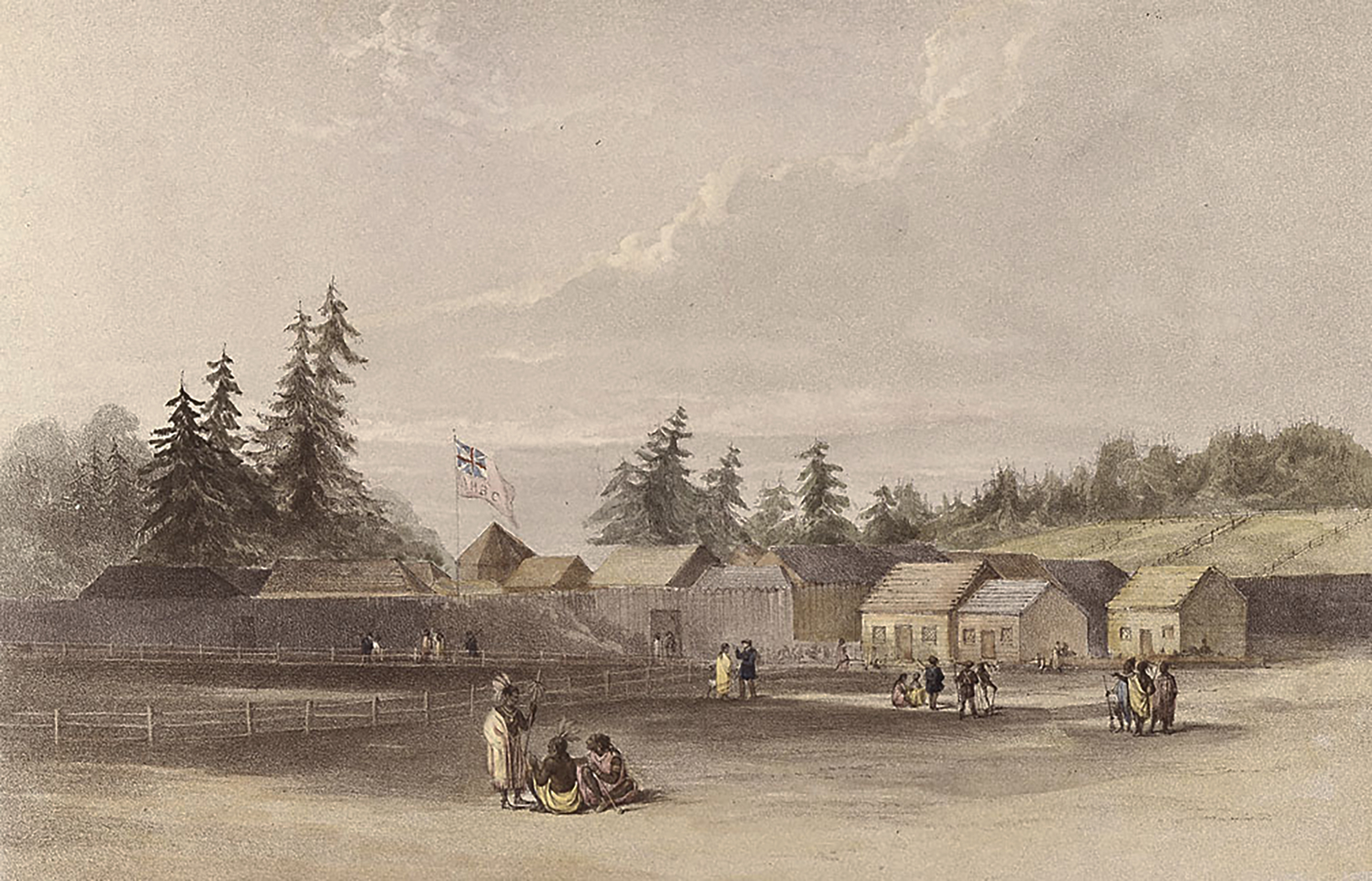
Fort Vancouver. The creator's caption reads: “This painting of Fort Vancouver was made in 1845 or 1846 by British military spy, Henry Warre, while under orders to ‘obtain a general knowledge of the capabilities of the Oregon Territory in a Military point of view’ in ‘perfect secrecy, so far as possible.’ The fort was being constructed during Smith's winter 1828-29 stay there and he may well have been among its first occupants.”Bob Zybach, illustration captions, 29 May 2023. The painting is long out of copyright; the file is the creator's own scan, and the Library shows a display copy.
Whose account this is
This series is the memorial project’s record of an event between Jedediah
Smith’s party and the Lower Umpqua (Kelawatset) people. It is assembled
from the surviving journals and letters of the trappers and of the Hudson’s
Bay Company, and from two centuries of writing that rests on them. Those are
one side’s papers.
The Confederated Tribes of Coos, Lower Umpqua and Siuslaw Indians hold their
own account of what happened. Where a Native account appears in this body
of work, the Library gives it in its own words with its source. One does:
on 11 October 1828 the Umpqua chief St. Arnoose told Alexander McLeod what
he understood the cause to have been, and McLeod wrote it down. The
creator’s own draft for the interpretive sign prints that passage under the
heading “Native Account of Event by Umpqua Chief Starnoose,” and the
Library prints it whole:
read it on the 1828 record page.
It reaches us at one remove, in the hand of a Hudson’s Bay Company officer.
A statement by the Confederated Tribes themselves is a different thing, and
the Library does not have one. What the creator’s files record is the
project’s approach to the Tribes — a presentation to the Culture Committee
on 20 July 2023 and an invitation to co-sponsor the memorial stone. They do
not contain the Tribes’ answer, and the Library has not been given it. The
Library does not speak for the Tribes and will not summarise a position it
has not been told.
The creator’s folders and file names use the word massacre, and
so do the nineteenth-century sources. Those words stand wherever he or they
are being quoted or a file of his is being named. In its own sentences the
Library writes about the 1828 attack and the events of 14 July 1828.
Ways in
If you want the documents
The journals and letters the whole story rests on, the creator’s own reports and articles printed page by page, and the map series made for the 2023 guidebooks.
The 1828 recordThe Smith and Rogers journals, McLoughlin’s letter, McLeod’s journal, and the reference shelf around them.
In the Library’s filesThe creator’s unpublished working files, described but not published.
How big it is
375files the creator publishes
11works printed page by page
296pages of his writing
41sources on the reference shelf
246photographs registered
9maps registered
51dated statements
44people named
20sponsors and contributors
Counted in the creator's own published folders on 4 September 2026, and in the Library's own registers built from them. His unpublished working files are counted separately, in the Library's files.
About this series
What it is
The 1828 Umpqua Memorial Project, run by Bob Zybach for Oregon Websites and
Watershed Project, Inc. and the Jedediah Smith Society: a research file on
the events of 1828 at the mouth of the Smith River, and the record of a
campaign between 2000 and 2023 to replace a state highway marker, place a
memorial stone, and put up an interpretive sign. 41 works
sit on its reference shelf, 11 of the creator’s own writings
are printed here page by page, and 15 sets of photographs,
9 maps and 14 named places are registered.
The originals
The creator publishes all of this himself, at
orww.org/1828_Umpqua_Memorial/. The Library
mirrors what he publishes, links to his files rather than making second
copies of the large ones, and adds its own layer on top: registers, a
chronology, people, places. His unpublished working files are described,
not published.
What is held back
Nothing about this event’s location is published: not a coordinate, not a
township and section, not a road intersection, not a site map, and not a
photograph captioned as the place. That applies to the attack, to the
Kelawatset village and to the trappers’ graves alike. Held items keep
their entry in the register and their permanent link, so a citation still
lands, and one notice covers them all.
Content note.
The creator's own published pages and files, 375 of them, read on 4 September 2026
In this collection
Described item by item; 10 pages and a small number of maps, photographs and illustrations held pending review
Consultation
The Confederated Tribes of Coos, Lower Umpqua and Siuslaw Indians have standing here. No site-location content is published.
How to cite this item
The first line is the citation as it is printed in the original. Use it when
you cite the work itself. Use the second when you cite this page.
As printed
Zybach, Bob. ORWW 1828 Umpqua Memorial Project. Oregon Websites and Watershed Project, Inc. and NW Maps Co., 2023. http://www.orww.org/1828_Umpqua_Memorial/