LOOKING BACK · Schools of the Republic · Prologue
Before the Section Lines
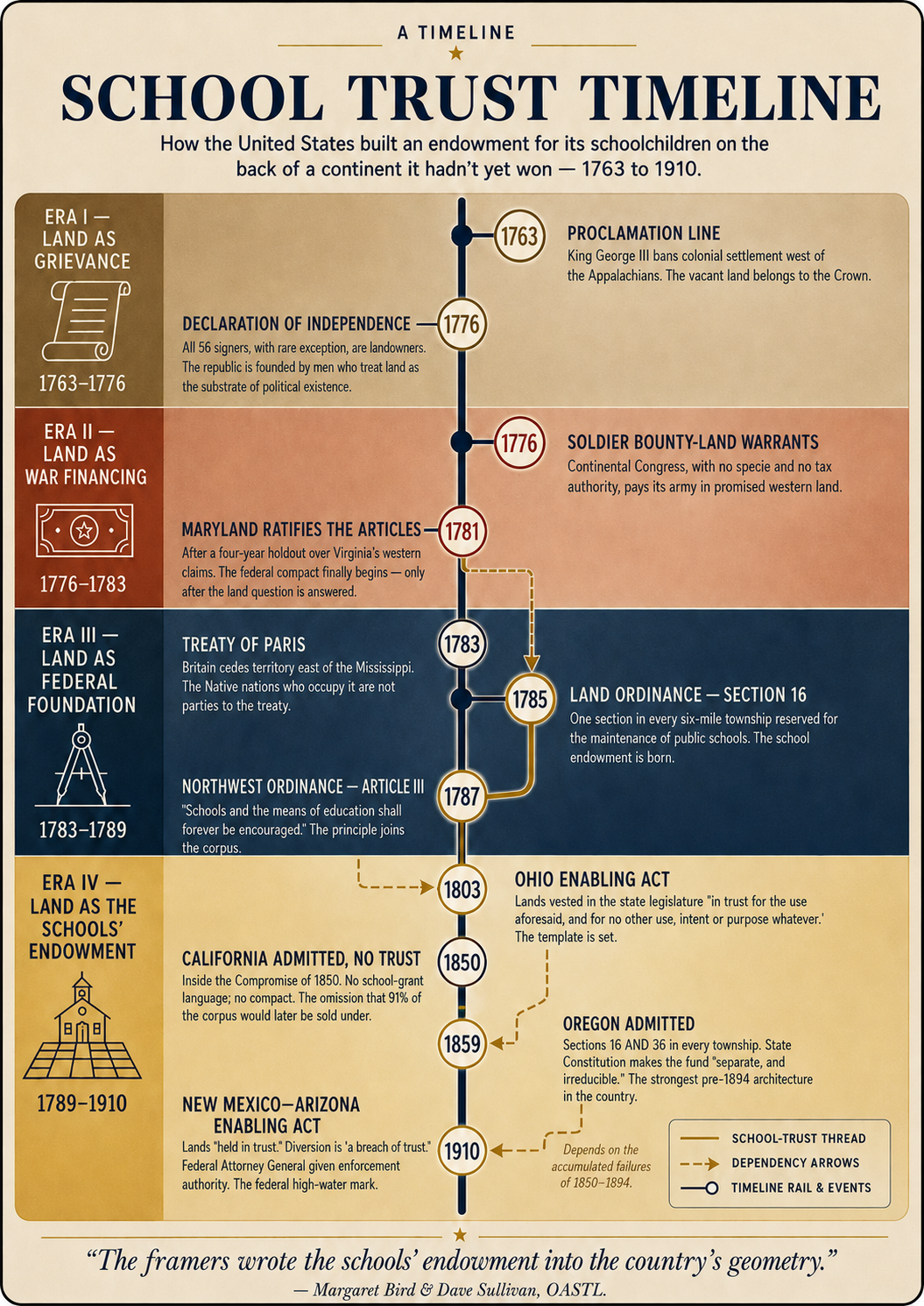
A school trust is a particular kind of promise.
It is a promise made by a state, in a particular form prescribed by federal law, to a class of beneficiaries who cannot speak for themselves. It says: this land, this corpus, this revenue stream — these belong to your children, your grandchildren, and the children who come after them. The state’s job is to manage the asset for them. Not for the state. Not for the legislature. Not for the bureaucracy that administers the lands. For the children.
I have spent forty years studying that promise — first as the analyst inside Utah’s school-trust system who watched a $5 million annual program grow, over thirty-five years of operational discipline and constituency-building, into a $150 million annual program; then as a national advocate working with peer states to do something similar; and most recently as the co-author of this volume. I have come to believe two things, simultaneously, with equal weight. The first is that the promise is real, and that the architecture written for it across the country in the years between 1785 and 1910 is one of the most carefully designed multi-generational fiduciary instruments any nation has ever attempted. The second is that the promise has been, in most places, only partially kept — and in some places it has been broken outright. This volume documents both.
Think of it the way a parent thinks of a gift from a grandparent. Suppose your grandmother set aside money for your daughter’s education before your daughter was born. She put the money in a trust. She named your daughter as the beneficiary. She named you, the parent, as the trustee. The arrangement is straightforward in its purpose and surprisingly difficult to execute well across the decades it has to run. You have to manage the assets. You have to invest the principal. You have to spend the income on the beneficiary’s education, not on yourself. You have to keep records that your daughter, when she comes of age, can read and accept. You have to do this for forty years, in good economic times and bad, while every other claim on your attention competes for the same energy.
Now multiply that by 240 years and by fifty states and by every legislator and every state land board and every comptroller who has ever held office in any of those states. That is the school-trust experiment. The framers of 1785 wrote a promise. The trustees of every generation since have either kept it, drifted away from it, or in some cases broken it. The state-by-state record is what this book documents.
Before we get to that record, the chronology has to be in place. The school endowment is not the first thing the country did. It is what the country eventually decided to do with the asset, but before there was an endowment there were four other questions the country had to answer. The Timeline at the head of this Prologue tracks them. They group into four eras.
Era I — Land as Grievance (1763–1776)
Before there was a federal land grant for schools, there had to be a federal claim to the land at all. In October of 1763, by the Royal Proclamation of King George III, the trans-Allegheny country — the territory between the Appalachian crest and the Mississippi — was Crown land. The colonists were forbidden to settle there. The land was reserved for the Native nations and for the Crown’s later disposition. Land speculators in Virginia and Pennsylvania, including a young George Washington who had been investing in trans-Allegheny tracts since the 1750s, found their investments frozen.
The Quebec Act of 1774 made the grievance worse. Parliament transferred the territory north of the Ohio River to the Catholic, French-speaking province of Quebec. The Anglo-American colonists experienced the transfer as the King handing their western inheritance to a foreign rival. By 1775, when the war began at Lexington and Concord, the colonies were in armed rebellion against a Crown that still legally owned the western half of the continent. By July of 1776, when the Declaration of Independence was signed, the 56 men who put their names on the document were, almost without exception, landowners. The republic the Declaration founded treated land as the substrate of political existence — the asset on which credit, civic standing, and the ability to provide for one’s children all rested. The school trust the country would eventually write inherits that assumption. The endowment is land before it is anything else.
Era II — Land as War Financing (1776–1783)
The Continental Congress that declared independence had no money. It had no constitutional authority to tax the new states. It could not coin specie. It paid its army with promises and its suppliers with paper, and in November of 1776 it began promising land — bounty warrants drawn on the western territory it did not yet legally own — to the soldiers it could not pay in cash. The currency collapsed. The phrase “not worth a Continental” entered the language as a measure of how thoroughly the paper had failed.
What the Confederation Congress had, by 1781, was Yorktown — a battlefield victory that ended the active fighting — and a pile of soldier bounty-land warrants that had to be honored. What it did not have, at the moment of victory, was a working federal government. The Articles of Confederation had been drafted in 1777 but had not become operative because Maryland refused to ratify. Maryland’s objection was about land. Virginia and the other large states held charter claims to vast trans-Allegheny territories — claims Maryland regarded as a threat to small-state equality in the federal compact. Maryland would not ratify until those claims were ceded to a federal domain.
The cession sequence ran from 1780 to 1784. New York went first; Virginia followed in 1781 with the largest single cession. The day Maryland received word of the Virginia cession, Maryland ratified the Articles. The Confederation Congress finally became operative — and the federal public domain that the schools’ endowment would eventually sit inside was created in the same political act. The country’s first federal compact and its school-trust foundation share a single political moment.
The Treaty of Paris of September 1783 then made the cession real. Britain ceded all territory east of the Mississippi to the United States. The Native nations who occupied that territory were not parties to the treaty — a fact that creates the doctrinal problem the Confederation Congress would address two weeks later, in the proclamation of September 22, 1783, reserving to Congress the sole authority to extinguish Native title in the Northwest. The doctrinal floor of every subsequent federal land transaction — including the school clause — rests on that proclamation.
Era III — Land as Federal Foundation (1783–1789)
By 1784, the Confederation Congress had a federal domain, a doctrinal claim to extinguish Native title, a war debt of unmanageable scale, and a single major asset — the western land — with which to address everything at once. The Westward Expansion Committee report of March 1784, written by Jefferson, Chase, and Howell, proposed a framework. The new western territory would be divided into geometrically bounded states, admitted to the Union on equal footing under a perpetual compact. Jefferson’s anti-slavery clause for all new states fell by one vote. The compact framework survived. It would carry the school trust before the trust itself was written.
The Land Ordinance of May 20, 1785 came next. It did two things. First, it established the rectangular survey grid that would map most of the country east of the Mississippi and, eventually, most of the country west of it: six-mile-square townships, divided into thirty-six 640-acre sections, surveyed before settlement. Second, it reserved Section 16 of every township for the maintenance of public schools.
The dedication is geographic. This is the design feature that I, as an economist, find most striking. The framers did not establish a permanent school fund in a distant capital and disburse income from it. They put a piece of every township into the schools’ hands before the township existed. The schools become beneficiaries of the local geometry — section by section, township by township, county by county, state by state. The architecture is distributed. The trust shows up everywhere. That distributed presence is, two centuries later, the structural feature that has made the school-trust constituency possible in the places where the constituency has formed. The sections are not numbers in a ledger; they are particular pieces of particular places, owned in trust for particular schools. People organize around things they can see. The framers, without quite knowing they were doing it, designed for the constituency we now know is necessary to defend a long-horizon trust.
In July of 1787, while the Constitutional Convention was meeting in Philadelphia, the Confederation Congress passed the Northwest Ordinance. Article III of the Ordinance contained the philosophical declaration that the 1785 reservation had not yet supplied: “Religion, morality, and knowledge being necessary to good government and the happiness of mankind, schools and the means of education shall forever be encouraged.” The Articles of compact in the same Ordinance were declared “perpetual.” The school endowment now sat inside a perpetual federal compact dedicated to civic ends.
The new Constitution was ratified in 1788, and the Confederation Congress dissolved into the new federal government in 1789. The school clause and the Northwest Ordinance survived the transition intact, carried forward by the first Congress’s Act of August 7, 1789. The schools’ endowment was now a federal commitment.
Era IV — Land as the Schools’ Endowment (1789–1910)
This era is the body of the book. The Prologue treats it briefly here as the bridge to the chapters that follow.
In March of 1803, Ohio entered the Union as the first state admitted from the federal public domain under the Northwest Ordinance template. The Ohio Enabling Act offered the new state a set of “propositions” — including the school-section grant — for the convention’s “free acceptance or rejection.” Ohio accepted. Then, at the convention’s request, the Ohio Supplementary Act of March 3, 1803 vested the school lands in the state legislature “in trust for the use aforesaid, and for no other use, intent or purpose whatever.” That phrase is the doctrinal floor of every school-trust case for the next two centuries. The school endowment, in the Northwest Ordinance template, is now formally a charitable trust in the technical legal sense.
The pattern hardened from there. Indiana in 1816, Mississippi in 1817, Illinois in 1818, Alabama in 1819, Missouri in 1821 — each admitted under a variant of the Ohio template. By the 1820s, the federal land office was working from a checklist rather than drafting from scratch. Texas in 1845 was the major exception: the Republic of Texas retained its public domain to pay its republic’s debts, and Texas’s school trust would be a state creature only.
California in 1850 was the pattern’s first major rupture. The Compromise of 1850 admitted California in the urgency of the Mexican-American War’s aftermath, with no school-section grant in the Admission Act. The 1853 Survey Act granted California sections sixteen and thirty-six “for the purposes of public schools” but without the “in trust” language the Northwest Ordinance template had carried since 1803. In Wyman v. Banvard in 1863, the California Supreme Court called the school-section grant an “absolute and unconditional grant,” without discussing the omission, and held in the same passage that “[n]either the lands nor the proceeds thereof can be used for any other purpose.” Justice Holmes would call Alabama’s school-grant obligation “honorary,” not legally enforceable, in Alabama v. Schmidt in 1914. By 1914, California had sold most of the corpus the 1853 Act had granted. The omission of three words from the federal text — in trust for — produced a different country, in California, than the country produced in Ohio.
This is the place where, as a fiduciary practitioner, I want to slow the reader down for a moment. The economic difference between a charitable trust and an “absolute and unconditional grant” is total. A charitable trust survives across generations because trustees are bound to it by law; the corpus is preserved because the corpus has to be preserved; the income is the only thing the state may spend, and the income has to be spent on the named beneficiary class. An “absolute and unconditional grant,” by contrast, fixes the purpose and, as the California court read it, leaves the mode of carrying it out to the legislature. The framers in 1803 understood the difference precisely; that is why they wrote the Ohio formula they wrote. The drafters in 1853 either did not understand it, or did and chose otherwise. Either way, the consequence has played out across 173 years of California’s school history. The trust architecture is not rhetorical. The wording matters.
Even as the California rupture worked itself out, the architecture continued to harden in the states that did get the in-trust language. Cooper v. Roberts in 1855 was the Supreme Court’s first authoritative naming of the school trust as a legal — not merely moral — obligation in compact-template states. Justice Campbell described the school-section grants as “trusts created by these compacts” imposing “a sacred obligation… on [the state’s] public faith.” The Minnesota Constitution of 1858 then carried the architecture to a higher pitch: Article XI § 8 declared that the principal of the permanent school fund “shall be perpetual and inviolate forever.” That was the first use of inviolate in school-trust constitutional language. State supreme courts in the years that followed would treat inviolate as a fiscal liability the state had to make whole when breached.
The Oregon Admission Act of February 14, 1859 is the federal pattern at its strongest pre-1894 form. Oregon entered the Union with sections sixteen and thirty-six in every township — a doubled grant. The state’s first constitution made the Common School Fund “separate, and irreducible,” with a constitutional requirement of “sufficient funding” added by the voters in 2000 as Article VIII section 8. Oregon’s record is the live test case I and my co-author David Sullivan have spent much of the past several years working with directly. The architecture is among the strongest in the country. Whether it is being honored is a more complicated question, and the chapters that follow will treat it carefully.
The federal architecture reached its high-water mark in the Utah Enabling Act of July 16, 1894 and the New Mexico–Arizona Enabling Act of June 20, 1910. The 1894 Utah Act introduced explicit federal-Attorney-General enforcement language into the trust grant. The 1910 Joint Act for New Mexico and Arizona declared the granted lands “held in trust,” defined diversion as “a breach of trust,” and authorized enforcement by the Attorney General of the United States, by the state, and by individual citizens. That is the strongest federal text in the public-land-state sequence. After 1910, the federal architecture would not get stronger. The work of holding the architecture would shift, increasingly, to the states themselves — and to the constituencies the states either built around the trust or failed to build.
What this book is, what it is not, and what comes next
This volume is the synthesis of what 240 years of operation tell us about the architecture the framers wrote in 1785. Six chapters trace the architecture’s evolution era by era — the Original Thirteen, the state-derived statehoods, the Northwest Ordinance template, the antebellum doubling, the western stack of 1861–1896, the twentieth-century admissions and their two outliers. The chapters are not jurisdiction-by-jurisdiction. The per-state record lives in the Library’s Atlas Room at schooltrusts.org, where the dossiers are continuously maintained and where the data is fresher than any printed book can be. The chapters here are the synthesis — what holds, what fails, what the historical record says about why.
A note on what this book does not do. This is the volume that looks back. It does not, by design, treat the architecture’s diagnostic implications for the AI-era trusts now being drafted — the AI Targeting Authorities, perpetual climate trusts, sovereign wealth for the unborn, longevity escrows, and compute reserves entering charter windows in 2026. That work is the subject of the companion volume, LOOKING FORWARD: The Eighth Anchor, written by my co-author David Sullivan, which begins where this one ends. Read this volume first if you want the architecture and the record. Read his when you want what the record implies.
The school trust is not a museum piece. Children are in classrooms today whose education is funded, in the states whose architecture has held, by the fiduciary discipline of trustees and the continuous attention of citizens who refuse to let the architecture rot. The phrase I have come back to over and over across forty years of this work is that the trust is a forever gift to forever schools for a forever democracy. The framers wrote a forever gift. Whether the country has lived up to that gift is the question this volume asks across the public-land states, against the same architectural standard.
It is a long-term game. It does not move on the calendar of legislative sessions or news cycles. It moves on the calendar of generations. That is what makes it hard, and it is also what makes the work worth doing. The architecture holds, in the places where it has held, because someone has been willing to defend it across the decades it has had to run. That, more than anything else this book documents, is what the next 240 years will need.
We begin in 1785, when the country had a war debt it could not pay, an asset it did not yet possess, and an obligation to its unborn children it chose to write into the geometry of the continent.
— Margaret Bird, Salt Lake City, 2026.
\newpage