V.5. The Knowledge Stack as Demonstration
There is a piece of the argument that can only be made by example, and the example is the book in your hands and the Library it sits inside.
Section V described the cost-drop in cognitive technology that has, in the period roughly between 2022 and 2026, dropped the per-citizen cost of sustained civic attention to a complex multi-generational asset by at least an order of magnitude. The cost-drop is what makes the eighth anchor a structural feature of the architecture rather than a contingent one. Section V also said that the school-trust framers needed external memory infrastructure their century could not supply, and that the architecture drifted in most places where the constituency was not present in sufficient numbers to defend it.
What Section V did not yet say is what the successor infrastructure looks like in operation. The Library at schooltrusts.org and the two books you are reading are built on a five-layer Knowledge Stack. The Stack is not a metaphor. It is a working architecture with parts you can name, files you can audit, and a versioning discipline that makes the parts maintainable across the kind of time horizons the trust itself is supposed to outlast. Future architects of forever-institutions will need to engineer their own equivalent. The Library’s Stack is one worked example.
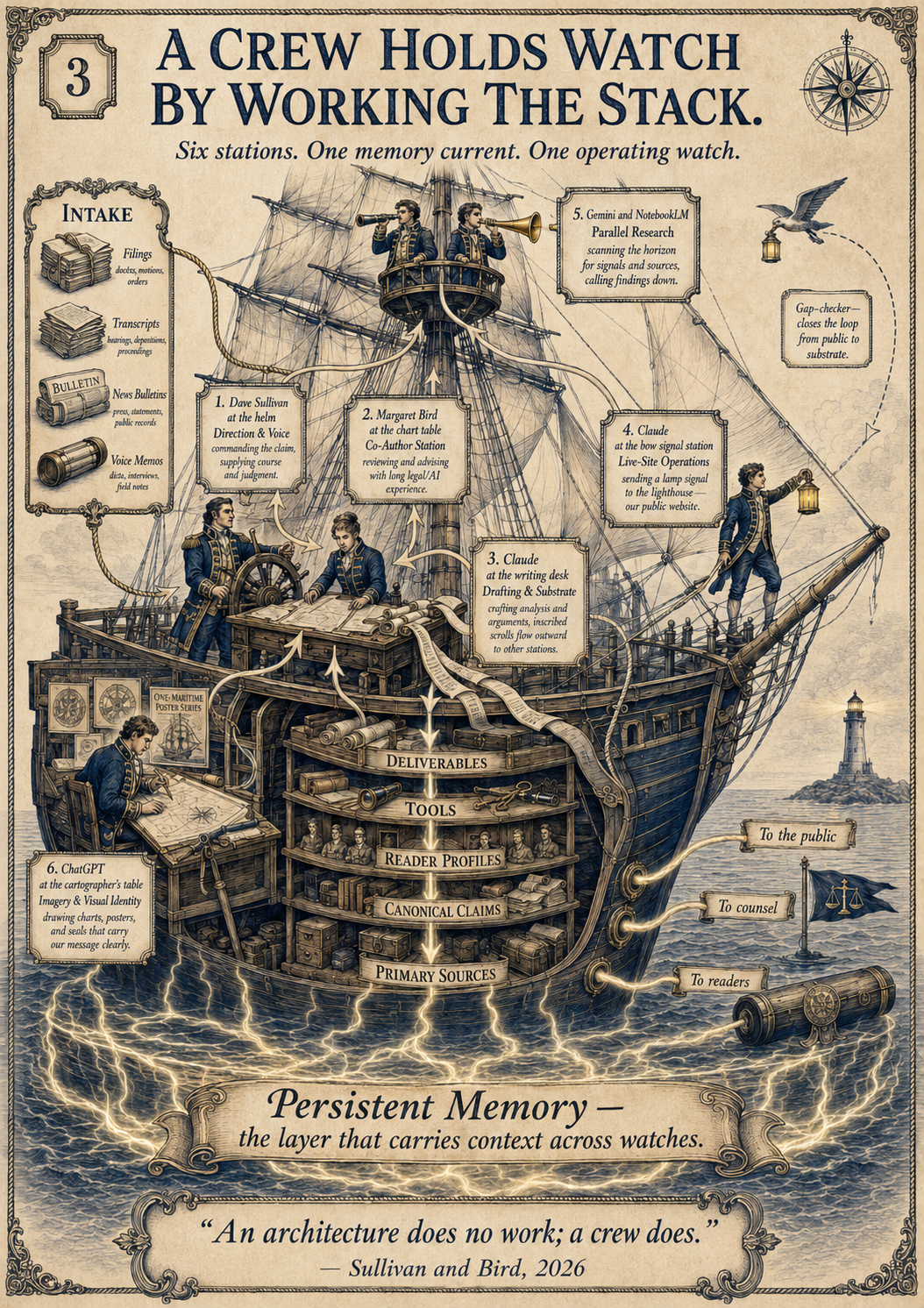
The rest of this section shows the Knowledge Stack as a balance sheet — what we have, layer by layer. This third panel shows it as an income statement — what the crew is doing, day by day, to keep the work moving.
Six stations stand on the deck. Direction and Voice is mine. Co-Author is Margaret’s. Drafting and Substrate is Cowork-side Claude. Live-Site Operations is Claude Code, the partner that publishes the substrate to schooltrusts.org. Parallel Research is Gemini and NotebookLM. Imagery and Visual Identity is ChatGPT — the station that drew the poster you are now reading.
Beneath the hull runs the feature that makes the rest of the architecture possible: persistent memory. Each station’s work survives into the next session. The framers of 1785 could not draw that current at all.
Drift, Anchors, At Work. Three panels. One argument. The first names the forces that pull every long-horizon trust off course. The second names the defenses that can hold. The third shows the crew working those defenses — which is the only condition under which the defenses do any work at all.
The five layers, as they exist in this project:
L0 — Primary sources. The evidentiary floor. Court filings, statutes, treaty texts, historical maps, expert declarations, Bates-stamped discovery production, period newspapers, recorded interviews, original photographs. Everything cited in either volume traces to an L0 source. The principle is verifiable inheritance: every claim a future reader doubts can be checked against the same primary source the original author used. L0 sources are added; they are not edited. The provenance discipline is what makes the rest of the architecture possible.
L1 — Canonical claims. Atomized facts and arguments, each cited back to its L0 source. The figures file (the master sheet from which every reusable number is drawn). The named claims (the watchful-crew mechanism in Margaret’s verbatim words; the bar-economics asymmetry that runs through every modern enforcement case; the cognitive-technology bound on the framers’ design). L1 claims are promoted from informal mention only after they appear in three deliverables or are formally settled. The promotion discipline is what keeps the canonical layer from becoming a junk drawer.
L2 — Audience models. Who reads what, in what register. The general-public audience for the books. The architect audience for Volume II’s working manual. The trustee audience for OASTL’s organizational correspondence. The legislator audience for state-by-state primers. The same substantive content gets rendered differently depending on which audience is being served. L2 models are why a single corpus can serve multiple readerships without descending into either generic-public-intellectual register or specialist-jargon register.
L3 — Toolchain. The operating partnership between the human authors and the frontier AI systems that do the synthetic load no individual mind could carry alone. Cowork-side Claude — drafting, synthesizing, holding context across multi-month working sessions. Claude Code — implementing the live infrastructure that publishes the substrate to the public. ChatGPT for image generation and architectural critique. Gemini for stress-testing arguments. Grok for prompt drafting and Drive-side operational work. Each tool’s role is specific; the routing is documented; the substantive judgment remains with the human authors. The toolchain is what reduces the per-author cognitive load to within what a small team can carry. Beneath the AI partnership sits a conventional public-facing infrastructure — a GitHub repository for version control and Cloudflare Pages for hosting — that makes the Library’s substrate publicly inspectable at schooltrusts.org as it matures. The infrastructure is unremarkable; the partnership above it is the novel piece.
L4 — Deliverables. The finished work product. The two books you are holding. The Library website at schooltrusts.org. Strategic memos. Trustee letters. Newsroom entries. Each deliverable is rendered from L0 + L1 + L2 + L3 — primary sources synthesized into canonical claims, calibrated to a named audience, produced through a documented toolchain. The deliverable is the visible end of a pipeline that has four invisible upstream layers.
The Stack is itself part of what this volume is about. The framers in 1785 used legal rigidity as a substitute for the institutional memory their century could not provide; the architecture drifted because the substitute was not enough across two and a quarter centuries. A successor architecture, built in 2026, can do something the framers could not: the institutional memory itself can be engineered. The five-layer Knowledge Stack is what engineering it looks like in this project’s particular form. Other forms are possible; this is one. The point is not that every long-horizon institution should adopt this Stack literally; the point is that long-horizon institutions need some working architecture for substrate, canonical claims, audience-aware rendering, partnered toolchains, and deliverables — and that without one, the institution will drift the way the school trusts drifted, for the same reason.
This volume is itself an example of the architecture it argues for. The argument the book makes — that long-horizon trusts need cognitive infrastructure their founders could not engineer — is itself an argument that could not have been written, at this scale, by any prior generation. The Library you are reading from is the Stack made operational. The two books in your hands is the Stack’s most legible deliverable. If the Stack works, the work compounds. If it fails, you will see it fail in real time on the live site, in the form of broken cross-references and stale figures and out-of-date author bylines. The exposure is the discipline.
The architects of the AI-era trusts have a design choice. Engineer the substrate, the canonical claims, the audience-aware rendering, the partnered toolchain, and the deliverable layer that serves your trust’s beneficiaries — or do not, and watch the trust drift across the gap that the cognitive-infrastructure absence will produce. The school-trust experiment is the worked example of the second path. This volume, and the Library that hosts it, is one worked example of the first. Section VI takes up what designing for the first path looks like in the AI-era trusts now arriving.