Interlude — The Institution That Held the Future
The people who hold a transformative thing are usually the people most likely to misread its importance.Dave Sullivan
There is a particular kind of testimony a writer can give only once, and only at the cost of admitting he was inside the room when the thing went wrong. I will give it here, before the chapters that follow ask the reader to take seriously a 250-year argument about institutional drift, because the testimony is the ground of the argument and not its decoration.
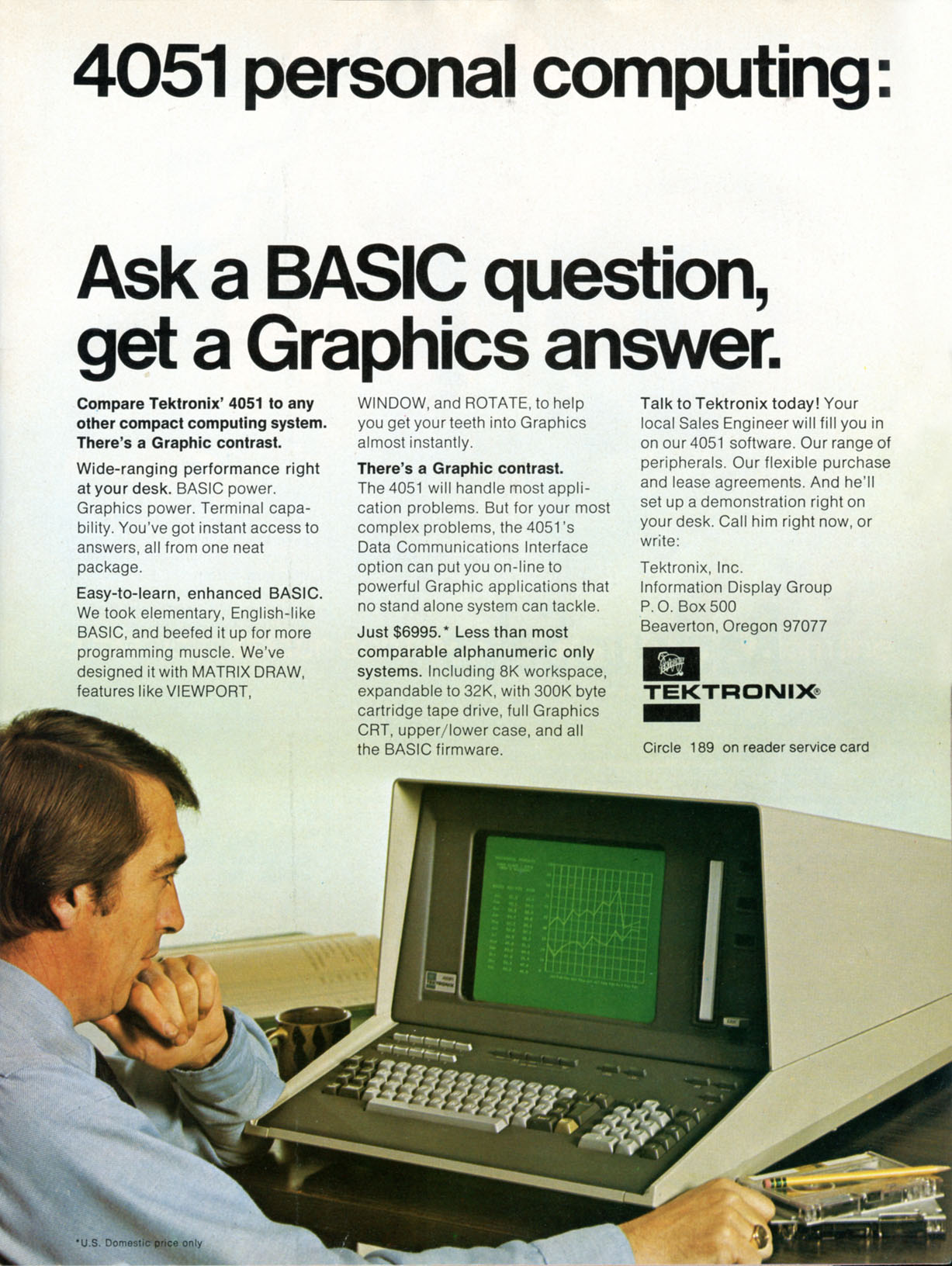
In the middle 1970s I was the division finance manager of the Information Display Systems Division at Tektronix, an Oregon company whose engineers had — several years before two young men in a Cupertino garage made the same idea famous — built the first graphical personal computer. The Tektronix 4051 shipped in 1975; the Apple II shipped in 1977. We had it first. We had the engineers, the manufacturing capacity, the distribution network, and a brand reputation built on the storage-tube oscilloscope that had put Tek on the map in laboratories across the world. We held, in our hands, the device that would in the next decade reshape how human beings did almost every kind of cognitive work the industrial economy still cared about.
We priced it the way we priced everything else. Tek had grown up selling specialized instruments to engineering niches — oscilloscopes, signal generators, curve tracers — at volumes of a few thousand to a few tens of thousands of each instrument per year, and the standard pricing model for a new instrument was to multiply its manufacturing cost by five. My job, as the division’s finance manager, was to add up every plausible cost of building a 4051, estimate every line on the high side so nothing got missed, layer in enough overhead to cover the miscellaneous, and then multiply the whole stack by five. The base 4051, with 8 KB of user RAM, came out at $5,995 in 1975 dollars — about $35,870 today. RAM upgrades, where most customers were going to live, we sold at no less than ten times our cost; if a customer installed the chips himself, we voided the warranty. The model worked the way it always had. Every 4051 we built, we sold; we carried a six-month backlog of orders for years.
The problem was not that the model failed. The problem was that the model succeeded, and the success obscured the question we should have been asking. We thought we were running our market at full tilt. We were, in fact, sandbagging a market two or three orders of magnitude larger than the one we measured ourselves against. The cost-times-five framework produced sales in the thousands, and so we believed the market was in the thousands; the real ceiling, as Apple and the other young companies would shortly demonstrate, was in the tens of millions. The only thing keeping us out of that market was that we had not yet noticed it existed. We thought of the 4051 as a niche-engineering tool. We priced it as a niche-engineering tool. We sold it through the channels we sold our other niche-engineering tools through. And we were vastly out-competed, over the next half-decade, by two guys in a garage in California whose marginal advantage over us was not engineering and not capital and not distribution. Their advantage was that they understood what they were holding.
The lesson of that experience, the one I have spent the forty years since trying to refine into something teachable, is the lesson this book exists to apply at a different scale: the people who hold a transformative thing are usually the people most likely to misread its importance. I learned it as a finance manager in his thirties watching a division of a billion-dollar company miss a generational opportunity in plain sight. I am applying it now, in my seventies, to the country that has held the school-trust experiment for two and a half centuries and is on the verge of applying — or, more likely, failing to apply — the same lessons to the AI-era trusts being designed in conference rooms a continent away from the geometry of the original 1785 grant. The school trust is the case the country has already run. Tektronix is the personal warrant for taking it seriously.