IV. The Pattern: Why Trusts Drift, and Why They Are Sometimes Seized
What the case studies are evidence for
The five categories laid out in Section III are the what. This section is the why. The job here is to take those categories and turn them into a working model — a model that explains why the failures and recoveries fall where they do across the fifty states, predicts what the next round of failures and recoveries is likely to look like, and hands the next section a list of structural defenses worth building.
The model has two layers and four findings.
The two layers are drift and directed seizure. Drift is the slow, structural, unintentional movement of an aspirational asset away from its purpose — what happens to a trust when no one is paying attention to it, when the people who would have insisted on the architecture in operational practice dissipate faster than the architecture itself can compensate for. Directed seizure is the affirmative act of conversion — what happens when someone is paying attention, and decides, in some particular legislative session or executive order, to take what the trust holds and use it for something else. The two phenomena require different defenses, and that is the point I want the reader to carry forward into Section V. A trust whose architecture is built only against drift is undefended against seizure. A trust whose constituency mobilizes only against named seizures will lose its corpus to drift in the years between.
The four findings, drawn from the comparative atlas the Schools of the Republic encyclopedia assembles, are these:1
- The federal floor matters less than the field has long assumed.
- State architecture is necessary for any defensible outcome. Constituency is what determines whether the architecture holds in practice.
- Drift and directed seizure are different problems, with different remedies.
- The federal text iterated across a century of learning. The learning was real. It was also not sufficient.
The rest of this section takes those findings one at a time.
Finding 1: The federal floor matters less than the field has long assumed
The single strongest predictor a reader of the legal literature might expect is the strength of the federal admission-act language. If a state’s enabling act says “in trust” and “null and void” and authorizes the federal Attorney General to enforce, the trust ought, on the literature’s standard reading, to be defended. If the enabling act says only “for the use of schools,” the trust ought to drift. The literature, on the whole, treats the federal text as the load-bearing element.
The comparative evidence does not bear out that prediction.
The 1910 New Mexico-Arizona Enabling Act § 10 is the high-water mark of federal trust language: explicit “in trust”; explicit “deemed a breach of trust”; an enforcement provision that names the federal Attorney General; a “null and void” clause that voids non-conforming dispositions; mandatory public auction; a mandatory minimum-value appraisal.2 New Mexico and Arizona received the same federal text, on the same day. By 2026, New Mexico’s Land Grant Permanent Fund holds approximately $30 billion. Arizona’s Permanent Land Endowment Trust Fund holds approximately $8 billion. The same words, on either side of the Four Corners, produced funds that differ by a factor of nearly four.3
Texas is the larger embarrassment for the federal-floor theory. Texas was annexed in 1845, not admitted from the federal public domain, and retained its public lands as a condition of annexation. There was no federal school grant. There was no admission-act trust language at all. By 2026, Texas’s Permanent School Fund holds approximately $56 billion — depending on which reporting period you look at, somewhere between $56 and $67 billion — larger than New Mexico’s, larger than Arizona’s, larger than any other state’s school endowment in the country.4
The Original 13 produced their own state-derived analogues without any federal grant at all. Connecticut sold its Western Reserve claim in 1795 and capitalized a school fund from the proceeds eight years before Ohio became a state; that fund still exists. Virginia’s Literary Fund (1810) and New York’s Common School Fund (1805) were state-derived structures the federal government never authorized.5
The federal grant turns out to be one tool the country happened to develop. It was not the only tool, and on the comparative evidence it was not even the decisive one.
This is not an argument against the federal grant. The grant worked: the existence of school sections in every western township at the moment of statehood is the reason this country has any kind of educational endowment infrastructure at all. But the literature’s habit of treating the federal text as the load-bearing element overstates its predictive force. What the comparative data suggests instead is that the federal text was the initial condition — the substrate the country handed each new state on the day it joined. What each state did with that substrate over the subsequent century and a half is what produced the outcome we can measure today.
The implication for the AI age is direct, and I want to name it plainly. A founding charter — for an AI Targeting Authority, a perpetual climate trust, a sovereign wealth fund — is the initial condition for what those structures will become. It is not the explanatory variable. The explanatory variable is what the institutions and constituencies inside the charter’s frame do with it over time. A weak charter handed to a strong constituency outperforms a strong charter handed to no one. Founders who concentrate their reform energy at the charter level alone are optimizing the wrong layer.
Finding 2: State architecture is necessary; constituency is sufficient
Every state in the comparative atlas with a school-trust corpus larger than five billion dollars in 2026 has, in addition to whatever federal grant it received, a constitutional architecture that survives the day-to-day politics of the legislature. New Mexico has Article XIII §§ 1 and 2. Texas has Article VII §§ 2-5. Utah has Article X §§ 5 and 7. Wisconsin has Article X § 7. Minnesota has Article XI §§ 8 and 10. Wyoming has Article 7 § 6. The architecture is not identical from state to state — the trustee may be elected, appointed, or ex-officio; the fund may be irreducible by name or by mechanism; the beneficiary may be defined narrowly or broadly — but the architecture exists, and exists at the constitutional level rather than at the legislative level. Architecture in statute alone is not enough; the legislatures that wrote the statutes can, by ordinary majority, amend them.6
Architecture in the constitution is not enough either. Oregon has had constitutional architecture since 1857 — among the most rhetorically muscular in the country, with the irreducible-fund clause of Article VIII § 2 and the executive-officer trustee board of Article VIII § 5 — and has nevertheless drifted into a situation where the State Land Board’s actions have required litigation to reverse. The Court of Appeals ruling on January 28, 2026 in Advocates for School Trust Lands v. State of Oregon established that the beneficiaries of the trust have constitutional standing to bring that litigation, by way of Article VIII § 8, which Oregonians added to the constitution by ballot initiative in 2000.7 That standing victory was possible because the architecture exists. The litigation is necessary because the architecture, on its own, did not prevent the drift.
Utah is the cleanest demonstration in the atlas of the two-layer requirement. Utah had strong constitutional architecture in 1894 through 1896, and yet by 1982 and 1983 the Utah Supreme Court had permitted mineral proceeds from school lands to flow into the general K-12 operating fund, and the legislature had withdrawn $37,500,000 from the permanent fund in a single fiscal year. The corpus collapsed from approximately $53.5 million to $18.6 million — a two-thirds reduction in one budget cycle. The architecture was, on paper, exactly what it had been before the collapse. The variable was operational discipline, and operational discipline was missing.8
Then Utah recovered. Beginning in 1989, the Utah PTA, the Utah Education Association, the Utah State Board of Education, the school boards, and a network of organized parents got to work. The 1991 to 1992 task force produced 1994’s Title 53C; the 1994 Land Trusts Protection and Advocacy Office became Title 53D in 2010. The corpus grew from approximately $50 million in 1994 to approximately $3.2 billion in 2025 — a sixty-fold expansion in three decades, with the same constitutional architecture that had allowed the 1983 collapse.9
The variable, in the recovery as in the collapse, was constituency. Architecture without constituency drifts. Constituency without architecture has no leverage. Both layers are required, and the second is the active ingredient.
That is the central thesis of the encyclopedia, and it is the central thesis this paper now adopts. The state-by-state atlas confirms it. New Mexico’s $30 billion fund rests on a constituency that includes the elected Commissioner of Public Lands, the State Investment Council, the Land Grant Permanent Fund Council, and an organized education-funding lobby that mobilizes when the corpus is threatened. Wisconsin’s Board of Commissioners of Public Lands — the oldest such body in the country — has held the line for a century and a half because its three constitutional officers see the trust as part of their constitutional identity, not a side duty.
The negative cases confirm the same thesis. Where the architecture is strong and the constituency dissipates — Oregon for most of its 167 years, until OASTL formed and began work — the trust drifts. Where the architecture is weak and no constituency forms — California — the trust effectively does not function as a trust, and the political conversation shifts to whether it ever was one.
Oregon’s case is the most instructive on this point because the doctrinal floor is literally the same in 2026 as it was in 1992. Oregon’s Attorney General concluded in 1992, and again in 2003, that the school lands “are a trust for the benefit of public education” and that the State’s “obligations are binding. They cannot be disregarded.” A 1983 AG opinion stated, plainly, that “the Common School Fund is a trust which must be invested by the State Land Board or the State Treasurer only in such manner as will obtain the maximum financial benefit over time to the fund.” The current AG’s office, defending the Elliott decoupling in 24CV38372, argues the State Land Board’s actions are legally permissible. The architecture has not changed. The lawyer interpreting the architecture has changed her tune. A trust whose own counsel can swap interpretations across two decades — and where no constituency was present to insist on the older interpretation — is a trust whose architectural rigidity exists on paper but not in operational practice. The architecture had to be enforced by someone, generation after generation. For most of those decades in Oregon, no one was there.10
The doctrine that ought to have held the line in Oregon is the punctilio of an honor the most sensitive — the highest standard known to fiduciary law, the standard a trustee is required to maintain whether or not anyone happens to be watching that day. The breach in Oregon is not that anyone in particular acted in bad faith. It is that the standard itself was allowed to slip, year by year, in the absence of a constituency whose job description was to insist on it. That is what the second finding names, and that is why the second finding is the active one.
The implication for the AI age is, again, direct. The new aspirational structures of 2026 will be defended by their constituencies, not by their charters. The charters are necessary. They are not sufficient. The work of building the constituency has to be undertaken by the people who care about the structure, with whatever institutional vehicle they can assemble, in the years immediately after the charter is signed. If the constituency does not assemble in those years, the charter will erode — slowly, then quickly — and the founders will discover, at some later moment, that the structure they built has been converted into something else by people who at every step had defensible reasons.
Finding 3: Drift and directed seizure are different problems with different remedies
Margaret Bird’s reframe of the standard “drift” vocabulary captures something the comparative data confirm. The architecture has been breached, in many states, by passive drift — the slow attrition of generations, the quiet sale of school sections at submarket prices in the nineteenth century, the commingling of trust revenues with general appropriations through inattention rather than through any specific intention to do harm. Mississippi, Alabama, Arkansas, and the early-template states of the Northwest Ordinance suffered drift in this sense. The corpus shrank because no one was steering hard enough to keep it from shrinking. The road to that hell was, in Dave’s phrase, paved with good intentions.
But the architecture has also been breached, in other moments, by directed seizure — affirmative legislative or executive action to convert what was inviolable into the general fund, often in moments of fiscal stress, often by people who knew exactly what they were doing. Utah’s 1983 $37.5 million withdrawal is a directed seizure, full stop. Nevada’s 1880 in-lieu exchange (21 Stat. 287), followed by the wholesale sale of the in-lieu lands by 1900, has elements of both — a tactical retreat that became a rout.11 Oregon’s Elliott State Forest divestiture (2017–2022) is contested in contemporary advocacy, but at minimum it has features of directed seizure. The Project Bold proposal in Utah (1982–1984) would have been a directed seizure on a scale this country has rarely seen, had it succeeded. Nebraska’s LB 1072 in 2026 is a directed seizure in progress.12
The remedies for drift and directed seizure are not the same.
Drift is corrected by attention — by inserting fiduciary discipline back into ordinary administrative practice, by the kind of statutory advocate office that Utah’s Title 53D and Minnesota’s School Trust Lands Director provide, by routine reporting and audit and the slow accumulation of competent stewardship. The instrument for drift is administrative, and the rhythm of the work is generation-on, professionally staffed, slow.
Directed seizure is corrected by contestation — by litigation, by constitutional amendment, by political mobilization sufficient to reverse the act of conversion or to make the next attempt costly. The instrument for directed seizure is adversarial, and the rhythm of the work is episodic, intense, and public. Daniel Crowe’s 24CV38372 motion to compel, Natalie’s S072734 response brief, the OASTL Court of Appeals victory of January 28, 2026 — these are directed-seizure remedies, deployed against an Oregon record that contains both drift (1859 to 1990) and directed-seizure features (the Elliott divestiture).
The two problems require different muscles. A constituency that organizes only to remedy drift may find itself unable to mobilize against directed seizure when one comes. A constituency that mobilizes only against named seizures may not have the staff to maintain the slow attention drift requires. Most successful recoveries — Utah’s especially — required both. The Utah PTA, UEA, USBA coalition that assembled in 1989 through 1994 produced both Title 53C (a drift defense — administrative architecture, fiduciary code, beneficiary advocate office) and the political muscle that contested every subsequent attempt to revisit the 1983 maneuver. The architecture would not have held without the muscle. The muscle would not have known where to push without the architecture.
The implication for the AI age, once more, is direct. Founders who build only against drift — who write fiduciary codes, install audit committees, and assume that the slow attrition is the only failure mode — will be unprepared for the moment when a particular legislature, in a particular fiscal crisis, decides to convert the corpus by ordinary statute. Founders who build only against seizure — who concentrate on litigation infrastructure and constitutional protection — will watch their structure erode, year by year, in ways no court will ever be asked to review. The defense has to be both at once.
Finding 4: The federal text iterated. The learning was real. The learning was not enough.
The fourth finding is the one the encyclopedia volume can show that single-state analyses cannot. The federal admission-act texts iterated over a century and a quarter, and each iteration was a response to the operational failures of the prior template. The learning is visible in the text itself.
The 1802 Ohio Enabling Act installed section sixteen of every township for “the inhabitants of such township” — distributed, township-level. By the 1830s the township-level structure was producing widespread depletion. Michigan’s 1835 constitutional convention centralized administration at the state level — the first state to do so — and Cooper v. Roberts (1855) developed the doctrinal framework that admission-act school grants create trusts as “sacred obligations” on state public faith.13
The 1853 California Survey Act doubled the grant by adding section thirty-six, partially anticipating the 1857 Minnesota Enabling Act, which doubled the grant formally. The doubling was a federal response to the recognition that single-section grants in arid Western territories produced corpora too small to do the work the trust was meant to do.
The 1889 Omnibus Enabling Act, which admitted North Dakota, South Dakota, Montana, and Washington, introduced the “null and void” clause for non-conforming dispositions — the first federal restoration mechanism. If a state sold trust land outside the act’s terms, the sale was void and the land returned to the trust. That was new doctrine, and it was a direct response to what the 1802 Ohio template had produced over the preceding eighty-seven years.14
The 1894 Utah Enabling Act tightened further: not just doubled but quadrupled (sections 2, 16, 32, and 36), and added explicit federal-text permanent-fund language. The proceeds “shall constitute a permanent school fund, the interest of which only shall be expended for the support of said schools.”
The 1910 New Mexico-Arizona Enabling Act § 10 was the high-water mark. Express “in trust” language. Federal Attorney General enforcement provision. “Breach of trust” naming. The “null and void” clause carrying forward. The federal text could not get any more protective without writing the state’s constitution for it.2
After 1912, no further section-template state was admitted. Alaska in 1959 received a 104-million-acre lump grant for general state purposes — not a school trust. Hawaii in 1959 received the Hawaiian Kingdom’s ceded lands in trust for five purposes (schools is one). The section template ended.
What that 125-year iterative learning curve tells us is that the federal government recognized, year over year, that its first attempts at the template were producing inadequate operational outcomes, and tried — to the credit of the people doing the work — to fix the template. The fixes were real. The 1894 Utah language and the 1910 New Mexico-Arizona language are genuinely stronger than the 1802 Ohio language. The strongest-language states have, on average, the largest endowments per capita today.
But the federal fixes also did not, by themselves, guarantee the outcome. Arizona, with the same 1910 federal text as New Mexico, produced a fund one-quarter the size. Texas, with no federal grant at all, produced a fund larger than either. The federal floor mattered. So did everything that came after.
The implication for the AI age is the synthesis of the prior three findings. The framers of the new aspirational structures will write founding charters, and the writing will matter; the iterative learning the school-trust template represents is the closest thing the country has to accumulated wisdom about how to write a perpetual-purpose charter. But the framers should not, on the school-trust evidence, expect the writing to do the work alone. The architecture has to be built into the constitution of the structure they create. The constituency has to be assembled in the years that follow. And the structure has to be defended against drift and against seizure simultaneously, by people who understand that the two phenomena are different.
What the framers could not engineer for
The closing point of this section is the one that hands the work to Section V.
The framers of the school compact had reasons to think the trust form would compensate for the political silence of the beneficiary. Equity courts would supervise. The federal Attorney General would enforce. The state’s constitutional officers would, by virtue of their oaths, defend. But the trust form depended on the supervision, the supervision depended on the enforcement, and the enforcement depended on whoever was in the relevant office actually showing up — in 1885, in 1925, in 1985, in 2025 — across the multi-generational span the trust was supposed to last.
What the framers had no instrument to supply was the constituency that would make sure those officers showed up. A multi-generational constituency, distributed accountability, sustained vigilance that does not depend on any single official happening to do her job: that instrument did not exist in 1785, did not exist in 1859, and arrived, when it arrived at all, at uneven moments in different states. It arrived in Wisconsin early. It arrived in Utah after a collapse. It is arriving in Oregon now.15
The next section is about what that instrument has to look like. The cases of Section III suggest the seven structural defenses. The four findings of this section suggest where the defenses have to be installed (in the state constitution, not the federal one), how they have to be activated (by an assembled constituency), and what they have to defend against (drift and directed seizure, on perpendicular axes). Section V is the architectural answer.
IV.F — The Four Faces of Drift (and the Two Faces of Directed Seizure)
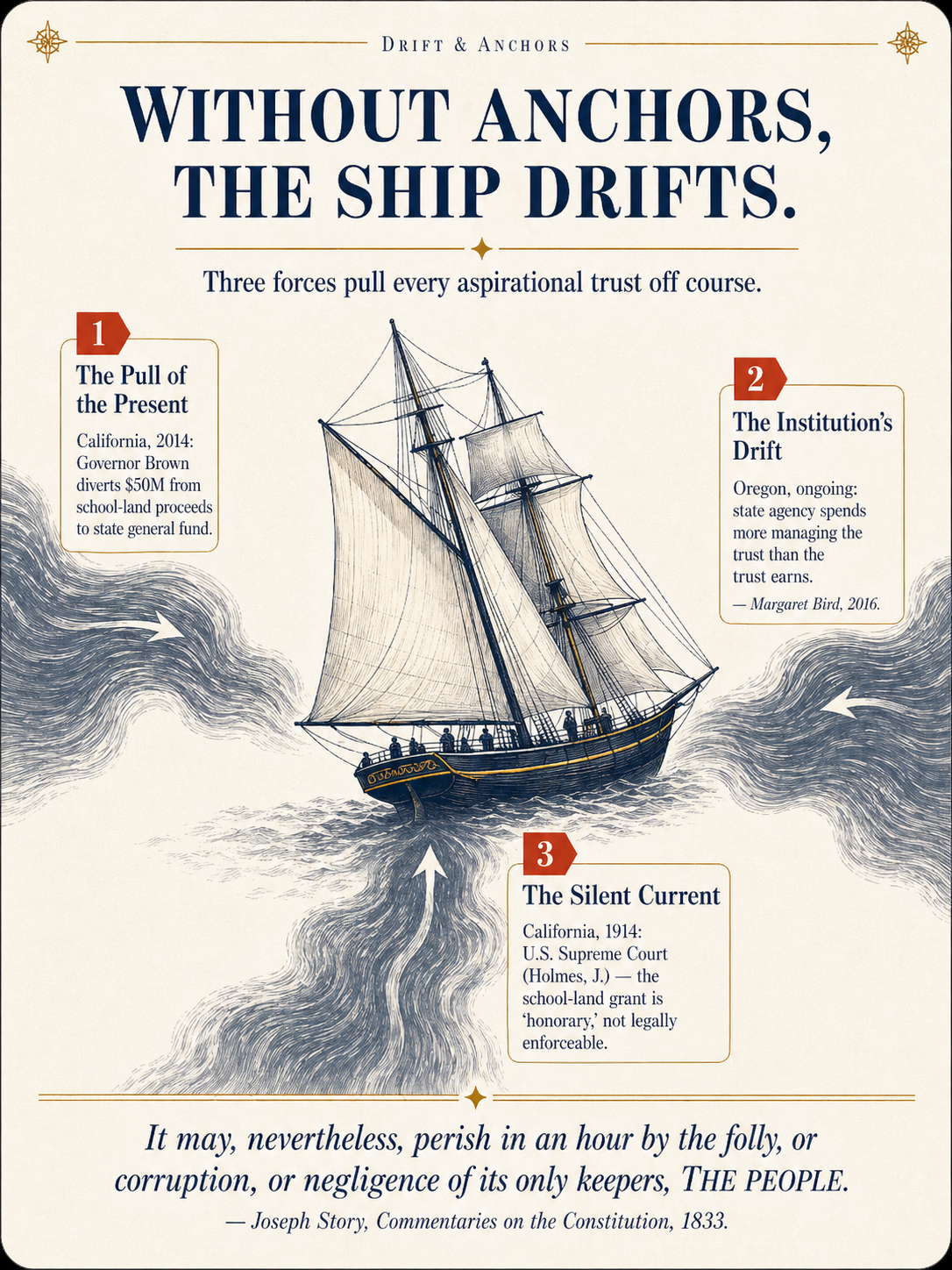
The model in this section identifies forces that compound to produce drift in any aspirational structure with intergenerational beneficiaries. The model also names the second pathology, directed seizure, that the same structures are vulnerable to. The two pathologies fracture trust architecture along distinct axes. Drift breaks the structure in four places. Directed seizure breaks it in two. The two-axis frame — gradual versus sudden, on one axis; corpus, purpose, beneficiary, legitimacy, on the other — is the analytic spine of this section, and it is the spine the seven anchors of Section V are designed to address.16
The four faces of drift
The first face is corpus drift — the obsolescence trap. A trust can be faithfully administered in the narrow sense and still starve. Section 16 of every township was the right asset class for 1785, when land was the ultimate durable asset and the central store of national wealth. It is not obviously the right asset class for 2125, when wealth has migrated to platforms, data, compute, intellectual property, and network effects. The school trust survived obsolescence only where it successfully translated its physical corpus into a diversified permanent fund. The framers locked the intent. They did not authorize, under fiduciary discipline, the periodic translation of the instrument. An AI-age trust endowed with a static server farm will be functionally bankrupt before the decade is out.
The second face is purpose drift — semantic capture. The formal language of the trust survives while the operative meaning underneath the words is hijacked. This is not a partisan observation, and I want to be clear about that. The drift cuts in every direction: a school trust can be captured by nationalist indoctrination, sectarian formation, technocratic credentialism, ideological monoculture, or anti-intellectual populism. The fiduciary defense is to identify a purpose kernel that survives changing circumstances — for common schools, education sufficient to prepare children for competent, independent citizenship in a self-governing republic. The curriculum may evolve. The fiduciary breach lies not in any choice of curriculum but in the substitution of a contemporary political program for the founding charitable object.
The third face is beneficiary drift — boundary disputes. The class served by the trust is narrowed, expanded, or substituted under conditions the framers’ definition did not anticipate. Charter schools, religious schools open to all, microschools, online and AI-tutored learners, families that exit the public system over compelled curricular content: each is a category the original beneficiary definition cannot resolve without interpretation. Drift occurs when trustees define the class too narrowly — excluding real beneficiaries to preserve bureaucratic control — or too broadly, dissolving the trust into general public spending. Beneficiary definition is itself a drift vector, and the wallet metaphor that animates Margaret’s framing applies here directly: the schools are not beneficiaries when the state hands them their own money back. They are beneficiaries when the corpus actually arrives, with interest, in service of the children the trust was set aside to serve. The schools are payees, not beneficiaries, the moment the trust starts treating distribution as a substitute for stewardship.
Schools as payees, not beneficiaries.Dave Sullivan
The fourth, and the hardest, is legitimacy drift — the adaptation tension. The founding purpose loses political support, and later generations treat the loss of enthusiasm as authority to modernize the trust into something more fashionable. Private charitable-trust law relies on the doctrine of cy pres — “as near as possible” — to adapt trusts whose original purposes become strictly impossible. For public aspirational trusts, the rule must be equally disciplined: the trust may translate its asset strategy and methods across time to better serve the original beneficiary; it may not cannibalize the inheritance of the unborn to fund the political preferences of the living. If the trust can be repurposed whenever its purpose becomes inconvenient, it is not a trust. It is a temporary appropriation with ceremonial language.
The two faces of directed seizure
The four faces of drift describe how an unattended trust comes apart. Directed seizure is the other failure mode — what happens when a particular legislature, a particular governor, a particular agency head decides to convert the trust by affirmative action.
The first face is seizure by stealth — the concealed conversion. A sophisticated actor inside the system attempts to convert the trust without the beneficiaries noticing. The conversion is buried in technical language; the proposal is framed in terms calculated to obtain consent on a different rationale; the page that contains the operative move is page 124 of a 200-page document. Utah’s Project Bold (1982–1984) is the case study.17 The defense is a beneficiary advocate who reads page 124 — a structural role the seven anchors of Section V will name as Anchor 5 (independent beneficiary advocacy).
The second face is seizure by floor vote — the open conversion. The legislature votes; the governor signs; the trust loses; everybody who is paying attention can see it happening. The disclosure is not the problem. The political response that would have stopped the vote is the problem. Utah’s 1983 $37.5 million withdrawal is the historical case; Nebraska’s 2026 LB 1072 is the live one.18 The defense is a constituency willing to make the political cost of the vote higher than its political benefit — Anchor 8 (the watchful crew) of Section V.
The architectural rule
A perpetual public trust must therefore be rigid as to beneficiary and charitable purpose, but adaptive as to means and asset strategy — and defended in two distinct registers. The four faces of drift require administrative architecture: fiduciary code, periodic review, purpose-kernel discipline, beneficiary-class definition. The two faces of seizure require adversarial architecture: standing, litigation infrastructure, political mobilization. The seven anchors of Section V are designed against drift; the eighth — the watchful crew — is what holds against seizure. Both are required. The AI-age structures inherit all six axes. The school-trust record is what tells us where to look.
—
IV.G — Drift and Directed Seizure: Naming the Dual Pathology
The diagnostic vocabulary this paper has worked with so far — drift — is doing too much work. Drift names the slow movement of a trust away from its purpose under no one’s particular direction. It is the right word for what happened in Oregon between 1859 and 1990, for what is happening in California by structural omission, for what mature bureaucracies do when no constituency is watching them.
It is the wrong word for what happened in Utah in 1983, when the legislature withdrew $37.5 million from the constitutionally protected State School Fund in a single fiscal year. It is the wrong word for what would have happened if Project Bold’s page-124 language had passed Congress. It is the wrong word for what happened in Nebraska in 2026, when LB 1072 swept $40 million from school-trust cash funds into a discretionary K-12 spending account by a 30-9 floor vote.19 Those are not movements without direction. Those are movements with authors. The authors are identifiable. The dollar amounts are documented. The motion is intentional.
Margaret Bird’s reframe of the field’s vocabulary captures the distinction in plain language. The aspirational trust is vulnerable to two pathologies, not one:20
-
Drift is the slow, structural, unintentional movement of the trust away from its purpose. The forces that compound to produce drift are cognitive (the human mind discounts the future), institutional (long-running bureaucracies optimize for their own continuity), and political (the beneficiary cannot vote). Drift is the predictable failure mode of an unattended trust. The four faces of drift named in §IV.F — corpus, purpose, beneficiary, legitimacy — are the axes along which drift fractures the structure.
-
Directed seizure is the affirmative act of conversion. A particular actor — a legislative majority, a governor, an agency head — moves to take what the trust holds and use it for a purpose the trust does not authorize. The two faces of directed seizure named in §IV.F — seizure by stealth, seizure by floor vote — are the modes by which the conversion is attempted. The faces differ in whether the move is concealed or open. They do not differ in their character as affirmative acts.
Naming the two pathologies separately has consequences for the rest of this paper. The remedies are not interchangeable.
Drift requires attention. The defenses against drift are administrative: a fiduciary code that names what trustees may and may not do; an asset-restoration mechanism that returns improperly disposed property to the trust; an independent beneficiary advocate who reviews trustee decisions before they are made; routine reporting and audit; periodic adversarial compact review by an external body whose mission is to ask whether the trust still serves its founding purpose. The instrument for drift is the long, slow, generation-on, professionally staffed defense that turns the trust’s daily administration into something more disciplined than it would otherwise be. Utah’s Title 53C (1994) and Title 53D (2010) are this kind of instrument.
Directed seizure requires contestation. The defenses against seizure are adversarial: clear beneficiary standing in state court; an active litigation capacity; a constituency willing to mobilize when a particular vote is announced; political muscle sufficient to make the vote costly. The instrument for seizure is the kind of thing the Nebraska Environmental Trust constituency assembled in early 2026, when Pillen’s first proposed sweep of $40.7 million was reduced to $11.1 million after public outcry, op-ed coverage, and a former state official’s threat of constitutional litigation.21 The school-trust constituency in Nebraska did not assemble that response in time. The architectural defenses on each side were comparable. The constituency defense was not.
A trust that builds only against drift is undefended against seizure. A trust that builds only against seizure will lose its corpus to drift in the years between named threats. The two defenses are not redundant. They are complementary. Most successful recoveries — Utah’s especially — required both.
The implication for Section V’s counter-architecture is that the seven anchors must be designed to address both pathologies at once. Anchors 1 through 7 are principally drift defenses: fiduciary code, asset restoration, individual accountability, direct distribution, independent advocacy, specialized legal defense, mandatory fiduciary education. Each is the kind of administrative discipline that, when in place, makes drift harder. The eighth anchor — the watchful crew, the standing constituency — is what makes the whole architecture work, and it is what holds against directed seizure when one comes. The seven structures address what the trust is. The eighth addresses who shows up to defend it.
The schools the framers built were a forever gift to forever schools for a forever democracy. The forever is structural. It requires defense against both pathologies, in every generation, by people who understand that the two phenomena are different and that the muscles that resist them are different.
The next section is about what those defenses have to look like.
—
Source notes
Footnotes
-
The four findings articulated and defended in this section are integrated from the encyclopedia’s Conclusion to Part I. Schools of the Republic v1.3, Conclusion (“Architecture, Constituency, and the Recovery That Is Possible”). The encyclopedia’s per-state entries supply the comparative atlas the findings rest on. ↩
-
New Mexico-Arizona Enabling Act, Act of June 20, 1910, ch. 310, §§ 9–10, 24, 28, 36 Stat. 557, 572–573, available at https://www.govinfo.gov/content/pkg/STATUTE-36/. Section 10 contains the express “in trust” language, the “deemed a breach of trust” naming, the “null and void” clause for non-conforming dispositions, the federal Attorney General enforcement provision, and the public-auction and minimum-appraisal requirements. ↩ ↩2
-
New Mexico Land Grant Permanent Fund corpus (
$30 billion) from the New Mexico State Investment Council and State Land Office annual reports, integrated into the encyclopedia’s New Mexico entry. Arizona Permanent Land Endowment Trust Fund corpus ($8 billion) from the Arizona State Treasurer’s office and the Arizona State Land Department annual reports, integrated into the encyclopedia’s Arizona entry. Both states operate under § 10 of the 1910 Enabling Act. See also Schools of the Republic v1.3, Conclusion (see footnote conc-1). ↩ -
Texas Permanent School Fund Corporation and Texas State Board of Education FY 2024–2025 annual reports, integrated into the encyclopedia’s Texas entry. The PSF corpus has ranged from approximately $56 billion (FY 2024) to approximately $67 billion (FY 2025–2026 reporting), depending on reporting period and asset valuation; both reflect the largest school endowment in the United States. See also Schools of the Republic v1.3, Conclusion (see footnote conc-2), and the Texas entry. ↩
-
Connecticut: 1795 sale of the Western Reserve claim, codified in the Connecticut School Fund (1798) and constitutionalized in Article VIII (1818). New York: Common School Fund established by act of the New York State Legislature, April 2, 1805. Virginia: Literary Fund established by act of the Virginia General Assembly, February 2, 1810; constitutionalized in Article VIII § 8 (1971 Constitution). See Schools of the Republic v1.3, Conclusion (see footnote conc-3) and the Connecticut, New York, and Virginia encyclopedia entries. ↩
-
State constitutional citations: N.M. Const. art. XIII §§ 1–2; Tex. Const. art. VII §§ 2–5; Utah Const. art. X §§ 5, 7; Wis. Const. art. X § 7; Minn. Const. art. XI §§ 8, 10; Wyo. Const. art. 7 § 6. Trustee structure (elected / appointed / ex-officio), corpus-protection mechanism, and beneficiary scope vary by state; the cross-cutting feature is constitutional rather than statutory protection. Per-state architecture is documented in the corresponding encyclopedia entries in Schools of the Republic v1.3, Part II. ↩
-
Or. Const. art. VIII §§ 2, 5 (1857); art. VIII § 8 (added by initiative, 2000). Advocates for School Trust Lands v. State of Oregon, 346 Or App 668 (2026), decided January 28, 2026 (standing for trust beneficiaries under Article VIII § 8). Companion trial-court matter: 24CV38372 (Coos County), in which the court granted the State summary judgment on July 24, 2026. See Schools of the Republic v1.3, Conclusion (see footnote conc-4) and the Oregon encyclopedia entry. ↩
-
Jensen v. Dinehart, 645 P.2d 32 (Utah 1982) (mineral proceeds); 1983 Utah Legislative session, $37.5 million withdrawal from the State School Fund permanent corpus. Corpus figures ($53.5M → $18.6M) from Utah State Board of Education historical accounting, integrated into the encyclopedia’s Utah entry. See Schools of the Republic v1.3, Conclusion (see footnote conc-5) and the Utah entry. ↩
-
Utah Code Title 53C (Land Trusts; enacted 1994) and Title 53D (Land Trusts Protection and Advocacy; enacted 2010). SITLA (School and Institutional Trust Lands Administration) corpus and distribution figures from Utah State Treasurer and SITLA annual reports, integrated into the encyclopedia’s Utah entry. See Schools of the Republic v1.3, Conclusion (see footnote conc-6). ↩
-
Oregon AG opinions: Op. Att’y Gen. (Or.) No. 8252 (Mar. 26, 1992); Op. Att’y Gen. (Or.) No. OP-2003-1 (2003); Op. Att’y Gen. (Or.) No. 8108 (1983) (the “maximum financial benefit over time” formulation). The State’s litigation posture is set out in Siuslaw School District 97J et al. v. State of Oregon et al. (24CV38372, Coos County); see Plaintiffs’ Motion to Compel Production filed April 21, 2026. Per-state operational treatment in Schools of the Republic v1.3, Oregon entry. ↩
-
Act of June 16, 1880, ch. 240, 21 Stat. 287 (Nevada in-lieu exchange). Approximately 2 million acres of in-lieu selections; the residual school-trust holdings in Nevada today are approximately 2,914 acres. See Schools of the Republic v1.3, Conclusion (see footnote conc-7) and the Nevada encyclopedia entry. ↩
-
Project Bold (Utah, Governor Scott Matheson, ~1982–1984): page-124 Congressional-amendment request preserved in Margaret Bird’s first-person account; primary archival material at the J. Willard Marriott Library, University of Utah, Matheson Papers, Box 29 (not digitized as of April 2026). See Schools of the Republic v1.3, Conclusion (see footnote conc-8). Nebraska LB 1072: enrolled bill signed by Governor Jim Pillen on April 7, 2026; § 174 contains the operative $40 million BELF cash-fund transfer to the Education Future Fund. Oregon Elliott State Forest divestiture (2017–2022) and the bond-financed compensation are treated in the Oregon encyclopedia entry and at Schools of the Republic v1.3, Conclusion (see footnote conc-7)–(see footnote conc-8). ↩
-
Ohio Enabling Act, Act of Apr. 30, 1802, ch. 40, 2 Stat. 173, § 7 (section sixteen of every township “for the use of schools”). Cooper v. Roberts, 59 U.S. (18 How.) 173 (1855), https://supreme.justia.com/cases/federal/us/59/173/ (“sacred obligations” framing of admission-act school grants). See Schools of the Republic v1.3, Conclusion (see footnote conc-9) and the Ohio and Michigan encyclopedia entries. ↩
-
Omnibus Enabling Act, Act of Feb. 22, 1889, ch. 180, 25 Stat. 676, §§ 10–11 (the “null and void” clause for non-conforming dispositions). North Dakota, South Dakota, Montana, and Washington admitted under this Act in November 1889. Utah Enabling Act, Act of July 16, 1894, ch. 138, 28 Stat. 107 (sections 2, 16, 32, 36; permanent-fund interest-only language). See Schools of the Republic v1.3, Conclusion (see footnote conc-10) and the per-state encyclopedia entries for the omnibus-act states. ↩
-
The three-feature causal model underwriting the closing point — hyperbolic discounting (cognitive), eusocial bureaucratic drift (institutional), and the perfect-host beneficiary (political) — is developed at length in Sullivan, Defining “Winning”: Master Manuscript & Seven Pillars, January 7, 2026, Sections I–II; the model is preserved in this paper at §IV.F (the four faces of drift) and is referenced where the present argument requires it. The mechanism literature anchors are: Ainslie and Laibson on hyperbolic discounting; Michels and Stigler on the iron law of oligarchy and regulatory capture; Edith Brown Weiss on intergenerational equity; and on eusociality, Bert Hölldobler and Edward O. Wilson, The Superorganism: The Beauty, Elegance, and Strangeness of Insect Societies (W.W. Norton, 2009). The Defining Winning manuscript exists in Sullivan’s drafting record; it has not been deposited in a public archive. ↩
-
The three-feature causal model from which the “four faces of drift” axis is derived (cognitive / institutional / political compounding) is developed in Sullivan, Defining “Winning”: Master Manuscript & Seven Pillars, January 7, 2026, Sections I–II; the present axis-by-axis treatment is the white paper’s restatement of that model for the general-reader register. The drift/directed-seizure paired framing is Margaret Bird’s reframe, adopted into the encyclopedia’s Conclusion (“Drift and directed seizure are different problems with different remedies”) at Schools of the Republic v1.3, Conclusion, and into §IV.G of this paper. The L0 location of the Defining Winning manuscript should be verified. ↩
-
Project Bold (Utah, Governor Scott Matheson, ~1982–1984): the page-124 Congressional-amendment request — to amend the 1894 Utah Enabling Act so that grant lands flowed “to the state” rather than “for public schools” — is preserved in Margaret Bird’s first-person account; primary archival material at the J. Willard Marriott Library, University of Utah, Matheson Papers, Box 29 (not digitized as of April 2026). See Schools of the Republic v1.3, Conclusion (see footnote conc-8); Utah encyclopedia entry. The 1894 Utah Enabling Act, Act of July 16, 1894, ch. 138, 28 Stat. 107, is the federal text the proposal would have amended. ↩
-
Utah 1983 withdrawal: 1983 Utah Legislative session, $37.5 million withdrawn from the State School Fund permanent corpus; corpus collapse from approximately $53.5 million to $18.6 million documented in Utah State Board of Education historical accounting, integrated into the encyclopedia’s Utah entry. Jensen v. Dinehart, 645 P.2d 32 (Utah 1982), is the doctrinal opening that preceded the withdrawal. See Schools of the Republic v1.3, Conclusion (see footnote conc-5). Nebraska LB 1072: enrolled bill signed by Governor Jim Pillen on April 7, 2026, § 174 (the operative $40 million BELF cash-fund transfer to the Education Future Fund); the final enrolled text is at https://nebraskalegislature.gov/FloorDocs/109/PDF/Final/LB1072.pdf. ↩
-
Utah 1983 withdrawal: 1983 Utah Legislative session, $37.5 million from the State School Fund permanent corpus; corpus figures from Utah State Board of Education historical accounting integrated into the encyclopedia’s Utah entry; Jensen v. Dinehart, 645 P.2d 32 (Utah 1982); see Schools of the Republic v1.3, Conclusion (see footnote conc-5). Project Bold (Utah, Governor Scott Matheson, ~1982–1984): page-124 Congressional-amendment request to amend the 1894 Utah Enabling Act, Act of July 16, 1894, ch. 138, 28 Stat. 107; primary archival material at the J. Willard Marriott Library, University of Utah, Matheson Papers, Box 29 (not digitized as of April 2026); see Schools of the Republic v1.3, Conclusion (see footnote conc-8). Nebraska LB 1072: enrolled bill signed by Governor Jim Pillen on April 7, 2026, § 174 (the operative $40 million BELF cash-fund transfer to the Education Future Fund); 30-9 floor vote in the Nebraska Legislature; the final enrolled text is at https://nebraskalegislature.gov/FloorDocs/109/PDF/Final/LB1072.pdf. ↩
-
The drift / directed-seizure paired framing is Margaret Bird’s reframe of the field’s standard “drift” vocabulary, adopted into the encyclopedia’s Conclusion at Schools of the Republic v1.3 (“Drift and directed seizure are different problems with different remedies”). The four-faces-of-drift axis (corpus / purpose / beneficiary / legitimacy) and the two-faces-of-directed-seizure axis (stealth / floor vote) are developed at §IV.F of this paper; the underlying three-feature causal model (cognitive / institutional / political) is from Sullivan, Defining “Winning”: Master Manuscript & Seven Pillars, January 7, 2026, Sections I–II. ↩
-
Nebraska Environmental Trust comparison: Governor Pillen’s original $40.7 million sweep proposal was reduced to $11.1 million after public mobilization, op-ed coverage in the Nebraska Examiner (January–February 2026), and a former state official’s threat of constitutional litigation. The source is the project’s working Nebraska file, which synthesizes Nebraska Examiner coverage and has not been deposited in a public archive; the specific Nebraska Examiner articles are not yet pinned to their published URLs; the school-trust constituency’s failure to mobilize a comparable response is the central operational comparison this paragraph rests on. ↩