V. The Counter-Architecture: Seven Anchors Plus a Watchful Crew
What a counter-architecture has to do
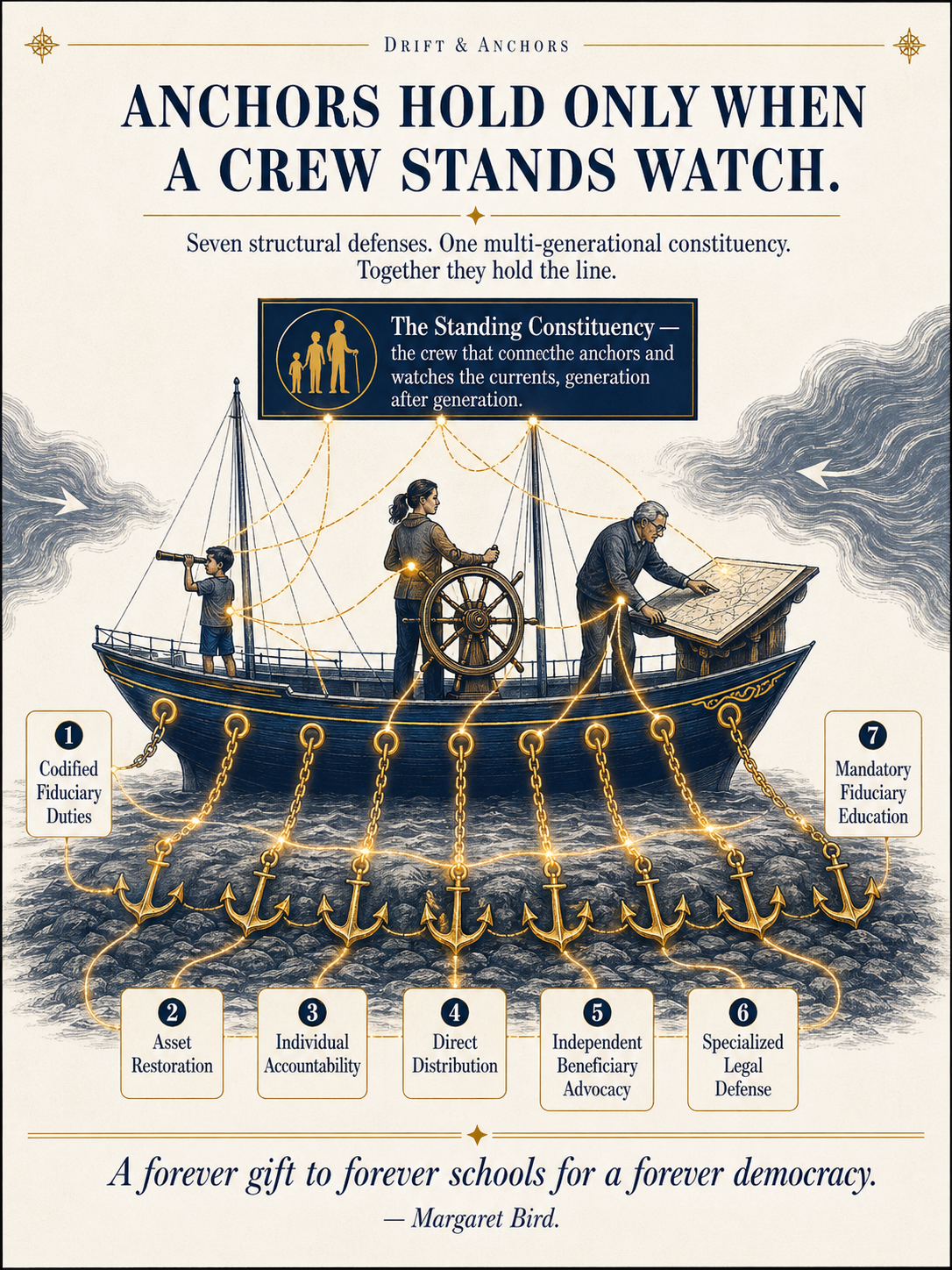
Figure 3 (Anchors), at the head of this section, maps the seven structural defenses as anchors on a ship and names the eighth element — the standing constituency — as the crew that connects them. The argument below works through each pillar and then turns to what makes the architecture hold.
The model in Section IV says three things compound to produce drift in any aspirational structure with intergenerational beneficiaries: people discount the future steeply; bureaucracies acquire their own survival interest; beneficiaries who cannot vote do not generate the political feedback that would otherwise correct the institution. The architecture that opposes this pathology has, accordingly, three jobs.
It must produce, first, a fiduciary identity that is robust to the cognitive bias — a set of duties so explicit, so personally consequential, and so frequently rehearsed that the trustee cannot quietly substitute the institution’s near-term comfort for the beneficiary’s long-term interest. The trust-doctrine standard for what that identity has to look like is the punctilio of an honor the most sensitive — Cardozo’s phrase, not mine, and the highest standard fiduciary law knows. The trustee’s duty is not to do as well as a competent administrator might do; it is to hold the line a hair short of the suspicion of self-dealing, every day, whether or not anyone is watching that day.
It must, second, structurally constrain the bureaucracy — by separating advocacy from administration, by attaching personal liability to breach, by giving the beneficiary side its own legal and informational resources. And it must, third, supply what the perfect-host beneficiary cannot supply for itself: feedback, attention, persistence across generational time.
Seven of these defenses can be derived directly from the comparative state record — from what worked where, what failed where, and what was visibly missing in the failures.1 An eighth, qualitatively different from the rest, is what makes the architecture work.
One caveat before the seven pillars. They defend principally against drift-by-deviation — the cognitive, institutional, and political-silence pathologies the model in Section IV named. They are less directly responsive to drift-by-redefinition along the four axes IV.F unpacked: corpus, purpose, beneficiary, legitimacy. Defense against drift-by-redefinition requires architecture of a different kind — periodic adversarial compact review, bounded asset-translation authority, and explicit beneficiary-class definitions that can identify their own boundaries when contested. The pillars below should be read as necessary but not, by themselves, sufficient. The remarks at the close of this section — and the V.H standing-constituency element — speak to the architectural work the pillars alone cannot do.
The seven pillars
The first pillar: codified fiduciary duties. The school-trust system’s legal status as a trust has been on the books since the Supreme Court named it in Cooper v. Roberts (1855), and has been restated in modern fiduciary terms in Lassen v. Arizona Highway Department (1967).2 It has nevertheless been challenged, in modern litigation, by states whose Attorneys General contend that their lands are not held in trust, that the duties of the State Land Board are political rather than fiduciary, that the rule of undivided loyalty does not constrain a board that is also performing other state functions. The first defense is to put the doctrine beyond rhetorical reach. State statute should declare, in terms the courts cannot misread, that the trustees owe undivided loyalty to the trust beneficiaries, that the sole-interest rule applies, that any act treating trust assets as state assets is a breach. The 1910 New Mexico-Arizona Enabling Act § 10 — declaring that “disposition of any of said lands … in any manner contrary to the provisions of this Act, shall be deemed a breach of trust” — is the federal-text model.3 Utah went the next step in 1994 by codifying the duty of “undivided loyalty” and the “strict requirement to administer the trust corpus for the exclusive benefit of the trust beneficiaries” in Utah Code § 53C-1-102.4 Every public-land state could, by statute, install equivalent language. Few have.
The second pillar: asset restoration. Aspirational structures lose ground in increments. A small diversion here; a transfer to a different fund there; an Elliott State Forest divested in 2017 over the objection of the trust’s beneficiaries; a $50 million general-fund raid in California; a percentage-point drop in the distribution rate.5 Over decades, the increments compound. The second defense is to require that diverted assets be returned. Restoration is doctrinally available in every state with trust-language admission acts; the federal “null and void” clause first introduced in the 1889 Omnibus Enabling Act § 10–11 (admitting North Dakota, South Dakota, Montana, and Washington), and carried forward into the 1910 New Mexico-Arizona Act, supplies the textual hook.6 What is missing, in most states, is the operational mechanism to convert breach into recovery. Where restoration has occurred — and there are documented instances in the Utah record (most consequentially the 1998 Schools and Lands Exchange Act compensating the trust for the Grand Staircase-Escalante incursion), the New Mexico record, and the contemporary Oregon litigation — it has converted what was political loss into legal recovery, and reset the baseline against which future drift is measured.7
The third anchor: individual trustee accountability — and the state being held to account.8 Boards have a way of dissolving responsibility. A vote is taken; the consequences are diffuse; the individual trustees can later report that they acted as the board acted. The trust-law tradition is older than the modern administrative board, and its rule on this question is direct: a trustee who participates in a breach is personally liable for the breach.9 Modern public-trust statutes have, almost without exception, blurred the rule. The third defense restores it. By statute, a State Land Board member who votes to divert trust assets to non-trust purposes is personally liable for the diversion, in the same sense that a charitable-trust trustee at common law would be. Personal liability is a check on the cognitive bias that no procedural reform can replace. It puts the trustee’s own resources in the same calculation as the beneficiary’s.
But individual trustee liability, alone, is not enough. The state is also the trustee. The institution itself owes the duties; the institution itself can breach them; the institution itself must be held to account.10 This is the framing Margaret Bird insists on, and the framing the historical record demands.11 When Oregon’s State Land Board, between 1990 and 2017, made the operational decisions that converted a century of stewardship into a documented pattern of breach, the breach was not only in the votes of the individual trustees who happened to hold the seats during those years. The breach was in the institutional drift those individual votes produced and ratified — a drift the State of Oregon owes its schoolchildren restitution for, regardless of which trustee’s name is on which 1997 minute.12 Calling individual trustees to account is a forensic question. Calling the state to account is a fiduciary one. Both are required, and the architecture must hold both available.
The two together close the institutional escape hatch that diffused responsibility otherwise opens. An individual trustee can claim she acted within her authority and the institution must indemnify her. An institution can claim its officers acted as individuals and must answer personally. The third anchor refuses both moves. The trustees are personally liable. The state is institutionally liable. The trust’s beneficiaries are owed restoration from whichever party the recovery can be obtained from. The anchor holds because the doctrine refuses to let either escape route close.
The fourth pillar: direct distribution. The Utah model that Margaret Bird’s work has documented at length is the cleanest available demonstration of this pillar in operation. Under the Utah School LAND Trust Program, established by the Utah Legislature in 1999, a portion of the trust’s earnings flows on a per-pupil basis directly to individual public schools — visible to teachers, parents, and principals at the building level, governed by a School Community Council at each school that by statute must have a parent majority and that adopts an annual academic plan.13 The visibility produces an enforcement constituency at scale. When a Utah governor moves to raid the fund, the political response comes not from a single advocacy office but from every school in the state whose annual disbursement is on the table. The mechanism is structurally elegant: it converts beneficiaries who cannot vote (the children) into surrogate beneficiaries who can (their parents and teachers and the local civic infrastructure). The school becomes the “distributed defensive perimeter” — every classroom an outpost of the trust’s enforcement community.
The wallet metaphor matters here, and Margaret has been firm about it. In states without direct distribution, the schools are not beneficiaries in any operational sense; they are payees. The state hands the schools their own money back from the general fund, and calls the transaction a distribution. That is what handing a wallet to its rightful owner, after first removing what was inside the wallet, looks like; it is not what a fiduciary distribution looks like. Direct distribution forces the trust to act as a trust at the point where the money actually arrives — visible to the beneficiary’s teachers, parents, principals — and the visibility is the discipline.
The fifth pillar: independent beneficiary advocacy. Utah’s Land Trusts Protection and Advocacy Office, established in 2018 under Title 53D, Chapter 2, is the clearest operational instance of this defense.14 The office is statutorily separate from the management agency. It has its own director, its own budget, and its own mandate: it advocates for the beneficiary against the competing pressures of the state treasury, the legislature, and other state agencies whose interests sometimes conflict with the trust’s. Section 53D-2-201 expressly directs the office to represent beneficiary interests across land management, fund investment, and distributions, and to advocate against state uses of trust assets that conflict with trust purposes. It is, structurally, what California, Oregon, and most other states do not have — a state office whose job description begins and ends with the welfare of the beneficiary.15 The fifth defense is to install one in every state with a school-trust system. The model is on the books. It works. Replication is a matter of legislative will, not of design.
The sixth pillar: specialized legal defense. State Attorneys General are politically appointed officers whose duties run, in most states, to multiple state clients with conflicting interests. When the trust’s interests conflict with the state’s general-fund interests — and they always do, eventually — the Attorney General is structurally compromised. The federal precedent is the 1910 New Mexico-Arizona Enabling Act, which expressly authorized enforcement of the school-trust provisions by the Attorney General of the United States as well as by the state or its citizens — building independent legal recourse directly into the federal text.16 The sixth defense is to give the trust its own counsel. State statute should provide that, in any matter where the trust’s interests diverge from the state’s general interests, independent counsel — selected by the trust’s beneficiary advocacy office, paid by the trust’s funds, accountable solely to the trust — represents the trust. The change is small in cost and large in effect. It separates the legal sword that defends the trust from the political control that, over time, would otherwise blunt it.
The seventh pillar: mandatory fiduciary education. The State Land Boards in most public-land states are composed of elected officials — typically the governor, the secretary of state, and the state treasurer — whose primary professional formation is political rather than fiduciary. They serve as trustees because the constitution or the enabling statute names them as trustees. In Oregon, the framers wrote this directly into Article VIII, Section 5 of the 1857 Constitution: “The Governor, Secretary of State, and Treasurer of State shall constitute a Board of Commissioners, for the sale of school, and university lands, and for the investment of the funds arising therefrom.”17 Most such trustees have no specific training in trust law, the rule of undivided loyalty, the prudent-investor standard, or the operational meaning of the sole-interest rule. The seventh defense is to require, by statute, annual training: a structured curriculum on the fiduciary duties of public trustees, taught by independent practitioners (not by the agencies the trustees oversee), with documented completion as a condition of remaining in office. The training is the cognitive recalibration the political mind otherwise misses. It says, every year, that the trustee’s duty is not to the institution’s continuity, not to the legislature’s appropriations math, not to the political moment. The trustee’s duty is to the beneficiary. The repetition is the point.
The eighth anchor: the watchful crew
Anchors do not set themselves.
The seven anchors of the previous section are the formal architecture. Each has at least one operational instance somewhere in the public-land states. The combination is mutually reinforcing: codified duties give the litigation a target; restoration gives the litigation a remedy; individual and state accountability give trustees a personal stake in compliance; direct distribution gives the trust visibility; advocacy gives it voice; specialized legal defense gives it independence; mandatory education gives every new trustee the cognitive tools to take the role seriously.
But anchors do not set themselves. Anchors do not check themselves. An anchor that no one inspects is, at the next storm, indistinguishable from no anchor at all.
The eighth anchor is the watchful crew.18
The framers, at the end of Section II.A, knew this without having a name for it. They built the school endowment for a beneficiary class without political voice — schoolchildren, future generations, the unborn — and they relied on attorneys general and courts of equity to act on the public’s behalf. They had no instrument with which to ensure that the attorneys general would act, or that the courts of equity would be petitioned, in 1885 or 1925 or 1985 or 2025. They had no instrument because the instrument did not exist. Multi-generational civic continuity, at the scale a 250-year trust would require, was beyond the period’s institutional reach. So they wrote what they could write: a rigid legal device, a clear charitable purpose, a perpetual dedication of a tangible asset, and language strong enough that a future generation could find its way back to the original promise if it chose to.
What they could not engineer for was the choosing.
The historical record bears this out with unusual clarity. Oregon’s pre-1990 architecture was, for its century, among the strongest in the country. The drift came anyway. The structural defenses on paper held; the people who would have insisted on them in operational practice — state foresters with mission orientation, timber-industry technicians who treated sustained-yield management as a fiduciary obligation, school-administrator advocates who spoke for the beneficiary at every legislative hearing, a legislative culture in which the trust’s status as a trust was unchallenged — that cohort dissipated faster than the architecture could compensate for. Utah’s contemporary record, by contrast, is the joint product of strong architecture and an active community of trustees, advocates, parents, teachers, journalists, and legislators who treat the architecture as binding. Tim Dawson’s line in the governor’s office in 2017 — “My job is to defend the trust” — is what an eighth anchor sounds like when one person’s vigilance is reinforced by an institutional culture and a national community that expects the line to be spoken.19
Margaret Bird’s framing puts the matter as it should be put. “A forever gift to forever schools for a forever democracy” is the white paper’s anchor sentence, and it carries a structural claim that the rest of the paper rests on.20 A forever gift presupposes a forever community to receive it. A forever school presupposes a forever insistence on its continuity. A forever democracy presupposes citizens who, generation after generation, refuse to let any one trustee’s quiet diversion stand. The architecture cannot do that work. Architecture is what makes accountability legible. The crew is what makes accountability operate.
The framers had no way to build the crew because the cost of sustained civic attention to a complex multi-generational asset, in 1785 or in 1885 or in 1985, was higher than any but a few citizens could pay. The Bates ranges, the statutory pin-cites, the legislative histories, the comparative-state data, the breach-of-fiduciary-duty doctrine, the figures in inflation-adjusted dollars, the genealogy of every diversion across forty years — to know any of this required a state archivist’s training and a state archivist’s salary. The school-trust beneficiary class — children — had no archivists.
That cost has, in the period between 2022 and 2026, dropped by at least an order of magnitude.
The cost-drop is the headline. The mechanism beneath the headline is what makes the eighth anchor a structural feature and not a contingent one.
What the framers were trying to engineer against, when they wrote the trust into rigid statutory and constitutional form, was a kind of forgetting they had no other tool to address. The cognitive-technology stack of 1785 — quill, paper, statute book, mail moving by horse, fragile human memory in heads spread across a continent without telegraph or rail — could not hold institutional context across the generations the trust was meant to bind. Memory had to live somewhere, and the available somewheres were either inside individual heads, where it died with the head, or inside paper records that depreciated faster than the asset they described. The framers used legal rigidity as a substitute for institutional memory because legal rigidity was the only memory technology the period offered at the scale a 250-year trust required. Their architecture was as good as the cognitive technology of their century could make it.
The same forgetting works at three nested scales, and the school-trust record shows it on every one. At the personal scale, a 73-year-old reader walks into another file to check a fact and forgets, on the way, why the file mattered; the work-around is a physical project where the artifact preserves context and its incomplete state tells the worker what still needs doing. At the institutional scale, a State Land Board forgets, across forty years and turnover at every seat, why the corpus was constitutionally protected, and starts spending principal as if it were income; the work-around is the doctrine — fiduciary law, restoration mechanisms, mandatory trustee education — that the seven anchors of this section codify. At the civic scale, a republic forgets, across two and a half centuries, why Section 16 of every township was set aside in 1785; the work-around is the eighth anchor, the standing institutional memory that holds context when the structural protections lose their salience.
Each scale fails the same way: through forgetting. Each scale needs the same kind of technology: external-memory infrastructure that holds context biological memory cannot. What the 1785 framers could not build at the civic scale is what their successors can now build, because the cognitive technology has finally arrived. The eighth anchor scales across decades when the founding generation tires because the cognitive labor of remembering can be partnered. The institution remembers when the people forget; now the people can remember through the institution. That is the structural claim under the operational fact of the cost-drop.
The institution remembers when the people forget; now the people can remember through the institution.
The civic-craft this requires is not new in the country; it is new only in this domain. In the 1970s, when American timber framing had nearly disappeared from working memory, Jack Sobon began walking the surviving New England barns — the eighteenth- and nineteenth-century barns whose joinery still held — and taking the technique apart, piece by piece, in his sketchbooks and his measured drawings. Tedd Benson, working in New Hampshire, founded Bensonwood and built a company around training the next cohort of framers. The two of them, with a small handful of others, founded the Timber Framers Guild in 1985. The Guild’s conferences, its journal, its training program, the half-century of accumulated technique it now holds — that infrastructure is the existence proof that civic-craft revival is possible when one generation does the archaeological work and the next builds the institutional infrastructure to carry it forward. The pattern is four steps: archaeological recovery of the technique; plain-language books that let others replicate (Sobon’s Build a Classic Timber-Framed House in 1994, Benson’s Building the Timber Frame House in 1980); institutional infrastructure (the Guild itself); workshops and community accumulation that compound the technique faster than any one practitioner could on his own. The Library is the analogous instrument for civic memory of the school trust, and for the AI-era trusts that will inherit the architecture this paper describes. The four steps are the same.
A citizen-trustee in Coos County in 2026 can ask, in a single afternoon, what would have taken a state archivist in 1986 a month: the trust’s current acreage, the historical revenue per acre, comparable states’ classroom disbursements, the breach-of-fiduciary-duty doctrine in courts of equity, the legislative record of every diversion across the past forty years, the figures restated in 2026 dollars. AI-assisted research does not replace the citizen’s judgment. It removes the credentialing barrier that, for two and a half centuries, kept the watchful crew small enough that single bureaucracies and single political moments could outlast them. The Library is where that work accumulates into a record the watchful crew can defend.
The instrument the framers needed and could not engineer for is, accordingly, becoming feasible. Sustained, multi-generational civic attention — distributed across thousands of citizens, augmented by tools that lower the per-citizen cost of competence, organized through institutions with their own continuity — is what an active enforcement constituency looks like in 2026.
America’s School Trust Library at schooltrusts.org is the first such institution to come into operation. The Library hosts the Sacred Compact and the Schools of the Republic synthesis as its evidentiary base, the per-state dossiers that document where the trusts are and how they are administered, the Newsroom that reports on the states as the record moves, and the Map Room that makes the state-by-state transparency posture legible. Around the Library are the organizations that carry the case forward in policy, litigation, and education: the Advocates for School Trust Lands (ASTL) at national level; the Oregon Advocates for School Trust Lands (OASTL) and parallel state organizations; the developing nationwide pro bono legal community that arrived in the past two years; the Utah Foundation–style historical-and-policy infrastructure now spreading to other states.21
The Library is the institutional locus. It is an independent Oregon nonprofit corporation with its own board; the advocacy organizations are separately governed bodies. The Library holds the record; the organizations carry the case. Together, they are what an eighth anchor looks like when the technology to forge it has finally arrived.
The mechanism that builds such a constituency is the same one Margaret Bird states explicitly for the Utah school-trust reform. “Increase the revenue to schools, get it directly to every single school where the parents, the teachers, and the principal are deciding how the money is implemented. And all of a sudden, you have built a huge constituency.” Routing decisions to the local sites where deliberation happens, letting the deliberation produce visible artifacts, and recognizing those artifacts in a public record — the chain runs route → deliberate → produce → recognize → constituency → defense. Utah’s school community councils, roughly 9,000 parents, teachers, and principals deliberating school by school, are what the mechanism looks like in operation; the thirty-fold revenue growth from $5 million annually to $150 million annually is the visible outcome of the architecture and the constituency working together. The mechanism does not displace the seven structural anchors; it is what makes them operate across generations. The Library applies the same mechanism in its own institutional form, routing consequential editorial work to named contributors who decide what to do at their site, with each artifact bearing a byline that writes the contributor into the cumulative record at /the-watchful-crew/. The principle generalizes: any multi-generational trust whose revenue or consequential work is routed to local deliberation sites builds the constituency that defends it; any whose allocation is centralized disperses that constituency. The school-trust record is the worked existence proof of the principle.
This is the part of the architecture the framers could not build. It is also the part most easily lost. The seven anchors are statutes, opinions, and operational practices; once installed, they are difficult to remove without leaving evidence. The eighth anchor is a community of practice. It can dissipate in a decade if the institutions that carry it lose their leadership, their funding, or their institutional memory. The school-trust record contains, in Oregon’s post-1990 dissipation, the cleanest available demonstration of how fast that loss can happen.
The seven anchors are necessary. The eighth anchor is what makes the seven enforceable across the kinds of time horizons that aspirational structures actually face.2223
What the architecture is not
Two things this counter-architecture is not.
It is not a guarantee. Each defense reduces the probability of drift; none of them eliminates it. A trust with all seven pillars in place and an active standing constituency around it can still fail, because human institutions can always fail. What the architecture changes is the base rate of failure, and the trajectory of decay when failure begins. With the architecture, drift is detectable, contestable, and (in some recovery cases) reversible. Without it, drift is only visible after the fact, when the loss is already capitalized.
It is not exclusively legal. The first six pillars are statutory; the seventh is administrative; the eighth is civic. The most consequential defense is the one that does not appear in any state code. The standing constituency is a community of practice, not a regulation. Its persistence is a function of leadership, organization, and cultural transmission across generations of advocates. The architecture supports the constituency. It does not produce it. The constituency, when present, makes the architecture work; when absent, no statute does the trick alone.
The next section turns from the school trust to the structures the AI moment is now constructing. The pillars are general. The constituency problem is general. The chance to install both, before the structures are funded, is rare and closing.
Footnotes / source notes
Footnotes
-
The seven-pillar derivation from the comparative state record is developed in Sullivan, Defining “Winning”: Master Manuscript & Seven Pillars, January 7, 2026, Section IV (“The Fiduciary Architecture: Seven Pillars of Victory”). The present section adapts the formulation for the white paper’s general-reader register and adds the eighth-element framing of the standing constituency, which the manuscript treats elsewhere. Secondary-literature backstop: Sally K. Fairfax & Jon A. Souder, State Trust Lands: History, Management, and Sustainable Use (Univ. Press of Kansas, 1996), the standard secondary work on the public-land-state trust system. ↩
-
Cooper v. Roberts, 59 U.S. (18 How.) 173, 181–82 (1855), https://supreme.justia.com/cases/federal/us/59/173/ (admission-act school grants create “sacred obligations” on state public faith); Lassen v. Arizona ex rel. Arizona Highway Department, 385 U.S. 458 (1967), https://supreme.justia.com/cases/federal/us/385/458/ (modern restatement of fiduciary obligations under enabling-act school grants). The punctilio of an honor the most sensitive standard invoked in the section preamble is from Cardozo’s opinion in Meinhard v. Salmon, 249 N.Y. 458, 464 (1928), the canonical statement of the fiduciary duty’s intensity in the trust-law tradition; the standard is named in this paper without inline citation because it is the doctrinal floor the trustee accepts when she takes the role, not a citation she should need to be reminded of. Discussed at Schools of the Republic (Sullivan & Bird, v1.3) Oregon entry (see footnote or-4)–(see footnote or-5) and Utah entry (see footnote ut-10). ↩
-
New Mexico-Arizona Enabling Act of June 20, 1910, ch. 310, §§ 9–10, 28, 36 Stat. 557, 561–63, 574 (codifying the express “in trust” language, the “breach of trust” naming for nonconforming dispositions, the “null and void” invalidation clause, and federal Attorney General enforcement authority). Discussed at Schools of the Republic (v1.3) Conclusion (see footnote conc-1) and Utah entry (see footnote ut-8) (comparing Oregon’s weaker 1859 federal text to the elaborated 1894 Utah and 1910 New Mexico-Arizona templates). ↩
-
Utah Code § 53C-1-102 (enacted as part of the School and Institutional Trust Lands Management Act, Utah Code Title 53C, 1994) (codifying the duty of “undivided loyalty” and the “strict requirement to administer the trust corpus for the exclusive benefit of the trust beneficiaries”); see United Mine Workers of America v. State of Utah, 6 F. Supp. 2d 1298, 1311–12 (D. Utah 1998) (federal-court recognition of Utah’s special fiduciary status after Title 53C). Discussed at Schools of the Republic (v1.3) Utah entry (see footnote ut-43)–(see footnote ut-45). ↩
-
On the Elliott State Forest decoupling (2017–2022) and the contested $221 million compensation to the Common School Fund, see Schools of the Republic (v1.3) Oregon entry at (see footnote or-49)–(see footnote or-56); the breach-of-fiduciary claims were brought in Siuslaw School District 97J et al. v. State of Oregon, Coos County Cir. Ct. No. 24CV38372, in which the court granted the State summary judgment on July 24, 2026, holding that the State owes no legally enforceable fiduciary duty. The Court of Appeals’ standing reversal in the companion 2023 case is at 346 Or App 668 (Jan. 28, 2026) (see footnote or-57); the Oregon Supreme Court denied review in S072734 on July 23, 2026. The California $50 million general-fund transfer is the 2008–09 fiscal-emergency raid; the project research file on it has not been deposited in a public archive. ↩
-
Omnibus Enabling Act of February 22, 1889, ch. 180, §§ 10–11, 25 Stat. 676, 681 (introducing the “null and void” clause for nonconforming dispositions of school-trust lands; admitting North Dakota, South Dakota, Montana, and Washington); carried forward and elaborated at New Mexico-Arizona Enabling Act of June 20, 1910, ch. 310, §§ 10, 28, 36 Stat. 557, 562–63, 574. Discussed at Schools of the Republic (v1.3) Conclusion (see footnote conc-10). ↩
-
Utah Schools and Lands Exchange Act of 1998, Pub. L. No. 105-335, 112 Stat. 3139 (transferring approximately 377,000 trust acres trapped within the 1996 Grand Staircase-Escalante National Monument and other federally restricted lands in return for $50 million in cash and equivalent federal lands of high development potential). Discussed at Schools of the Republic (v1.3) Utah entry (see footnote ut-49)–(see footnote ut-50). The Arches camp-out exchange — Margaret Bird’s first-person account of the precursor pressure that produced the federal exchange architecture — is preserved in her recorded account of the Utah reform coalition and the Arches exchange (not yet deposited). ↩
-
The seven-pillar formulation that Section V adapts — within which “individual trustee accountability” is the third pillar — originates in Sullivan, Defining “Winning”: Master Manuscript & Seven Pillars, January 7, 2026, Section IV. The present subsection extends the third pillar to add the institutional-accountability layer per Margaret Bird’s April 29, 2026 correction; the extension is faithful to the manuscript’s framing and to trust-law doctrine but enlarges the pillar’s scope. ↩
-
The personal-liability rule for participating trustees is the standard charitable-trust doctrine. Its application to school-trust trustees runs through the Supreme Court’s holding in Cooper v. Roberts, 59 U.S. (18 How.) 173, 178–183 (1855), which held that the State takes section-16 lands “in the character of a trustee” subject to a “sacred obligation.” See Schools of the Republic v1.3, Ch. 3 (see footnote ch3-4); cross-referenced at Section V.A pillar one (see footnote 4). Cooper names the doctrinal anchor for both halves of the third pillar — the trustee’s personal duty and the State’s institutional duty. ↩
-
That the State itself is the trustee — and not merely the assembly of individuals who hold trustee seats at any given moment — is the textual reading of Cooper v. Roberts (the State takes “in the character of a trustee”); see 9. Oregon’s own Attorney General has restated the institutional formulation repeatedly: “the school lands granted to the State of Oregon are a trust for the benefit of public education” and the State’s “obligations are binding. They cannot be disregarded. Oregon must use [Admission Act lands] consistent with the trust.” Or. Att’y Gen. Ops. (1992 and 2003), discussed at Section III (The Drift), III.B. Both halves of the doctrine name the State institutionally, not the trustee individually. ↩
-
Margaret Bird call with Dave Sullivan, April 29, 2026 (correction to Anchor 3 framing). Margaret’s exact phrase, “calling the state to account,” is preserved in the prose of this subsection; this footnote records the source of the framing per project convention that Margaret’s first-hand contributions are cited to the call in which they were made. ↩
-
For the Oregon 1990–2017 institutional drift the prose summarizes here, see Section III (The Drift), III.C (the post-1990 Elliott State Forest case study, including the 2017 sale vote, the 2019 $100 million bond compensation, and the 2022 conversion to an OSU research forest). Per-state encyclopedia entry: Schools of the Republic v1.3, Ch. 5 (Oregon). The institutional-breach framing is the analytic move this subsection adds; the operational record it rests on was already documented. ↩
-
Utah School LAND Trust Program, established by the Utah Legislature in 1999; the per-school distribution architecture and the parent-majority School Community Council governance structure are described in detail at Schools of the Republic (v1.3) Utah entry (see footnote ut-51)–(see footnote ut-52). Operational reporting is published annually at the Utah State Board of Education’s School LAND Trust portal, https://schools.utah.gov/schoollandtrust, and at the Utah Trust Lands Administration’s annual reports, https://trustlands.utah.gov. ↩
-
Utah Code Title 53D, Chapter 2 (Land Trusts Protection and Advocacy Office, enacted 2018). The encyclopedia treatment establishes 2018 as the LTPAO’s enactment date under Title 53D Chapter 2; an earlier 2010 advocacy-office instance was superseded by the 2018 statute. The full statutory framework — Title 53C (1994) for SITLA, Title 53D Chapter 1 (2014) for the School and Institutional Trust Fund Office (SITFO), and Title 53D Chapter 2 (2018) for the LTPAO — is the three-piece operational architecture of the Utah model. Schools of the Republic (v1.3) Utah entry (see footnote ut-53)–(see footnote ut-56). ↩
-
Utah Code § 53D-2-201 (codifying the LTPAO’s mandate to represent beneficiary interests across land management, fund investment, and distributions, and to advocate against state uses of trust assets that conflict with trust purposes). Operational accounts of the office’s first-cycle work are preserved in Margaret Bird’s recorded accounts (not yet deposited); the office’s annual reports are published at the Utah Trust Lands portal, https://trustlands.utah.gov. ↩
-
New Mexico-Arizona Enabling Act of June 20, 1910, ch. 310, § 10, 36 Stat. 557, 562–63 (express federal Attorney General enforcement provision). Discussed at Schools of the Republic (v1.3) Conclusion (see footnote conc-1) and New Mexico entry footnotes. ↩
-
Or. Const. art. VIII, § 5 (1857; current text reflecting 1968 and subsequent amendments), https://codes.findlaw.com/or/oregon-constitution/or-const-art-viii-sect-5/. Discussed at Schools of the Republic (v1.3) Oregon entry (see footnote or-11), (see footnote or-32). The 1968 amendment recast the Board’s duty as managing trust lands “with the object of obtaining the greatest benefit for the people of this state, consistent with the conservation of this resource under sound techniques of land management” — the doctrinal pivot that Cascadia Wildlands v. Department of State Lands (2019) would later test. Id. (see footnote or-47)–(see footnote or-48). ↩
-
Sullivan, Defining “Winning”: Master Manuscript & Seven Pillars, January 7, 2026, Section IV. The seven-pillar formulation is the manuscript’s; the explicit “eighth anchor” naming — and the watchful-crew framing — emerged in the Margaret Bird call of April 29, 2026, and is adopted here as the white paper’s contribution. The manuscript’s analogous category is the “standing enforcement constituency”; “eighth anchor” honors the nautical metaphor carried through the visual pieces. ↩
-
Tim Dawson’s 2017 governor’s-office encounter — “My job is to defend the trust” — is recounted in Section IV (the Pattern). Dawson is Utah’s permanent-fund chief investment officer. The quotation is preserved in Margaret Bird’s first-hand account; it is not yet pinned to a specific recording. ↩
-
“A forever gift to forever schools for a forever democracy.” — Margaret Bird, oral remarks; carried throughout the white paper as Margaret’s anchor phrase and accepted on the Margaret Bird call, April 29, 2026, as the structural hinge of this section. The structural reading offered here (forever gift → forever community; forever school → forever insistence; forever democracy → forever vigilance) is Sullivan/Claude; the phrasing is Margaret’s. ↩
-
The named entities of the standing-constituency illustration: Advocates for School Trust Lands (ASTL), the national-level parent organization; the Oregon Advocates for School Trust Lands (OASTL), the Oregon affiliate, which litigated 24CV38372 (Coos County; summary judgment for the State entered July 24, 2026) and S072734 (Oregon Supreme Court; review denied July 23, 2026); the Utah cluster of long-running civic infrastructure, including the Utah PTA, the Utah Education Association, and the Utah Foundation, whose engagement with the Utah school-trust system is the cleanest available demonstration of a multi-decade standing constituency. Specific establishment dates and statutory or charter authorities for each organization are [CITE PENDING — Utah PTA founded 1911, UEA 1860, Utah Foundation 1945; the ASTL and OASTL incorporation dates are not yet confirmed against the Utah and Oregon corporate registries]. ↩
-
The technological-feasibility claim — that AI-assisted civic attention has reduced the per-citizen cost of competence by an order of magnitude in the 2022–2026 period — is an analytical claim of this paper, not a borrowed claim, and accordingly carries no primary-source citation. It is the white paper’s contribution and stands or falls on the worked examples the rest of the paper develops. The order-of-magnitude formulation is not yet supported by a documented operational example, and remains an estimate. ↩
-
The three-scale forgetting framing — personal, institutional, civic — and the cognitive-partnership-as-external-memory-infrastructure analysis are developed in Sullivan’s working notes of May 6, 2026 (not yet deposited). The timber-framing precedent — Jack Sobon’s archaeological recovery of New England timber-frame technique in the 1970s, and Tedd Benson’s construction of Bensonwood and the broader Timber Framers Guild infrastructure — is the existence proof for civic-craft revival deployed in the prose. Sobon, Build a Classic Timber-Framed House (Storey, 1994); Benson, Building the Timber Frame House (Scribner, 1980); the Timber Framers Guild, https://www.tfguild.org/. ↩