Soap Creek Valley oral history series · Monograph #9
Eugene Glender
Monograph #9 in the Soap Creek Valley oral history series: Eugene Glender, recorded in 2 sessions between January 6, 1990 and 1994-07, printed 1994.
Growing Up on a Tampico Family Farm, Benton County, Oregon: 1910-1941
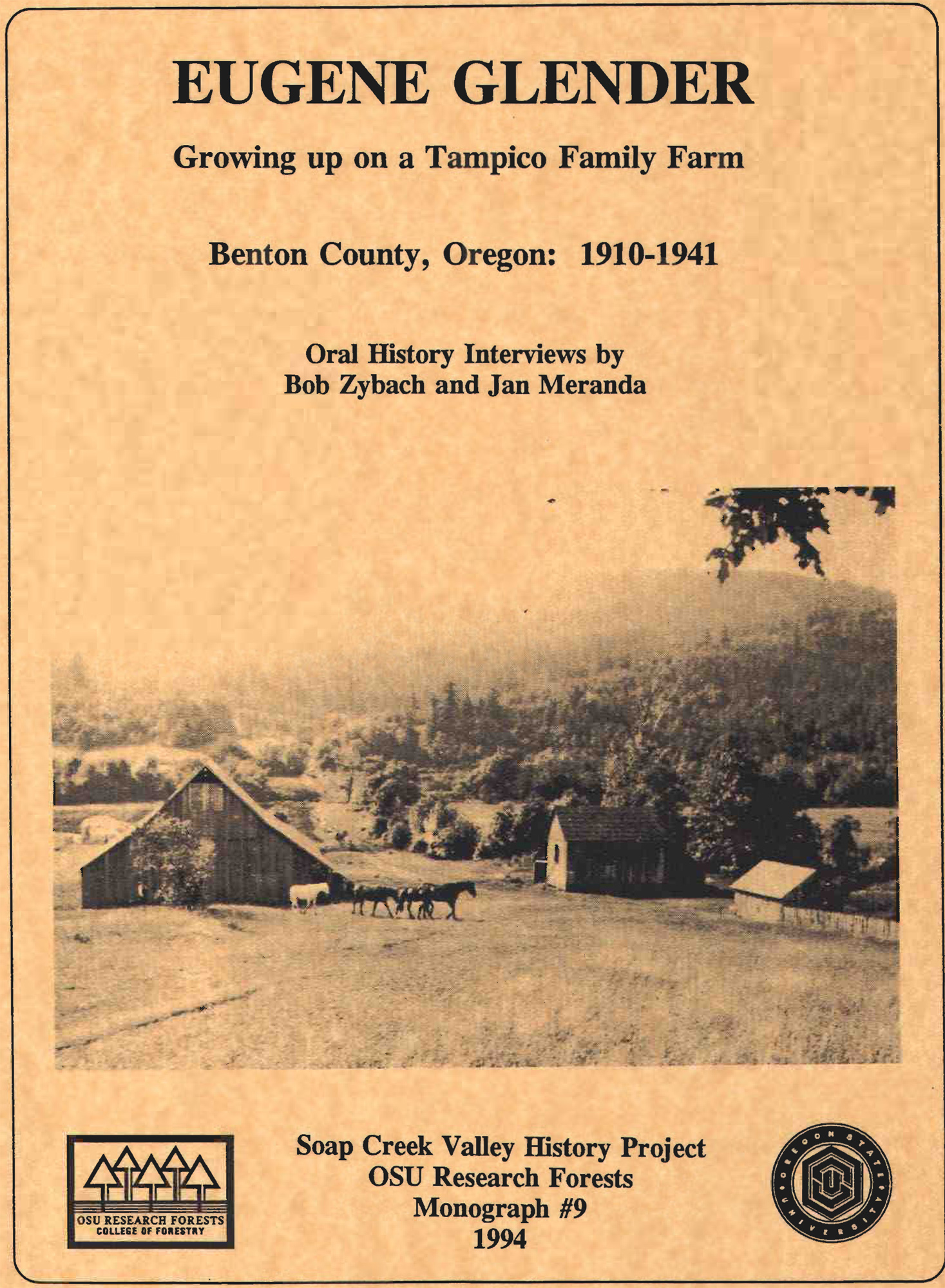
The printed cover. Full-size scan on
the creator's own site, nwmapsco.com.
Zybach, Bob and Janet Meranda 1994. Eugene Glender. Growing Up on a Tampico Family Farm, Benton County, Oregon: 1910-1941. Soap Creek Valley History Project, Monograph #09. Oregon State University Research Forests and College of Forestry, Corvallis, Oregon: 155 pp.
Bob Zybach (interviewer); Bob Zybach (co-author); Jan Meranda (interviewer); Janet F. Meranda (co-author); Dr. William Atkinson (authorizer); Lisa Buschman (transcriber); Holly Behm Losli (editor); Tanii Torres (editor); Md. Shahidul Islam (editor); Pam Beebee (editor); Bonnie Humphrey (other); Elvera Glender Muller (other); Viola Glender (other); Royal G. Jackson (other); John B. Homer (other); Laura Glender (photographer); Bob Zybach (photographer); Jan Meranda (photographer); Mary Payne (photographer); Samuel H. Moore (photographer); William Ball (other)
Printed
1994 · Oregon State University Research Forests and College of Forestry, Corvallis, Oregon
Withheld from this edition.
Printed pp. 129–146 — 18
pages of this volume are withheld while the Library
completes a review. Each keeps its number and its permanent link, so a
citation to any of them still lands on the page it names. The reasons
differ from page to page and are not given here, so that the notice on
one page says nothing about another.
What is withheld, and why.
Front matter, as printed
Cover, as printed
EUGENE GLENDER
Growing up on a Tampico Family Farm
Benton County, Oregon: 1910-1941
Oral History Interviews by
Bob Zybach and Jan Meranda
Soap Creek Valley History Project
OSU Research Forests
Monograph #9
1994
Cover photograph
Cover Photo: Courtesy of Myra Moore Lauridson and the Soap Creek Schoolhouse Foundation. Pictured is the Moore family farm on Soap Creek, taken about 1899 or 1900 by Mrs. Lauridson's father, Samuel H. Moore.
Acknowledgments
ACKNOWLEDGEMENTS
The Soap Creek Valley History Project was authorized by, and is under the direction of, Dr. William Atkinson, former Director of the OSU Research Forests. Funding for the project is provided by the OSU College of Forestry.
Lisa Buschman, former OSU Research Forests secretary, transcribed interview recordings to computer ifies and assisted with draft editing, formatting, and indexing. Holly Behm Losli, Tanii Torres, and Md. Shahidul Islam, OSU Research Forests text editors, completed final formatting and indexing under the direction of Pam Beebee, OSU Research Forests Office Manager. This project could not have been completed without the help of these people.
Cover Photo: Courtesy of Myra Moore Lauridson and the Soap Creek Schoolhouse Foundation. Pictured is the Moore family farm on Soap Creek, taken about 1899 or 1900 by Mrs. Lauridson's father, Samuel H. Moore.
Title Page Photo: Sisters Leone (left) and Elvera (right) Glender pose in front of the Glender family farmhouse in the early 1920s. Coffin Butte appears to the north in the background, while the Beatty fir trees (reputed to have been planted in 1858 along the old wagon road to the California gold mines) are seen to the immediate east of the home. These trees are the earliest known planted Douglas-fir trees in Benton County and are still growing in 1994.
Soap Creek Valley History Project
THE SOAP CREEK VALLEY HISTORY PROJECT
The Soap Creek Valley History Project was undertaken by the Oregon State University's Research Forests in 1989 for the purpose of better understanding the history, ecology, and culture of an area that has been impacted by OSU land management practices for nearly seventy years. An important part of the project has been the location and publications of existing recorded oral history interviews with individuals who have had an influence upon the valley's history. New recordings have also been made with significant individuals who have not been previously consulted, as well as "follow-up" interviews with a few people who have continued to contribute to our understanding of the Soap Creek area.
The publication of these interviews as a series of cross-referenced and indexed monographs has been undertaken in an effort to make them available to resource managers, researchers, and educators. An additional use is accurate and available references for a planned written history of the area.
One of the primary accomplishments of the project has been the creation of a computerized concordance file. This was made possible through the assistance and expertise of Bonnie Humphrey, of the former Homer Museum staff, Lisa Buschman, former secretary for the OSU Research Forests, and Holly Behm Losli, Tami Torres, and Md. Shabidul Islam, text editors for OSU Research Forests. The file allows for both the efficient and systematic indexing of the monographs in this series, as well as providing a method for cross-referencing other research materials being used in the construction of a scholarly history of the Soap Creek Valley.
The Soap Creek history is being assembled from the written and spoken words of the people who made it and lived it. The use of the concordance file allows information from the journal entries of botanist David Douglas, the transcribed words of Kalapuyan William Hartless, the memories of pioneer "Grandma" Carter, and the recordings of Eugene Glender and his sister, Elvera - a history to be systematically searched and organized. The index to this monograph is an example of the applied use of the file.
Gene's cooperation and encouragement during the recording and writing of his story will prove to be of value to students and teachers of local history, horticulture, economy, agriculture, and fish and wildlife in the years to come. Gene's story covers the period of 1910by which time his parents had helped to establish the Glender Brothers farmuntil 1941, when many local families (including the Glenders) were moved to make room for the WW II training facilities at Camp Adair. Most of the other oral histories in this series also cover this specific period of time. As an aid to better understanding the names, nationalities, and migration patterns of the people who lived in the Soap Creek area during this period, two appendices of general use to the entire series have been added: the 1910 census of the Soap Creek Precinct and the entire listing of individuals from the 1941 Corvallis telephone book.
Citations should mention both the OSU College of Forestry and OSU Research Forests.
Introduction
INTRODUCTION
In the early 1900s two young Illinois men of German parentage, William and Charles Glender, began talking about moving West to Oregon. Sometime before 1910, they had arrived in the Soap Creek Valley, purchased 400 acres and an old farmhouse at the corner of Tampico and Soap Creek roads, and started farming as a partnership. Will married a young neighbor woman, Laura Metge, and in 1916 Charlie married her younger sister, Selma.
Charlie and Selma had two girls, Elvera and Leone, before their Tampico farmhouse burned down in 1920. Elvera remembers her mother carrying baby Leone from the house and a neighbor woman offering the frightened girls a stick of chewing gum to help them calm down during the emergency. Eugene was born and raised in the new house that arose from the ashes of the old.
This monograph represents Gene's recollections of farm life in the Tampico area during the years prior to World War II. The establishment of Camp Adair during the early stages of the war caused the U.S. Army to force local farmers to sell up and move out. The united Glender families moved to Albany in 1942 and were never allowed to return to their Tampico home. After Camp Adair was dismantled, Oregon State University acquired the Glender property. The house was moved in 1992, not long after Bob and I first began our search for the "lost" town of Tampico.
It was a great pleasure to participate in the interviews upon which this monograph is based. It is our hope that other researchers and lovers of history will use and enjoy this work into the future. Perhaps they will be encouraged to extend human knowledge through their own efforts at capturing not just the facts but also the spirit of our ties to the past. It is a never-ending journey on the ever-flowing river of time.
Janet F. Meranda
Corvallis, Oregon
July 1994
The map
Glender Tampico Tour Map: Map of tour on January 6, 1990 by Gene Glender, Jan Meranda, and Bob Zybach. Circled letters correspond to tape recorded stops along the tour route and to specific chapter headings in the table of contents.
The recording sessions
January 6, 1990 — Tampico area, Soap Creek Valley, Benton County, Oregon Interviewers: Bob Zybach, Jan Meranda · Mode: tour · Source: as stated Tape-recorded driving tour with lettered stops A-S; mileages are called out during the recording. Chapter headings correspond to circled letters on the Glender Tampico Tour Map.
1994-07 Interviewers: Bob Zybach, Jan Meranda · Mode: interview · Source: inferred Follow-up discussions with Gene Glender and his sister Elvera Glender Muller reported in editors' footnotes on pp. 1, 5 and 39; the monograph is signed 'Corvallis, Oregon / July 1994'.
SOAP CREEK VALLEY MAPPrinted page [front-5]Full-page sketch map; legend reads "TAMPICO", "SOAP CREEK VALLEY", "NOT TO SCALE". Unnumbered front-matter plate.
Glender Tampico Tour MapPrinted page [front-6]Legend: A · B · C · D · E · F · G · H · I · J · K · L · M · N · O · P · Q · R · SMap of tour on January 6, 1990 by Gene Glender, Jan Meranda, and Bob Zybach. Circled letters correspond to tape recorded stops along the tour route and to specific chapter headings in the table of contents. Unnumbered front-matter plate; lettered keys A-S are taken from the chapter headings because the circled letters are not legible in the scan.
1929 Metsker's map of Tsp. 10 S., Rng. 5 W.Printed page Consulted during the tour (p. 54); not reproduced in the monograph.
U.S. Army Corps of Engineers 1944. Camp Adair. Corvallis. OreQon: Training Aids General Layout.Printed page Cited in footnote 9 (p. 55) and consulted during the tour; original on file with Kerr Library Map Room, OSU. Not reproduced in the monograph.
Photographs
Captions are printed exactly as they appear in the book. The photographs
themselves are in the printed volume and are not online yet; the scanned
PDF of the whole book shows them.
Cover Photo: Courtesy of Myra Moore Lauridson and the Soap Creek Schoolhouse Foundation. Pictured is the Moore family farm on Soap Creek, taken about 1899 or 1900 by Mrs. Lauridson's father, Samuel H. Moore. Photograph in the printed book, [front-1] (not yet online) about 1899 or 1900 · Photograph by Samuel H. Moore · Courtesy Myra Moore Lauridson and the Soap Creek Schoolhouse Foundation
Title Page Photo: Sisters Leone (left) and Elvera (right) Glender pose in front of the Glender family farmhouse in the early 1920s. Coffin Butte appears to the north in the background, while the Beatty fir trees (reputed to have been planted in 1858 along the old wagon road to the California gold mines) are seen to the immediate east of the home. These trees are the earliest known planted Douglas-fir trees in Benton County and are still growing in 1994. Photograph in the printed book, [front-2] (not yet online) early 1920s
Photograph # 1167 in a series of 1936 aerials on file with the OSU Kerr Library map room. An enlargement from this series is referenced in the text to this history. Notations show the 1936 locations of the Glender House, Tampico road, and the Tampico Schoolhouse. Photograph in the printed book, v (not yet online) 1936 · Courtesy OSU Kerr Library map room
Tampico, c. 1860. This watercolor was painted by William Ball in 1925 under the direction of OfAC history professor, John Homer, based upon the memories of several 1850s-era Tampico residents. The building on the hill to the left (west) was thought to have been an old schoolhouse by both Gene and Elvera Glender, who found evidence of a building in that general location during the 1920s and 1930s. The main road through town formed a link to the southern route of the Oregon Trail in the 1840s and was probably developed into a race track during the 1950s. The peak to the Glender's home can be seen in the middle background; Smoth Peak is in the background; and Coffin Butte is the hill to the east. Photograph in the printed book, p. 98 (not yet online) c. 1860 (painted 1925) · Photograph by William Ball (watercolor) Read the page it is printed on
Mastodons and Elephants in Early Oregon. This illustration appeared as the frontspiece to John B. Homer's 1931 text book, Oregon History and Early Literature, published by the J. K. Gill Company, Portland, Oregon. Photograph in the printed book, p. 106 (not yet online) 1931 Read the page it is printed on
Dr. Homer, the Glenders, and the Elephant Tooth, c. 1919. The finding of this tooth caused a big stir in Benton County, and was featured in an article in the local newspaper. This formal photograpph commemmorated the event. Back row, left to right: [unknown], Dr. Homer, Ed Blake, [unknown], [unknown]. Front row, left to right: Selma Glender, [unknown], Laural Glender, Will Glender (with tooth), Lottie Blake. Photograph in the printed book, p. 106 (not yet online) c. 1919 Read the page it is printed on
Will Glender and the Elephant Tooth. This photograph appreared in local newspapers that reported on the find at the Glender Brothers farm. Photograph in the printed book, p. 108 (not yet online) Read the page it is printed on
Gene Glender stands at the site of the spring in which elephant fossils were recovered between 1919 and 1941. Photograph taken in 1989 by Bob Zybach. Photograph in the printed book, p. 108 (not yet online) 1989 · Photograph by Bob Zybach Read the page it is printed on
Early Tampico school photograph (1923) by Laura Glender shong infant Gene Glender, teacher Lottie Blake, and Mother Selma Glender. Students are Mildred Schmidt, Edward Schmidt, Virginia Schmidt, Gerald Mackie, George Mackie, Fern Barzee, Leah Barzee, Leone Glender, Elvera Glender, and an unidentified girl that may have been named Ethel. Handwriting (and identification) is by Viola Glender in 1994. Photograph in the printed book, p. 111 (not yet online) 1923 · Photograph by Laura Glender Read the page it is printed on
Original Glender farmhouse. This home may have been built as early as 1856 by the William Beatty family. It was known as the "Smith house" when the Glenders purchased it between 1905 and 1910, and may have been owned by Green Berry Smith in the late ISOOs. The peak of the house roof can be seen in the watercolor painti of early Tampico (Appendix A). Photograph in the printed book, p. 112 (not yet online) Read the page it is printed on
After the fire. Will Glender was burning gift wrapping paper in the fireplace the Sunday morning after Christmas in 1920 when the flue caught fire and burned the house down. While recounting the event in later times he always observed that if he'd "gone to church that morning, as I was supposed to do," the fire would have never taken place. Photo by Laura Glender. Photograph in the printed book, p. 112 (not yet online) 1920 · Photograph by Laura Glender Read the page it is printed on
The new house, summer 1923. Cousin Lily Giender (daughter of uncle John Glender in Linn County) and aunt Laura Glender stand in background, next to new home. Selma Glender holds baby Gene, while sisters Leone and Elvera stand close by. Photo by Mary Payne, a family friend visiting from the East. Photograph in the printed book, p. 113 (not yet online) summer 1923 · Photograph by Mary Payne Read the page it is printed on
(lene (3lender and sister Elvera Muller stand in front of the Glender home for the first time since leaving nearly 50 years earlier, in 1941. A few months later the house was sold and moved. Photo by Jan Meranda, 1989. Photograph in the printed book, p. 113 (not yet online) 1989 · Photograph by Jan Meranda Read the page it is printed on
Elvera Glender plays in front of the family barn, c. 1920. Photo by Laura Glender. Photograph in the printed book, p. 114 (not yet online) c. 1920 · Photograph by Laura Glender Read the page it is printed on
From horses to steam. Will Glender drives the frnii1y tractor while Charlie Glender attends to the hitch. Photo by Laura Glender. Photograph in the printed book, p. 114 (not yet online) Photograph by Laura Glender Read the page it is printed on
Gene Glender stands between uncle Wifi and Stub (the dog) in front of family's new red barn, c. 1928. Photo by Laura Glender. Photograph in the printed book, p. 115 (not yet online) c. 1928 · Photograph by Laura Glender Read the page it is printed on
The Glender barn in 1989. Photo by Bob Zybach. Photograph in the printed book, p. 116 (not yet online) 1989 · Photograph by Bob Zybach Read the page it is printed on
The Glender house in 1989. Photo by Jan Meranda. Photograph in the printed book, p. 116 (not yet online) 1989 · Photograph by Jan Meranda Read the page it is printed on
Gene Glender and Jan Meranda stand in front of a depression to the north of the Glender house. As a child, Gene was told that the depression was the site of an early day Tampico tavern. Photo by Bob Zybach, 1989. Photograph in the printed book, p. 117 (not yet online) 1989 · Photograph by Bob Zybach Read the page it is printed on
Glender fields, c. 1905. Named hills in background include Writsmans Hill and Forest Peak. Trees in field line the course of Soap Creek. Background hills now form the eastern extent of OSU's Dunn Forest. Photograph in the printed book, p. 117 (not yet online) c. 1905 Read the page it is printed on
Index to this volume
Bob's own back-of-book index, made live: each page number opens that page
of the transcript. Every heading also appears in the
Series Index, where it gathers references
from all fifteen monographs.
The first line is the citation as it is printed in the original. Use it when
you cite the work itself. Use the second when you cite this page.
As printed
Zybach, Bob and Janet Meranda 1994. Eugene Glender. Growing Up on a Tampico Family Farm, Benton County, Oregon: 1910-1941. Soap Creek Valley History Project, Monograph #09. Oregon State University Research Forests and College of Forestry, Corvallis, Oregon: 155 pp.